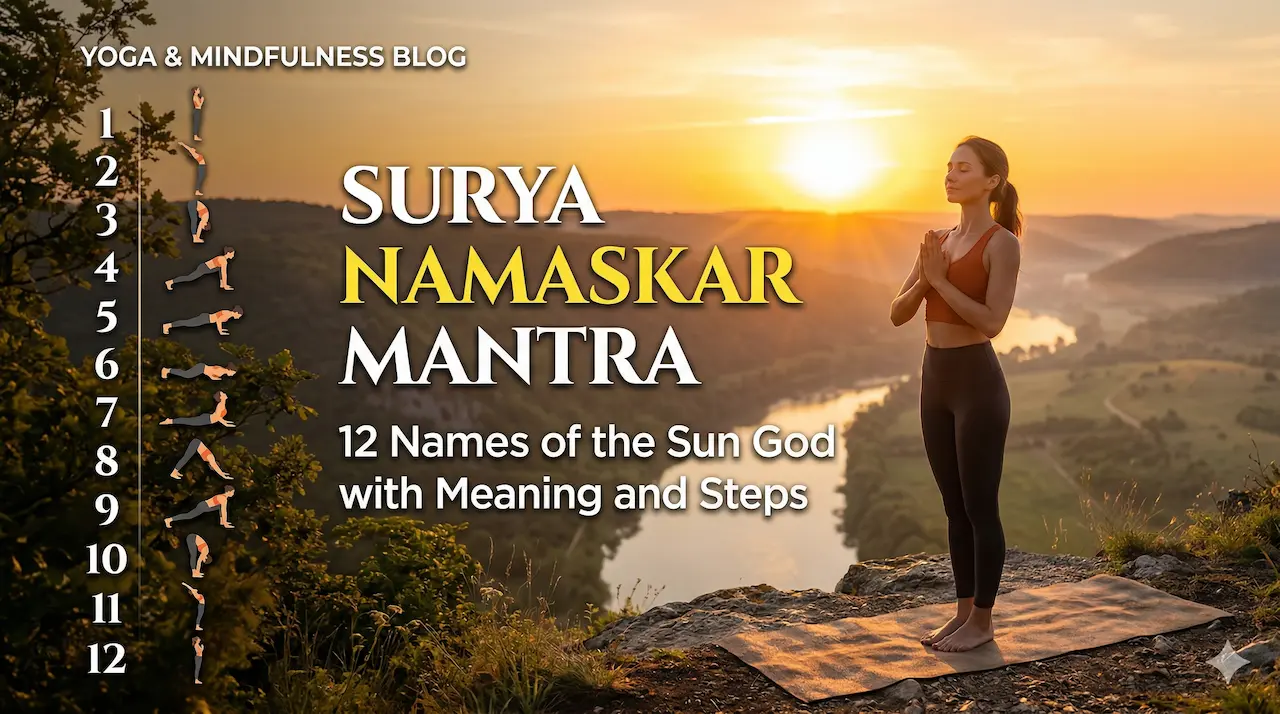

Most people know Surya Namaskar as a sequence of twelve yoga poses. Few know that each of those poses was designed to carry a mantra, a sacred name of Lord Surya that turns a physical exercise into a complete act of solar worship.
When you add the Surya Namaskar Mantra to your practice, something shifts. The sequence stops being about flexibility or fitness and becomes a moving prayer, a way of greeting the Sun God at the start of each day with your body, breath and voice aligned.
This guide covers all 12 names of the Sun God used in Surya Namaskar, their Sanskrit meaning, the yoga pose each name corresponds to, and a practical chanting method you can begin using tomorrow morning.
For the complete guide to Surya Mantra including the Beej Mantra and Aditya Hridayam, see our Surya Mantra: Meaning, Benefits and Correct Chanting Method.
What Is the Surya Namaskar Mantra?
The Surya Namaskar Mantra is a set of twelve Sanskrit salutations, each addressed to a specific form or quality of Lord Surya. The word Surya means Sun, Namaskar means respectful greeting, and the mantras are the sacred sound expressions of that greeting.
Each of the twelve names begins with Om and ends with Namah, meaning salutation or I bow. In between sits the specific name that activates a particular solar quality: friendship, radiance, nourishment, illumination and so on.
In traditional Vedic practice, Surya Namaskar was never a silent exercise. The ancients understood that sound vibration and physical movement, when synchronised, create a more powerful effect than either does alone. The mantras are the sonic half of that equation.
This is not merely tradition speaking. A 2019 study published in the International Journal of Yoga found that participants who combined mantra recitation with physical practice showed significantly greater reductions in perceived stress and greater improvements in heart rate variability than those who performed the physical sequence alone. The Vedic rishis documented this relationship centuries ago; modern physiology is confirming it.
Source: Sharma et al. (2019). Effects of mantra-based meditation on autonomic function. International Journal of Yoga, 12(3).
The 12 Names of the Sun God: Complete Table
Below is the complete Surya Namaskar Mantra sequence with all 12 names, their corresponding yoga pose, English meaning and the spiritual quality each name awakens.
| # | Yoga Pose | Sanskrit Name | English Meaning | Spiritual Quality |
| 1 | Pranamasana | Om Mitraya Namah | Salutation to the friend of all | Universal friendship and warmth |
| 2 | Hasta Uttanasana | Om Ravaye Namah | Salutation to the radiant one | Radiance, brilliance and vitality |
| 3 | Hastapadasana | Om Suryaya Namah | Salutation to the one who induces activity | Motivation and purposeful action |
| 4 | Ashwa Sanchalanasana | Om Bhanave Namah | Salutation to the one who illuminates | Clarity, insight and illumination |
| 5 | Dandasana | Om Khagaya Namah | Salutation to the one who moves through the sky | Freedom, movement and expansion |
| 6 | Ashtanga Namaskara | Om Pushne Namah | Salutation to the one who nourishes all | Nourishment and spiritual strength |
| 7 | Bhujangasana | Om Hiranya Garbhaya Namah | Salutation to the golden cosmic womb | Creativity and cosmic consciousness |
| 8 | Adho Mukha Svanasana | Om Marichaye Namah | Salutation to the lord of the dawn | New beginnings and morning energy |
| 9 | Ashwa Sanchalanasana 2 | Om Adityaya Namah | Salutation to the son of Aditi | Cosmic inspiration and freedom |
| 10 | Hastapadasana 2 | Om Savitre Namah | Salutation to the stimulating power of the sun | Purification and divine power |
| 11 | Hasta Uttanasana 2 | Om Arkaya Namah | Salutation to the one worthy of praise | Dignity, glory and spiritual worthiness |
| 12 | Pranamasana 2 | Om Bhaskaraya Namah | Salutation to the one who leads to enlightenment | Enlightenment and liberation |
Each round of Surya Namaskar covers 12 poses. A complete cycle means performing two rounds, one leading with the right leg and one with the left, which brings you through all 24 movements while chanting each of the 12 names twice.
The 12 Names Explained
Knowing the name is useful. Understanding what it means transforms how you chant it. Here is a deeper look at each of the twelve names.
1. Om Mitraya Namah — The Universal Friend
Mitra is one of the oldest Vedic solar deities, predating even the name Surya in some texts. The Sun is called Mitra because it rises for everyone without discrimination. Rich, poor, saint, sinner: it shines on all with equal warmth. Chanting this name at the opening prayer pose plants the seed of non-judgement and openness in your practice.
2. Om Ravaye Namah — The Radiant One
Ravi is the name most commonly used for the Sun in everyday Indian languages. It comes from the root meaning to shine or to blaze. This name is chanted in the raised arms pose, a posture of expansion and reaching upward. It invokes radiance not just in the outer world but within the practitioner’s own aura and personality.
3. Om Suryaya Namah — The One Who Induces Activity
This is the most familiar name and carries the meaning of that which sets things in motion. The Sun is the force that starts the day, stirs life out of sleep and drives action across the natural world. In the forward fold, as the body moves toward the earth, this name grounds solar energy into purposeful physical activity.
4. Om Bhanave Namah — The Illuminator
Bhanu means light or illumination, and this name honours the Sun as the giver of sight and insight. On a spiritual level, Bhanu refers to the inner light of awareness that dispels ignorance. This name is chanted in the lunge pose, where one leg extends back and the chest opens forward as if receiving light.
5. Om Khagaya Namah — The Sky Traveller
Khaga means one who moves through the sky. This name recognises the Sun’s ceaseless movement across the heavens without pause, without rest, without deviation from its path. Chanting it in the plank pose, where the body is held in a single straight line, reflects that same quality of unwavering steadiness.
6. Om Pushne Namah — The Nourisher
Pushna means one who nourishes or strengthens. Every grain of food, every drop of water in the clouds, every leaf that feeds an animal traces its origin back to solar energy. The eight-limb salutation is a posture of complete humility and surrender, appropriate for honouring the Sun as the ultimate provider.
7. Om Hiranya Garbhaya Namah — The Golden Cosmic Womb
Hiranya Garbha is one of the most profound Vedic concepts. It refers to the golden egg from which the entire universe emerged at creation. The Sun, as the most visible embodiment of this golden cosmic source, carries the quality of infinite creative potential. This name is chanted in the cobra pose, a posture of rising and creation.
8. Om Marichaye Namah — The Lord of the Dawn
Maricha means ray of light, particularly the rays of the early morning sun. These first rays carry the highest prana of the day, which is why Vedic texts consistently recommend sunrise practice. Chanting this name in the downward-facing dog pose, which inverts the body and sends blood to the brain, is said to refresh the mind with morning clarity.
9. Om Adityaya Namah — Son of Aditi
Aditya means the son of Aditi, the Vedic goddess of infinity and the mother of all gods. In this context, the Sun is honoured not merely as a physical object but as a divine being born of the infinite. This name is chanted in the second lunge, mirroring the first lunge on the opposite side.
10. Om Savitre Namah — The Purifying Power
Savitra is the purifying and stimulating aspect of the Sun, most famously invoked in the Gayatri Mantra. Savitra purifies through light and transforms through inspiration. Chanting this name in the second forward fold marks the inward movement of purification as the sequence begins its return.
11. Om Arkaya Namah — The One Worthy of Praise
Arka means the one who deserves to be worshipped or praised. This name acknowledges the Sun’s supreme worthiness as an object of devotion. In the raised arms pose of the return sequence, lifting the arms in praise is the physical expression of this acknowledgement.
12. Om Bhaskaraya Namah — The Path to Enlightenment
Bhaskara means the one who leads to light or the one who causes enlightenment. This is the most spiritually elevated of the twelve names. It recognises the Sun not just as a physical source of light but as the guiding force toward inner illumination and liberation. The sequence closes as it opened, in the prayer pose, now charged with the full energy of all twelve names.
How to Chant the Surya Namaskar Mantra: Step-by-Step Method
The method below follows traditional practice while remaining accessible for beginners. No prior experience with Sanskrit or yoga is necessary to begin.
Preparation
1. Wake up before sunrise. Ideally begin your practice 20 to 30 minutes before the sun rises.
2. Shower or at least wash your hands, feet and face. Cleanliness is considered a prerequisite in Vedic mantra practice.
3. Lay your mat facing east, toward the direction of the rising sun.
4. Stand in Pranamasana (palms joined at the heart) for two to three minutes. Breathe slowly and set your intention for the practice.
Chanting Method
There are two ways to incorporate the mantras into Surya Namaskar. Choose the one that suits your current level.
Method 1: Chant before each pose.
Stand briefly at the top of your mat between poses and chant the corresponding mantra aloud or silently before moving into the next position. This is ideal for beginners who are still learning the sequence.
Method 2: Chant as you move into each pose.
Experienced practitioners chant each mantra during the transition into its corresponding pose, so the sound and movement arrive together. This creates a more fluid, meditative quality in the practice.
From our practice: When we first introduced the mantras into Surya Namaskar, Method 1 felt awkward — stopping between poses interrupted the flow. We found that spending one full week simply listening to the mantra sequence while doing silent Surya Namaskar, before attempting to chant along, made the transition to Method 2 completely natural. If you feel disconnected chanting and moving at the same time, that two-step approach removes the frustration.
Pronunciation Guide for Beginners
| Mantra | Sounds Like | Common Mistake to Avoid |
| Om Mitraya Namah | Om Mee-TRAY-ya Na-mah | Do not rush the final ‘ah’ in Namah — hold it briefly |
| Om Ravaye Namah | Om Ra-VAY-yeh Na-mah | Ravaye has three syllables, not two |
| Om Suryaya Namah | Om Soor-YAY-ya Na-mah | The ‘u’ in Surya is short, like ‘book’ not ‘moon’ |
| Om Bhanave Namah | Om Bha-NAH-veh Na-mah | The ‘bh’ is an aspirated b, not a plain b |
| Om Hiranya Garbhaya Namah | Om Hee-RAHN-ya Gar-BHA-ya Na-mah | This is the longest name; take a full breath before chanting it |
Number of Rounds
A single round of Surya Namaskar covers 12 poses with 12 mantras. A complete set is two rounds, one leading with the right leg and one with the left. Traditionally, 12 complete sets are performed on auspicious occasions, but for daily practice 3 to 6 rounds is entirely sufficient and sustainable.
Benefits of Chanting the Surya Namaskar Mantra
Adding the mantras to Surya Namaskar transforms the practice in three distinct ways.
Physical Benefits
• Controlled chanting regulates the breath, improving lung capacity over time.
• Sound vibration in the chest and throat stimulates the vagus nerve, which governs the parasympathetic nervous system.
• Synchronising mantra with movement creates a meditative rhythm that reduces cortisol levels.
A study in the Journal of Ayurveda and Integrative Medicine found that participants who chanted during yoga practice showed measurably lower salivary cortisol levels after 8 weeks compared to a silent yoga group, suggesting the mantra component carries physiological weight beyond the physical movement alone.
Source: Bhavanani, A.B. et al. (2012). Immediate cardiovascular effects of pranava relaxation in patients with hypertension and diabetes. Journal of Ayurveda and Integrative Medicine.
Mental and Emotional Benefits
• Each name activates a specific quality of consciousness. Chanting Mitraya at the start of practice seeds the mind with openness and non-judgement for the day ahead.
• The repetitive, rhythmic quality of mantra recitation is among the most effective tools for dissolving mental chatter and anxiety.
• Regular practitioners consistently report improved concentration, quicker emotional recovery and a greater sense of inner stability.
Spiritual Benefits
• The mantras establish a direct energetic connection with Lord Surya as a conscious cosmic force, not merely a physical object.
• Consistent practice over 40 days is said to activate the solar plexus chakra (Manipura), the energy centre governing personal power and will.
• The sequence from Mitra to Bhaskara traces a complete arc of spiritual evolution within each practice session.
Best Time and Days for Surya Namaskar Mantra Practice
Sunrise is the single most important timing factor. The window between the moment the sun touches the horizon and 30 minutes after is considered Brahma Muhurta, when the air carries the highest concentration of prana and the mind is naturally quieter than at any other time of day.
Sunday (Ravivar) holds special significance for Surya worship, as Ravi is a name of the Sun. Many traditional practitioners observe a more elaborate practice on Sundays, including the chanting of additional Surya hymns after the main Namaskar sequence.
Auspicious solar occasions for intensified practice include Makara Sankranti, Ratha Saptami, Chhath Puja and the two solstices.
For a detailed guide to the Surya Beej Mantra and how it can be combined with Surya Namaskar for advanced practice, see our article on the Surya Beej Mantra.
Common Mistakes to Avoid
• Chanting too fast. Speed reduces the vibrational quality of each syllable. A slower, more deliberate pace is always more effective than rushing through the names.
• Skipping the Om at the start. Om is not decorative. It is the universal resonance that sets the frequency for everything that follows. Always include it.
• Mispronouncing Namah as Namas. The final aspirated ‘h’ is significant in Sanskrit phonology and should be sounded clearly, like a soft exhalation.
• Practising without facing east. Orientation matters in solar practice. If you cannot face east due to space constraints, face the direction closest to sunrise from your location.
• Stopping practice during illness. If physical Surya Namaskar is not possible, sit quietly and chant only the 12 names. The sound practice alone carries full benefit.
Quick Reference: One Complete Round
| Step | Pose Name | Mantra | Body Action |
| 1 | Pranamasana | Om Mitraya Namah | Stand upright, palms joined at chest, feet together |
| 2 | Hasta Uttanasana | Om Ravaye Namah | Inhale, raise and extend arms overhead, gentle backbend |
| 3 | Hastapadasana | Om Suryaya Namah | Exhale, fold forward, palms to floor beside feet |
| 4 | Ashwa Sanchalanasana | Om Bhanave Namah | Inhale, step right leg back into a deep lunge |
| 5 | Dandasana | Om Khagaya Namah | Hold breath briefly, step left leg back to plank |
| 6 | Ashtanga Namaskara | Om Pushne Namah | Exhale, lower knees, chest and chin to floor |
| 7 | Bhujangasana | Om Hiranya Garbhaya Namah | Inhale, slide forward and lift chest into cobra pose |
| 8 | Adho Mukha Svanasana | Om Marichaye Namah | Exhale, lift hips into inverted V, heels toward floor |
| 9 | Ashwa Sanchalanasana (other side) | Om Adityaya Namah | Inhale, step right foot forward between hands into lunge |
| 10 | Hastapadasana | Om Savitre Namah | Exhale, bring left foot forward, fold back to standing |
| 11 | Hasta Uttanasana | Om Arkaya Namah | Inhale, rise and extend arms overhead, gentle backbend |
| 12 | Pranamasana | Om Bhaskaraya Namah | Exhale, return to prayer pose, palms joined at chest |
Conclusion
The Surya Namaskar Mantra is one of the most complete spiritual practices available to a modern person. In twelve poses and twelve names, it covers the body, the breath, the voice and the mind in a single continuous act of devotion. You do not need to be a yogi or a Sanskrit scholar to benefit. You need only a mat, an east-facing direction, a willingness to rise before the sun, and the intention to greet it with your whole self.
Start with three rounds tomorrow morning. Chant whatever names you already know and learn the rest over the following days. Consistency matters far more than perfection in the early stages of practice. The Sun shows up every day without fail. Over time, your practice will too.
To deepen your Surya practice, read our complete guide: Surya Mantra: Meaning, Benefits and Correct Chanting Method. For the powerful standalone practice of the Aditya Hridayam, the solar hymn chanted by Lord Rama before battle, see our dedicated Aditya Hridayam guide.
Frequently Asked Questions
What is the Surya Namaskar Mantra?
The Surya Namaskar Mantra is a set of 12 Sanskrit names of Lord Surya, one chanted at each step of the Surya Namaskar sequence. Each name invokes a specific solar quality and transforms the physical practice into a complete spiritual offering.
Can I chant the Surya Namaskar Mantra in English?
Yes. While Sanskrit pronunciation amplifies the vibrational effect, chanting the English transliteration with sincere focus and devotion is entirely effective, especially for beginners. The intention and consistency of practice matter most.
How many times should I do Surya Namaskar with mantra?
Traditionally, 12 rounds are considered one complete cycle, corresponding to the 12 solar months and the 12 names of Surya. Beginners can start with 3 to 5 rounds and build up gradually over several weeks.
What is the best time to practise Surya Namaskar with mantra?
Sunrise is the ideal time. The first light of dawn carries the purest solar energy, and chanting the mantras at this hour aligns the practice with natural cosmic rhythms. Facing east toward the rising sun is recommended.
Can women practise Surya Namaskar Mantra during menstruation?
Traditional texts advise against vigorous Surya Namaskar during menstruation. However, quiet mantra chanting or seated meditation on the 12 names without the physical sequence is considered appropriate and beneficial during this period.
Is it necessary to know all 12 names before starting?
No. You can begin by chanting the single Surya Beej Mantra throughout the full sequence while you gradually memorise the 12 individual names. Even chanting Om with each pose carries significant benefit during the learning phase.
Narendra Kumar Chaubey is a Jyotisha Acharya with over 30 years of experience, based in Bihar and serving clients across India in Vedic astrology, mantra shastra, Vastu and ritual practice.
He completed his formal training at Kameshwar Singh Darbhanga Sanskrit University (KSDSU), one of India’s oldest and most respected institutions for Vedic and Sanskrit scholarship, where he studied Jyotisha shastra, mantra vidya and related classical sciences. KSDSU’s tradition of rigorous Sanskrit education tracing directly to the Mithila region’s centuries-old pandit lineage forms the foundation of his practice.
Over three decades, Narendra Kumar Chaubey has worked with thousands of individuals and families across Bihar and across India, offering guidance in:
- Kundli (birth chart) analysis: Identifying karmic patterns, planetary periods and life path guidance through classical Jyotisha
- Palmistry (Hasta Samudrika): Reading the hand according to the classical Samudrika Shastra tradition
- Vastu Shastra: Assessment and correction of living and working spaces according to directional and elemental principles
- Mantra and Pooja vidhi: Performing and guiding all categories of puja, havan, and mantra sadhana for personal, family and business situations
- Predictive Jyotisha: Transit analysis, muhurta (auspicious timing) selection and remedial guidance
He works across four languages Sanskrit, Hindi, English and Bhojpuri making classical knowledge accessible to practitioners across educational backgrounds and regions.
His writing for ABMantra brings the precision of classical Vedic training to practical mantra guidance: not general advice but specific prescriptions grounded in shastra, lineage and 30 years of direct practice with real situations.
For more info follow on: