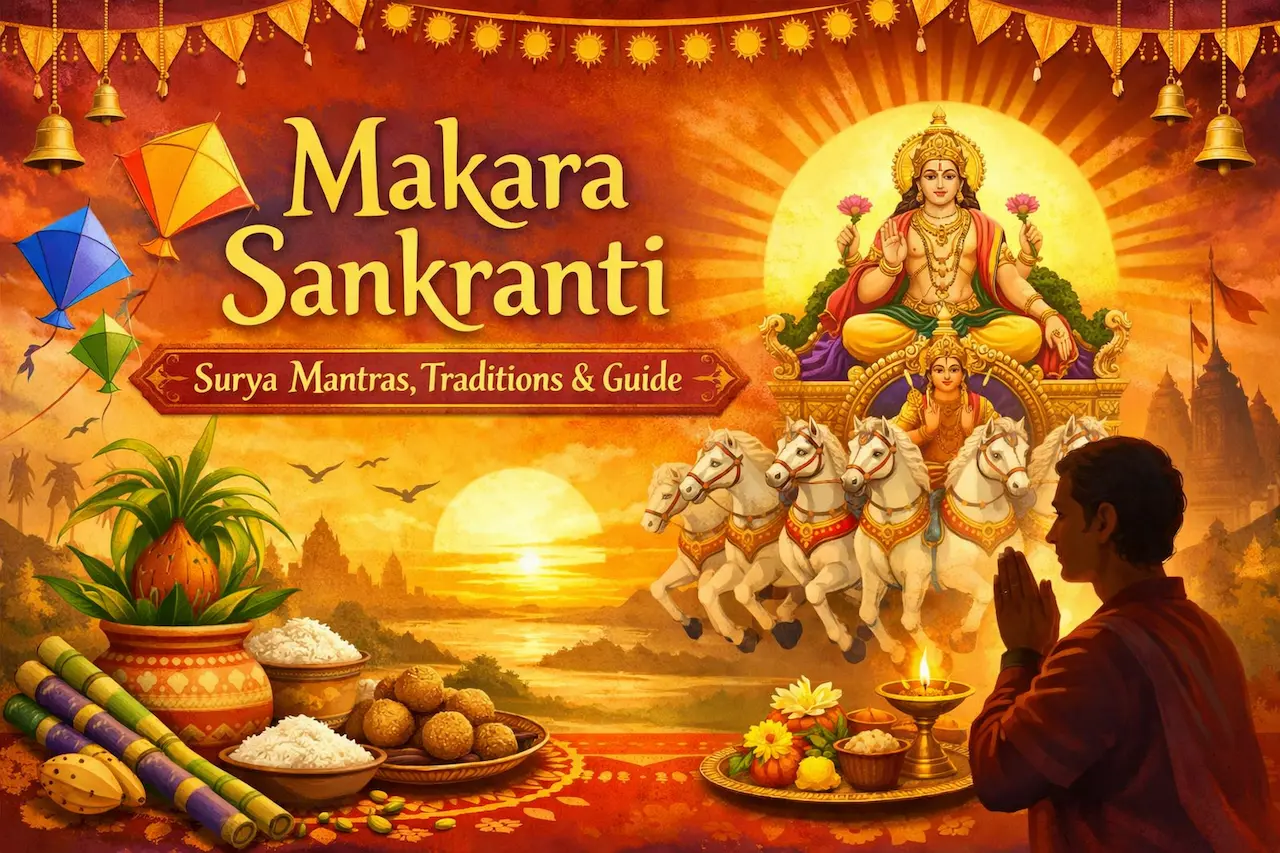

Every year on or around January 14, something specific happens in the sky. The Sun moves into Capricorn. Days start getting a little longer. The cold of winter is still there, but it has passed its peak. The light is slowly coming back.
Makara Sankranti is the festival that marks this moment. Unlike most Hindu festivals, it does not follow the lunar calendar. It follows the actual movement of the Sun. That is what makes it special: it celebrates a real, measurable event in the solar year, and it has done so for thousands of years.
The festival is known by different names across India: Uttarayan in Gujarat, Pongal in Tamil Nadu, Magh Bihu in Assam, and Lohri the evening before in Punjab. The rituals are different. The food is different. The languages are different. But the meaning is the same: the Sun is turning north. Winter is loosening. Life is returning.
This guide covers the confirmed 2026 dates and timings, why Makara Sankranti matters in the Surya worship tradition, how to do Surya puja and Arghya on this day, which mantras to chant and when, what to donate, and how the festival is celebrated in different parts of India.
For the complete guide to Surya Mantras including pronunciation, meaning and daily practice method, see our main article: Surya Mantra: Meaning, Benefits and Correct Chanting Method.
Why Makara Sankranti Is the Most Important Solar Festival in India
There are many festivals in India that involve the Sun. But Makara Sankranti is the one where the Sun is not just acknowledged in passing. It is the reason for the festival itself.
The Sun entering Capricorn (Makara Rashi) marks the start of Uttarayana, the Sun’s northward journey. In Vedic tradition, Uttarayana is the daytime of the gods. It is the period when Surya’s energy is considered most accessible, most powerful and most beneficial. The six months of Uttarayana (from Makara Sankranti through the summer solstice) are considered ideal for spiritual practice, new beginnings, weddings and any important undertaking.
The Bhagavad Gita mentions Uttarayana directly. In Chapter 8, verse 24, Lord Krishna says that those who depart during Uttarayana, the path of light, reach Brahman and do not return. This makes the period beginning on Makara Sankranti one of the most spiritually significant windows in the entire Vedic calendar.
Source: Bhagavad Gita, Chapter 8, verse 24 (Uttarayana and the path of light). Brihat Parashara Hora Shastra, chapter on Surya and Uttarayana significance.
In Jyotish (Vedic astrology), the Sun entering Capricorn is also significant because Capricorn is ruled by Saturn (Shani), who is the Sun’s son. The Sun in his son’s sign creates a specific cosmic energy: authority meeting structure, vitality meeting discipline. Surya mantras chanted on this day carry the combined quality of both planets.
Another reason this festival is unique: it is one of the only days in the Hindu calendar when two Arghya offerings are made. The morning Arghya at sunrise honours the Sun as it begins the day. The afternoon Arghya at the Sankranti Moment (3:13 PM on January 14, 2026) honours the exact second of the solar transition. Both matter. Neither replaces the other.
Makara Sankranti 2026: Complete Date and Timing Guide
The timings below are for India Standard Time (IST). If you are outside India, convert to your local time zone. The Sankranti Moment is a fixed astronomical event that occurs simultaneously across the world, though the local time differs.
| Event | Date and Time | What to Do |
| Makar Sankranti Day | Wednesday, January 14, 2026 | Main festival day. Most snan, daan and puja rituals are done on this day. |
| Sankranti Moment | 3:13 PM on January 14 | The exact time when the Sun enters Capricorn. All charity and Arghya done from this moment onward carry maximum merit. |
| Maha Punya Kaal | 3:13 PM to 4:58 PM | The most auspicious window. Complete your snan, Arghya and daan within this period if possible. |
| Punya Kaal (extended) | 3:13 PM to 5:46 PM | Extended auspicious window. Donations and Surya puja done in this window still carry high merit. |
| Alternative observation day | Thursday, January 15, 2026 | Some communities observe Sankranti on January 15 because Ekadashi falls on January 14 (no rice on Ekadashi). Both days are accepted by most traditions. |
| Lohri (Punjab / North India) | Tuesday, January 13, 2026 | The eve of Makar Sankranti in Punjab and nearby states. Bonfires, folk songs, sesame and jaggery offerings. |
| Magh Bihu (Assam) | Thursday, January 15, 2026 | Assamese harvest festival linked to Makar Sankranti. The Sankranti moment falls on January 14 but the main celebration is January 15. |
How to Do Surya Puja on Makara Sankranti: Step-by-Step
Makara Sankranti has two key puja moments: the morning Arghya at sunrise and the afternoon Arghya at the Sankranti Moment. Below is the complete sequence for both.
Morning Puja (at Sunrise)
1. Wake before sunrise. Add a pinch of sesame seeds to your bathwater and bathe. This is the snan (sacred bath) of Makara Sankranti.
2. Wear clean clothes. Saffron, yellow or white are appropriate. Avoid black and dark colours.
3. Fill a copper kalash with clean water. Add red flower petals, a pinch of sesame and a few drops of raw milk.
4. Stand facing east in an open space where you can see the rising Sun.
5. Offer Arghya: hold the kalash at forehead level and pour the water in an arc toward the Sun. Chant Om Suryaya Namah three times as you pour.
6. After Arghya, chant the Surya Beej Mantra (Om Hraam Hreem Hraum Sah Suryaya Namah) 108 times.
7. Sit quietly for 5 minutes facing east before beginning the rest of your day.
Afternoon Puja at the Sankranti Moment (3:13 PM)
This is the most powerful Surya puja of the year. At 3:13 PM on January 14, 2026, the Sun enters Capricorn. Doing Arghya at this exact moment, or within the Maha Punya Kaal (3:13 PM to 4:58 PM), carries the merit of a full year of regular Surya worship according to the Garuda Purana.
8. Prepare a fresh kalash of water with sesame and red flowers.
9. Go to your terrace, balcony or any place where you can see the sky in the direction of the Sun.
10. At 3:13 PM, offer Arghya while chanting the Surya Gayatri Mantra (Om Adityaya Vidmahe Sahasra Kiranaya Dhimahi, Tanno Surya Prachodayat). Offer three times.
11. After Arghya, chant the Surya Beej Mantra 108 times or the first three verses of the Aditya Hridayam.
12. Complete your donation (daan) before 4:58 PM. This is the Maha Punya Kaal. Any charity given in this window carries maximum merit.
From our practice: The afternoon Arghya on Makara Sankranti is a very different experience from the daily morning Arghya. The Sun is lower in the January sky, the light is golden, and there is something about offering water at a specific cosmic moment that feels very different from the same action done out of routine. We have found that setting a phone alarm for 3:13 PM and stepping away from whatever we are doing at that moment, even for just five minutes of sincere Arghya and one chant, is one of the most meaningful things we do in the entire solar year.
Surya Mantras for Makara Sankranti: Which to Chant and When
You do not need to chant all five mantras. Pick the one or two that feel right for you. The most important thing is sincerity, not the number of mantras.
| Mantra | When to Chant | Why This Mantra |
| Om Suryaya Namah | During morning Arghya and throughout the day | The simplest and most universal Surya salutation. Anyone can chant it. It is the core Makar Sankranti mantra. |
| Om Adityaya Vidmahe Sahasra Kiranaya Dhimahi, Tanno Surya Prachodayat | During Arghya at the Sankranti Moment (3:13 PM onwards) | The Surya Gayatri. Specifically invokes the thousand-rayed Sun. Chanting this at the exact Sankranti moment is especially powerful. |
| Om Hraam Hreem Hraum Sah Suryaya Namah | 108 times in the morning and after the afternoon Arghya | The Surya Beej Mantra. The most concentrated Surya mantra. Chanting 108 times on this day is said to carry 40 days worth of regular practice. |
| Om Namo Bhagavate Suryaya | During snan (bath) and throughout the day | A devotional salutation to Surya as the Supreme Lord. Simple and suitable for all ages. |
| Aditya Hridayam (opening verse) | After the afternoon Arghya during Maha Punya Kaal | The opening verse of the Aditya Hridayam is recited at the peak auspicious moment. Full recitation is recommended if time permits. |
For the complete guide to the Surya Beej Mantra with syllable meaning, pronunciation and a 4-week beginner schedule, see our article: Surya Beej Mantra: Meaning, Benefits and How to Chant Om Hraam Hreem Hraum.
What to Donate on Makara Sankranti: A Practical Guide
Daan (charity) is the central act of Makara Sankranti. The Garuda Purana describes it as the most meritorious action you can perform on this day. The best donation is one that is made with a warm heart during the Maha Punya Kaal (3:13 PM to 4:58 PM on January 14).
| What to Give | Why It Matters | How to Do It |
| Sesame seeds (til) | Sesame is the most important Makar Sankranti offering. In Vedic astrology, sesame is associated with Saturn (Shani), who rules Capricorn, the sign the Sun enters on this day. Donating sesame helps ease the Sun-Saturn tension and is said to remove suffering caused by past karma. | Donate a handful of black sesame seeds to a Brahmin, temple or any person in need. You can also add sesame to khichdi and donate that. |
| Jaggery (gud) | Jaggery is the traditional sweet of Surya. It is unrefined, natural and solar in quality. Exchanging sesame-jaggery sweets is one of the most widespread Makar Sankranti customs across all regions of India. | Make or buy til-gud laddoos and distribute them to family, neighbours and the needy. The traditional greeting while giving: ‘Til gul ghya, god god bola’. |
| Khichdi | Rice and lentils cooked together into khichdi is the symbolic food of Makar Sankranti in North India and Bihar. It represents the blending of two foods just as the Sun moves into a new position blending seasons. | Cook khichdi at home and donate it to someone who needs a warm meal. Many temples distribute khichdi to the poor on this day. |
| Warm clothing or blankets | January is winter. Donating warm clothes on Makar Sankranti is a practical expression of the festival’s message: share the warmth of the Sun’s return with those who feel the cold most. | Give a blanket, a sweater or any warm item of clothing to a person sleeping outdoors or to a shelter. Even a pair of socks given with sincerity counts. |
| Cow fodder or milk | In the Vedic tradition, the cow is associated with Surya through the imagery of sunlight as divine milk. Donating milk or green fodder to cows on Makar Sankranti is considered a very meritorious act. | Visit a gaushala (cow shelter) and donate fodder or money for the cows’ care. In rural areas, simply taking green grass to the cattle nearby fulfills this. |
| Wheat and rice | These are harvest grains, the literal product of the Sun’s work over the growing season. Donating them on Makar Sankranti completes a cycle: the Sun gave us the harvest, we give some of it back to those in need. | Donate 1 to 2 kg of wheat or rice to a temple, school or household that needs it. The gesture does not have to be large to carry meaning. |
Source: Garuda Purana (Preta Khanda, chapters on Daan and Sankranti merit). The seven categories of donation listed here correspond to the Saptadhanya (seven grains) and Surya-associated items in classical Jyotish texts.
A note on how much to give: the tradition is clear that sincerity matters more than size. A small amount given cheerfully is better than a large amount given reluctantly. Even handing one til-gud laddoo to a neighbour with the words ‘Til gul ghya, god god bola’ is a complete act of Makar Sankranti charity.
How India Celebrates Makara Sankranti: Region-by-Region Guide
One of the most remarkable things about Makara Sankranti is how many different forms it takes across the country. The same astronomical event is celebrated through kite flying, bonfires, harvest rituals, river baths, rice cooking and cow worship, depending on where you are.
| Region | Local Name | Key Practice | Traditional Food | Surya Worship |
| Uttar Pradesh and Bihar | Makar Sankranti / Khichdi | Holy bath in the Ganga at dawn. Donation of khichdi (rice and lentils), sesame, jaggery, blankets and warm clothing. Kite flying in many parts of UP. | Khichdi, til-gud laddoo, chura (flattened rice) with curd and jaggery | Surya Arghya at the riverbank with Om Suryaya Namah and Surya Gayatri |
| Gujarat | Uttarayan | The International Kite Festival in Ahmedabad draws participants from across the world. Rooftop kite battles. The sky is filled with kites of every colour from before sunrise to after sunset. | Undhiyu (mixed vegetable dish), til-chikki, sesame laddoo, jalebi | Surya Arghya in the morning. Surya worship at home before the kite festival begins. |
| Tamil Nadu | Pongal (4-day festival) | Pongal is the Tamil Makar Sankranti and is celebrated over four days: Bhogi (day before, cleaning and fire), Thai Pongal (main day, cooking the Pongal rice), Mattu Pongal (honouring cows) and Kaanum Pongal (family gathering). | Sweet Pongal (rice cooked with jaggery and milk, boiled until it overflows symbolising abundance), Venn Pongal, sugarcane | Kolam (rangoli) of the Sun drawn at home entrance. Boiling the Pongal rice outside facing the Sun and calling ‘Pongalo Pongal’ when it overflows. |
| Andhra Pradesh and Telangana | Sankranti (3-day festival) | Bhogi bonfire on Day 1. Sankranti Puja on Day 2. Kanuma (cattle worship) on Day 3. Kite flying is central. Children receive new clothes and sweets from elders. | Ariselu (rice flour and jaggery sweet), Garjalu, Bobbatlu, Pongali rice | Surya Puja at home with special bhog of Ariselu. Women draw elaborate Muggulu (rangoli) in front of the house. |
| Maharashtra | Makar Sankranti / Til Sakarat | Women visit each other for Haldi-Kumkum. Sesame and jaggery sweets are exchanged with the greeting: ‘Til-gul ghya, god god bola’ (take sesame-jaggery, speak sweetly). Cows are decorated and worshipped. | Tilgul (sesame and jaggery balls), Puran Poli, Halwa | Surya Arghya at sunrise. Sesame offered to the Sun with Om Suryaya Namah. |
| Punjab and Haryana | Lohri (January 13) then Sankranti | Lohri is the bonfire festival on the eve of Makar Sankranti. Families gather around a fire and offer sesame, peanuts and popcorn to the flames. Bhangra and gidda folk dances. Lohri is especially celebrated for newborns and newlyweds. | Til, revri (sesame brittle), peanuts, sarson da saag, makki di roti | Offerings to the fire on Lohri are also offerings to Surya through Agni (fire is a form of solar energy in Vedic thought). |
| Rajasthan | Makar Sankranti / Sankrant | Kite flying from before sunrise. Women give 14 items as gifts to friends and family. Fairs (melas) and community gatherings at major temples. | Til ke laddu, Pheeni (vermicelli sweet), Ghevar (if available) | Surya Arghya at sunrise. Kites offered to the sky are a form of community solar celebration. |
| West Bengal and Odisha | Makar Sankranti / Poush Sankranti | Holy bath in the Ganga or other sacred rivers at dawn. The Gangasagar Mela in West Bengal is one of the largest pilgrimages in India, where millions take a holy bath at the point where the Ganga meets the sea. | Pithe-Puli (rice flour sweets with coconut and jaggery filling), Patishapta, Nolen gur (date palm jaggery) dishes | Surya Arghya at the river. Puja at home altar. |
Makara Sankranti and Jyotish: Why This Day Is Special for Solar Practice
In Vedic astrology, the Sun entering a new sign is called a Sankranti. There are 12 Sankrantis in a year, one for each sign. But Makara Sankranti (Sun entering Capricorn) is the most important of all twelve. Here is why.
• Capricorn is ruled by Saturn, who is the Sun’s son. When the Sun enters his son’s sign, it creates a unique relationship between the two most powerful planets in Jyotish. Solar mantras chanted on this day are believed to help ease any Saturn-related difficulties in the chart.
• Uttarayana begins on this day. The six months of Uttarayana are considered the most auspicious period in the Vedic calendar. Starting a 40-day Surya sadhana on Makara Sankranti means you carry the energy of this auspicious window through the following weeks.
• Sun-Saturn conjunction energy: Even without knowing your birth chart, the Sun moving into Saturn’s sign on this day makes it ideal for bringing discipline (Saturn) and vitality (Sun) together. Hard work, long-term projects and health routines begun on this day are considered more likely to succeed.
• Best Jyotish remedy day: For anyone with a weak or afflicted Sun in the natal chart, Makara Sankranti is the single most powerful day for solar remedies. Chanting the Surya Beej Mantra 108 times, donating the seven items, and offering Arghya at the Sankranti Moment carries the effect of weeks of regular practice.
For a complete guide to Surya Mantra for success including the Jyotish framework and condition-specific practice, see our article: Surya Mantra for Success: Career, Business and Students Complete Guide.
Conclusion
Makara Sankranti is the Sun’s own festival. Not a festival to pray for the Sun’s return, but a festival that celebrates the fact that it has returned. The days are getting longer. The cold is beginning to ease. The harvests are in. The Sun has earned its worship.
On January 14, 2026, take a sesame bath in the morning. Offer Arghya at sunrise. At 3:13 PM, step outside or to your window, pour water toward the sky and say Om Suryaya Namah three times. Give something to someone who needs it. Eat til and jaggery with your family. Fly a kite if you can.
This is Makar Sankranti. It is old, it is simple, and it works.
FAQs:
What is Makara Sankranti and why is it celebrated?
Makara Sankranti is a Hindu festival that marks the day when the Sun moves into Capricorn (Makara Rashi), beginning its northward journey called Uttarayana. It is a solar festival, meaning its date is based on the actual movement of the Sun rather than the lunar calendar, which is why it falls on or around January 14 every year. The festival celebrates the Sun’s return to strength after winter, the harvest season, the end of Kharmas (the inauspicious period), and the beginning of a time considered auspicious for weddings, new ventures and spiritual practice.
When is Makara Sankranti in 2026?
Makara Sankranti 2026 falls on Wednesday, January 14, 2026. The Sankranti Moment, when the Sun enters Capricorn, is at 3:13 PM on that day. The Maha Punya Kaal (most auspicious window) is from 3:13 PM to 4:58 PM. Some communities observe the main rituals on January 15, 2026, because Ekadashi falls on January 14, making it a day when many households avoid eating rice. Both dates are accepted across traditions.
What is the best Surya Mantra to chant on Makara Sankranti?
The Surya Beej Mantra (Om Hraam Hreem Hraum Sah Suryaya Namah) is the most powerful Surya Mantra for Makara Sankranti. Chanting it 108 times during the Maha Punya Kaal (3:13 PM to 4:58 PM on January 14) carries the merit of 40 days of regular practice, according to classical texts. The Surya Gayatri Mantra is used specifically during the Arghya. Om Suryaya Namah is the simplest and can be chanted by all family members throughout the day.
What should I donate on Makara Sankranti?
The most traditional donations are sesame seeds (til), jaggery (gud), khichdi, warm clothing and blankets. Sesame and jaggery sweets are the signature Makar Sankranti offering across most regions of India. These are given to Brahmins, temples, or anyone in need. Donations made during the Maha Punya Kaal (3:13 PM to 4:58 PM) carry the greatest merit. Even a small, sincere donation given with attention is accepted.
What is the difference between Makar Sankranti, Pongal, and Uttarayan?
They are all the same festival observed in different regions of India under different names. Makar Sankranti is the name used across North India and Maharashtra. Pongal is the Tamil name, celebrated over four days in Tamil Nadu. Uttarayan is the Gujarati name, famous for its kite festival. Magh Bihu is the Assamese version. Lohri, celebrated on January 13 in Punjab, is the eve-of-Sankranti bonfire festival. All of them mark the same astronomical event: the Sun’s entry into Capricorn and the beginning of Uttarayana.
Can I do Surya Puja at home on Makara Sankranti?
Yes, absolutely. You do not need to go to a river or temple for Makara Sankranti puja. At home, take a bath in the morning and add a pinch of sesame seeds to your bathwater. Offer Arghya in the morning facing east. At the Sankranti Moment (3:13 PM), offer Arghya again from your balcony or window. Chant the Surya Beej Mantra 108 times. Donate sesame, jaggery and one warm item to someone in need. Eat khichdi or tilgul with your family. That is a complete Makara Sankranti.
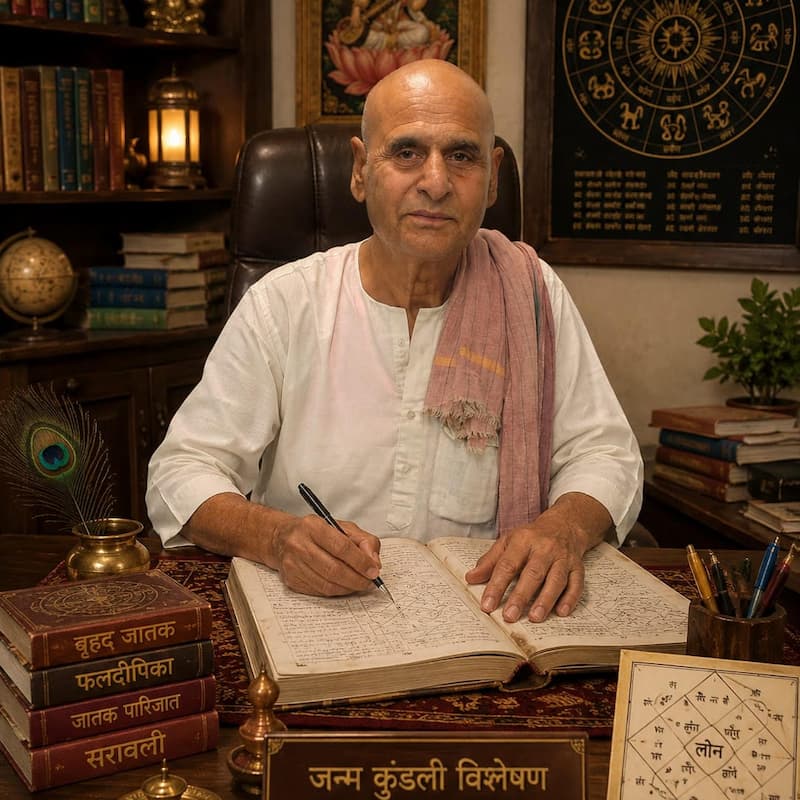
Narendra Kumar Chaubey is a Jyotisha Acharya with over 30 years of experience, based in Bihar and serving clients across India in Vedic astrology, mantra shastra, Vastu and ritual practice.
He completed his formal training at Kameshwar Singh Darbhanga Sanskrit University (KSDSU), one of India’s oldest and most respected institutions for Vedic and Sanskrit scholarship, where he studied Jyotisha shastra, mantra vidya and related classical sciences. KSDSU’s tradition of rigorous Sanskrit education tracing directly to the Mithila region’s centuries-old pandit lineage forms the foundation of his practice.
Over three decades, Narendra Kumar Chaubey has worked with thousands of individuals and families across Bihar and across India, offering guidance in:
- Kundli (birth chart) analysis: Identifying karmic patterns, planetary periods and life path guidance through classical Jyotisha
- Palmistry (Hasta Samudrika): Reading the hand according to the classical Samudrika Shastra tradition
- Vastu Shastra: Assessment and correction of living and working spaces according to directional and elemental principles
- Mantra and Pooja vidhi: Performing and guiding all categories of puja, havan, and mantra sadhana for personal, family and business situations
- Predictive Jyotisha: Transit analysis, muhurta (auspicious timing) selection and remedial guidance
He works across four languages Sanskrit, Hindi, English and Bhojpuri making classical knowledge accessible to practitioners across educational backgrounds and regions.
His writing for ABMantra brings the precision of classical Vedic training to practical mantra guidance: not general advice but specific prescriptions grounded in shastra, lineage and 30 years of direct practice with real situations.
For more info follow on: