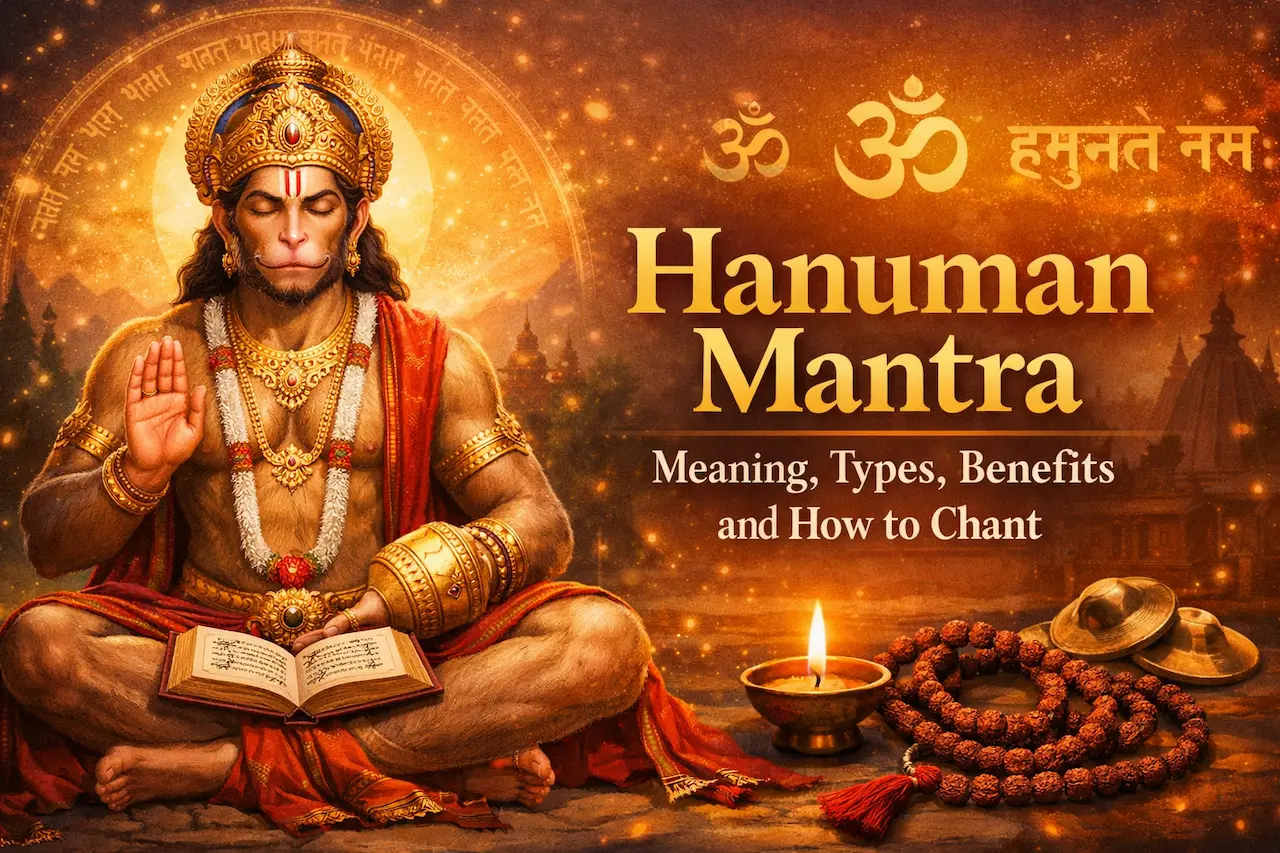

Hanuman Mantra is one of the most powerful and accessible mantra practices in the entire Hindu tradition. Unlike mantras that require formal initiation or years of preparation, the Hanuman Mantra asks for only one thing: sincere devotion. This quality makes Hanuman the most widely worshipped deity in Kalyug, the present age, where spiritual discipline is harder to maintain but the need for protection, strength and courage is greater than ever.
There is not one single Hanuman Mantra. There are several, each designed for a specific purpose. The Hanuman Mool Mantra is for daily devotion. The Hanuman Beej Mantra is for deep sadhana and removing stubborn obstacles. The Hanuman Gayatri Mantra builds courage and intellect. The Bajrang Baan is reserved for serious protection. The Sankat Mochan Mantra works in moments of sudden fear or crisis. Each has its own Sanskrit text, meaning, correct count and best day to chant.
This complete guide to Hanuman Mantra covers all seven principal mantras with their Sanskrit, transliteration and meaning. Whether you want to understand Hanuman Mantra meaning and significance, explore all the Hanuman Mantra benefits for your specific situation, or learn the correct Hanuman Mantra chanting method from scratch — everything is covered here. You will find the rules to follow, the mistakes to avoid and a full 40-day sadhana guide to begin or deepen your practice today.
For the complete 40-verse Hanuman Chalisa with each verse meaning, see our article: Hanuman Chalisa — Complete Lyrics, Meaning and How to Read.
Who Is Lord Hanuman: Understanding the Deity and the Mantra
Before learning the Hanuman Mantra, it helps to understand who Hanuman is, because the mantra carries the qualities of the being it invokes. Chanting with understanding is always more effective than chanting without it. The Hanuman Mantra meaning goes deeper than a simple prayer — it is a call to the qualities of strength, wisdom and devotion that Hanuman himself embodies.
Hanuman is described in the Valmiki Ramayana as Buddhimatam Varishtham, the foremost among the wise and intelligent. He is Mahabala, the one of immense strength. He is Mahavira, the great hero. He is Pavan Putra, the son of the wind god Vayu. He is Anjaneya, the son of Anjana. And he is Ramaduta, the sacred messenger of Lord Rama.
Source: Valmiki Ramayana, Kishkindha Kanda. Hanuman is described across multiple sargas as the embodiment of Bala (strength), Buddhi (wisdom) and Bhakti (devotion) simultaneously.
The Shiva Purana describes Hanuman as Ekadasha Rudra, one of the eleven forms of Rudra and therefore a direct manifestation of Lord Shiva. This is why Hanuman carries Shiva’s energy of transformation and protection alongside his role as Vishnu’s (Rama’s) devotee.
What makes Hanuman uniquely powerful for mantra practice is the combination of three qualities that rarely appear together in one being. He has infinite strength and yet no ego. He has the highest intelligence and yet complete surrender. He serves with absolute dedication and yet asks nothing in return. These qualities are what the Hanuman Mantra invokes in the practitioner.
The Surya Connection: How Hanuman Learned the Vedas
One of the most important stories for understanding Hanuman Mantra practice is the story of Hanuman as a student of Lord Surya. After being blessed with extraordinary powers at birth, young Hanuman approached Lord Surya and asked to become his student. Surya initially refused because, as the Sun, he was always moving across the sky and could not have a student who needed him to sit still.
Hanuman solved this by growing to cosmic size and facing Surya directly, walking backwards to match the Sun’s movement so that Surya was always facing him. In this way he received the complete Vedic education while walking backwards across the sky. Surya, moved by his determination and devotion, taught him the nine systems of knowledge including grammar, logic, philosophy and the Vedas.
This story establishes a direct link between Hanuman Mantra and Surya Mantra practice. Surya is Hanuman’s guru. This is why both mantra traditions are deeply connected and why strengthening one often strengthens the other.
For the complete Surya Mantra guide including the mantras Hanuman learned from his guru, see our article: Surya Mantra: Meaning, Benefits and Correct Chanting Method.
All 7 Hanuman Mantras: Sanskrit, Meaning and Purpose
Here are the seven principal Hanuman Mantras used in practice today. Each is presented with its full Sanskrit text, transliteration, meaning, purpose, chanting count and the best day to use it.
1. Hanuman Mool Mantra
| ॐ हनुमते नमः Om Hanumate Namah Meaning: Salutation to Lord Hanuman |
| Purpose | Daily worship, beginners, children |
| Count | 11, 21 or 108 times |
| Best Day | Tuesday or Saturday |
| Benefits | The simplest and most universally accepted Hanuman mantra. Creates an immediate connection with Hanuman’s energy. Perfect for beginners and daily practice. |
2. Hanuman Beej Mantra
| ॐ ऐं भ्रीं हनुमते रामदूताय नमः Om Aim Bhreem Hanumate Ramadutaya Namah Meaning: I bow to Lord Hanuman, the greatest messenger and devotee of Lord Rama |
| Purpose | Deep sadhana, obstacle removal, protection |
| Count | 108 times daily |
| Best Day | Tuesday or Saturday — begin on Tuesday |
| Benefits | The most concentrated form of Hanuman’s energy. Imbeds the Beej sound of Hanuman directly into consciousness. Particularly effective for removing deeply rooted obstacles and for those facing repeated setbacks. |
3. Hanuman Gayatri Mantra
| ॐ आञ्जनेयाय विद्महे वायुपुत्राय धीमहि। तन्नो हनुमत् प्रचोदयात्॥ Om Anjaneyaya Vidmahe Vayuputraya Dhimahi, Tanno Hanumat Prachodayat Meaning: We meditate on Anjaneya, the son of Vayu; may that Hanuman inspire and illuminate our intellect |
| Purpose | Courage, intellect, protection, Anahata chakra activation |
| Count | 11 or 108 times |
| Best Day | Tuesday or Saturday |
| Benefits | Follows the Gayatri metre, making it a complete meditation mantra. Particularly effective for students, those seeking clarity in decisions and those who need courage in difficult situations. |
4. Hanuman Dhyana Shloka
| मनोजवम् मारुततुल्यवेगम् जितेन्द्रियम् बुद्धिमताम् वरिष्ठम्। वातात्मजम् वानरयूथमुख्यम् श्रीरामदूतम् शरणम् प्रपद्ये॥Manojavam Marutatulyavegam Jitendriyam Buddhimatam Varishtham, Vatatmajam Vanarayuthamukhyam Shriramadutam Sharanam Prapadye Meaning: I take refuge in Lord Hanuman, who is swift as thought, equal to the wind in speed, conqueror of the senses, foremost among the wise, son of the wind, commander of the monkey army and the messenger of Lord Rama |
| Purpose | Opening meditation, before Hanuman Chalisa, before any puja |
| Count | 3 times at the start of practice |
| Best Day | Any day |
| Benefits | The complete meditation on Hanuman’s qualities. Reciting this before the Chalisa or any puja centres the mind and establishes the correct inner attitude of surrender and devotion. |
5. Hanuman Rudra Mantra
| ॐ नमो हनुमते रुद्रावताराय सर्वशत्रुसंहारणाय सर्वरोगहराय सर्ववशीकरणाय रामदूताय स्वाहा Om Namo Hanumate Rudravataray Sarvashtrubadhanaya Sarvavashikaranaya Ramadutaya Swaha Meaning: Salutation to Hanuman as the Rudra avatar, destroyer of all enemies, remover of all disease, fulfiller of all desires, messenger of Rama |
| Purpose | Protection from enemies, serious illness, evil eye (nazar), black magic |
| Count | 21 times — ideally before sunrise on Tuesday |
| Best Day | Tuesday |
| Benefits | Invokes Hanuman in his Rudra aspect. Used when facing serious external threats, persistent illness, or when there is a feeling of negative energy around a person, home or situation. |
6. Sankat Mochan Mantra
| ॐ हं हनुमते नमः Om Ham Hanumate Namah Meaning: Salutation to Hanuman with his seed sound Ham — the remover of all obstacles |
| Purpose | Quick relief from difficulties, crisis situations, sudden fear |
| Count | 108 times |
| Best Day | Any day, any time |
| Benefits | The Ham beej is Hanuman’s direct sound resonance. This mantra can be chanted silently during stressful situations, in traffic, before exams or during any moment of sudden anxiety. It works immediately. |
7. Bajrang Baan (opening verse)
| निश्चय प्रेम प्रतीति ते, बिनय करें सनमान। तेहि के कारज सकल शुभ, सिद्ध करें हनुमान॥ Nishchay Prem Prateeti Te, Binay Karen Sanmaan, Tehi Ke Karaj Sakal Shubh, Siddha Karen Hanuman Meaning: With firm faith and loving devotion, the one who prays to Hanuman with humility and respect — all their good works will be fulfilled |
| Purpose | Serious protection, removing black magic, crisis situations |
| Count | Once — with full sincerity and specific intention |
| Best Day | Tuesday |
| Benefits | The Bajrang Baan is the most powerful protective Hanuman prayer in the tradition. It should be recited with a specific need, not casually. One sincere recitation carries more power than repeated casual use. |
For the complete Bajrang Baan with all verses, Hindi lyrics and meaning, see our article: Bajrang Baan — Complete Lyrics, Meaning, Benefits and How to Chant.
For the complete Hanuman Beej Mantra syllable breakdown and 40-day sadhana guide, see our article: Hanuman Beej Mantra — Meaning, Benefits and How to Chant.
Hanuman Chalisa: The Most Chanted Hanuman Mantra in the World
The Hanuman Chalisa is the most widely chanted devotional text in the world. Over 8 lakh people search for it every month. It is chanted in temples, homes, buses, factories, hospitals and army camps across India every single day.
The Hanuman Chalisa was composed by the poet-saint Tulsidas in the 16th century. Tulsidas himself said he composed it after a direct vision of Lord Hanuman, and the text reflects that — it is not a scholarly composition but a direct, personal declaration of Hanuman’s greatness from someone who had experienced his presence.
Source: Ramcharitmanas by Goswami Tulsidas (16th century). The Hanuman Chalisa appears as a standalone text in the Vinaya Patrika and is also associated with the Sundarkand tradition.
The word Chalisa means forty in Hindi. The Chalisa has 40 chaupai (four-line verses) plus a doha (couplet) at the beginning and end. Each verse focuses on one quality, deed or aspect of Hanuman. Together they form a complete meditation on his nature.
Chanting the Hanuman Chalisa once takes about 10 to 15 minutes. Eleven repetitions, a common Tuesday practice, takes about two hours. Many dedicated devotees have memorised all 40 verses and can chant with eyes closed in full contemplation. If you are new to the Chalisa, begin by reading it once daily with the meaning of each verse in front of you. Memorisation follows naturally after a few weeks.
- Best time to chant: Sunrise on Tuesday and Saturday. Also powerful at sunset.
- Best count: Once daily as a minimum. 11 times on Tuesdays and Saturdays for dedicated practice.
- Combined with: Hanuman Mool Mantra (108 times before the Chalisa) + Hanuman Aarti after.
From our practice: The first time we chanted the Hanuman Chalisa 11 times in one sitting was on a Tuesday morning starting at 5:30 AM. By the 7th or 8th repetition something shifts. The words stop being words and become sound — a steady, warm vibration in the chest that does not feel like concentration anymore but like being held. Tulsidas was not writing poetry. He was writing a doorway. You understand this only by walking through it, which means chanting it enough times in a row that the thinking mind quiets and the sound takes over.
Benefits of Hanuman Mantra: What the Practice Actually Does
The benefits of Hanuman Mantra are described across multiple classical texts including the Valmiki Ramayana, the Ramcharitmanas, the Shiva Purana and various Navagraha texts. Modern practitioners also report consistent patterns of benefit that align with what the texts describe.
| Benefit Area | Best Mantra | How and Why It Works |
| Courage and Fearlessness | Hanuman Mool Mantra + Gayatri | Hanuman represents Abhaya, the state of fearlessness. Regular practice dissolves anxiety, self-doubt and the paralysis of fear. The Ramcharitmanas describes Hanuman as Mahavira, the great hero, and chanting his mantra awakens this quality in the devotee. |
| Protection from Evil Eye and Negativity | Rudra Mantra + Bajrang Baan | Classical texts state that no negative energy, ghost or spirit can remain in the presence of Hanuman’s name. This is why Hanuman temples are built at crossroads and at the entrance of villages in India. His mantra creates the same protective field around the practitioner. |
| Removing Saturn Affliction (Sade Sati) | Hanuman Beej Mantra + Mool Mantra | Hanuman saved Shani (Saturn) from Ravana’s captivity in Lanka. Out of gratitude, Shani promised never to trouble Hanuman’s devotees excessively. Jyotish texts recommend Hanuman mantra as the primary remedy for Sade Sati and Saturn mahadasha periods. |
| Physical Strength and Energy | Sankat Mochan + Mool Mantra | Prana (life force) is the primary gift of Hanuman, who is himself Vayu Putra, the son of the wind. Regular morning chanting with attention on the breath directly increases prana, which manifests as sustained physical energy and endurance. |
| Success in Work and Studies | Hanuman Gayatri + Dhyana Shloka | Hanuman is described in the Ramayana as Buddhimatam Varishtham, the foremost among the wise and intelligent. Students preparing for exams and professionals facing competitive challenges benefit particularly from the Gayatri mantra. |
| Removing Obstacles (Karya Siddhi) | Hanuman Beej Mantra | Hanuman succeeded in every mission Lord Rama assigned to him. This quality of complete success against all odds is what devotees invoke through the Beej Mantra. Chanting 108 times daily for 40 days while holding a specific intention is the traditional method for obstacle removal. |
One benefit that deserves specific mention is the Sade Sati and Saturn remedy. In Jyotish (Vedic astrology), Saturn’s seven-and-a-half-year transit over the natal Moon (Sade Sati) is considered one of the most challenging periods in a person’s life, bringing delays, losses and frustration. The traditional remedy prescribed in almost every classical Jyotish text for Sade Sati is regular chanting of the Hanuman Mantra, specifically on Saturdays. This is because Hanuman saved Shani from captivity in Lanka, and Shani in gratitude promised to lighten his influence on Hanuman’s devotees.
Source: Brihat Parashara Hora Shastra, Saturn (Shani) remedies chapter. Also described in multiple Navagraha Stotra texts.
How to Chant Hanuman Mantra: The Correct Method
The Hanuman Mantra does not require elaborate preparation. Hanuman himself is described as the simplest of all deities to please. What matters is consistency, attention and sincerity.
What You Need
- A clean, quiet space — even a small corner of a room works
- A red or saffron cloth to sit on
- A ghee diya and agarbatti lit before you begin
- A rudraksha or tulsi mala (108 beads) for counting
- A photo or small idol of Hanuman (optional but helpful for focus)
- Red flowers and a small offering of jaggery or laddoo for the weekly practice
Step-by-Step Chanting Method
- Bathe and wear clean clothes before the practice. Red or saffron are traditional for Hanuman worship.
- Light the ghee diya and agarbatti. Face east or north.
- Sit with your spine straight, either cross-legged on the floor or on a chair. Do not slouch.
- Hold the mala in your right hand, with the index finger extended and not touching the beads. Use the thumb and middle finger to move beads.
- Close your eyes. Take three slow, deep breaths. Let the mind settle.
- Begin with the Hanuman Dhyana Shloka: Manojavam Marutatulyavegam… recited three times. This is the opening meditation.
- Begin the main mantra. Chant clearly and at a pace where each syllable is distinct. Move one bead per repetition.
- When the mind wanders, gently bring it back to the sound of the mantra. Do not judge the distraction, simply return.
- Complete the full count. On the last bead, pause for one minute in silence.
- Open your eyes. Offer the jaggery or laddoo to the Hanuman image. Distribute as prasad.
Daily Practice vs Weekly Practice
| Element | Daily Practice | Weekly Practice (Tue/Sat) |
| Time needed | 5 to 15 minutes | 45 minutes to 2 hours |
| Mantra | Om Hanumate Namah | Full sequence: Dhyana Shloka + Mool Mantra + Chalisa + Aarti |
| Count | 11 or 27 times | 108 Mool Mantra + Chalisa 1 to 11 times |
| Offering | Not required | Laddoo, red flowers, ghee diya |
| Fasting | Not required | Optional — avoid non-veg food on Tuesday |
| Best for | Maintaining connection, building daily habit | Deep sadhana, obstacle removal, serious Jyotish remedies |
Hanuman Mantra on Tuesday and Saturday: Why These Days Matter
Tuesday (Mangalvar) is Hanuman’s primary day. In Jyotish, Tuesday is ruled by Mars (Mangala), the planet of courage, energy and protection, all qualities that Hanuman embodies perfectly. Chanting the Hanuman Mantra on Tuesday is said to strengthen these qualities in the practitioner’s chart and life.
Saturday (Shanivar) is ruled by Saturn (Shani). As described earlier, Hanuman saved Shani from Ravana’s captivity. This created a divine obligation: Saturn’s effects are lightened for those who sincerely worship Hanuman. Chanting Hanuman Mantra specifically on Saturdays is the most widely prescribed Jyotish remedy for Saturn-related difficulties across all classical texts.
When Hanuman Jayanti falls on a Saturday or Tuesday, that day becomes extraordinarily auspicious. In 2026, Hanuman Jayanti falls on Thursday April 2, which is Guruvar — Jupiter’s day. Jupiter amplifies wisdom, grace and the quality of devotion. Any mantra chanted on Hanuman Jayanti is considered to carry 40 days worth of regular practice in a single session.
For the complete guide to chanting on Tuesday and Saturday with week-by-week practice schedules, see our article: Hanuman Mantra for Tuesday and Saturday — Why These Days Matter and What to Chant.
Hanuman Mantra: Do’s and Don’ts for Effective Practice
What to Do
- Wake before sunrise on Tuesday or Saturday for the main weekly practice.
- Bathe before chanting. If this is not possible, wash hands and face at minimum.
- Sit facing east or north. Both directions are auspicious for Hanuman practice.
- Use a red or rudraksha mala for counting repetitions.
- Wear red or saffron coloured clothes during the formal weekly practice.
- Light a ghee diya and agarbatti before starting. The flame creates the right energetic atmosphere.
- Chant at a steady pace — not too fast, not too slow. Each syllable should be clear.
- Hold a specific intention in mind if chanting for a particular purpose.
- Complete the full count before stopping. If interrupted, begin the count again from zero.
- Offer jaggery and laddoo as prasad after the weekly practice.
What to Avoid
- Do not eat non-vegetarian food or consume alcohol on the day of your main Hanuman practice.
- Do not chant the Bajrang Baan casually or without a specific genuine need.
- Do not chant with a distracted or impatient mind. Quality always matters more than speed.
- Do not miss your practice day once you have started a 40-day sadhana. If you miss a day, start the 40-day count again from day one.
- Do not chant in impure or unclean spaces. The vibration of the mantra deserves a clean environment.
- Avoid chanting in full voice in public places. A whisper or silent mental chant is equally valid and more appropriate in crowded settings.
Hanuman Mantra in Jyotish: Which Mantra for Which Planet
In Vedic astrology (Jyotish), the Hanuman Mantra is not just a general spiritual practice. Specific Hanuman Mantra types are prescribed as targeted remedies for specific planetary difficulties. Understanding this framework helps you choose the right Hanuman Mantra for your situation rather than chanting randomly.
Hanuman Mantra for Saturn (Shani) — Sade Sati and Shani Dasha
The Hanuman Mool Mantra (Om Hanumate Namah) chanted 108 times every Saturday is the single most widely prescribed Jyotish remedy for Saturn-related difficulties. This includes Sade Sati (Saturn’s 7.5-year transit over the natal Moon), Shani Mahadasha, Shani Antardasha and Shani’s transit through the 12th house. The Hanuman Beej Mantra is recommended for more serious Saturn afflictions where simple remedy is not producing results within 40 days.
Hanuman Mantra for Mars (Mangal) — Mangal Dosh and Low Courage
Tuesday is ruled by Mars (Mangala), and chanting the Hanuman Mantra on Tuesday specifically targets Mars-related issues: low confidence, lack of drive, physical weakness, fear and Mangal Dosh in the marriage chart. The Hanuman Gayatri Mantra is particularly effective for Mars because it directly invokes courage and the quality of being Jitendriyam, the one who has conquered the senses — the highest expression of a well-functioning Mars.
Hanuman Mantra for Rahu and Ketu — Confusion and Sudden Change
Rahu and Ketu, the shadow planets, are associated with sudden upheaval, obsession, confusion and past-life karma. The Hanuman Rudra Mantra (Om Namo Hanumate Rudravataray…) is the most effective Hanuman Mantra for Rahu-Ketu related difficulties because it invokes Hanuman in his fierce Rudra aspect, which directly dissolves the illusions and entrapments that Rahu and Ketu create. Chanting 21 times before sunrise on Tuesday for 40 consecutive days is the standard prescription.
Source: Brihat Parashara Hora Shastra, Navagraha remedies chapters. Classical Jyotish texts prescribe Hanuman worship specifically for Saturn, Mars, Rahu and Ketu afflictions across multiple planetary contexts.
Hanuman Mantra 40-Day Sadhana: How to Begin
A 40-day sadhana is the traditional method for receiving the full benefit of any Hanuman Mantra practice. The number 40 comes from the Hanuman Chalisa itself, which describes 40 days as the period after which results become visible to the sincere practitioner.
Here is the correct way to begin a 40-day Hanuman Mantra sadhana:
- Choose your start day: Begin on a Tuesday. Tuesday and Saturday are the two most auspicious days for Hanuman Mantra practice. Tuesday is the primary start day for a 40-day sadhana — beginning on the most powerful day of the week sets the energetic foundation for the entire practice.
- Choose one mantra and commit to it for the full 40 days. Do not switch mantras mid-way. The Hanuman Beej Mantra (Om Aim Bhreem Hanumate Ramadutaya Namah) chanted 108 times daily is the standard 40-day practice.
- Set a fixed time: Same time every day for the full 40 days. Sunrise or early morning is ideal.
- Hold a clear intention: Know what you are asking for before you begin. Obstacle removal, protection, career progress, health — be specific. Hanuman responds to specific, sincere requests.
- Keep a simple vow for 40 days: Avoid non-vegetarian food, alcohol and the particular vice or habit you wish to overcome. The vow anchors the sadhana.
- If you miss a day, restart from day one. This is the traditional rule. Missing a day breaks the energetic thread. It is strict but it is what makes the practice effective.
- On day 40, offer a special puja: Laddoo, red flowers, a new red cloth for the altar, and distribute prasad to at least five people. Express gratitude regardless of whether you see the result yet.
Hanuman Jayanti 2026 (April 2) is an excellent day to begin a 40-day sadhana. The energy of the festival carries the practice through its entire 40-day arc.
Conclusion: Your First Step with Hanuman Mantra
The Hanuman Mantra tradition is one of the oldest, most tested and most accessible in the world. Every village in India has a Hanuman temple. Every Tuesday and Saturday, without fail, millions of people across India and the Indian diaspora chant his name. This is not superstition or habit. It is accumulated, lived experience across thousands of years that something real happens when you approach Hanuman with a sincere heart.
Start with Om Hanumate Namah. Chant it 11 times tomorrow morning. Do the same the day after. By the end of the week you will understand from direct experience what no article can fully convey. And from that direct experience, the deeper Hanuman Mantra practice — the Beej Mantra, the Chalisa, the full Tuesday sadhana — will grow naturally. The Hanuman Mantra benefits are not theoretical. They are experienced. Every practitioner in this tradition will tell you the same thing: begin, stay consistent, and let Hanuman do the rest.
Jai Bajrang Bali. Every sincere practitioner of the Hanuman Mantra tradition carries the same testimony across generations: this practice works. It works for the student who chants before exams. It works for the person facing Sade Sati. It works for the one who has tried everything else. It works because Hanuman himself works, and he has never once in the entire recorded tradition turned away a devotee who came with a genuine heart.
FAQs About Hanuman Mantra
What is the most powerful Hanuman mantra?
Different mantras serve different purposes, so the most powerful mantra depends on what you need. For daily devotion and building a consistent practice, the Hanuman Mool Mantra (Om Hanumate Namah) is the most accessible and effective. For deep sadhana and removing serious obstacles, the Hanuman Beej Mantra (Om Aim Bhreem Hanumate Ramadutaya Namah) is the most concentrated and potent. For protection from serious external threats, the Bajrang Baan is considered the strongest. The Hanuman Chalisa combines all aspects of Hanuman’s qualities in a single 40-verse meditation and is the most complete daily practice.
Which day is best for chanting Hanuman mantra?
Tuesday (Mangalvar) and Saturday (Shanivar) are the two dedicated days for Hanuman worship in the Vedic tradition. Tuesday is associated with Mars (Mangala), and Hanuman’s energy resonates with the courage and vitality that Mars governs. Saturday is associated with Saturn (Shani), and Hanuman is the most powerful remedy for Saturn’s negative effects. Of the two, Tuesday is the most auspicious day to begin a new Hanuman mantra sadhana.
How many times should I chant Hanuman mantra?
The standard counts are 11, 21, 27 or 108 repetitions. 11 is a good starting point for beginners. 27 is one quarter of a full mala and is suitable for a shorter daily practice. 108 is the complete mala count and is the standard for any dedicated sadhana. For the Bajrang Baan, which is a longer prayer, one sincere recitation is the traditional guidance.
Can women chant Hanuman mantra?
Yes. There is no gender restriction on chanting any Hanuman mantra. Women can and should chant the Hanuman Mool Mantra, Gayatri, Beej Mantra and Dhyana Shloka without restriction. The Bajrang Baan is sometimes described in traditional texts as more effective when chanted by men, but this is a traditional guidance, not a prohibition. Women who chant the Bajrang Baan with sincere devotion will receive the same protection.
What is the difference between Hanuman Chalisa and Hanuman mantra?
A mantra is a short sacred sound or phrase, typically one to three lines, designed for repeated chanting (japa). The Hanuman Chalisa is a stotra, a devotional hymn of 40 verses composed by Tulsidas in the 16th century. It tells the story of Hanuman’s qualities and deeds and is recited as a complete meditation rather than repeated as a chant. Both are powerful practices. Mantras are used for japa counting on a mala. The Chalisa is recited once or several times as a complete devotional act.
How long does it take to see results from Hanuman mantra?
Most practitioners notice an increase in energy, clarity and calmness within the first week of daily practice. More significant results, such as removal of a persistent obstacle or relief from Saturn’s effects, typically become noticeable after 21 to 40 days of consistent daily practice. The traditional sadhana period is 40 days. The key factor is consistency: one mantra chanted every single day for 40 days produces more results than 1,000 chanted in a single session.
Can I chant Hanuman mantra at night?
Yes. Hanuman is described as Chiranjeevi, the immortal who is always awake and always protecting his devotees. His mantra can be chanted at any time, including at night. In fact, chanting before sleep is specifically recommended for those who experience fear, nightmares or negative thoughts at night. The Sankat Mochan Mantra (Om Ham Hanumate Namah) is particularly effective as a pre-sleep practice.
Do I need a guru to chant Hanuman mantra?
No. Hanuman mantras are accessible without initiation from a guru. This is one of the defining qualities of Hanuman’s tradition. He is described as the most approachable of all deities, asking only for sincere devotion and nothing else. You can begin chanting Om Hanumate Namah today without any formal initiation. For advanced tantric practices involving Hanuman, guidance from an experienced teacher is advisable, but for all the mantras described in this guide, no initiation is required.
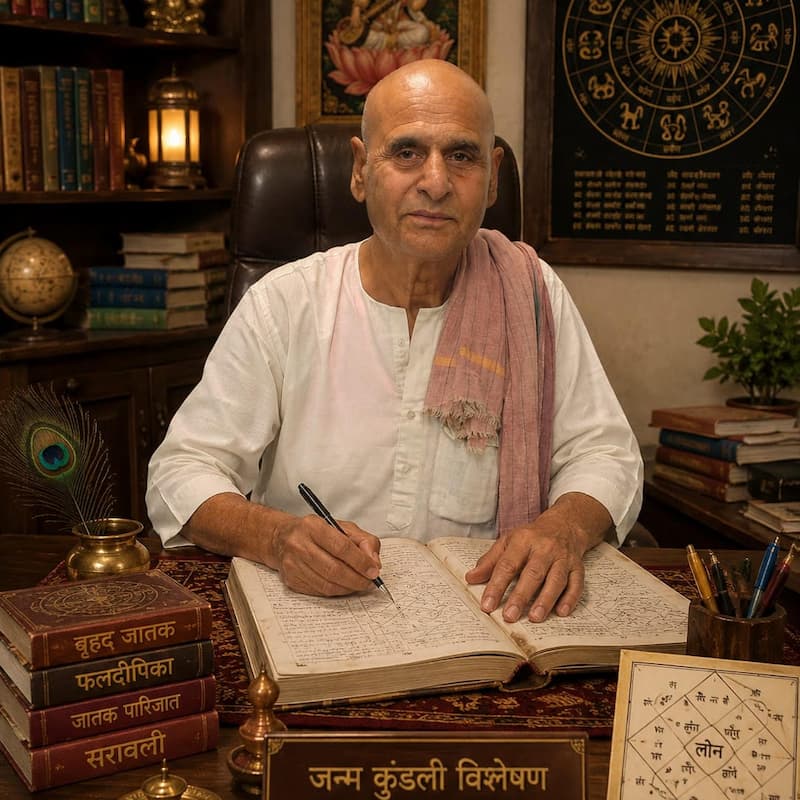
Narendra Kumar Chaubey is a Jyotisha Acharya with over 30 years of experience, based in Bihar and serving clients across India in Vedic astrology, mantra shastra, Vastu and ritual practice.
He completed his formal training at Kameshwar Singh Darbhanga Sanskrit University (KSDSU), one of India’s oldest and most respected institutions for Vedic and Sanskrit scholarship, where he studied Jyotisha shastra, mantra vidya and related classical sciences. KSDSU’s tradition of rigorous Sanskrit education tracing directly to the Mithila region’s centuries-old pandit lineage forms the foundation of his practice.
Over three decades, Narendra Kumar Chaubey has worked with thousands of individuals and families across Bihar and across India, offering guidance in:
- Kundli (birth chart) analysis: Identifying karmic patterns, planetary periods and life path guidance through classical Jyotisha
- Palmistry (Hasta Samudrika): Reading the hand according to the classical Samudrika Shastra tradition
- Vastu Shastra: Assessment and correction of living and working spaces according to directional and elemental principles
- Mantra and Pooja vidhi: Performing and guiding all categories of puja, havan, and mantra sadhana for personal, family and business situations
- Predictive Jyotisha: Transit analysis, muhurta (auspicious timing) selection and remedial guidance
He works across four languages Sanskrit, Hindi, English and Bhojpuri making classical knowledge accessible to practitioners across educational backgrounds and regions.
His writing for ABMantra brings the precision of classical Vedic training to practical mantra guidance: not general advice but specific prescriptions grounded in shastra, lineage and 30 years of direct practice with real situations.
For more info follow on: