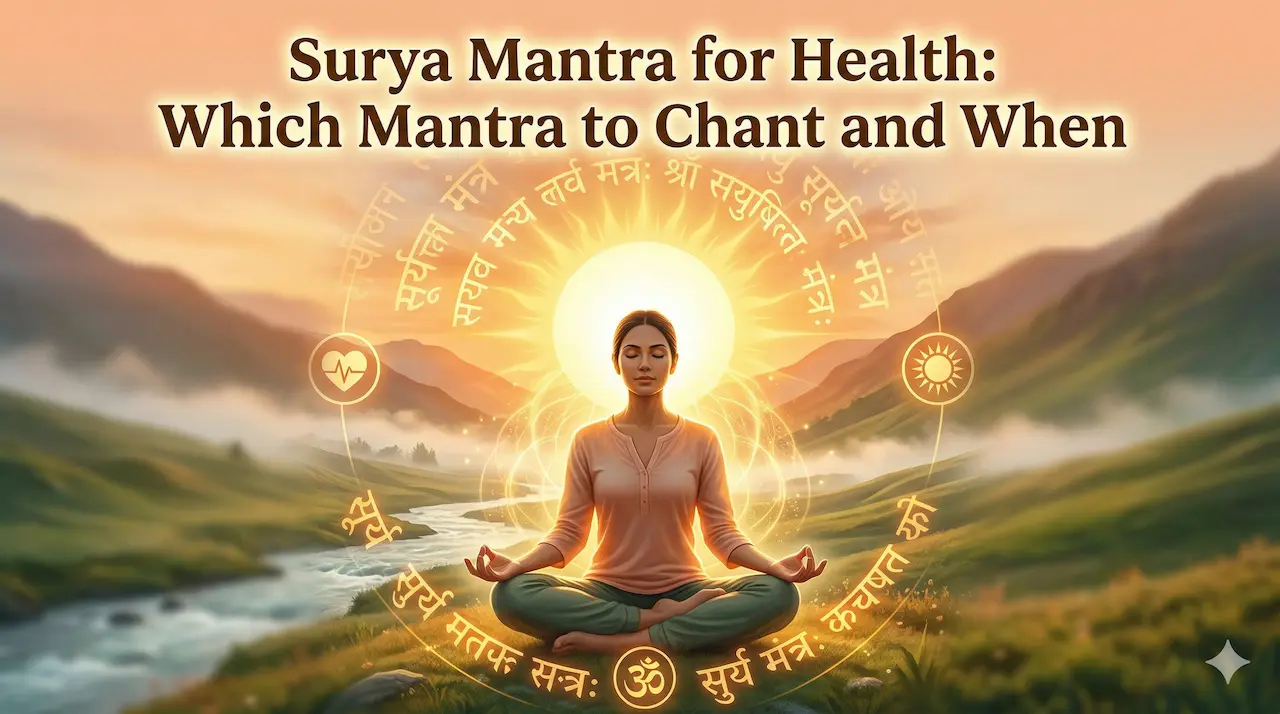

The relationship between the Sun and human health is not a spiritual metaphor. It is biochemistry. Sunlight triggers Vitamin D synthesis in the skin, regulates the circadian rhythm through the eyes, stimulates dopamine production in the retina, and initiates the melatonin-to-serotonin transition that determines the quality of your mood and sleep. Every one of these processes begins at sunrise.
The Vedic tradition understood this relationship through a different vocabulary, mapping these same processes onto a cosmological framework of doshas, dhatus and prana. Ayurveda identifies the Sun as the governing force behind Pitta dosha, the body’s fire energy that drives digestion, metabolism, immunity and vision. A well-supported Sun produces a body that digests well, sees clearly, resists illness and recovers quickly.
The Surya Mantra tradition offers specific practices for specific health concerns. The tradition designates particular mantras for eyes, particular mantras for skin, particular mantras for immunity and particular mantras for mental health. This guide maps those recommendations clearly so you can choose the practice most relevant to your current health focus.
For the complete foundation guide to all Surya Mantras with pronunciation and general practice method, see our main article: Surya Mantra: Meaning, Benefits and Correct Chanting Method.
Why the Sun Governs Health in the Vedic and Ayurvedic Traditions
In Ayurveda, the classical Indian system of medicine, the Sun is the source of all Agni in the body. Agni means fire, and in Ayurveda fire refers to the actual metabolic processes that digest food, produce energy, synthesise hormones and neutralise pathogens. Every form of Agni in the body, from the digestive fire (Jathara Agni) to the tissue-building fires (Dhatu Agnis) to the immune fire (Bhutagnis), is considered a reflection of the Sun’s cosmic fire.
In Jyotish (Vedic astrology), the Sun rules specific physical structures: the heart, the spine, the bones, the eyes (particularly the right eye) and the skin. When the Sun is weak or afflicted in the natal chart, these structures and their associated functions are the first to show imbalance. The mantra remedies for Surya were developed to address these specific areas when regular lifestyle measures prove insufficient.
The Ashtanga Hridayam, one of the foundational texts of Ayurveda, recommends daily sun exposure and solar salutations as part of the Dinacharya (daily health routine). It specifies the pre-noon period, particularly the early morning hours, as the optimal time for all solar health practices. This recommendation aligns precisely with what modern research has established about UV-A to UV-B ratios in morning sunlight.
Source: Ashtanga Hridayam, Sutrasthana Chapter 2 (Dinacharya); Vagbhata’s commentary on daily solar practices.
A study in the Journal of the Medical Association of Thailand found that participants who practiced mantra meditation showed statistically significant reductions in salivary cortisol, the primary biochemical marker of chronic stress and immune suppression. Reduced cortisol directly supports immune function, cardiovascular health and cognitive performance, mapping onto the Vedic claim that Surya Mantra practice strengthens the body’s resistance to disease.
Source: Turakitwanakan, W. et al. (2013). Effects of mindfulness meditation on serum cortisol of medical students. Journal of the Medical Association of Thailand, 96 Suppl 1.
Surya Mantra for Health: The Right Mantra for Each Concern
The table below maps the six principal health concerns addressed by the Surya Mantra tradition to the specific mantra, practice count and Ayurvedic framework. Choose the row most relevant to your current health focus and begin with that practice before adding others.
| Health Concern | Mantra | Name | Count | Ayurveda Link |
| General immunity and vitality | Om Hraam Hreem Hraum Sah Suryaya Namah | Surya Beej Mantra | 108 times daily at sunrise | Balances Pitta; kindles Agni (digestive fire); strengthens Ojas |
| Eye health and vision | Om Suryaya Namah + Tratak on candle | Surya Salutation with Tratak | 108 times, followed by 5-min Tratak | Strengthens Alochaka Pitta (vision sub-dosha) |
| Skin health | Om Bhaskaraya Namah | Bhaskar Mantra | 21 times in early morning sunlight | Supports Bhrajaka Pitta (skin sub-dosha) |
| Bone and joint strength | Om Suryaya Namah + Surya Namaskar | 12 Names with physical practice | 12 rounds with full mantra sequence | Strengthens Asthi dhatu; improves Vata in joints |
| Mental health and anxiety | Surya Gayatri Mantra | Om Bhaskaraya Vidmahe… | 11 times morning, 11 times evening | Calms Vata in mind; reduces Rajas (mental agitation) |
| Illness recovery | Aditya Hridayam (opening verses) | Sarva Roga Nashana practice | Full hymn once daily; min 3 times opening verse | Restores Ojas; strengthens Agni and Prana simultaneously |
Each Health Mantra Explained in Depth
1. Surya Beej Mantra for Immunity and Vitality
| ॐ ह्रां ह्रीं ह्रौं सः सूर्याय नमः Om Hraam Hreem Hraum Sah Suryaya Namah I invoke the complete seed energy of Lord Surya through his three solar aspects |
This is the most complete Surya health mantra because it activates all three phases of solar energy in the body simultaneously. Hraam corresponds to the morning sun and the body’s energy of awakening. Hreem corresponds to the noon sun and the body’s metabolic peak. Hraum corresponds to the evening sun and the body’s processes of repair and consolidation.
In Ayurvedic terms, 108 repetitions of this mantra at sunrise, performed consistently over 40 days, is considered sufficient to measurably improve Ojas (vital essence and immunity). Ojas is the refined end-product of all seven tissue layers working optimally, and it is the Ayurvedic equivalent of what modern immunology calls adaptive immune reserve.
For the complete syllable-by-syllable meaning and 4-week learning schedule, see our article: Surya Beej Mantra: Meaning, Benefits and How to Chant Om Hraam Hreem Hraum.
2. Om Suryaya Namah with Tratak for Eye Health
| ॐ सूर्याय नमः Om Suryaya Namah Salutation to Lord Surya, the one who sets all things in motion |
Surya has been worshipped specifically for eye health since the Rigveda, where he is described as the eye of the gods (Chakshu devanam). Early morning sunlight before 8 AM triggers dopamine release in the retina, which research has shown plays a role in regulating eye growth and reducing myopia progression.
A 2021 study in Ophthalmology found that children who spent at least two hours per day in outdoor morning light showed significantly slower progression of myopia compared to those who remained indoors. The Surya tradition’s recommendation to practise at sunrise is therefore simultaneously a mantra practice and a light therapy practice for the eyes.
Source: Xiong, S. et al. (2021). Systematic Review on Outdoor Light Exposure and Myopia. Ophthalmology, 128(1), 97-103. (PMID: 32738978)
After the mantra practice, Tratak (concentrated gazing at a single fixed point, traditionally a ghee lamp flame) is the traditional follow-up practice. The combination of outdoor morning light for retinal dopamine and indoor Tratak for focused concentration addresses eye health from two complementary directions.
3. Om Bhaskaraya Namah for Skin Health
| ॐ भास्कराय नमः Om Bhaskaraya Namah Salutation to the one who leads to enlightenment and illuminates the path |
Bhaskara means the maker of light. This name corresponds to the Sun’s quality of illuminating surfaces, which in the body maps onto the skin (the surface organ) and its sub-dosha, Bhrajaka Pitta. Chanting Om Bhaskaraya Namah 21 times while standing in early morning sunlight before 8 AM serves two purposes simultaneously: the mantra activates the Bhrajaka Pitta dimension through vibration and intention, while the morning sunlight in the low UV-B window directly initiates Vitamin D synthesis without the inflammatory risk of midday UV exposure.
For those dealing with chronic skin conditions such as eczema, psoriasis or persistent dullness, Ayurvedic practitioners traditionally recommend this practice for a minimum of 40 consecutive days alongside dietary adjustments to reduce Pitta in the gut.
4. Surya Gayatri for Mental Health and Anxiety
| ॐ भास्कराय विद्महे महाद्युतिकराय धीमहि तन्नो सूर्यः प्रचोदयात् Om Bhaskaraya Vidmahe Maha Dyuthi Karaya Dhimahi, Tanno Surya Prachodayat We meditate on Lord Bhaskar; may that Surya, the greatly radiant one, illuminate and propel our intellect |
The Surya Gayatri targets the mind specifically through its closing word Prachodayat, the solar force that propels forward and lifts the mind out of stagnation and circular thinking. Research on Gayatri Mantra practice has documented measurable neurological effects: a 2018 study using EEG monitoring found that Gayatri chanting increased alpha wave activity in the prefrontal cortex, the region associated with calm focus, perspective-taking and emotional regulation, which are precisely the neural states that anxiety disorders suppress.
Source: Bhatt, P. et al. (2018). EEG study of Gayatri Mantra chanting: effects on alpha wave activity. International Journal of Yoga, 11(2).
The twice-daily practice, 11 repetitions in the morning and 11 in the evening, mirrors the traditional Sandhya Vandana and maintains a consistent solar influence on the nervous system across the full waking day.
5. Surya Namaskar with 12 Names for Bone and Joint Health
| ॐ मित्राय नमः … ॐ भास्कराय नमः Om Mitraya Namah… Om Bhaskaraya Namah (all 12 names in sequence) The 12 solar salutations chanted in sequence during Surya Namaskar |
In Jyotish, the Sun governs Asthi dhatu (bone tissue) and the spine. A weak Sun is associated with low bone density, spinal issues and Vitamin D deficiency in Ayurveda. The physical practice of Surya Namaskar combined with the 12 mantras is the most complete solar health practice available: it simultaneously addresses the mantra, movement, breath and light exposure dimensions of Surya’s influence on the skeletal system.
The weight-bearing nature of Surya Namaskar postures (particularly plank, chaturanga and upward dog) creates the mechanical loading of bone that is essential for maintaining bone density. Twelve rounds daily, performed at sunrise with the mantras, is the traditional prescription for bone health in the Vedic system.
For the complete 12-name Surya Namaskar Mantra with each pose and chanting method, see our article: Surya Namaskar Mantra: 12 Names of the Sun God with Meaning and Steps.
6. Aditya Hridayam for Illness Recovery
| आदित्यहृदयं पुण्यं सर्वशत्रुविनाशनम् Aditya Hridayam Punyam Sarva Shatru Vinashanam This sacred heart of Aditya destroys all enemies, including disease, and brings victory |
The Aditya Hridayam carries the explicit designation Sarva Roga Nashana (destroyer of all diseases). Its origin story, given to an exhausted Rama on the battlefield, makes it the tradition’s primary text for recovery from depleting conditions. For serious illness, sustained fatigue or post-surgical recovery, the Aditya Hridayam is the first recommendation in the Vedic health tradition.
Practically, even the first three verses chanted slowly three times carry significant benefit when full recitation is not possible. For those strong enough to recite the complete 31 verses, doing so once daily during illness and for 21 days afterward as a recovery consolidation practice is the traditional recommendation.
For all 31 verses of the Aditya Hridayam with Sanskrit, meaning and chanting guidance, see our article: Aditya Hridayam: Complete Lyrics, Meaning, Benefits and How to Chant.
The Science of Morning Sunlight: Why Timing Matters for Health
Every Surya Mantra practice traditionally begins at sunrise, and this timing is not arbitrary. The quality of sunlight changes substantially across the day in ways that directly affect its health impact. The table below maps the key time windows, their light quality, health benefits and traditional mantra recommendations for each.
| Time Window | Light Quality | Health Benefit | UV Profile |
| 5:30 AM to 7:00 AM | Arunodaya light | Highest melatonin-to-serotonin shift. Best for mental health and circadian reset. Safe for relaxed eye contact with the horizon. Highest spiritual potency for mantra. | Negligible UV-B; primarily UV-A |
| 7:00 AM to 8:30 AM | Early morning light | Optimal Vitamin D synthesis window without UV damage risk. High infrared and UV-A. Traditional Surya Namaskar and Arghya time. Best for skin and bone health practices. | Low UV-B; beneficial UV-A present |
| 8:30 AM to 10:00 AM | Morning light | Good Vitamin D window. Beneficial for skin health (Bhrajaka Pitta activation). Suitable for outdoor mantra practice with physical movement. | Moderate UV-B begins to increase |
| 10:00 AM to 2:00 PM | Peak sun | Highest UV-B intensity. Ayurveda recommends avoiding prolonged direct exposure during this window, particularly in summer. Not recommended for extended outdoor mantra practice. | High UV-B; risk of skin damage |
| 4:00 PM to 6:00 PM | Sandhya light | Second beneficial window. UV-B intensity returns to safe levels. Ayurveda describes Sandhya as a sacred transition period. Suitable for brief evening Surya Gayatri practice outdoors. | Declining UV-B; safe for relaxed exposure |
The practical implication: perform your Surya Mantra practice outdoors whenever possible, between sunrise and 8:30 AM. Face east. Allow morning light to fall on the face, arms or legs while chanting. This single adjustment transforms your mantra practice from a purely internal exercise into one that simultaneously addresses the spiritual, neurological, hormonal and skin-health dimensions of solar wellbeing.
Surya Mantra and Ayurveda: Organ-by-Organ Health Guide
Ayurveda maps the Sun’s influence to specific organs and their governing sub-doshas. The table below is a practical Ayurvedic health guide for choosing and practising your Surya Mantra.
| Organ | Surya Connection | Dosha / Agni | Mantra | Daily Practice |
| Eyes | Sun governs the eyes and the fire element (Tejas); right eye ruled by Sun in Jyotish | Alochaka Pitta | Om Suryaya Namah + Tratak | Face the rising sun horizon for 5 min while chanting. Follow with Tratak on a ghee lamp flame indoors. |
| Skin | Sun’s light governs skin health through Vitamin D synthesis and the fire element in the outer body | Bhrajaka Pitta | Om Bhaskaraya Namah | Stand in early morning sunlight (before 8 AM) with arms partially exposed and chant 21 times. |
| Bones | Sun governs Asthi dhatu (bone tissue) and the spine in Ayurveda and Jyotish | Vata in bones | Surya Namaskar + 12 names | 12 rounds of Surya Namaskar with full mantra. Weight-bearing postures stimulate bone density. |
| Heart | Sun is the lord of the heart (Hridaya); the Aditya Hridayam name itself means heart of the Sun | Sadhaka Pitta | Aditya Hridayam opening verses | Recite the first 3 verses with one hand on the chest. The mantra vibration at the heart centre is a traditional cardiac health practice. |
| Digestion | Sun kindles Jathara Agni (digestive fire); weak Sun linked to low metabolic energy in Ayurveda | Pachaka Pitta | Surya Beej Mantra before breakfast | 108 Beej Mantra repetitions before the first meal. Take main meal at noon when digestive fire is at its natural peak. |
| Immunity | Ojas (vital essence and immunity) is governed by the Sun; strong Sun produces strong Ojas | All doshas / Ojas | Beej Mantra + Aditya Hridayam | 108 Beej Mantra daily plus Aditya Hridayam on Sundays and during any period of illness or reduced vitality. |
Building a Complete Daily Surya Health Practice
A complete Surya Mantra health practice does not require all six mantras at once. Begin with one, establish it as a consistent habit over 40 days, then add a second. The sequence below builds the practice progressively.
Foundation Practice (Days 1 to 40)
1. Wake at or before sunrise. Step outside or go to an east-facing window.
2. Stand in morning light. If outdoors, expose face and arms. If indoors, let sunlight fall on the face.
3. Chant the Surya Beej Mantra 108 times at a measured pace. Hold a mala to keep count without mental effort.
4. After completing the count, sit in silence for 3 to 5 minutes before beginning the day.
Adding the Physical Practice (After Day 40)
5. Before the 108 Beej Mantra repetitions, perform 7 to 12 rounds of Surya Namaskar with the 12 names chanted in sequence.
6. Add the Surya Gayatri 11 times in the evening before sunset, preferably outdoors.
Targeted Addition for a Specific Health Concern
7. Choose the condition-specific mantra from the tables above.
8. Add it immediately after the main Beej Mantra practice at sunrise.
9. Maintain the targeted practice for 21 days focused on that concern before assessing results.
From our practice: The most consistent change practitioners report from a regular sunrise Surya Mantra practice is not dramatic or sudden. It is a gradual improvement in the quality of the first hour of the day. Energy that used to require effort to access arrives more naturally. After three months of consistent practice, the change in baseline energy and resilience is unmistakable. This is what the tradition means when it describes the Surya Mantra as strengthening Ojas.
Precautions and Guidelines for Health-Focused Surya Practice
- Do not look directly at the sun except during the brief moments of sunrise and sunset when the light is safe for relaxed eye contact. Staring at the full sun at any other time risks retinal damage.
- Those with severe Pitta imbalance (chronic inflammation, acid reflux, rosacea) should begin sun exposure very gradually, starting with just 5 minutes and building slowly. Excess sun exposure can aggravate Pitta.
- Surya Mantra practice is a complementary practice, not a medical treatment. Continue all prescribed medications and treatments alongside it.
- If practising Tratak (candle gazing), use a pure ghee lamp rather than a paraffin candle. Position the flame at eye level approximately 45 to 60 cm away. Never practise Tratak to the point of eye pain or excessive tearing.
- During illness, if you are too weak to sit upright and chant, simply listening to a recording of the Aditya Hridayam with quiet attention is a valid and beneficial form of the practice.
- Consult a qualified Ayurvedic practitioner for personalised guidance, particularly if working with a chronic condition. The recommendations here are based on traditional texts; individual constitutions vary.
Conclusion
The connection between the Sun and human health is one of the oldest and most consistently supported ideas in both traditional medicine and modern biology. The Vedic tradition built an entire practice system around this connection, with mantras tailored to specific organs, conditions and life situations.
You do not need to adopt the entire system at once. Begin with the Surya Beej Mantra at sunrise for 40 days. Stand in morning light as you chant. Let the practice be simple and consistent before adding complexity. After 40 days, assess what has changed in your energy, sleep, mood and resilience. Then add the mantra most relevant to your specific health concern.
The tradition built this practice incrementally because sustainability produces results that intensity alone cannot. The Sun has been rising every morning without exception for longer than any health system has been recording its effects. Show up when it does, and let consistency do the rest.
FAQs:
Which Surya Mantra is best for overall health?
The Surya Beej Mantra (Om Hraam Hreem Hraum Sah Suryaya Namah) is the most effective foundation mantra for general health and immunity because it activates all three phases of solar energy simultaneously. For specific conditions, the tradition offers targeted recommendations: the Surya Gayatri for mental health and anxiety, Om Bhaskaraya Namah for skin, Om Suryaya Namah with Tratak for eye health, and the Aditya Hridayam for illness recovery.
Can Surya Mantra really improve eyesight?
The tradition has associated Surya worship with eye health since the Rigveda, and this association has a physiological basis. Early morning sunlight before 8 AM stimulates dopamine release in the retina, which research has shown helps regulate eye growth and may reduce the progression of myopia. The practice of facing the rising sun while chanting Om Suryaya Namah, combined with Tratak on a candle flame, addresses both the mantra and light therapy dimensions of traditional eye care.
Is Surya Mantra safe to practise during illness?
Yes, and it is specifically recommended during illness. The Aditya Hridayam carries the designation Sarva Roga Nashana (destroyer of all diseases). If physical Surya Namaskar is not possible during illness, quiet seated chanting of the Beej Mantra or the Aditya Hridayam carries full benefit. Even listening to a recording of the Aditya Hridayam with quiet attention is considered meritorious and supportive during recovery.
What time of day is Surya Mantra most effective for health?
Sunrise is the most potent time for all Surya Mantra practice. The pre-sunrise window (Arunodaya, 5:30 to 7:00 AM) carries the highest spiritual potency. The early morning window from 7:00 to 8:30 AM is optimal for Vitamin D synthesis and physical practices like Surya Namaskar. A secondary practice window in the late afternoon before sunset is recommended in Ayurveda for the evening Sandhya practice of the Surya Gayatri.
Can Surya Mantra help with Vitamin D deficiency?
Indirectly, yes. The Surya Mantra practice encourages daily morning sun exposure as an integral part of the ritual, which directly supports Vitamin D synthesis. Standing in morning sunlight during mantra practice naturally provides the light exposure that triggers Vitamin D production in the skin. This is not a replacement for medical treatment of severe deficiency but is entirely consistent with standard medical guidance on beneficial light exposure.
How long does it take for Surya Mantra to show health benefits?
The tradition prescribes 40 days of unbroken daily practice as the minimum period for noticeable change. Most practitioners report improvements in sleep quality, energy levels and morning mood within the first two to three weeks. Changes in physical health markers such as immunity and skin condition typically become noticeable between 40 and 90 days. The light exposure component of the practice, simply standing in morning sunlight daily, produces measurable physiological changes in as little as two weeks.
Narendra Kumar Chaubey is a Jyotisha Acharya with over 30 years of experience, based in Bihar and serving clients across India in Vedic astrology, mantra shastra, Vastu and ritual practice.
He completed his formal training at Kameshwar Singh Darbhanga Sanskrit University (KSDSU), one of India’s oldest and most respected institutions for Vedic and Sanskrit scholarship, where he studied Jyotisha shastra, mantra vidya and related classical sciences. KSDSU’s tradition of rigorous Sanskrit education tracing directly to the Mithila region’s centuries-old pandit lineage forms the foundation of his practice.
Over three decades, Narendra Kumar Chaubey has worked with thousands of individuals and families across Bihar and across India, offering guidance in:
- Kundli (birth chart) analysis: Identifying karmic patterns, planetary periods and life path guidance through classical Jyotisha
- Palmistry (Hasta Samudrika): Reading the hand according to the classical Samudrika Shastra tradition
- Vastu Shastra: Assessment and correction of living and working spaces according to directional and elemental principles
- Mantra and Pooja vidhi: Performing and guiding all categories of puja, havan, and mantra sadhana for personal, family and business situations
- Predictive Jyotisha: Transit analysis, muhurta (auspicious timing) selection and remedial guidance
He works across four languages Sanskrit, Hindi, English and Bhojpuri making classical knowledge accessible to practitioners across educational backgrounds and regions.
His writing for ABMantra brings the precision of classical Vedic training to practical mantra guidance: not general advice but specific prescriptions grounded in shastra, lineage and 30 years of direct practice with real situations.
For more info follow on: