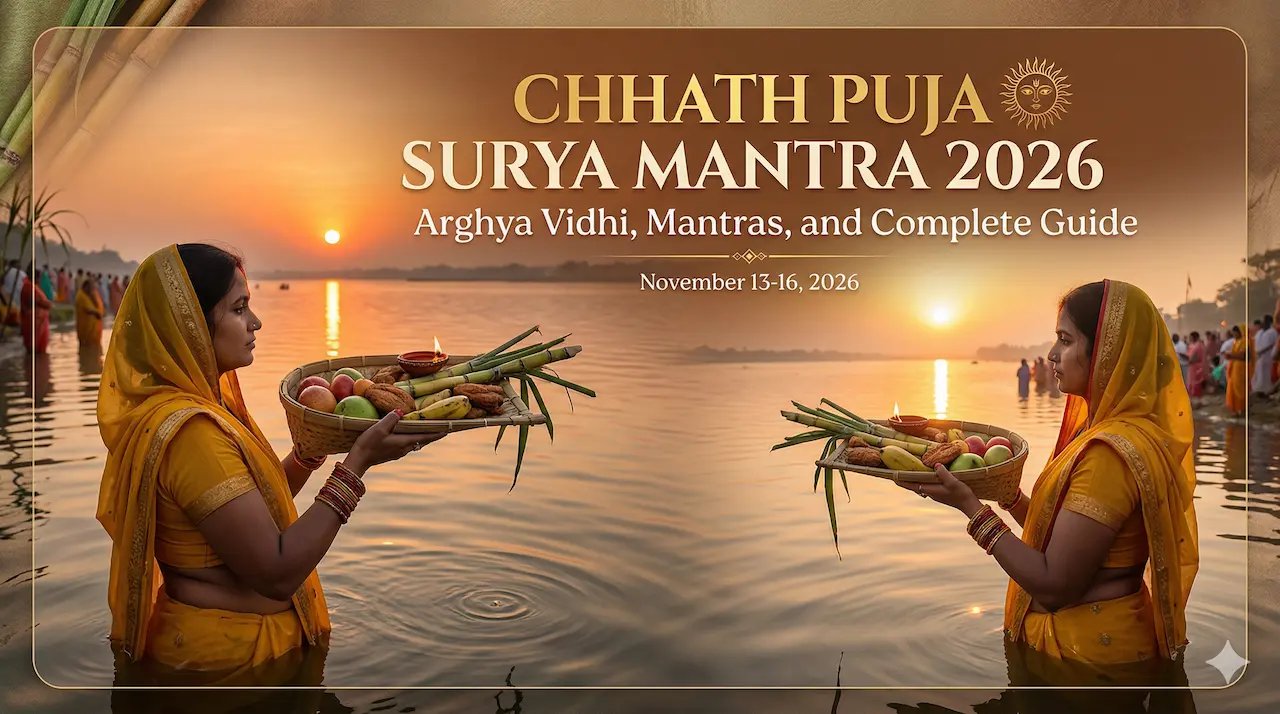

Of all the festivals in the Hindu calendar, Chhath Puja stands apart. There is no idol, no priest, no temple required. A vrati (the person observing the fast) stands waist-deep in a river at sunset, holds a bamboo basket filled with fruits and thekua above the water, and offers Arghya directly to the Sun. The simplicity of the gesture carries the weight of one of the oldest living solar worship traditions in the world.
Chhath Puja is observed on the sixth day (Shashti) after Diwali, across four days in Kartik month. It is the only major Hindu festival that honours the Sun directly in both its setting form (the evening Arghya on Day 3) and its rising form (the morning Arghya on Day 4). No other festival in the Hindu tradition makes this distinction, and it reflects a profound Vedic understanding: the Sun in both its withdrawal and its return deserves equal gratitude.
This guide covers the complete Chhath Puja 2026 dates, the Surya Mantras chanted during each ritual, the step-by-step Arghya Vidhi, the complete prasad list with significance, the vrat rules, and a practical guide for those observing Chhath for the first time.
For the complete guide to all Surya Mantras used in Chhath and daily solar worship, see our main article: Surya Mantra: Meaning, Benefits and Correct Chanting Method.
Significance of Chhath Puja in the Vedic Tradition
The roots of Chhath Puja reach back to the Rigveda, where numerous hymns are addressed directly to Surya as the sustainer of all life. The Surya Sukta of the Rigveda (Book 1, Hymn 115) describes the Sun as the eye of the gods, the life of all moving beings, and the light that makes all other lights visible.
Two major epics provide specific narrative anchors for the festival. In the Mahabharata, Draupadi is said to have observed Chhath Vrat to restore health and prosperity to the Pandavas during their forest exile. In the Ramayana, Sita is described as offering prayers to the Sun after Rama’s victory, in what some scholars interpret as an early form of the Arghya ritual. These textual connections give Chhath Puja a narrative legitimacy that extends far beyond regional folk practice.
Source: Valmiki Ramayana, Uttara Kanda; Mahabharata, Vana Parva, Sec. 3 (Draupadi’s solar vrat). Archaeological Survey of India records document solar worship sites in the Ganga-Yamuna basin dating to the Mauryan period.
In 2021, the Government of India nominated Chhath Puja for UNESCO Intangible Cultural Heritage status, recognising it as one of the most ecologically conscious festivals in the world. Chhath is observed without pollution of the water bodies involved, a remarkable fact given the scale of the festival which draws millions of participants to rivers across northern India and the Nepali Terai.
Source: Ministry of Culture, Government of India. Nomination dossier for Chhath Puja, UNESCO ICH 2021.
Chhath Puja 2026: Day-Wise Dates, Rituals and Mantras
Chhath Puja 2026 falls across four days in November. The dates below are confirmed for the Kartik Shukla Paksha cycle for 2026.
| Day / Name | 2026 Date | Main Ritual | Surya Mantra |
| Day 1 — Nahay Khay | Friday, 13 Nov 2026 | Vratis bathe in the holy river, cook and eat a single meal of chana dal and bottle gourd (lauki). The home is cleaned and purified. | Om Suryaya Namah (108 times at sunrise) |
| Day 2 — Kharna (Lohanda) | Saturday, 14 Nov 2026 | Full day fast without water. In the evening vratis prepare kheer (rice pudding with jaggery) and puris as prasad. After offering to the Sun, they break their fast with this prasad and then observe a nirjala (waterless) fast until the final Arghya. | Om Adityaya Namah + Surya Beej Mantra at dusk |
| Day 3 — Sandhya Arghya | Sunday, 15 Nov 2026 | The most significant ritual of Chhath. Vratis stand in the river or a water body at sunset and offer Arghya (water in a soop or bamboo basket) to the setting sun. Family members stand in the water alongside. Entire communities gather on the riverbank. | Surya Arghya Mantra + Chhath Geet (folk songs) throughout |
| Day 4 — Usha Arghya | Monday, 16 Nov 2026 | The concluding ritual. Vratis stand in the water before sunrise and offer the final Arghya to the rising sun. After the sun fully rises, the fast is broken with prasad: thekua, rice laddoo and seasonal fruits. | Surya Arghya Mantra chanted facing the rising sun |
Note: All Arghya timings should be confirmed against local sunrise and sunset times for your city. The timings in Bihar and eastern UP differ from those in Mumbai, Delhi or overseas locations by up to 45 minutes.
Surya Mantras for Chhath Puja: Complete List
Chhath Puja uses a combination of classical Sanskrit mantras and traditional folk songs (Chhath Geet) during its rituals. Below are all the principal Surya Mantras associated with the festival, with their meaning and the specific moment each is most appropriate.
| Mantra | Meaning | When to Chant |
| Om Suryaya Namah | Salutation to Lord Surya | Can be chanted throughout all four days; the most basic and universal Surya salutation |
| Om Hraam Hreem Hraum Sah Suryaya Namah | The Surya Beej Mantra — invoking the seed energy of the Sun | Chanted 108 times during morning and evening worship; particularly powerful on Kharna day |
| Om Adityaya Vidmahe Sahasra Kiranaya Dhimahi, Tanno Surya Prachodayat | We meditate on the thousand-rayed Aditya; may that Surya inspire our intellect | Surya Gayatri; chanted during the Arghya ritual while standing in water |
| Jai Chhathi Maiya, Surya Devta Ki Jai | Victory to Chhath Maiya, victory to the Sun God | Traditional folk invocation chanted by the gathered community during both Sandhya and Usha Arghya |
| Om Bhaskaraya Namah | Salutation to the one who leads to enlightenment | Chanted at sunrise on Usha Arghya day while watching the sun rise above the horizon |
| Aditya Hridayam Punyam Sarva Shatru Vinashanam, Jayavaham Japet Nityam Akshayyam Paramam Shivam | This sacred heart of Aditya destroys all enemies and brings victory; chanting it daily brings inexhaustible merit | Opening verses of Aditya Hridayam; recited by experienced practitioners before both Arghya rituals |
For the complete syllable-by-syllable meaning and 108-count chanting method of the Surya Beej Mantra, see our detailed guide: Surya Beej Mantra: Meaning, Benefits and How to Chant Om Hraam Hreem Hraum.
Arghya Vidhi: Step-by-Step Guide for Sandhya and Usha Arghya
The Arghya ritual is the heart of Chhath Puja. It is performed twice: once at sunset (Sandhya Arghya on Day 3) and once at sunrise (Usha Arghya on Day 4). The steps below apply to both, with the key difference noted.
Preparation Before Leaving for the Ghat
1. Bathe and wear clean, freshly washed clothes. Traditional colours for Arghya are yellow (associated with the Sun) or white. Synthetic fabrics are avoided; cotton or silk is preferred.
2. Prepare the Soop (bamboo winnowing basket) the day before. Arrange the prasad: thekua, rice laddoo, seasonal fruits, sugarcane stalks, coconut and a small earthen diya. The soop should be clean and freshly made each year if possible.
3. Fill a copper or brass kalash (pitcher) with clean water and add raw milk. This forms the Arghya water offered to the Sun.
4. Gather family members and any close friends who will accompany the vrati to the ghat. Chhath is a communal ritual; the support of the family is considered part of the offering.
At the Ghat: The Arghya Ritual
5. Enter the water body. The vrati wades in to approximately waist depth. Family members stand nearby in the water or at the water’s edge to pass the soop.
6. Face the Sun directly. For Sandhya Arghya, face west (toward the setting sun). For Usha Arghya, face east (toward the rising sun). The direct visual contact with the Sun is essential and is one of the defining features of Chhath worship.
7. Receive the Soop from a family member and hold it above the water, facing the Sun. Begin chanting the Arghya mantra.
8. Chant: Om Adityaya Vidmahe Sahasra Kiranaya Dhimahi, Tanno Surya Prachodayat. Repeat 3 times, then continue with Om Suryaya Namah and the Surya Beej Mantra.
9. Pour the Arghya water from the kalash toward the Sun three times while chanting. The water should arc upward and fall back into the river, creating a bridge of light and water between the devotee and the Sun.
10. Remain standing in the water for the full duration of the ritual. For Sandhya Arghya, this is until the sun has fully set below the horizon. For Usha Arghya, this is until the sun has fully risen above the horizon.
11. After the final Arghya, touch the water with both palms and bow your forehead to the water surface as a gesture of complete surrender to the Sun.
12. Exit the water, distribute prasad to family members and those gathered at the ghat.
From our experience at the Chhath ghat: The atmosphere during Sandhya Arghya is unlike anything else in the Hindu festival calendar. The river is lined with thousands of vratis in yellow and white, all facing the setting sun in silence except for the sound of Chhath Geet and the soft chanting of mantras. The moment the sun touches the horizon, a collective sound rises from the crowd. For anyone who has stood in that water, the power of the ritual needs no scriptural explanation.
Chhath Prasad: Complete List with Significance
The prasad offered during Chhath Puja is entirely homemade by the vrati. Store-bought items are not used. Every item carries a specific meaning tied to solar worship and agricultural gratitude.
| Prasad Item | Ingredients | Significance |
| Thekua | Whole wheat flour, jaggery, ghee, water | The most sacred Chhath prasad. Thekua represents the Sun’s energy in solid form. The jaggery symbolises the sweetness of solar blessings and the wheat represents the earth nourished by the Sun. |
| Kheer | Rice, milk, jaggery | Prepared on Kharna evening as the first prasad after breaking the day’s fast. Represents purity, nourishment and abundance. The jaggery (not sugar) is essential as it is considered more sattvic. |
| Rice Laddoo | Puffed rice, jaggery, sesame seeds | Offered as part of the final Usha Arghya prasad. Sesame seeds have been offered to the Sun in Vedic rituals since ancient times, referenced in the Surya Upanishad. |
| Fruits in Soop | Banana, sugarcane, water chestnut, coconut, orange | The bamboo soop (winnowing basket) filled with fruits is the most iconic image of Chhath Puja. Each fruit carries a specific meaning: banana for prosperity, sugarcane for energy, coconut for divine grace. |
| Sugarcane Stalks | Raw sugarcane | Placed upright on the riverbank as an offering to the Sun. Sugarcane grows entirely through solar energy and represents the direct transformation of sunlight into sweetness and nourishment. |
All prasad items should be prepared using only jaggery (not refined sugar), as jaggery is considered more sattvic and is the traditional sweetener in Vedic offerings. The copper or bronze vessels used for cooking the prasad should be dedicated exclusively to Chhath Puja and not used for regular cooking during the festival days.
Chhath Vrat Rules: What to Follow and Why
The Chhath vrat is one of the most stringent in the Hindu tradition. The rules are observed not as punishments but as preparations: the body and mind are made progressively pure so that the vrati becomes an instrument capable of channelling and transmitting solar blessings to her family and community.
| Rule | Detail and Reason |
| Nirjala fast on Day 2 and 3 | From the evening of Kharna until the Usha Arghya on Day 4, vratis observe a complete fast without water. This is among the most stringent fasts in any living religious tradition and is undertaken voluntarily as a mark of total surrender to the Sun God. |
| Cook without tasting | All prasad must be cooked by the vrati herself without tasting any of the food during preparation. The first consumption of the prepared food is by the Sun God through the offering. Tasting before offering is considered a breaking of the vrat. |
| Sleep on the floor | During all four days of Chhath, vratis traditionally sleep on the floor on a simple mat, avoiding the comfort of a bed as a mark of austerity and focus. |
| No onion, garlic or non-vegetarian food | From the first day of Chhath, the vrati and often the entire household observe a sattvic diet, avoiding all tamasic foods including onion, garlic, non-vegetarian items and alcohol. |
| Maintain ritual purity | The vrati remains in a state of ritual purity throughout the four days. This includes wearing clean cotton clothes (traditionally yellow or white on Puja days), avoiding physical contact with those who are unwell, and staying apart from areas of ritual impurity. |
A note for first-time vratis: the nirjala (waterless) fast that spans from Kharna evening through Usha Arghya morning is physically demanding. Those with health conditions such as diabetes, kidney issues or cardiac concerns should consult their doctor before undertaking it. Many families allow a modified fast with coconut water or raw fruit juice in such cases, though the traditional practice is complete abstinence from all food and water.
Observing Chhath Puja Outside India
Chhath Puja is now observed by Bihari and eastern UP communities across the world: the United Kingdom, the United States, Canada, Australia, Mauritius, Fiji and the Gulf countries all have established Chhath communities that gather annually at lakes, ponds and community halls.
For those outside India, the following adaptations are commonly accepted within the tradition:
• A clean bathtub, large plastic tub or community lake can substitute for a river. The water should be clean and the face should be directly visible to the Sun.
• Where health and safety regulations prevent standing in public water bodies, the Arghya can be performed from the bank by pouring water from the kalash toward the Sun.
• The prasad items remain unchanged. Thekua, kheer and the fruits in the soop are available across Indian grocery stores worldwide.
• Chhath Geet recordings are available on all major streaming platforms and can be played during the Arghya ritual to maintain the communal atmosphere even in smaller gatherings.
• The mantra recitation and the direction of the Sun are the two non-negotiable elements. Everything else can be adapted to circumstance.
Chhath Puja and the Broader Surya Mantra Tradition
Chhath Puja does not exist in isolation. It is the most visible expression of a continuous solar worship tradition that includes the Surya Namaskar Mantra, the Surya Beej Mantra, the Aditya Hridayam, and the Surya Gayatri. All of these practices share a single premise: that the Sun is not merely a star but a conscious, benevolent force that responds to sincere devotion.
Practitioners who observe Chhath and also maintain a daily Surya Mantra practice often report that the four days of Chhath function as an intensification of the annual practice. The power accumulated through daily mantra chanting throughout the year is offered back to the Sun during Chhath in concentrated form through the Arghya, the prasad and the vrat.
If you are new to solar practice, Chhath Puja is an excellent entry point. Even attending the Arghya as a family member or bystander, standing at the river at sunset and watching the light fall on the water and the devotees, is an experience that makes the meaning of Surya Mantra immediately felt rather than merely understood.
For a deeper understanding of the Aditya Hridayam, the most powerful Surya hymn in the tradition and one recited by experienced practitioners during Chhath, see our complete guide: Aditya Hridayam: Lyrics, Meaning, Benefits and How to Chant.
Conclusion:
Chhath Puja distils the entire Vedic relationship with the Sun into four days of fasting, prayer and offering. It strips away every intermediary: no idol, no priest, no temple. Just a person standing in water, holding fruits above their head, looking directly at the Sun.
The Surya Mantras chanted during Chhath are the same ones chanted in daily practice throughout the year: Om Suryaya Namah, Om Hraam Hreem Hraum Sah Suryaya Namah, the Surya Gayatri and the verses of the Aditya Hridayam. Chhath does not replace daily practice; it deepens it.
Whether you observe the full four-day vrat or simply stand at the river on Sandhya Arghya evening and watch the sun set, approach the festival with the understanding that you are participating in one of the oldest continuous acts of solar gratitude on earth.
FAQs:
What is Chhath Puja and why is it dedicated to the Sun?
Chhath Puja is a four-day Vedic festival primarily observed in Bihar, Jharkhand, eastern Uttar Pradesh and among their diaspora communities worldwide. It is the only major Hindu festival in which worship is offered directly to the Sun in both its setting and rising forms, without the mediation of a murti or idol. The festival honors Surya as the source of all life and Chhath Maiya (the sixth day goddess) as his sister. Its origins trace to the Vedic sun worship tradition and to episodes in both the Ramayana and Mahabharata.
What is the significance of offering Arghya during Chhath?
Arghya is the ritual offering of water to the Sun, carried in a bamboo soop along with fruits and thekua. The act of standing in water while offering Arghya has a specific Vedic significance: water is the medium through which solar energy reaches the earth (through rain), so offering water back to the Sun is a gesture of gratitude and completion. The evening Arghya honors the setting sun, acknowledging that even as light withdraws it will return. The morning Arghya honors the rising sun, welcoming its return with gratitude.
Which Surya Mantra is most important during Chhath Puja?
For traditional practitioners, the Surya Arghya Mantra (Om Adityaya Vidmahe Sahasra Kiranaya Dhimahi, Tanno Surya Prachodayat) is the primary mantra for both Arghya rituals. The Surya Beej Mantra (Om Hraam Hreem Hraum Sah Suryaya Namah) is chanted 108 times on Kharna day. More advanced practitioners also recite the opening verses of the Aditya Hridayam before both Arghya sessions.
Can men observe the Chhath vrat?
Yes. While Chhath Puja is traditionally observed primarily by women as vratis (the person undertaking the fast), men can and do undertake the vrat as well. In many families a male member takes the vrat when a woman is unable to, and in some regions male Chhath vratis are equally common. The rules of the vrat are identical regardless of gender.
Can Chhath Puja be performed at home without going to a river?
Yes. For those without access to a river or lake, a large vessel or tub filled with clean water can be used for the Arghya ritual. The vessel is placed in an open space where the sun is visible. The essential elements are the soop with prasad, clean water for Arghya, and the face turned toward the Sun during the offering. Many diaspora communities worldwide observe Chhath this way.
What is thekua and how is it made?
Thekua is the most sacred Chhath prasad, made from whole wheat flour, jaggery and ghee, shaped into flat rounds or animal figures and fried or baked. It is the primary solid offering placed in the soop along with fruits. The use of jaggery (not refined sugar) is essential in the traditional recipe. Thekua stays fresh for several days without refrigeration, which suited the festival’s origins as a harvest celebration in agricultural communities.
Narendra Kumar Chaubey is a Jyotisha Acharya with over 30 years of experience, based in Bihar and serving clients across India in Vedic astrology, mantra shastra, Vastu and ritual practice.
He completed his formal training at Kameshwar Singh Darbhanga Sanskrit University (KSDSU), one of India’s oldest and most respected institutions for Vedic and Sanskrit scholarship, where he studied Jyotisha shastra, mantra vidya and related classical sciences. KSDSU’s tradition of rigorous Sanskrit education tracing directly to the Mithila region’s centuries-old pandit lineage forms the foundation of his practice.
Over three decades, Narendra Kumar Chaubey has worked with thousands of individuals and families across Bihar and across India, offering guidance in:
- Kundli (birth chart) analysis: Identifying karmic patterns, planetary periods and life path guidance through classical Jyotisha
- Palmistry (Hasta Samudrika): Reading the hand according to the classical Samudrika Shastra tradition
- Vastu Shastra: Assessment and correction of living and working spaces according to directional and elemental principles
- Mantra and Pooja vidhi: Performing and guiding all categories of puja, havan, and mantra sadhana for personal, family and business situations
- Predictive Jyotisha: Transit analysis, muhurta (auspicious timing) selection and remedial guidance
He works across four languages Sanskrit, Hindi, English and Bhojpuri making classical knowledge accessible to practitioners across educational backgrounds and regions.
His writing for ABMantra brings the precision of classical Vedic training to practical mantra guidance: not general advice but specific prescriptions grounded in shastra, lineage and 30 years of direct practice with real situations.
For more info follow on: