
Quick Answer
Swami Samarth Tarak Mantra (Marathi text):
Nishanka ho Nirbhay ho Mana Re
Prachand Swami Bal Pathishi Re
Atarkya Avadhut He Smarangami
Ashakya Hi Shakya Karatil Swami
Jyacha Padasparshe Kami Na Kahi
Tya Devabakti Bhaktachi Kahi Nahi
Swamichya Ichchhevina Mrityu Nahi
Param Kalyanache Bhaktache Kahi Nahi
English meaning (verse 1): “O my mind, be without doubt, be without fear. The immense power of Swami is at your back. Remember: he is beyond logic, the Avadhut. The impossible will be made possible by Swami.”
English meaning (verse 2): “Where Swami’s feet have touched, there is no lack of anything. The devotee of such a divine has no want. Without Swami’s wish, death cannot take one away. The welfare of devotees is completely in his care.”
Who This Article Is For
This article is for you if you are a devotee of Swami Samarth and want the complete English meaning of the Tarak Mantra | you are new to the Swami Samarth tradition and want to understand who he was and what Tarak means | you chant the Tarak Mantra in Marathi and want to understand its meaning in English.
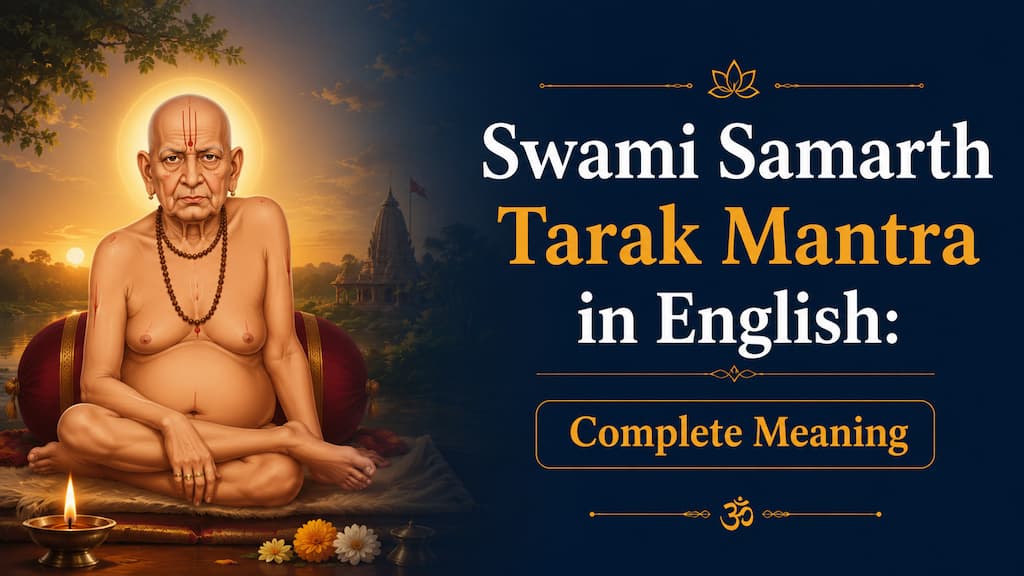
The Swami Samarth Tarak Mantra is unlike most Sanskrit mantras on ABMantra. It is composed in Marathi : not Sanskrit : and it is addressed not to a deity in the traditional sense but to a 19th-century saint who is revered as a living incarnation of Lord Dattatreya. Understanding both of these points is essential to understanding what the Tarak Mantra is and what it does.
Here is what most Tarak Mantra articles miss: they provide a rough translation but do not explain the key terms : Tarak, Avadhut and the specific teaching in each verse. The Tarak Mantra is not primarily a healing or protection mantra in the conventional sense. It is a reminder: a devotee who has genuinely surrendered to Swami Samarth has nothing to fear, not because the outer circumstances are guaranteed to be pleasant, but because the divine is fully present and in charge. This is the mantra’s specific function : to restore the devotee’s trust in the divine when fear, doubt and helplessness have temporarily obscured it.
Who Was Swami Samarth of Akkalkot
Swami Samarth: Essential Background
Identity: Swami Samarth (also known as Akkalkot Swami or Shri Swami Samartha Maharaj) was a 19th-century saint who lived in Akkalkot, Solapur district, Maharashtra. He is the third full-fledged incarnation of Lord Dattatreya in the tradition, after Sripad Vallabh and Srinrusimha Saraswati.
Avadhut: Swami Samarth belonged to the Avadhut tradition : saints who have completely transcended conventional social norms and identities. An Avadhut (from Sanskrit: he who has shaken off all worldly attachment) lives outside of all social categories: no caste, no prescribed behaviour, no predictable way of operating. This quality is explicitly referenced in the Tarak Mantra: “Atarkya Avadhut” : the Avadhut who is beyond logic.
Dattatreya: Dattatreya is the combined form of the Hindu Trinity (Brahma, Vishnu, Shiva in one body). His incarnations in the Datta lineage combine the creating, sustaining and dissolving functions of divinity. This is why devotees of Swami Samarth report miraculous interventions across all types of life situations : health, finances, relationships : simultaneously.
Akkalkot: Swami Samarth lived in Akkalkot for approximately 22 years until his Samadhi (conscious departure from the physical body). His shrine in Akkalkot is one of the most visited pilgrimage sites in Maharashtra. Devotees report that the energy of his presence remains actively available to sincere devotees who chant his mantra and remember him with devotion.
Tarak: The Word and Its Meaning
Tarak (तारक) comes from the Sanskrit root Tar, meaning to cross over. Tarak means the liberator : one who enables others to cross over the ocean of worldly suffering and fear. The same root appears in the Maha Mrityunjaya Mantra: “Mrityor Mukshiya Maamritat” : liberate me from death. Swami Samarth is called Tarak because his devotees’ testimony, across many generations, is that his presence enables them to cross over situations that seemed impossible without crossing : illness, grief, financial ruin, family crisis.
The Tarak Mantra is therefore the “mantra of liberation by the liberator” : not liberation in the abstract philosophical sense but the very immediate, practical liberation from the specific fear and helplessness of the present moment.
The Complete Tarak Mantra with Line-by-Line Meaning
Verse 1
Marathi:
Nishanka ho Nirbhay ho Mana Re
Prachand Swami Bal Pathishi Re
Atarkya Avadhut He Smarangami
Ashakya Hi Shakya Karatil Swami
English line by line:
Nishanka ho: be without doubt, without suspicion
Nirbhay ho: be without fear
Mana Re: O my mind
Prachand Swami Bal: the immense, tremendous power of Swami
Pathishi Re: is at your back, supporting you from behind
Atarkya: beyond logic, beyond the ordinary mind’s ability to comprehend
Avadhut He: this Avadhut (the one who has transcended all)
Smarangami: comes to one who simply remembers him
Ashakya Hi: even what is impossible
Shakya Karatil Swami: Swami will make possible
Complete meaning: O my mind, be without doubt, be without fear. The immense power of Swami is standing at your back in support. Remember: this Avadhut is beyond all logic : he who is simply remembered finds Swami present. The impossible, Swami will make possible.
Verse 2
Marathi:
Jyacha Padasparshe Kami Na Kahi
Tya Devabakti Bhaktachi Kahi Nahi
Swamichya Ichchhevina Mrityu Nahi
Param Kalyanache Bhaktache Kahi Nahi
English line by line:
Jyacha Padasparshe: where Swami’s feet have touched
Kami Na Kahi: there is no lack of anything
Tya Devabakti Bhaktachi Kahi Nahi: the devotee of such a divine one has no want
Swamichya Ichchhevina: without Swami’s wish and will
Mrityu Nahi: even death cannot touch one
Param Kalyanache Bhaktache Kahi Nahi: the supreme welfare of devotees is completely ensured
Complete meaning: Where Swami’s feet have touched, there is no lack of anything. The devotee of such a divine one has no want. Without Swami’s will, death itself cannot come. The supreme welfare of his devotees is completely in his care.
How to Chant the Tarak Mantra
| Situation | Method | Count |
|---|---|---|
| Daily devotional practice | Morning after bathing, facing east or toward Swami Samarth’s image or Akkalkot direction. Chant the complete Tarak Mantra (both verses) each as one unit. | 3, 7, 11 or 21 repetitions. No restriction on more. |
| Acute crisis or fear | Chant anywhere, in any posture, as many times as needed. The tradition specifically says: just remember him (Smarangami). There is no elaborate preparation required for the Tarak Mantra in crisis. | As many times as needed until inner calm arrives |
| Akkalkot pilgrimage | Chant continuously during the journey and upon arrival at the shrine | Continuous |
| Swami Samarth Jayanti (birthday celebration) | Community chanting with 108 or 1,008 repetitions | 108 or 1,008 |
From Our Practice
From Our Practice
The Tarak Mantra belongs to a different category from the Sanskrit mantras I work with in my Jyotisha practice. It is not a planetary remedy or a beej mantra with specific vibrational functions. It is devotional prayer : a direct address to a saint whose living presence devotees experience as immediately available through remembrance.
What I observe is that the Tarak Mantra is particularly effective in situations of acute helplessness : situations where the practical options have been exhausted and what remains is the need for inner resources that ordinary coping cannot provide. The specific content of the mantra addresses exactly this: the reassurance to a fearful mind that support is present, that what seems impossible is possible, that the devotee is not alone.
A colleague from Maharashtra shared a testimony that stays with me: he was in a hospital waiting room while his mother was in emergency surgery, having been told the outcome was uncertain. He chanted the Tarak Mantra continuously for three hours. He told me: “I did not stop fearing. But the fear became bearable. And then it became something I could sit inside without being destroyed by.” That quality of interior support : not the removal of difficulty but the presence of something larger than the difficulty : is what the Tarak Mantra specifically delivers in my observation.
Frequently Asked Questions
❓ I am not from Maharashtra. Can I still chant the Swami Samarth Tarak Mantra?
Yes, without restriction. Swami Samarth’s tradition explicitly includes people of all castes, regions and religious backgrounds. During his lifetime, his devotees included Muslims and Christians alongside Hindus of all communities. The tradition states that his grace is available to anyone who approaches with sincerity, regardless of regional, linguistic or cultural background. The Tarak Mantra in Marathi is accessible to all : its meaning is universal even if the language is regional.
❓ Is Swami Samarth the same as Sai Baba of Shirdi?
No, they are different saints. Swami Samarth of Akkalkot and Sai Baba of Shirdi were contemporaries in 19th-century Maharashtra and are both revered as Dattatreya incarnations in their respective traditions. Some traditions hold that Sai Baba was a disciple of Swami Samarth : there are accounts of Sai Baba speaking of having received blessings from Akkalkot Swami. They share the same spirit of universality, acceptance and the granting of grace regardless of the devotee’s background.
❓ Do I need to take initiation or diksha to chant the Tarak Mantra?
No. The Tarak Mantra does not require initiation, diksha or any formal qualification. This accessibility is one of its most important features : the tradition holds that Swami Samarth’s grace is available to anyone who simply remembers him. The mantra itself teaches this: Smarangami : he comes to one who simply remembers. The sincerity of the remembrance is the only requirement.
❓ What does Avadhut mean and why is Swami Samarth called an Avadhut?
Avadhut comes from Sanskrit: Ava (away, off) + Dhuta (shaken). An Avadhut is literally one who has shaken off everything : all social conventions, all identities, all predictable behaviour patterns. Avadhuts typically appear unconventional, unpredictable and sometimes socially transgressive. Swami Samarth was known for apparently erratic behaviour, for blessing people in unexpected ways and for being completely outside the conventions of polite religious observance. The tradition understands this as the behaviour of one who has transcended the ego entirely and is no longer governed by social performance. “Atarkya Avadhut” in the Tarak Mantra means: this Avadhut whose actions are beyond the mind’s ability to analyse and predict.
❓ What is the difference between the Tarak Mantra and Om Swami Samarth?
Om Swami Samarth (also written Jay Swami Samarth) is the simple name-invocation : the most direct and accessible form of calling on Swami Samarth’s presence. The tradition considers it equal in efficacy to any more elaborate practice. The Tarak Mantra is a longer devotional composition that specifically addresses the devotee’s fear and doubt and the qualities of Swami Samarth that address those states. Both are valid. Om Swami Samarth is for continuous informal chanting throughout the day. The Tarak Mantra is for dedicated devotional sessions and acute situations requiring the full reassurance of its content.
❓ Where can I hear the correct pronunciation of the Tarak Mantra?
The Tarak Mantra in Marathi is widely available on YouTube and devotional music platforms in recordings by trained Marathi kirtan singers. Search for “Swami Samarth Tarak Mantra” and listen to recordings from Akkalkot devotees or from recognised Maharashtra bhajan traditions for the most authentic pronunciation. The mantra is in Marathi, not Sanskrit, so Marathi-speaking devotees or recordings from Maharashtra will give you the most natural and correct pronunciation.
Simply Remember
The Tarak Mantra’s core instruction is given in the mantra itself: Smarangami : he who is simply remembered finds Swami present. No elaborate preparation is needed. No correct pronunciation is mandatory. No specific location or time.
Simply remember Swami Samarth. Say the Tarak Mantra however many times feels right. Let the meaning sink into whatever you are currently afraid of or doubtful about: Nishanka ho Nirbhay ho Mana Re : be without doubt, be without fear, O my mind. The immense power of Swami is at your back.
Sources
- Wikipedia : Swami Samarth: life, dates, Akkalkot residence, Dattatreya incarnation tradition and the Om Abhayadata mantra
- Wikipedia : Dattatreya: the Datta lineage of incarnations, Avadhut tradition and Sripad Vallabh through Swami Samarth lineage
- Tarak Mantra full lyrics and English translation. SwamiMantra.com : Marathi original text, line-by-line English translation
- Akkalkot Swami Samarth Tarak Mantra. BhaktiHome.com : five-stanza structure, Dattatreya sect context, benefits of daily chanting
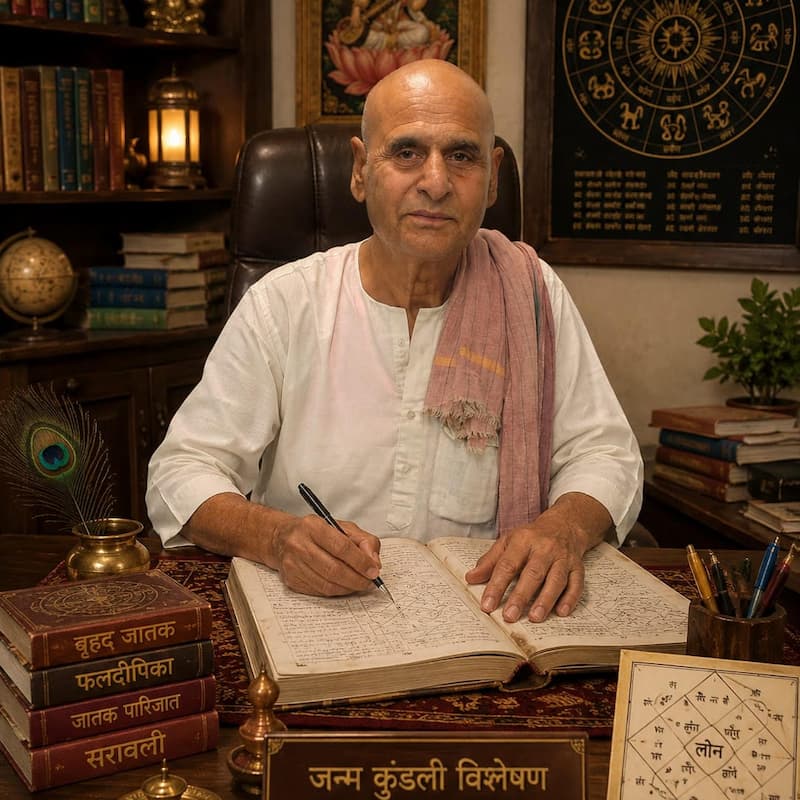
Narendra Kumar Chaubey is a Jyotisha Acharya with over 30 years of experience, based in Bihar and serving clients across India in Vedic astrology, mantra shastra, Vastu and ritual practice.
He completed his formal training at Kameshwar Singh Darbhanga Sanskrit University (KSDSU), one of India’s oldest and most respected institutions for Vedic and Sanskrit scholarship, where he studied Jyotisha shastra, mantra vidya and related classical sciences. KSDSU’s tradition of rigorous Sanskrit education tracing directly to the Mithila region’s centuries-old pandit lineage forms the foundation of his practice.
Over three decades, Narendra Kumar Chaubey has worked with thousands of individuals and families across Bihar and across India, offering guidance in:
- Kundli (birth chart) analysis: Identifying karmic patterns, planetary periods and life path guidance through classical Jyotisha
- Palmistry (Hasta Samudrika): Reading the hand according to the classical Samudrika Shastra tradition
- Vastu Shastra: Assessment and correction of living and working spaces according to directional and elemental principles
- Mantra and Pooja vidhi: Performing and guiding all categories of puja, havan, and mantra sadhana for personal, family and business situations
- Predictive Jyotisha: Transit analysis, muhurta (auspicious timing) selection and remedial guidance
He works across four languages Sanskrit, Hindi, English and Bhojpuri making classical knowledge accessible to practitioners across educational backgrounds and regions.
His writing for ABMantra brings the precision of classical Vedic training to practical mantra guidance: not general advice but specific prescriptions grounded in shastra, lineage and 30 years of direct practice with real situations.
For more info follow on: