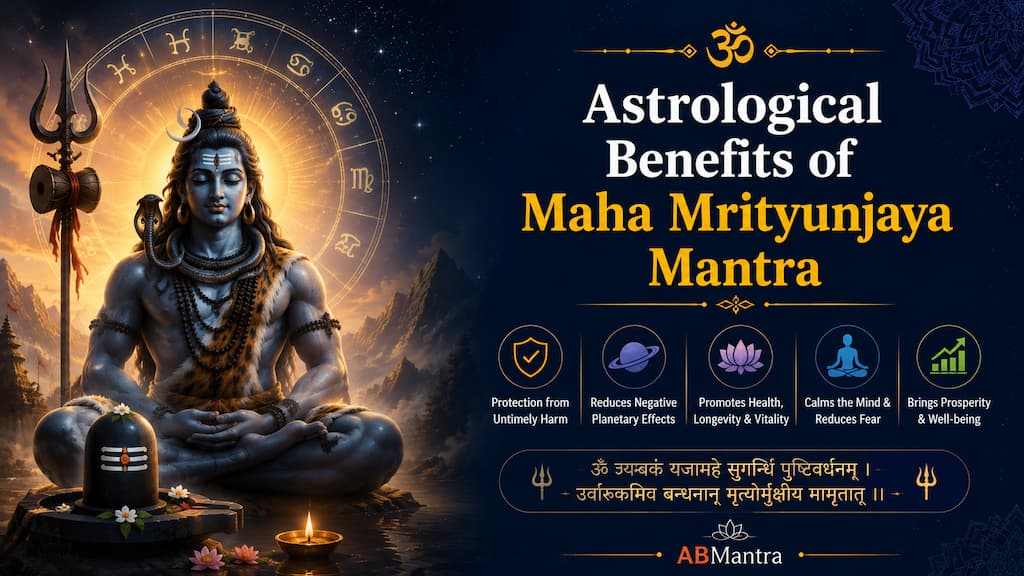

The astrological benefits of Maha Mrityunjaya Mantra go beyond general spiritual protection. In Vedic astrology (Jyotisha), this mantra – sourced from Rigveda 7.59.12 – is the primary remedy prescribed for planetary situations involving genuine threat to life, prolonged suffering, and the specific category of fear that malefic Dasha periods produce. Unlike the Navagraha mantras that each address a single planet, the Maha Mrityunjaya Mantra invokes Lord Shiva in his Mrityunjaya aspect – the only force in Vedic cosmology with authority over Yama, the deity of death, whom even Saturn ultimately serves.
उर्वारुकमिव बन्धनान् मृत्योर्मुक्षीय मामृतात्॥
Urvarukamiva Bandhanan Mrityormukshiya Mamritat
Source: Rigveda 7.59.12 | Daily count: 108 times | Best time: Brahma Muhurta (before sunrise) or Pradosha evening | Full Purashcharan: 1.25 lakh (125,000) repetitions
Every Word: The Astrological Meaning
Most articles give a paraphrase. Here is what each word specifically does in the astrological context.
Tryambakam (त्र्यम्बकम्) – the three-eyed one: Shiva’s three eyes correspond to the three primary luminaries: the Sun (right eye – vitality, authority, life force), the Moon (left eye – mind, emotions, mental peace), and Fire (third eye – transcendent vision that burns away what is false). Invoking Tryambakam provides planetary protection across all three dimensions simultaneously – physical, mental and spiritual. No other mantra achieves this in its opening word.
Yajamahe (यजामहे) – we worship: The plural is deliberate. Planetary affliction affects the entire energy field of the person and their household. This is a collective invocation, not only a personal petition.
Sugandhim (सुगन्धिम्) – the fragrant one: Astrologically, fragrance represents benefic planetary influences (Jupiter’s wisdom, Venus’s grace, Moon’s nourishment) being called in to counterbalance the malefic forces currently dominant.
Pushtivardhanam (पुष्टिवर्धनम्) – the nourisher and sustainer: Pushti corresponds to what benefic planets provide when they are strong. The mantra asks Shiva to serve as this nourishing force when the benefic planets are weakened or overpowered by malefics in the Dasha period.
Urvarukamiva (उर्वारुकमिव) – like a ripe fruit from the stem: The most astrologically significant line. The prayer is not for forced removal of karma but for graceful, natural release at the right moment – as a ripe fruit falls without violence. During difficult Dasha periods, the mantra asks for this quality: not to override the karma but to pass through it as smoothly as nature allows.
Bandhanan (बन्धनान्) – from bondage: All forms of planetary bondage – Saturn’s slow obstruction, Rahu’s fear and obsession, Ketu’s forced detachment, Mars’s sudden violence – are covered by this single word. The mantra asks for release from all of them.
Mrityormukshiya (मृत्योर्मुक्षीय) – liberate from death: In Jyotisha, Mrityu includes all death-like experiences: serious illness, financial collapse, a relationship ending under malefic Dasha, the ending of a life phase. The prayer encompasses every form.
Mamritat (मामृतात्) – not from immortality: The prayer asks to be freed from death but not from divine grace – ensuring the remedy does not create new karmic bonds even as it dissolves existing ones. This makes the mantra safe across all planetary situations without creating new problems in the process.
The Markandeya Story: An Astrological Reading
The mantra’s mythological source carries a teaching that most articles miss entirely. The sage Mrikandu chose a brilliant son – Markandeya – who had a death yoga in his birth chart at age 16, over a dull son with a long life. When Yama’s messengers arrived at 16, Markandeya did not fight them or try to change his chart. He embraced the Shivalinga and surrendered completely to Shiva, chanting what became the Maha Mrityunjaya Mantra. Shiva emerged, struck down Yama, and declared Markandeya immortal.
The Three Dimensions of Planetary Affliction
The Vedic tradition categorises all suffering into three types. The Maha Mrityunjaya Mantra is specifically the mantra that addresses all three – which is why it is prescribed across a wider range of situations than any other single mantra.
| Type | What it means | Astrological form | What the mantra does |
|---|---|---|---|
| Adhidaivika | Suffering from planetary/divine forces | Sade Sati, Rahu-Ketu transits, Kaal Sarp Dosh, malefic Mahadasha | Invokes Shiva as Kalantaka – the force that overcomes Yama’s authority over all planetary periods |
| Adhibhautika | Suffering from physical and material causes | Mars-caused accidents, Sun-caused vitality loss, Saturn-caused chronic illness | The Pushtivardhanam quality nourishes and rebuilds the physical dimension alongside medical treatment |
| Adhyatmika | Suffering from one’s own karmic tendencies – the internal dimension | Ketu-caused spiritual confusion, Saturn-caused depression, Rahu-caused obsession | The Tryambakam’s third eye activates transcendent awareness that sees through the temporary nature of the current planetary period |
Planet-by-Planet Astrological Benefits
This is the analysis missing from every competing article. Here is how the mantra specifically addresses each planet’s affliction.
| Planet | Affliction | Life manifestation | Specific MMM benefit | Best timing |
|---|---|---|---|---|
| Saturn | Sade Sati (7.5 yrs), Shani Mahadasha (19 yrs) | Prolonged obstruction, chronic illness, depression, the slow grinding down of circumstances over years | Saturn represents Mrityu’s extended approach. The Urvarukamiva line directly addresses Saturn’s quality – graceful release from what is dissolving, rather than violent resistance. Practice reduces the fear and internal resistance that amplify Saturn’s suffering. | Saturday evenings. Daily during Mahadasha. 1,008 on Shani Amavasya. |
| Rahu | Rahu Mahadasha (18 yrs), Rahu in 7th or 8th house | Sudden reversals, inexplicable fear, obsessive attachment, deception, relationship breakdowns from hidden causes | Rahu governs the fear of endings – not always physical death but the death of what one is attached to. The Mrityormukshiya line specifically addresses Rahu’s domain: liberation from fear of endings. Prescribed even when no physical illness is present. | Saturday-Sunday midnight. Eclipse periods: 10,800 times. |
| Ketu | Ketu Mahadasha (7 yrs), Ketu in 1st or 8th house | Mysterious illness, sudden accidents, spiritual confusion, near-death experiences | Ketu rules moksha and its shadow – forced premature detachment. The Bandhanan line asks for release from Ketu’s forced detachment, replacing it with the graceful release of the ripe fruit. Ketu-caused mysterious illness is among the most consistent MMM prescriptions in practice. | Daily without exception. Before sleep if Ketu is in 12th house. |
| Mars | Mars Mahadasha (7 yrs), Mangal Dosh, Mars in 8th house | Accidents, surgeries, blood disorders – sudden violent events | Mars governs blood and sudden force. The Pushtivardhanam quality nourishes and rebuilds after Mars-caused physical damage. Specifically prescribed before and after surgery. | Tuesday evenings. 1,008 times the night before any scheduled surgery. |
| Sun | Sun affliction, combust planets, Sun conjunct malefics | Vitality depletion, heart conditions, loss of life force (Prana) | The Tryambakam’s right eye is the Sun. The mantra strengthens the connection between the practitioner’s Prana and its divine source – directly addressing the life force that an afflicted Sun has weakened. | Sunday mornings. Uttarayana period (Jan 14 to Jul 14). |
| Moon | Moon in 8th house, Moon-Saturn (Visha Yoga), Moon-Rahu (Shakata Yoga) | Mental illness, emotional disturbance, depression, fear without clear external cause | The Tryambakam’s left eye is the Moon. The mantra specifically strengthens the Moon’s connection to Soma – the cosmic nourishment that sustains mental peace. Visha Yoga and Shakata Yoga are among the most painful astrological conditions; MMM is the primary prescription for their psychological suffering. | Monday evenings. Purnima: 1,008 times. |
| Kaal Sarp Dosh | All planets between Rahu-Ketu axis | Pervasive simultaneous obstruction across every area of life – persistent inexplicable misfortune | Since all planets are constricted simultaneously, single-planet mantras are insufficient. MMM addresses all planetary afflictions in one invocation through Tryambakam (all luminaries) and Bandhanan (all bondage). The 1.25 lakh Purashcharan is most commonly prescribed here. | Daily 108 times for life. Full Purashcharan. Mahakaleshwar visit if possible. |
When Your Jyotisha Prescribes This Mantra
| Situation | Daily count | Weekly intensive | Purashcharan |
|---|---|---|---|
| Saturn Sade Sati | 108 daily | 1,008 every Saturday | Optional but beneficial |
| Saturn Mahadasha (19 yrs) | 108 daily | 1,008 every Saturday | 1.25 lakh in year 1 |
| Rahu Mahadasha (18 yrs) | 108 daily | 1,008 on eclipses | 1.25 lakh in year 1 |
| Ketu Mahadasha (7 yrs) | 108 daily – no exceptions | 1,008 every Monday | 1.25 lakh in year 1 |
| Mars Mahadasha (7 yrs) | 108 daily | 1,008 every Tuesday | Before procedures |
| Kaal Sarp Dosh | 108 daily – lifelong | 1,008 on Nag Panchami | 1.25 lakh – most critical |
| Acute health crisis | 1,008 daily during crisis | As intensive as possible | As concentrated as possible |
| 8th house Dasha active | 108 daily | 1,008 on Mondays | 11,000 as targeted intensive |
Why Mahakaleshwar Ujjain Is the Most Powerful Location
Mahakaleshwar at Ujjain is the only Jyotirlinga where Shiva is specifically worshipped as Mahakala – the Great Time, the master of Kala. Since all Vimshottari Dasha periods are expressions of time moving through the chart, chanting the Maha Mrityunjaya Mantra here is chanting it at the point in India’s sacred geography where Shiva’s authority over all Dasha periods is most concentrated. The tradition holds that one mala (108 repetitions) at Mahakaleshwar equals 1,008 repetitions anywhere else. This is why the complete Purashcharan for Kaal Sarp Dosh and major Mahadasha situations is traditionally recommended to be performed there or at Trimbakeshwar.
Complete Daily Practice
What you need: 5 Mukhi Rudraksha mala (most appropriate for all Shiva mantras). Bilva (Bel) leaves as offering. A Shivalinga image or photograph of Lord Shiva. The tradition holds that offering bilva leaves while chanting multiplies the mantra’s effect significantly.
Step 1 – Opening (Om Namah Shivaya, 11 times): This establishes the devotional connection before the Mrityunjaya invocation begins. Do not skip this – it shifts the practice from mechanical chanting to genuine invocation.
Step 2 – Sankalpa: State your specific situation clearly: “I am chanting this Maha Mrityunjaya Mantra for relief from [Sade Sati / Kaal Sarp Dosh / Ketu Mahadasha / illness] and for the protection of [yourself or the person you are chanting for].” The Sankalpa directs the mantra’s energy to your specific need.
Step 3 – Main Japa (your prescribed count): Om Tryambakam Yajamahe Sugandhim Pushtivardhanam, Urvarukamiva Bandhanan Mrityormukshiya Mamritat – move one bead per complete mantra. Do not cross the Meru bead. Chant at a steady, unhurried pace.
Step 4 – Chanting for someone else: The MMM has a well-established tradition of being chanted by family members on behalf of someone who is ill or in crisis. Hold the person clearly in mind throughout. Include their name in the Sankalpa. During acute medical crisis: 1,008 repetitions daily by family members is the prescribed intensity.
Step 5 – Closing silence (5 minutes): Do not speak immediately after completing the count. The tradition holds this silence is when the mantra’s effect settles most deeply. Then offer the bilva leaves and close with Om Namah Shivaya 11 times.
From Our Practice
The Maha Mrityunjaya Mantra is the single most commonly prescribed remedy in 30 years of Jyotisha practice. Not because it is a cure-all – it is not prescribed casually – but because the situations that genuinely require it are among the most common: serious illness, the prolonged experience of Sade Sati, the inexplicable reversals of Rahu Mahadasha, the mysterious health challenges of Ketu Mahadasha.
The question asked most frequently: if I am chanting the Saturn mantra for Sade Sati, why do I also need the Maha Mrityunjaya Mantra? The answer is straightforward. The Saturn mantra addresses Saturn specifically – it creates devotion toward that planet. The Maha Mrityunjaya Mantra addresses the force behind Saturn’s most destructive expression – the Mrityunjaya consciousness that is the only force in Vedic cosmology with genuine authority over Yama. During the most difficult planetary periods, you need both.
The most consistent shift observed within 40 to 60 days of daily practice: the quality of fear that the difficult Dasha produces reduces noticeably. Not the external circumstances – those are governed by karma and resolve on their own timeline. But the inner experience of facing something overwhelming changes. Shiva’s Mrityunjaya quality is a quality of fearlessness in the face of endings. When that begins to develop through practice, the same external circumstances become navigable that were previously experienced as unbearable.
Frequently Asked Questions
- Wikipedia – Maha Mrityunjaya Mantra: Rigveda 7.59.12, the Markandeya origin story, Tryambaka as Shiva’s three-eyed form
- Wikipedia – Navagraha: the nine planets and their classical associations with death-related experiences in Vedic astrology
- Wikipedia – Mahakaleshwar Jyotirlinga: Shiva as Mahakala at Ujjain and the south-facing Jyotirlinga’s significance
- Brihat Parashara Hora Shastra – Vimshottari Dasha durations, 8th house significations, and prescribed Shiva mantra remedies for malefic planetary periods
- Shiva Purana – the Markandeya story: death yoga in the chart, Yama’s arrival, and the Maha Mrityunjaya Mantra as the instrument of divine intervention
Narendra Kumar Chaubey is a Jyotisha Acharya with over 30 years of experience, based in Bihar and serving clients across India in Vedic astrology, mantra shastra, Vastu and ritual practice.
He completed his formal training at Kameshwar Singh Darbhanga Sanskrit University (KSDSU), one of India’s oldest and most respected institutions for Vedic and Sanskrit scholarship, where he studied Jyotisha shastra, mantra vidya and related classical sciences. KSDSU’s tradition of rigorous Sanskrit education tracing directly to the Mithila region’s centuries-old pandit lineage forms the foundation of his practice.
Over three decades, Narendra Kumar Chaubey has worked with thousands of individuals and families across Bihar and across India, offering guidance in:
- Kundli (birth chart) analysis: Identifying karmic patterns, planetary periods and life path guidance through classical Jyotisha
- Palmistry (Hasta Samudrika): Reading the hand according to the classical Samudrika Shastra tradition
- Vastu Shastra: Assessment and correction of living and working spaces according to directional and elemental principles
- Mantra and Pooja vidhi: Performing and guiding all categories of puja, havan, and mantra sadhana for personal, family and business situations
- Predictive Jyotisha: Transit analysis, muhurta (auspicious timing) selection and remedial guidance
He works across four languages Sanskrit, Hindi, English and Bhojpuri making classical knowledge accessible to practitioners across educational backgrounds and regions.
His writing for ABMantra brings the precision of classical Vedic training to practical mantra guidance: not general advice but specific prescriptions grounded in shastra, lineage and 30 years of direct practice with real situations.
For more info follow on: