
The benefits of Green Tara Mantra are specific, structured and deeply rooted in one of Buddhism’s most beloved practices. Green Tara – Shyama Tara in Sanskrit – is the swift, active, compassionate form of the female Buddha Tara, and her mantra Om Tare Tuttare Ture Svaha is chanted by millions of practitioners daily across Tibet, India, Nepal, and worldwide. Understanding why requires looking beyond the generic “removes obstacles” description that most articles offer – and into what each syllable actually does, which fears it specifically addresses, and why the colour green and the posture of readiness are not incidental but central to this mantra’s power.
Pronunciation: Om (ohm) – TAH-ray – too-TAH-ray – TOO-ray – swah-HA
Complete meaning: Homage to Tara – she who liberates from samsara (Tare), she who swiftly protects from all fears (Tuttare), she who heals and grants liberation from suffering (Ture) – I offer this completely (Svaha).
Tradition: Tibetan Buddhism (Vajrayana) – also recognised in the Hindu Shakta tradition as the mantra of Tara, the second of the ten Mahavidyas
Daily count: 108 times – one mala round
Best time: Early morning or before sleep
Mala: Green jade, crystal quartz or turquoise mala – or any mala with which you have an established practice
Who Is Green Tara
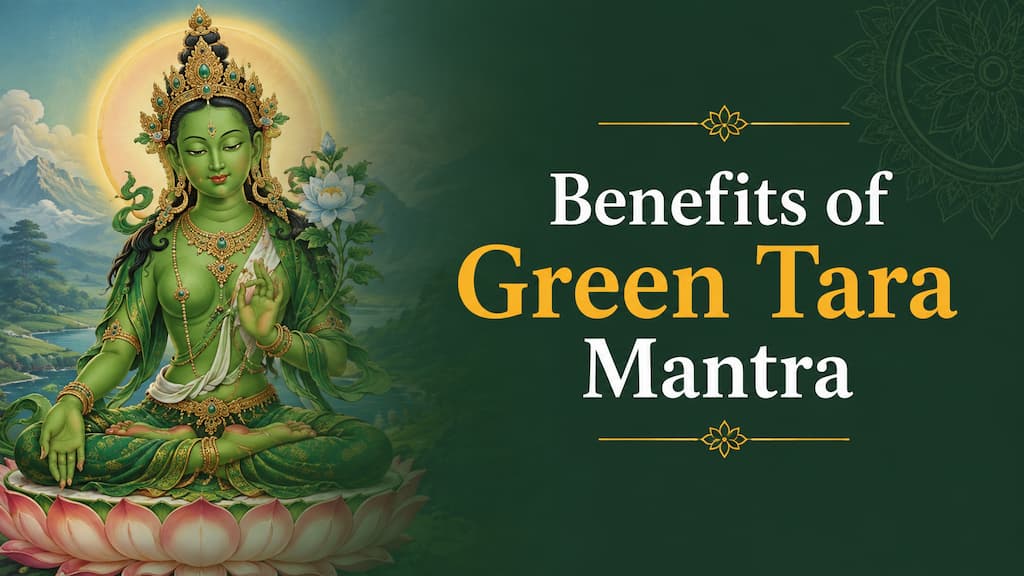
Green Tara is the active, swift, protective form of Tara – the female Buddha who embodies enlightened compassionate action. Where White Tara sits in deep meditation radiating healing grace, Green Tara sits with one leg extended and ready to spring into action – the posture of immediate response to suffering. She does not wait for suffering to arrive at her door; she rushes toward it.
Her green colour is specific and meaningful. In the Buddhist colour symbolism, green represents the wind element – movement, quickness, and the capacity to go anywhere instantly. It is the colour of active compassion, natural abundance, and the life force that responds dynamically to need. It is also connected to Amoghasiddhi – the Buddha of all-accomplishing wisdom – whose family colour is green and whose quality is the fearless accomplishment of all virtuous activities. Green Tara embodies this all-accomplishing, all-responding quality.
She holds a blue lotus (Utpala) in her left hand at the level of her heart – symbolising her purity of mind amid the world of suffering. Her right hand is in the Varada mudra (gesture of giving), palm outward, indicating that her gift is freely given without condition. She is adorned with the jewels of an enlightened being and wears the crown of the five Dhyani Buddhas – indicating that she encompasses all five wisdoms.
Tara’s Origin: The Princess Who Chose Her Form
Tara’s origin story contains a teaching that is particularly relevant to understanding her mantra’s benefits. In a time before recorded history, a princess named Yeshe Dawa (Moon of Primordial Awareness) was a dedicated Buddhist practitioner who made vast offerings to the Buddha of her time and attained a high level of realisation. The monks of that time encouraged her to pray to be reborn as a man in her next life, so that her spiritual progress could continue more easily (reflecting the cultural assumptions of that period).
Yeshe Dawa refused. She said: “There is no man, there is no woman, no self, no person, and no consciousness. Labelling ‘male’ or ‘female’ is hollow. Oh, how worldly fools delude themselves! I shall work for the benefit of beings in a woman’s form as long as samsara endures.” She then made a vow: to attain full enlightenment in a female form and, from that enlightenment, to help all beings. Tara is the fulfilment of that vow.
This origin story explains why Tara is specifically invoked for situations of unjust difficulty, for overcoming the particular obstacles that arise from being dismissed, underestimated, or constrained by circumstances beyond one’s control. She chose her path against conventional wisdom and overcame every obstacle to fulfil her vow. Her mantra carries this specific energy of determined, compassionate, unstoppable forward movement.
Green Tara Mantra Word by Word: The Three Liberations
The four core syllables of the Green Tara Mantra – Om, Tare, Tuttare, Ture – each correspond to a specific type of liberation. This three-liberation structure is what gives the mantra its comprehensive protective power and is completely absent from most articles about it.
| Syllable | Devanagari | Literal meaning | Liberation it provides | Specific benefits |
|---|---|---|---|---|
| Om | ॐ | The body, speech and mind of all enlightened beings; the primordial cosmic ground | Alignment with enlightened consciousness | Opens the channel of the practice; aligns the practitioner’s body, speech and mind with Tara’s enlightened qualities before the specific liberations begin |
| Tare | तारे | From the root “tr” – to cross over, to ferry across. “She who ferries across.” Tara means both “star” (as a guiding light) and “she who saves” (as in one who helps you cross the ocean of suffering) | Liberation from samsara – from the cycle of conditioned suffering at the most fundamental level | Relief from suffering caused by external circumstances, dangers and adverse situations. Protection during travel, in dangerous situations, and when life feels overwhelmingly difficult. The first Tare addresses the outer level of difficulty. |
| Tuttare | तुत्तारे | An intensive form of Tare – “she who saves very swiftly,” “the swift liberatrix” | Liberation from the eight fears (Ashtabhaya) – the specific internal obstacles and defilements that create suffering from within | Removing fear, anxiety, doubt and the specific eight obstacles both as external dangers and as internal psychological patterns (see the eight fears section below). This is the most distinctive dimension of the Green Tara Mantra – the specific protection from the Ashtabhaya that no other Buddhist mantra addresses as directly. |
| Ture | तुरे | “Swift,” “the swift one,” also related to the Sanskrit “tura” meaning prompt, quick, heroic | Liberation from illness and spiritual obscurations – specifically physical and mental health, and the removal of the obscurations that prevent enlightenment | Healing of physical illness; removal of mental obscurations (the subtle misperceptions that prevent clear seeing); swift action in situations requiring immediate response; protection from negative energies |
| Svaha | स्वाहा | “May it be so,” “so be it,” “I offer this to the fire.” The same Svaha that appears in Vedic fire offerings – the completion syllable that releases the intention. | Sealing and releasing the mantra’s intention into the universe | The Svaha confirms that the practice is complete and releases the practitioner’s intention with trust – not holding onto the outcome but offering it fully. This quality of release is itself a teaching: the mantra’s benefits come not from gripping the intention but from offering it completely. |
The Eight Fears: What Tuttare Specifically Protects
The Ashtabhaya – eight fears – are specific dangers that the Green Tara Mantra is classically understood to protect from. What most articles miss is that each of the eight external dangers has an internal equivalent – a mental or emotional state that it symbolises. The Green Tara Mantra addresses both the external danger and the inner state simultaneously.
| # | External danger | Internal obstacle it represents | What Tuttare dissolves |
|---|---|---|---|
| 1 | Lions | Pride and arrogance | The sense of inflated self that creates conflict and prevents genuine learning |
| 2 | Elephants | Delusion and ignorance | The fundamental misperception of reality that is the root of all suffering in Buddhist understanding |
| 3 | Fire | Hatred and anger | The burning emotion that destroys relationships, health and spiritual progress |
| 4 | Snakes | Jealousy and envy | The poisonous quality of comparing oneself to others and being diminished by what others have |
| 5 | Bandits and thieves | Wrong views and false beliefs | The distorted worldview that “steals” genuine understanding and replaces it with harmful misperceptions |
| 6 | Imprisonment and bondage | Greed and miserliness | The mental chains of attachment that imprison the practitioner in cycles of wanting and not having |
| 7 | Floods and water | Attachment and desire | The overwhelming force of craving that sweeps away wisdom and discernment |
| 8 | Evil spirits | Doubt and indecision | The paralysing uncertainty that prevents commitment to a path and makes genuine spiritual progress impossible |
This dual-level understanding transforms the Green Tara Mantra from a generic protection practice into a precise psychological tool. When you chant Tuttare, you are not only asking for protection from external dangers – you are also specifically working on the eight internal obstacles that Buddhist psychology identifies as the root causes of all suffering. This is why the mantra is considered complete in itself: it addresses the full spectrum from the most external (physical danger) to the most internal (fundamental delusion).
Benefits of Green Tara Mantra: Complete Analysis
Swift removal of obstacles
Green Tara is specifically described as swift – this is the quality that distinguishes her from other Bodhisattvas and Buddhas. Avalokiteshvara (Chenrezig) embodies boundless compassion. Manjushri embodies wisdom. Green Tara embodies the immediate, active, fearless response to suffering. Her mantra is therefore invoked specifically when obstacles need to be cleared quickly, when a situation is urgent, and when waiting is not an option. The Tare syllable directly invokes this swift clearing quality.
Protection from fear and anxiety
The Tuttare syllable specifically addresses all forms of fear. This makes the Green Tara Mantra among the most directly applicable mantras for modern practitioners, where anxiety, worry and fear of the future are among the most common and debilitating experiences. Regular chanting – particularly before sleep, when anxious mental activity tends to peak – produces a progressive calming of the fear response. This is not suppression but a genuine dissolution of the specific internal fears that the Ashtabhaya represents.
Healing of illness
The Ture syllable is specifically the healing syllable. The tradition holds that chanting the Green Tara Mantra during illness – one’s own or for a loved one – invokes Tara’s swift healing compassion directly. The mantra is often chanted over water or medicine before it is taken, or repeated for a set count over a person who is ill. This is not an alternative to medical treatment but a complement to it – the mantra addressing the energetic and spiritual dimension of illness while medical treatment addresses the physical.
Success in all virtuous activities
Green Tara is specifically associated with the accomplishment of all virtuous activities – work that benefits others, creative projects with genuine purpose, educational endeavours, and any activity undertaken with genuine positive motivation. Chanting the mantra before beginning work of genuine purpose invokes her quality of all-accomplishing wisdom (Amoghasiddhi’s quality, which her green colour connects to).
Purification of negative karma
Regular chanting of Om Tare Tuttare Ture Svaha is held in the tradition to purify negative karma accumulated through harmful past actions. The mantra’s comprehensive liberation framework (from samsara, from the eight fears, from obscurations) addresses karma at multiple levels simultaneously – not only the surface manifestations but the underlying patterns that drive harmful behaviour.
Awakening of compassion
Tara is the embodiment of compassion in action. Her mantra, when chanted consistently with the dedication of merit to all beings (a practice common in Tibetan Buddhism – dedicating the benefit of one’s practice to all sentient beings, not only oneself), gradually opens the practitioner’s own compassion. This is considered among the most important long-term benefits: the mantra transforms the practitioner toward Tara’s qualities, not only invokes her protection.
Guidance and direction in life
Tara’s name also means “star” – specifically the guiding star that navigators use to find their way. The mantra is invoked when the practitioner feels lost, directionless, or unable to see a clear path forward. Just as ancient navigators used the pole star as their fixed reference point in a changing sky, Tara serves as the fixed reference point of compassionate wisdom amid the confusion of life’s circumstances.
Green Tara in the Hindu Tradition
Most articles present Green Tara exclusively as a Buddhist deity. The picture is more complex and more interesting. In the Hindu Shakta tradition, Tara is the second of the ten Mahavidyas – the great wisdom goddesses – immediately following Kali in the classical ordering. Hindu Tara shares significant iconographic and philosophical connections with Buddhist Tara, reflecting centuries of mutual influence between the two traditions in India and Nepal.
Hindu Tara is specifically associated with the power of Vak (speech) and is particularly invoked for protection during difficult transits in life, for learning and knowledge, and for crossing over (the “Tara” root of crossing over is shared) particularly difficult life circumstances. The Nila (blue) Tara of the Hindu tradition and the Green Tara of the Buddhist tradition share this core quality: the compassionate, swift, crossing-over energy that rescues beings from the midst of difficulty.
For Indian practitioners approaching this mantra from a Hindu background: the mantra Om Tare Tuttare Ture Svaha is fully accessible. It does not require adoption of Buddhist doctrine to produce benefit. Many Hindu practitioners incorporate it alongside their existing practice, particularly for protection during difficult periods and for the specific clearing of the eight internal obstacles that the Ashtabhaya represents.
Pronunciation Guide
| Syllable | Correct pronunciation | Common mistake | How to remember |
|---|---|---|---|
| Om | Ohm – a full sustained sound, mouth closing gently at the m | Rushing through it | One full breath for Om alone before the mantra begins |
| Tare | TAH-ray – two syllables, stress on the first, the final e is pronounced as “ray” not “ree” | “Tare” rhyming with “care” (English) – the a is a long open Sanskrit a | TAH as in “father” – ray as in the sun’s ray |
| Tuttare | too-TAH-ray – three syllables, stress on the second syllable | TOO-tah-ray (stress wrong) or “tuttare” with a short u | The double t is a slight hold before release – too (pause) TAH-ray |
| Ture | TOO-ray – two syllables, the u is long as in “moon” | “Tyoor” – adding a y sound that is not present | TOO (moon) – ray (light). Swift as a moonbeam. |
| Svaha | swah-HA – two syllables, light stress on the second. The sv is a smooth blend of s and v | “Sva-ha” with equal stress or “swaha” with English vowels | The breath releases completely on the final HA – like a sigh of release |
Complete Daily Practice Guide
Best times: Early morning before sunrise, or in the evening before sleep. Green Tara is accessible at all times – she is specifically described as one who responds at any hour – but dawn and dusk are the most potent practice windows.
Posture and preparation: Sit comfortably with the spine erect. Face east (the direction of the rising sun and of Amoghasiddhi, whose quality Tara embodies). Light a stick of incense or a ghee lamp if available. If you have a Green Tara image, place it at eye level in front of you.
Visualisation (optional but powerful): Before beginning the mantra count, spend 1 to 2 minutes visualising Green Tara: a beautiful figure in vibrant emerald green, seated on a white lotus and full moon disc, with her right leg extended and ready to spring into action, holding a blue lotus at her heart, her right hand in the gesture of giving. She smiles at you with complete, unconditional compassion and recognition.
The mantra count: Om Tare Tuttare Ture Svaha – 108 times on a mala. Move one bead per complete mantra. After completing the count, sit in silence for 3 minutes.
Dedication of merit: End by dedicating the benefit of your practice to all beings. This is a specific Tibetan Buddhist practice that the tradition holds multiplies the mantra’s effect: “May the merit of this practice benefit all beings. May all beings be free from suffering and its causes. May all beings find happiness and its causes.” This dedication is not mandatory but is considered an essential part of complete Tara practice.
For urgent situations: The mantra can be chanted informally at any time – while walking, commuting, or in any moment of fear or difficulty. Even a single sincere repetition is considered to invoke Tara’s compassionate attention. The tradition specifically emphasises that Tara responds to even one sincere calling of her name.
From Our Practice
The Green Tara Mantra is one of the few mantras I recommend without qualification to practitioners from any background – Hindu, Buddhist, or simply spiritual without formal tradition. Its accessibility comes from Tara’s own nature: she is the deity who specifically responds to all beings in need, not only initiates, not only those with correct doctrinal understanding, not only long-term practitioners. She responds to anyone who calls with genuine need.
In my experience across 30 years, the Green Tara Mantra produces the fastest experiential response of any mantra I work with. This is consistent with her classical description as “swift” – practitioners who begin the practice typically report a quality of inner calm and increased sense of being supported or held within 7 to 14 days of consistent daily chanting. This is faster than most mantras, which typically require 21 to 40 days before the first shifts become noticeable.
The specific benefit I observe most consistently is what I would call a reduction in the contraction of fear. Not the removal of the external difficulty but a change in the practitioner’s inner relationship with it. The situation that was paralyzing becomes navigable. The fear that was overwhelming becomes manageable. This is the Tuttare quality at work – not removing the external danger but dissolving the internal contraction around it so that clear, compassionate action becomes possible. This is, I think, the deepest benefit of the Green Tara Mantra and the one that is most difficult to describe from the outside but most unmistakable from the inside.
Frequently Asked Questions
- Wikipedia – Tara (Buddhism): Green Tara as the swift, active Bodhisattva; the Ashtabhaya (eight fears); the mantra Om Tare Tuttare Ture Svaha; iconography including the extended leg posture and blue lotus
- Wikipedia – Tara (Hinduism): Tara as the second Mahavidya in the Shakta tradition; shared qualities between Hindu and Buddhist Tara; Nila Tara iconography
- Wikipedia – Tara’s origin story: Princess Yeshe Dawa’s vow to attain enlightenment in female form and to serve all beings from that form until samsara is emptied
- Tara Tantra (Taratantra) and the Praises to the Twenty-One Taras – the classical Tibetan Buddhist source texts for the Green Tara Mantra, the three-liberation structure (Tare/Tuttare/Ture) and the Ashtabhaya protection framework
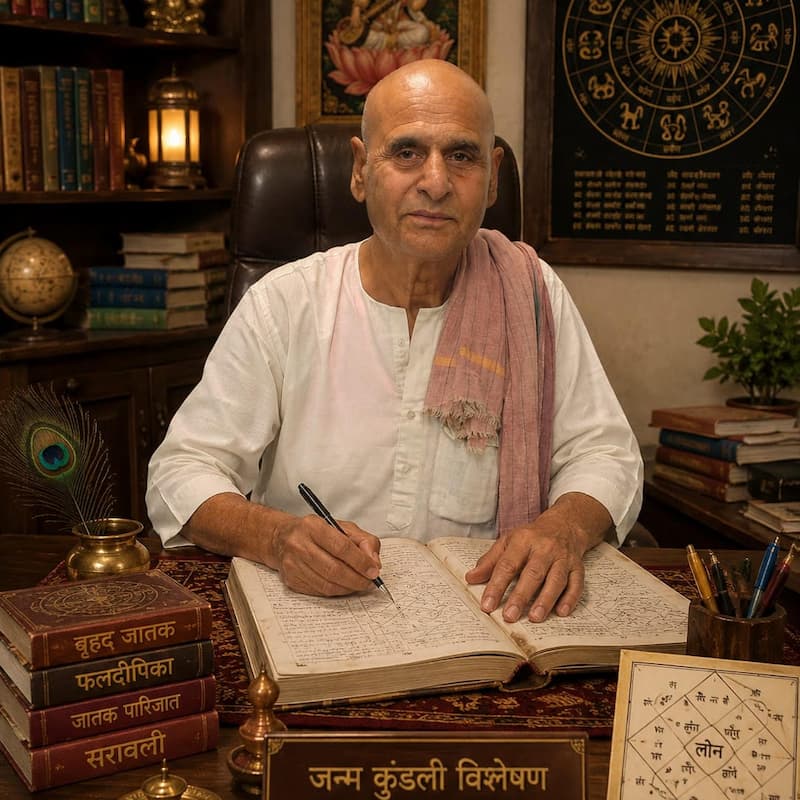
Narendra Kumar Chaubey is a Jyotisha Acharya with over 30 years of experience, based in Bihar and serving clients across India in Vedic astrology, mantra shastra, Vastu and ritual practice.
He completed his formal training at Kameshwar Singh Darbhanga Sanskrit University (KSDSU), one of India’s oldest and most respected institutions for Vedic and Sanskrit scholarship, where he studied Jyotisha shastra, mantra vidya and related classical sciences. KSDSU’s tradition of rigorous Sanskrit education tracing directly to the Mithila region’s centuries-old pandit lineage forms the foundation of his practice.
Over three decades, Narendra Kumar Chaubey has worked with thousands of individuals and families across Bihar and across India, offering guidance in:
- Kundli (birth chart) analysis: Identifying karmic patterns, planetary periods and life path guidance through classical Jyotisha
- Palmistry (Hasta Samudrika): Reading the hand according to the classical Samudrika Shastra tradition
- Vastu Shastra: Assessment and correction of living and working spaces according to directional and elemental principles
- Mantra and Pooja vidhi: Performing and guiding all categories of puja, havan, and mantra sadhana for personal, family and business situations
- Predictive Jyotisha: Transit analysis, muhurta (auspicious timing) selection and remedial guidance
He works across four languages Sanskrit, Hindi, English and Bhojpuri making classical knowledge accessible to practitioners across educational backgrounds and regions.
His writing for ABMantra brings the precision of classical Vedic training to practical mantra guidance: not general advice but specific prescriptions grounded in shastra, lineage and 30 years of direct practice with real situations.
For more info follow on: