
Quick Answer
The primary Kamakhya mantra:
Om Kreem Kamakhyai Namah
ॐ क्रीं कामाख्यै नमः
Meaning: Om. Kreem (Kali’s beej : transformative power). To Kamakhya (the beloved of Kama, the one who fulfils desires). I bow.
Kamakhya Mula Mantra (extended form):
Om Aim Hreem Shreem Kleem Sauh Kamakhyai Namah
ॐ ऐं ह्रीं श्रीं क्लीं सौः कामाख्यै नमः
Method: 108 times daily. Friday and Tuesday are most auspicious. Red flowers offered at the mantra’s completion.
Who This Article Is For
This article is for you if you want to know the Kamakhya mantra and understand what Kamakhya Devi represents | you want the correct mantra text and method for the Kamakhya Shakti Peeth tradition | you want to understand the difference between Kamakhya and other Shakti forms and why her mantra is sought for specific purposes.
Also see: Kreem Mantra Benefits: the Kali beej explained and Durga Mantra: complete protection practice
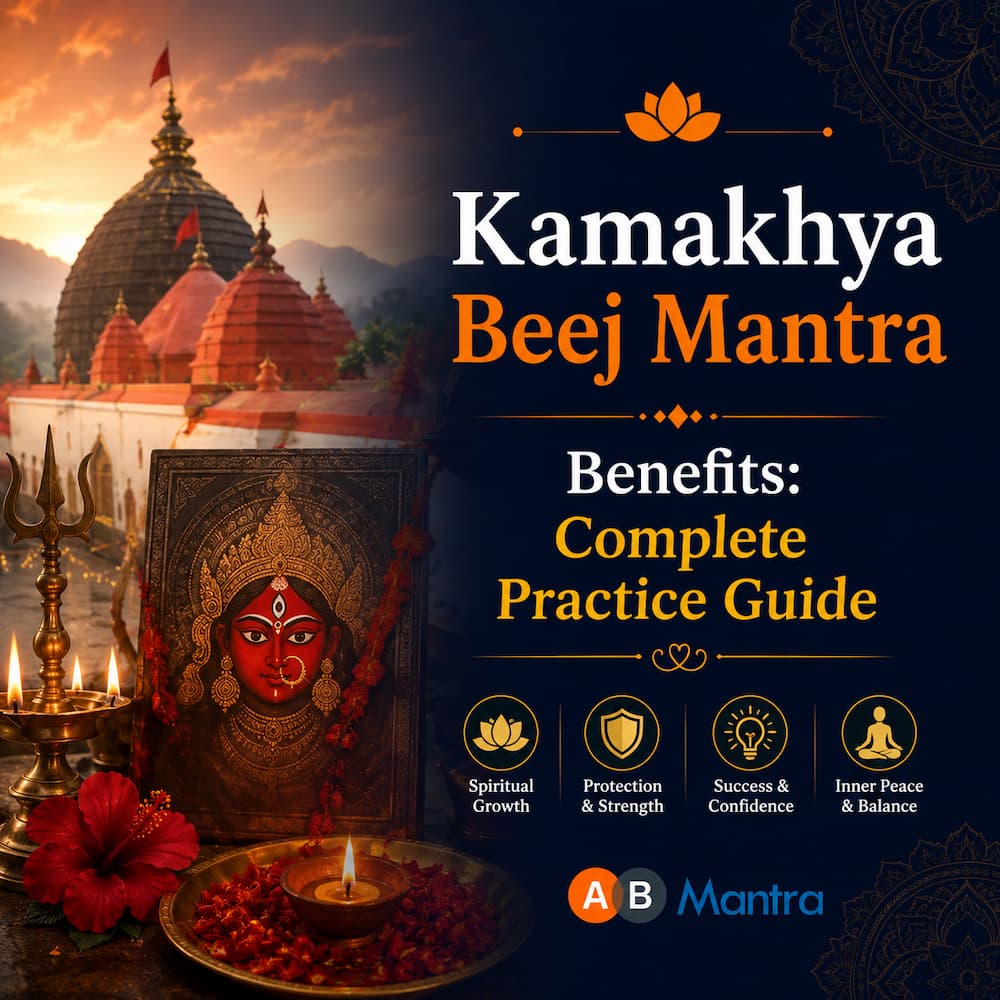
The Kamakhya temple at Nilachal Hill in Guwahati, Assam is one of the most powerful Shakti Peethas in India and one of the primary centres of Tantric practice in the Hindu tradition. It is unique among all the Shakti Peethas: unlike most which enshrine a specific body part of Sati (the deceased consort of Shiva whose body fell in pieces across the subcontinent), the Kamakhya temple enshrines the yoni (the seat of feminine creative power) of Sati. This makes Kamakhya the most direct manifestation of the divine feminine in its creative and generative aspect in the entire Shakti Peeth system.
Here is what most Kamakhya mantra articles miss: they present Kamakhya primarily as a mantra for wish-fulfilment and desire. While this is accurate : Kama means desire, and Kamakhya means the one who fulfils desires : the tradition’s understanding of what Kamakhya actually governs is more precise and more profound than simple wish-fulfilment. Kamakhya is the goddess of the divine creative power itself: the power through which all of existence comes into being. This is the deepest meaning of Kama in the Vedic tradition : not mere desire but the primordial creative impulse that underlies all existence.
Who Is Kamakhya
Kamakhya: Understanding the Goddess
Name meaning: Kamakhya comes from Kama (desire, love, the creative impulse) + Akhya (named, known as). She is the one known by desire, the one who is desire itself in its divine form. She is also the one who knows (Akhya also means to tell or reveal) the innermost desires of her devotees.
The Shakti Peeth: Kamakhya is the Shakti Peeth where Sati’s womb (yoni) fell. In the Tantric tradition, this makes Kamakhya the direct manifestation of the divine feminine creative power at the most fundamental level: the source of all life and all creation.
The Ambubachi Mela: Once a year, typically in June, Kamakhya temple closes for three days during which the goddess is said to be in her annual menstrual period. The Ambubachi Mela that follows is one of the largest Tantric gatherings in India, attended by thousands of sadhus and Tantric practitioners. The temple’s annual closing and reopening cycle honours the goddess’s creative cycle as sacred rather than impure : a direct inversion of mainstream social attitudes toward menstruation.
The ten Mahavidyas: Kamakhya is the mother of the ten Mahavidyas (great wisdom goddesses) in the tradition of Assam’s Tantric practice. Worshipping Kamakhya is considered to invoke the combined energy of all ten Mahavidyas simultaneously.
The Kamakhya Mantra: Full Analysis
| Mantra form | Text | Best for | Count |
|---|---|---|---|
| Simple form (beginners) | Om Kreem Kamakhyai Namah | Daily practice, general Kamakhya devotion, establishing the connection | 108 times daily |
| Mula Mantra (complete form) | Om Aim Hreem Shreem Kleem Sauh Kamakhyai Namah | Serious sadhana, wish fulfilment, invoking all five Shakti beej simultaneously | 108 times for 40 days minimum |
| Kali form (for removal of obstacles) | Om Kreem Kreem Kreem Kamakhyai Namah | Specific obstacle removal, breaking persistent negative patterns | 108 times on Tuesdays |
| Dhyana (meditation) mantra | Om Kamakhyaye Varade Devi Nilparvata Vasini Tvam Devi Jagatmata Yoni Mudra Namostute | Formal Kamakhya puja and meditation | Once at beginning of puja |
The Five Beej Syllables in the Mula Mantra
The Kamakhya Mula Mantra : Om Aim Hreem Shreem Kleem Sauh Kamakhyai Namah : contains five of the most powerful Shakta beej syllables in a single mantra. This combination is what distinguishes the Mula Mantra from the simple form and what makes it the most complete invocation of Kamakhya’s energy:
- Aim: Saraswati’s beej : speech, intelligence, the power of expression
- Hreem: Bhuvaneshwari’s beej : manifestation, creative power, the bringing into form
- Shreem: Lakshmi’s beej : abundance, auspiciousness, the fullness of life
- Kleem: The beej of attraction and love : Kamadeva’s energy, drawing desired outcomes
- Sauh: The Para Bija : the supreme seed syllable of the Shakta tradition, representing the highest aspect of the divine feminine consciousness before it takes any specific form
Together, these five beej syllables address all five dimensions of Shakti’s power simultaneously: intelligence (Aim), manifestation (Hreem), abundance (Shreem), attraction (Kleem) and the supreme divine ground (Sauh). The Kamakhya Mula Mantra is not five separate mantras combined : it is one integrated invocation of the complete Shakti energy as Kamakhya embodies it.
Specific Benefits of Kamakhya Mantra Practice
The tradition’s specific claims for Kamakhya mantra practice:
- Fulfilment of sincere desires: Kamakhya as the deity of desire in its divine form specifically responds to sincere desires that align with the practitioner’s genuine self. She does not fulfil ego-driven wants mechanically; she fulfils the deeper wishes that the heart genuinely holds.
- Removal of deep karmic obstacles: Kamakhya’s Kreem energy (present in the simple mantra form) specifically dissolves deep-rooted karmic obstacles that have been blocking genuine growth.
- Fertility and conception: As the goddess of the divine creative principle, Kamakhya is specifically invoked for fertility, conception difficulties and safe pregnancy in the Assamese tradition.
- Protection from negative forces: The Tantric tradition of Kamakhya includes strong protective practices. Her mantra creates a field of Shakti energy specifically hostile to negative external forces.
- Spiritual advancement: For Tantric practitioners, Kamakhya’s grace is specifically sought for accelerated spiritual development : the same quality that Kali’s energy produces through the Kreem beej.
From Our Practice
From Our Practice
The Kamakhya temple at Nilachal Hill is one of the few sacred sites I have visited that immediately communicates its power without any preparation or expectation. The energy of the place is unmistakable. The tradition that has been maintained at that site : continuously, without interruption : for centuries produces something that is experienced by visitors regardless of their belief system or intention.
For practitioners who cannot visit Kamakhya, the mantra is the primary means of connection. Om Kreem Kamakhyai Namah : the simple form : is the mantra I prescribe for clients who need the combination of transformation and desire-fulfilment that Kamakhya specifically provides. Not one or the other: both simultaneously. Kali’s Kreem energy transforms what is blocking the fulfilment of desire; Kamakhya’s own nature then fulfils the purified desire that remains.
The most important guidance I give to practitioners of the Kamakhya mantra is this: be honest with yourself about what you actually desire, at the deepest level, as opposed to what you think you should desire or what others expect you to desire. Kamakhya responds to genuine desire. She is indifferent to performed desire. The mantra is most powerful in practitioners who know clearly what they want and want it with the whole of their being without apology.
Frequently Asked Questions
❓ Can I chant the Kamakhya mantra without visiting the Kamakhya temple?
Yes. The mantra is the primary means of connecting to Kamakhya’s energy for practitioners who cannot visit Assam. Visiting the temple is described in the tradition as the most powerful form of connection but it is not a prerequisite for the mantra practice. The Mula Mantra establishes the energetic connection through sound vibration regardless of physical location. If you do visit the Kamakhya temple, the practice of sitting in the temple and chanting the Mula Mantra 108 times in that space is considered one of the most powerful Tantric practices available.
❓ Is the Kamakhya mantra safe to chant without initiation?
The simple form : Om Kreem Kamakhyai Namah : is safe for practice without formal initiation. The Mula Mantra with all five beej syllables (Om Aim Hreem Shreem Kleem Sauh Kamakhyai Namah) is more intense and traditionally benefits from guidance from a qualified Shakta or Tantric teacher, particularly if you are chanting for specific purposes rather than general devotion. Begin with the simple form. Establish a consistent daily practice. If deeper engagement is needed, seek a qualified teacher in the Shakta tradition.
❓ What are the Ambubachi Mela and its significance for mantra practice?
Ambubachi Mela is the annual festival at Kamakhya temple when the goddess is said to be in her menstrual period. The temple closes for three days (during which the goddess is in a state of heightened power) and reopens. The prasad (sacred offering) from the Ambubachi Mela reopening : particularly the red cloth distributed as the goddess’s menstrual blessing : is highly sought by Tantric practitioners. For mantra practitioners at home: chanting the Kamakhya Mula Mantra during the Ambubachi period (even without being present at the temple) is considered particularly powerful, as the goddess’s energy is at its most concentrated.
❓ What does Sauh beej mean? I have not seen it in other mantras.
Sauh (सौः) is the Para Bija : the supreme or transcendent seed syllable in the Shakta Tantric tradition. It represents the Shakti energy in its most undifferentiated, pre-formal state: before it takes any specific quality like creation, preservation or dissolution. In the Kamakhya Mula Mantra, Sauh grounds the other four beej syllables (Aim, Hreem, Shreem, Kleem) in the transcendent divine feminine source from which all specific Shakti expressions emerge. It is less commonly seen in accessible mantras because it belongs specifically to the higher Shakta Tantric tradition.
❓ Can women chant the Kamakhya mantra during menstruation?
Yes, and the Kamakhya tradition specifically affirms this. The Ambubachi Mela’s central teaching is that the goddess herself menstruates and that this is a sacred, powerful state, not an impure one. Women chanting the Kamakhya mantra during their own menstrual period are in the tradition’s understanding chanting in the most natural alignment with the goddess’s own energy. This is one of the specific ways in which the Kamakhya tradition directly challenges mainstream Hindu restrictions on women’s spiritual practice during menstruation.
❓ I want to visit Kamakhya temple. When is the best time to go?
Three ideal times: Ambubachi Mela (typically June, check the exact dates each year as they follow the Hindu calendar) : the most powerful and most crowded; Navratri (twice yearly, in March-April and September-October) : the Devi festival when all Shakti temples are at their most energetically active; and any Tuesday or Friday morning, which are Devi’s days across the tradition. Avoid visiting during the three days when the temple is closed for Ambubachi without checking the specific closure dates each year.
Begin Today
Om Kreem Kamakhyai Namah. 108 times. Red flowers if you have them. Today, or this Friday, or this Tuesday.
Kamakhya is the goddess of genuine desire. She does not ask you to suppress what you want or to pretend you want something more spiritual. She asks you to know what you genuinely desire and to bring that desire into the mantra’s space with honesty and wholeness. What you discover in that space : what the mantra reveals about the difference between what you think you want and what you genuinely need : is already the beginning of her grace working.
Sources
- Wikipedia : Kamakhya Temple: the Nilachal Hill Shakti Peeth, Ambubachi Mela, the yoni as the enshrined form, Tantric tradition of Assam
- Wikipedia : Ambubachi Mela: the annual festival, the three-day closure, significance for Tantric practitioners
- Wikipedia : Mahavidya: the ten great wisdom goddesses, Kamakhya as their source in the Assam tradition
- Shakti and Shakta : Arthur Avalon (Sir John Woodroffe). The Sauh Para Bija and its significance in the Shakta Tantric tradition; five beej combination in Shakti mantras
Narendra Kumar Chaubey is a Jyotisha Acharya with over 30 years of experience, based in Bihar and serving clients across India in Vedic astrology, mantra shastra, Vastu and ritual practice.
He completed his formal training at Kameshwar Singh Darbhanga Sanskrit University (KSDSU), one of India’s oldest and most respected institutions for Vedic and Sanskrit scholarship, where he studied Jyotisha shastra, mantra vidya and related classical sciences. KSDSU’s tradition of rigorous Sanskrit education tracing directly to the Mithila region’s centuries-old pandit lineage forms the foundation of his practice.
Over three decades, Narendra Kumar Chaubey has worked with thousands of individuals and families across Bihar and across India, offering guidance in:
- Kundli (birth chart) analysis: Identifying karmic patterns, planetary periods and life path guidance through classical Jyotisha
- Palmistry (Hasta Samudrika): Reading the hand according to the classical Samudrika Shastra tradition
- Vastu Shastra: Assessment and correction of living and working spaces according to directional and elemental principles
- Mantra and Pooja vidhi: Performing and guiding all categories of puja, havan, and mantra sadhana for personal, family and business situations
- Predictive Jyotisha: Transit analysis, muhurta (auspicious timing) selection and remedial guidance
He works across four languages Sanskrit, Hindi, English and Bhojpuri making classical knowledge accessible to practitioners across educational backgrounds and regions.
His writing for ABMantra brings the precision of classical Vedic training to practical mantra guidance: not general advice but specific prescriptions grounded in shastra, lineage and 30 years of direct practice with real situations.
For more info follow on: