
Quick Answer
A beej mantra (also spelled bija mantra) is a single syllable or short sound that contains the complete energy of a deity or cosmic force in condensed form. The word beej means seed in Sanskrit.
Just as a seed contains the entire tree within it, a beej mantra contains the full vibrational signature of the deity it represents. The most important beej mantras are:
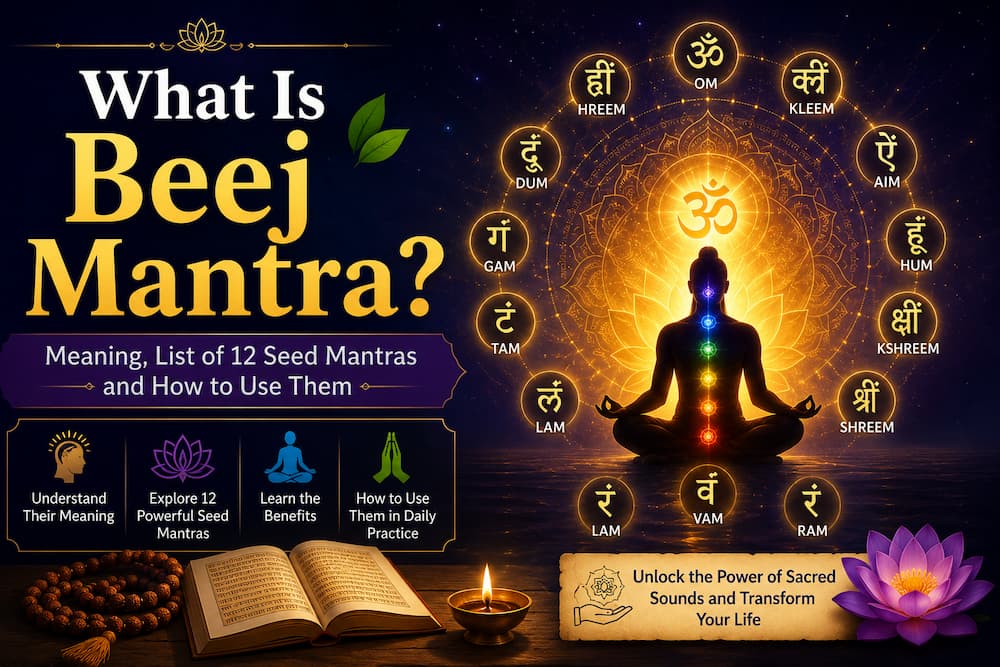
Om (universal), Shreem (Lakshmi), Hreem (Mahamaya), Kleem (Kamadeva/Krishna), Aim (Saraswati), Kreem (Kali), Doom (Durga), Gam (Ganesha), Hoom (Shiva), Streem (protection), Hroum (Shiva Mahakal), Gram (Jupiter/Guru).
Who This Article Is For
This article is for you if: you keep seeing syllables like Shreem, Hreem or Kleem in mantras and do not know what they mean | you want to understand why a single syllable carries more power than a full prayer | you want to know which beej mantra applies to your specific situation.
Also see: Lakshmi Mantra guide including Shreem beej and Durga Mantra guide including Doom and Kreem beej
If you have been chanting mantras and noticed short syllables like Shreem, Hreem or Kleem appearing at the beginning, you have already been using beej mantras without knowing it. This article explains what they are, why they work differently from longer mantras, and which beej mantra to use for your specific situation.
Here is what most explanations miss: a beej mantra is not an abbreviation of a longer prayer. It is the other way around. The beej is the original sound. The longer mantra is an expansion of the beej. The seed is not less than the tree. It is the tree in its most concentrated form.
What Is Beej Mantra: The Sanskrit Explanation
The word beej (or bija) means seed in Sanskrit. A beej mantra is defined by NKB Meditation citing Tantric and Vedic sources as: “A monosyllabic mantra believed to contain the essence of a given deity. It is considered the true name of the deity as well as a manifestation of the deity in sonic form.”
The tradition that produced beej mantras is primarily Tantric Hinduism, where they appear extensively in the Devi Bhagavata Purana, the Shiva Purana, and the Tantric texts collectively known as the Agamas. They are also found in Esoteric Buddhism, where they are called dharanis.
| Term | Meaning | Used for |
|---|---|---|
| Beej (Bija) | Seed in Sanskrit | The mantra itself |
| Beej mantra | Seed mantra: the compressed sonic form of a deity | Invocation, protection, healing, attraction |
| Mantra Drashta | The rishi who perceived the beej in meditation | Attribution: each beej has a classical seer |
| Devata | The presiding deity of the beej | Tells you which cosmic force the beej activates |
| Chandas | The poetic meter governing the beej | Determines the energetic rhythm of the sound |
| Bindu | The nasal sound at the end of most beej mantras | The dot above the final letter that seals the vibration |
Every beej mantra contains within it a Devata (deity), a Drashta (seer), a Chandas (meter) and a Shakti (the feminine energy activating the sound). These four components are what distinguish a beej mantra from an ordinary syllable. The syllable Shreem chanted with knowledge of its Devata, with proper pronunciation including the bindu, with a settled mind, for the prescribed count: that is the beej mantra.
Why a Single Syllable Carries More Power Than a Full Mantra
This is the question most articles avoid because the answer challenges the intuitive assumption that more words carry more power.
The Tantric tradition explains it through the concept of dhvani (sound essence) and artha (meaning). Longer mantras combine the sound and the meaning explicitly. Beej mantras operate at a level before meaning. They are pure sound without semantic content.
The Counterintuitive Logic of Beej Mantras
Meaning creates the interference of thought. When you chant “Om Namah Shivaya”, part of your mind is processing: Shiva, salutation, I bow. That processing, however subtle, creates a layer between the sound and the direct energetic effect.
A beej mantra like Hoom carries the complete Shiva energy but has no translatable meaning that the thinking mind can process. It bypasses thought entirely and resonates directly at the energetic level.
This is why advanced practitioners in the Tantric tradition use beej mantras rather than longer prayers for the deepest practices. Not because the longer mantras are inferior, but because the beej operates at a level of consciousness that precedes language.
The 12 Most Important Beej Mantras: Complete Reference
| Beej | Deity | Syllable meaning | Chakra | Use this when |
|---|---|---|---|---|
| Om (OM) ॐ |
Brahma, Vishnu, Shiva (Trimurti) | A = Brahma, U = Vishnu, M = Shiva. The three sounds of creation, preservation and dissolution united | Ajna (third eye) | Universal opener. Precedes every other mantra. Use alone for meditation, clarity and universal connection. |
| Shreem (SHREEM) श्रीं |
Mahalakshmi | Sha = Lakshmi, Ra = prosperity, Ee = contentment, Bindu = dispeller of sorrow | Manipura (solar plexus) | Attracting abundance, wealth, beauty and material prosperity. |
| Hreem (HREEM) ह्रीं |
Bhuvaneshwari / Mahamaya | Ha = Shiva, Ra = Prakriti, Ee = Mahamaya, Bindu = dispeller of sorrow | Anahata (heart) | Transformation, removal of illusion, invoking the divine feminine. |
| Kleem (KLEEM) क्लीं |
Kamadeva / Krishna | Ka = Kamadeva/Krishna, La = Indra, Ee = contentment, Bindu = perfection | Svadhisthana (sacral) | Attraction, love, fulfillment of desire, drawing positive people and opportunities. |
| Aim (AIM) ऐं |
Saraswati | Ai = Saraswati, Bindu = resolution and concentration | Vishuddha (throat) | Knowledge, learning, memory, speech, creativity. Use before study or intellectual work. |
| Kreem (KREEM) क्रीं |
Kali | Ka = Kali, Ra = Brahman, Ee = Mahamaya, Bindu = dispeller of sorrow | Muladhara (root) | Destruction of obstacles, removal of deep negative patterns. |
| Doom (DOOM) दुं |
Durga | Da = Durga, U = protection, Bindu = infinite | Manipura (solar plexus) | Protection, strength, removal of enemies and external threats. |
| Gam (GAM) गं |
Ganesha | Ga = Ganesha, Bindu = perfection of the sound | Muladhara (root) | Removal of obstacles before any new beginning. |
| Hoom (HOOM) हूं |
Shiva (fierce form) | The primal Shiva sound of protection and destruction of evil | Ajna (third eye) | Fierce protection, destruction of negative forces, purification. |
| Hroum (HROUM) ह्रौं |
Shiva (Mahakal form) | Shiva as the great destroyer of time and death | Sahasrara (crown) | Protection against untimely death, serious illness, extreme fear. |
| Streem (STREEM) स्त्रीं |
Tara (protective goddess) | The Tara beej of divine protection and rescue | Anahata (heart) | Rescue from danger, protection during travel or crisis. |
| Gram (GRAM) ग्रां |
Jupiter / Brihaspati | The Jupiter planetary beej for wisdom and divine grace | Sahasrara (crown) | Strengthening Jupiter in the birth chart, attracting wisdom and dharmic clarity. |
How to Chant a Beej Mantra Correctly
1. Pronunciation: The Bindu Is Not Optional
Every beej mantra ends with a bindu: the nasal resonance written as the dot above the final letter. In Shreem, the final M carries this nasal resonance: not a hard M like “mom” but a humming nasal resonance like the end of Om. This nasal resonance is what seals the vibration and completes the energetic circuit of the beej.
Chanting Shreem without the nasal bindu produces a different sound with a different vibrational signature. It is the difference between a seed with its outer coating intact and a seed with the coating removed. One germinates. The other does not.
2. Count: The Minimum Thresholds
| Purpose | Minimum count | Complete sadhana count |
|---|---|---|
| Daily maintenance practice | 11 repetitions | 108 repetitions (one mala) |
| Specific wish or intention | 108 repetitions daily | 1,008 total across multiple days |
| Serious obstacle or major goal | 108 repetitions daily | 10,000 or 100,000 (classical purashcharan) |
| Emergency or acute situation | 21 repetitions | Resume full count the next day |
3. State: Settled Mind Before the First Syllable
A beej mantra chanted with a restless mind produces a fraction of its effect. The tradition recommends three slow breaths before the first syllable. Not as a ritual. As a practical preparation: each breath lengthens the exhalation slightly, activating the parasympathetic nervous system and creating the settled internal state in which the beej resonates most deeply.
The Mala Rule for Beej Mantras
Use a mala with 108 beads. Hold it in the right hand with the beads resting on the middle finger. Move one bead per repetition using the thumb. Do not cross the sumeru (the large bead at the top of the mala): when you reach it, reverse direction.
For Lakshmi beej (Shreem): use Kamalgatta (lotus seed) or Sphatik (crystal) mala.
For Shiva beej (Hoom, Hroum): use Rudraksha mala.
For Saraswati beej (Aim): use white Sphatik or pearl mala.
For Durga or Kali beej (Doom, Kreem): use Rudraksha or red coral mala.
For Jupiter beej (Gram): use yellow Sphatik or Rudraksha mala.
Beej Mantra vs Full Mantra: When to Use Each
| Situation | Use beej mantra | Use full mantra |
|---|---|---|
| You are a beginner | No. Start with a full mantra that has clear meaning and context | Yes. The meaning helps anchor the mind and build devotion |
| You are in an acute crisis | Yes. A beej like Gam or Hoom can be chanted anywhere, anytime, without setup | Helpful if time permits, but beej is faster to deploy |
| You are building a 40-day sadhana | Yes, as the primary count. Beej mantras are ideal for sustained practice | Yes, as a supplement before or after the beej count |
| You want to understand what you are chanting | No. Understand the beej’s deity and purpose first | Yes. Full mantras are more transparent in meaning |
| You are an advanced practitioner | Yes. The Tantric tradition uses beej mantras as the primary vehicle for advanced practice | Use full mantras for devotional contexts and worship |
From Our Practice
From Our Practice
The first time I sat with just Shreem for 40 days, I expected to find it boring. One syllable. How much can one syllable hold?
By Day 10 I had the answer: more than I could contain. The syllable was not getting simpler. It was getting deeper. Each sitting, the sound seemed to expand inward rather than outward. By Day 25, I stopped trying to understand what was happening and simply chanted.
What I know from that practice: a beej mantra is not less than a full mantra in the way that a key is not less than a door. The key is not the point. What the key opens is the point. Shreem alone, chanted for 108 repetitions daily over 40 days, opens something. I cannot tell you what it will open for you. I can tell you it will not be nothing.
Frequently Asked Questions
❓ Can I chant a beej mantra without knowing its full meaning?
Yes, with one qualification: you should know the deity the beej represents and the general intention you are chanting for. Chanting Shreem with the knowledge that it invokes Lakshmi for abundance produces a qualitatively different result than chanting it as a sound you read online without any context.
❓ I have been told not to chant certain beej mantras without initiation. Is that true?
Partially true. The publicly available beej mantras in this article (Om, Shreem, Hreem, Kleem, Aim, Gam, Gram) are widely used without formal initiation. The more intense Tantric beej mantras used in Mahavidya sadhana are traditionally given by a guru with specific guidance. This is a practical caution, not a prohibition.
❓ Can I chant multiple beej mantras together?
Yes. Many traditional mantras combine multiple beej mantras. The Navarna Mantra (Om Aim Hreem Kleem Chamundaye Vichche) contains three beej mantras in sequence: Aim (Saraswati), Hreem (Mahamaya) and Kleem (Kali). Combining beej mantras in this way is the foundation of most complex Tantric mantras.
❓ Which beej mantra should I chant for money problems?
Shreem (Lakshmi beej) is the primary beej for material abundance. Chant Om Shreem Mahalakshmiyei Namaha 108 times daily on Fridays. If the money problem involves repeated financial loss rather than simple absence of wealth, also include the Durbhagya Nashak Mantra practice first to address the underlying misfortune.
❓ What is the difference between Om and other beej mantras?
Om is the primary beej, the source from which all other beej mantras arise. The Chandogya Upanishad describes Om as the essence of all essences. It corresponds to no single deity but to the totality of existence: A (Brahma/creation), U (Vishnu/preservation), M (Shiva/dissolution), plus the silence after the M which represents turiya, the fourth state beyond the three.
❓ Is Gam the correct Ganesha beej or is it Glam?
Both are used. Gam is the standard Ganesha beej in most mainstream Vedic and Tantric traditions, found in the Ganapati Atharvashirsha Upanishad. Glaum is used in specific Tantric lineages. For daily practice without a Tantric initiation, Gam is the correct and widely accepted form.
Begin With One Beej
Do not try all twelve. That is the most common mistake when people discover beej mantras: they want to chant all of them at once, addressing all deities simultaneously.
Choose one. Choose it based on your most pressing need right now, using the table in this article. Begin with 11 repetitions tomorrow morning if 108 feels like too large a commitment. Say the syllable slowly. Hear the nasal resonance at the end. Let it settle.
A seed planted in one place grows a tree. A seed scattered in twelve directions produces nothing.
Sources and Citations
- Beej Mantra: Meaning, Significance, Benefits and Hindu Gods. NKB Meditation. Definition citing Tantric Hinduism and Esoteric Buddhism sources
- Meaning of Beej Mantra: Complete List. Temple Purohit. Individual syllable breakdown for Hreem, Shreem, Kleem and Aim
- Beej Mantras: Complete Guide to Seed Mantras. ShreeKundli. Chakra associations and benefits for each major beej mantra
- Kleem Mantra: Meaning, Benefits and Attraction Secrets. YantraChants. Syllable-level breakdown of Kleem citing classical Shastras
Narendra Kumar Chaubey is a Jyotisha Acharya with over 30 years of experience, based in Bihar and serving clients across India in Vedic astrology, mantra shastra, Vastu and ritual practice.
He completed his formal training at Kameshwar Singh Darbhanga Sanskrit University (KSDSU), one of India’s oldest and most respected institutions for Vedic and Sanskrit scholarship, where he studied Jyotisha shastra, mantra vidya and related classical sciences. KSDSU’s tradition of rigorous Sanskrit education tracing directly to the Mithila region’s centuries-old pandit lineage forms the foundation of his practice.
Over three decades, Narendra Kumar Chaubey has worked with thousands of individuals and families across Bihar and across India, offering guidance in:
- Kundli (birth chart) analysis: Identifying karmic patterns, planetary periods and life path guidance through classical Jyotisha
- Palmistry (Hasta Samudrika): Reading the hand according to the classical Samudrika Shastra tradition
- Vastu Shastra: Assessment and correction of living and working spaces according to directional and elemental principles
- Mantra and Pooja vidhi: Performing and guiding all categories of puja, havan, and mantra sadhana for personal, family and business situations
- Predictive Jyotisha: Transit analysis, muhurta (auspicious timing) selection and remedial guidance
He works across four languages Sanskrit, Hindi, English and Bhojpuri making classical knowledge accessible to practitioners across educational backgrounds and regions.
His writing for ABMantra brings the precision of classical Vedic training to practical mantra guidance: not general advice but specific prescriptions grounded in shastra, lineage and 30 years of direct practice with real situations.
For more info follow on: