
Quick Answer
The Durbhagya Nashak Mantra is:
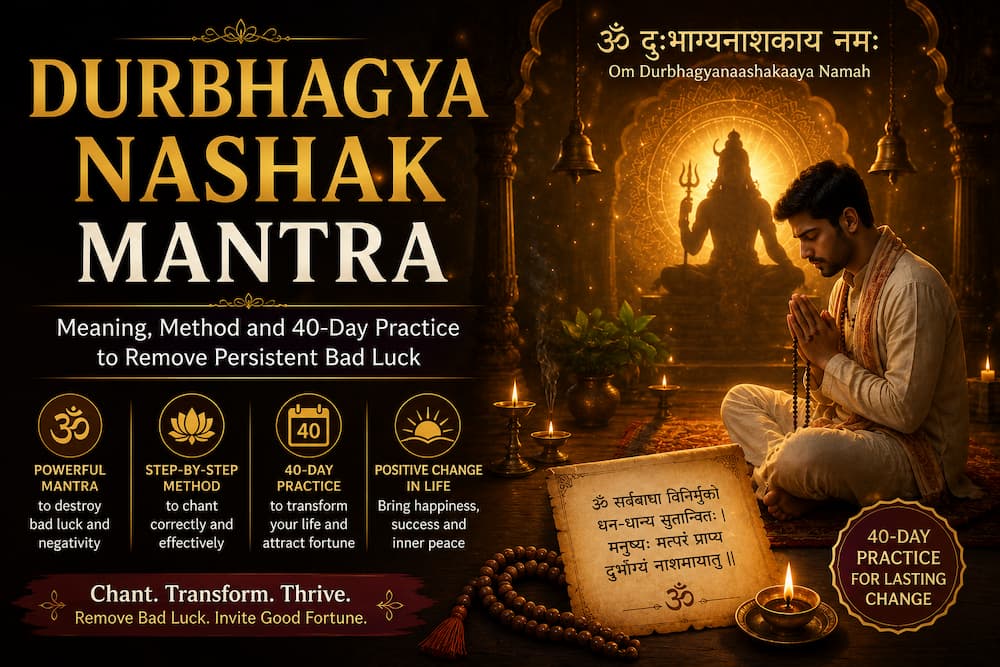
Om Hreem Shreem Kleem Durgati Nashinayei Mahamayayei Swaha
ॐ ह्रीं श्रीं क्लीं दुर्गति नाशिन्यै महामायायै स्वाहा
Chant this 108 times daily for 40 continuous days, starting on a Tuesday. It invokes Goddess Durga in her Durgati Nashini form : the destroyer of misfortune : and is sourced from the Devi Mahatmya tradition within the Markandeya Purana.
Who This Article Is For
This article is for you if: bad luck has followed you for months or years with no clear reason | financial losses keep repeating despite your efforts | you have tried other remedies without results | you want the correct Sanskrit text, method, and realistic expectations.
This article is NOT for you if: you are looking for a quick fix or a single chant that works overnight.
If the same kind of bad luck has hit you more than twice : financial loss, a relationship falling apart, a job that should have worked out : you are not imagining a pattern. Persistent durbhagya (misfortune) that repeats across different areas of life is what this mantra specifically addresses. Not ordinary difficulty. The kind that follows you.
This guide gives you the correct mantra, its verified Sanskrit source, the exact 40-day method, and an honest answer to how long this actually takes.
What Does Durbhagya Nashak Mean?
The term breaks into three Sanskrit words. Dur means bad or inauspicious. Bhagya means fate or fortune. Nashak means destroyer or remover. Together: the destroyer of bad fate.
In the Vedic tradition, durbhagya is not simply bad luck in the Western sense. It refers to a persistent condition of misalignment : where a person’s efforts consistently produce results opposite to what was intended. The scriptures trace this to either past karma, the influence of Alakshmi (the goddess of misfortune, elder sister of Lakshmi), or the weakening of one’s protective spiritual field over time.
The Durbhagya Nashak Mantra works by invoking Goddess Durga in her specific form as Durgati Nashini : she who destroys durgati, meaning the condition of going in the wrong direction. This is one of her 108 names listed in the Devi Mahatmya, the central text of the Shakta tradition within the Markandeya Purana (Chapters 81 to 93).
The Durbhagya Nashak Mantra: Full Sanskrit Text and Meaning
The Mantra
Devanagari:
ॐ ह्रीं श्रीं क्लीं दुर्गति नाशिन्यै महामायायै स्वाहा
Transliteration:
Om Hreem Shreem Kleem Durgati Nashinayei Mahamayayei Swaha
Word-by-Word Meaning
| Word | Meaning |
|---|---|
| Om (ॐ) | The primordial sound. The universal invocation that opens the channel to divine energy. |
| Hreem (ह्रीं) | Shakti beej mantra. Invokes the cosmic energy of the Divine Mother and removes illusions. |
| Shreem (श्रीं) | Lakshmi beej mantra. Attracts auspiciousness and abundance to replace misfortune. |
| Kleem (क्लीं) | Attraction beej mantra. Draws positive energy and fulfillment toward the practitioner. |
| Durgati Nashinayei | To the one who destroys durgati (misfortune, going in the wrong direction). |
| Mahamayayei | To Mahamaya: the great cosmic illusion, Durga’s form that controls fate itself. |
| Swaha | Sacred offering. Seals the mantra, dedicating the vibration to the deity. |
Three beej (seed) mantras in sequence : Hreem, Shreem, Kleem : is unusual and intentional. Hreem removes the illusion that keeps misfortune in place. Shreem replaces it with auspiciousness. Kleem draws that auspiciousness toward you. The mantra is not just asking Durga to remove bad luck. It is actively creating the conditions for the opposite to enter.
Durbhagya Nashak vs Durwakshat: What Is the Difference?
Most articles online confuse these two. They are distinct mantras with different origins, different purposes, and different methods.
| Feature | Durbhagya Nashak Mantra | Durwakshat Mantra |
|---|---|---|
| Origin | Devi Mahatmya, Markandeya Purana | Shukla Yajurveda, Mithila tradition |
| Deity | Goddess Durga (Durgati Nashini form) | General Vedic blessing invocation |
| Purpose | Remove persistent bad luck and financial misfortune | Bless auspicious occasions (marriage, upanayana) |
| Who chants | Individual practitioner, solo practice | Minimum 5 married elder Brahmin priests |
| Method | 108 times daily, 40-day continuous practice | Ritual occasion only, not personal daily practice |
| Best for | Repeating financial loss, career blocks, persistent ill luck | Blessings at life ceremonies and rituals |
The Correct 40-Day Method: Step by Step
The 40-day sadhana is the standard practice for this mantra. Shorter periods are insufficient for persistent durbhagya.
What You Need
- A Rudraksha mala (preferred) or any mala with 108 beads
- A clean puja space: even a small corner with a cloth and a lamp is sufficient
- An image or idol of Goddess Durga (or Durgati Nashini specifically)
- Incense, a ghee lamp, and red flowers if available
Daily Practice Sequence
- Start on a Tuesday. This is non-negotiable. Tuesday is the day of Mars, whose energy aligns with Durga’s warrior aspect and breaks negative planetary patterns.
- Wake before sunrise if possible, or practise in the early morning after bathing.
- Sit facing south. Durgati Nashini mantras are traditionally directed south : the direction of Yama (the deity of fate) whose influence over karmic patterns the mantra is meant to override.
- Light the ghee lamp and incense. Place red flowers at Durga’s image.
- Hold your mala in your right hand. Close your eyes. Take three slow breaths.
- Chant Om Hreem Shreem Kleem Durgati Nashinayei Mahamayayei Swaha : 108 times. Move one bead per repetition. Do not hurry. Each word should be audible, even in a whisper.
- After completing 108 repetitions, sit quietly for 5 minutes. Do not immediately stand up or check your phone. This rest period is when the mantra settles.
- Repeat every day for 40 days without a single break. Missing even one day requires starting from Day 1.
Important Rules During the 40-Day Period
Avoid meat and alcohol: tamasic food weakens the protective field the mantra is building.
Do not share that you are doing this practice: disclosing an ongoing sadhana disperses its energy.
Women may continue this practice during menstruation: Durga has no such restriction in Shakta tradition.
If you miss a day for any reason, restart from Day 1 on the next Tuesday.
From Our Practice
A student who came to me after three consecutive years of financial setbacks : a failed business, a job loss, and a medical expense that wiped out savings : began this sadhana on the first Tuesday of Navratri. By day 21 she described not a dramatic change but a quieting of the feeling that something was actively working against her. By day 40 she had received an unexpected job offer.
I share this not as proof but as context for what the 40-day commitment is actually designed to do: it does not create luck. It removes the obstruction that has been blocking what was already yours.
How Long Before This Mantra Works?
This is the most common question and the one that most articles answer dishonestly.
The 40-day practice addresses karmic and energetic patterns. These do not shift overnight. Most practitioners report a noticeable change in their internal state : specifically a reduction in anxiety, a feeling of being less opposed : around Day 21. External changes in circumstances typically begin to appear between Day 30 and Day 60 after the sadhana ends.
If you have experienced durbhagya for multiple years, one 40-day cycle may not be sufficient. The traditional guidance is three complete 40-day cycles, each beginning on a Tuesday, with a gap of at least one full lunar cycle between them.
The single most reliable indicator that the mantra is working is not external events. It is a shift in how you respond to difficulty. When the same type of setback that previously felt catastrophic begins to feel manageable, the Durgati Nashini energy is active.
Who Should Chant This Mantra
This mantra is appropriate for anyone experiencing:
- Financial losses that repeat despite genuine effort and correct decisions
- Career setbacks at the point of success: interviews that go well but produce no offer, opportunities that disappear at the last moment
- Relationship difficulties that follow the same pattern across different people
- Health problems that return after recovery
- A general sense that your efforts produce significantly less than they should
It is not intended for general wish-fulfillment or as a replacement for practical action. The mantra removes the obstruction. You still have to walk through the door.
The Scriptural Source: Why This Mantra Works
The Durgati Nashini form of the goddess appears in the Devi Mahatmya (Chapters 81 to 93 of the Markandeya Purana, composed approximately 5th to 6th century CE). In the text, when the gods ask Durga to describe her own power, she states that she will appear in times of durgati : misfortune : to remove it from her devotees. This is not a later addition. It is a central promise within the text itself.
The Alakshmi Nashana tradition : the ritual removal of Alakshmi, the goddess of misfortune who is the elder sister of Lakshmi : is referenced in the Shri Suktam (Rigveda tradition) and the Padma Purana. The Durbhagya Nashak Mantra functions within this same tradition: where Lakshmi represents fortune, Alakshmi represents persistent misfortune. The mantra invokes Durga specifically to remove Alakshmi’s influence from the practitioner’s life.
Frequently Asked Questions
❓ I have been having bad luck for 3 years. Will one 40-day cycle be enough?
Three consecutive years of misfortune suggests deep-seated karmic obstruction. One cycle will likely produce a shift but not a complete resolution. Plan for three 40-day sadhanas, each starting on a Tuesday, with a gap of one full lunar month between them. Track what changes after each cycle rather than waiting for a final result.
❓ Can I chant this mantra if I do not have a Rudraksha mala?
Yes. A Rudraksha mala amplifies Saturn and Durga-related mantras because Rudraksha beads have a natural electromagnetic property verified in a 2006 study in the International Journal of Yoga. But the mantra is fully effective with any 108-bead mala. The consistency of the 40-day practice matters far more than the material of the mala.
❓ Is this the same as the Durwakshat Mantra I have seen mentioned online?
No. The Durwakshat Mantra is a Vedic blessing chant from the Mithila region of Bihar, chanted by minimum five married male Brahmins at auspicious ceremonies. It is not a personal practice mantra and not designed for removing persistent bad luck. The Durbhagya Nashak Mantra is a solo, daily practice derived from the Shakta Tantra tradition via the Devi Mahatmya.
❓ My financial situation is very bad right now. Can I chant more than 108 times to speed up the result?
108 is the prescribed count. Chanting more does not accelerate the result and can create agitation rather than resolution. If you want to deepen the practice, add the Durga Saptashloki : seven specific verses from the Devi Mahatmya : before your 108 repetitions. This is the traditional method for intensifying the sadhana without simply increasing the count.
❓ I missed Day 18 of my 40-day practice. Do I really have to restart?
Yes. The 40-day continuity is structural, not superstitious. The mantra works by gradually overwriting a persistent energetic pattern. A break resets the accumulated effect. Restart on the next available Tuesday. The days you completed were not wasted : they established a foundation. The second attempt will move faster.
❓ Which day of the week is best to start if not Tuesday?
Tuesday is the correct day to start. There is no acceptable substitute for the starting day. You can begin chanting at any time on Tuesday: morning is ideal, but evening is valid. If the next Tuesday is two weeks away, use that time to prepare your puja space, obtain your mala, and study the correct pronunciation of the Sanskrit text.
Begin the Practice
The next Tuesday available to you is your starting day. Before that day, write down the specific form of bad luck you are addressing. Be precise, not general. Not “my life is hard” but “I have lost employment three times in 18 months despite strong interviews.” Clarity of intention is part of what this sadhana requires.
On that Tuesday morning, light your lamp, hold your mala, and chant the mantra 108 times. Return the next morning. Return the morning after that. Continue for 40 mornings without exception.
That is what Goddess Durga asks of you in this practice. And that is everything she asks.
Sources and Citations
- Durwakshat Mantra. Wikipedia, sourced from Shukla Yajurveda, Mithila Vedic tradition
- Devi Mahatmya (Durga Saptashati). Markandeya Purana, Chapters 81 to 93. Origin of Durgati Nashak deity and mantra
- Alakshmi Nashana tradition. Padma Purana and Shri Suktam, Rigvedic tradition
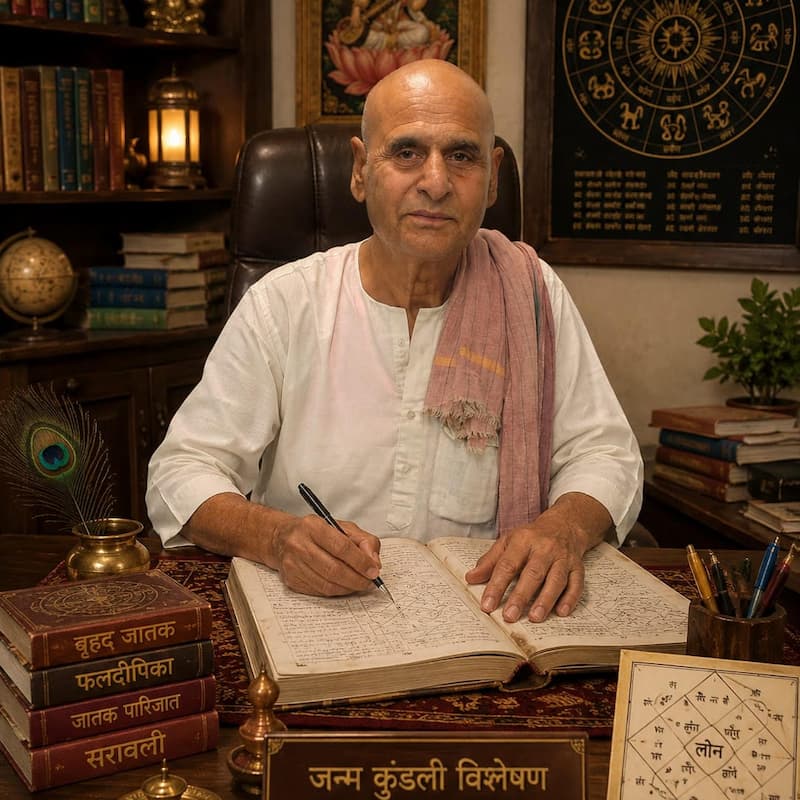
Narendra Kumar Chaubey is a Jyotisha Acharya with over 30 years of experience, based in Bihar and serving clients across India in Vedic astrology, mantra shastra, Vastu and ritual practice.
He completed his formal training at Kameshwar Singh Darbhanga Sanskrit University (KSDSU), one of India’s oldest and most respected institutions for Vedic and Sanskrit scholarship, where he studied Jyotisha shastra, mantra vidya and related classical sciences. KSDSU’s tradition of rigorous Sanskrit education tracing directly to the Mithila region’s centuries-old pandit lineage forms the foundation of his practice.
Over three decades, Narendra Kumar Chaubey has worked with thousands of individuals and families across Bihar and across India, offering guidance in:
- Kundli (birth chart) analysis: Identifying karmic patterns, planetary periods and life path guidance through classical Jyotisha
- Palmistry (Hasta Samudrika): Reading the hand according to the classical Samudrika Shastra tradition
- Vastu Shastra: Assessment and correction of living and working spaces according to directional and elemental principles
- Mantra and Pooja vidhi: Performing and guiding all categories of puja, havan, and mantra sadhana for personal, family and business situations
- Predictive Jyotisha: Transit analysis, muhurta (auspicious timing) selection and remedial guidance
He works across four languages Sanskrit, Hindi, English and Bhojpuri making classical knowledge accessible to practitioners across educational backgrounds and regions.
His writing for ABMantra brings the precision of classical Vedic training to practical mantra guidance: not general advice but specific prescriptions grounded in shastra, lineage and 30 years of direct practice with real situations.
For more info follow on: