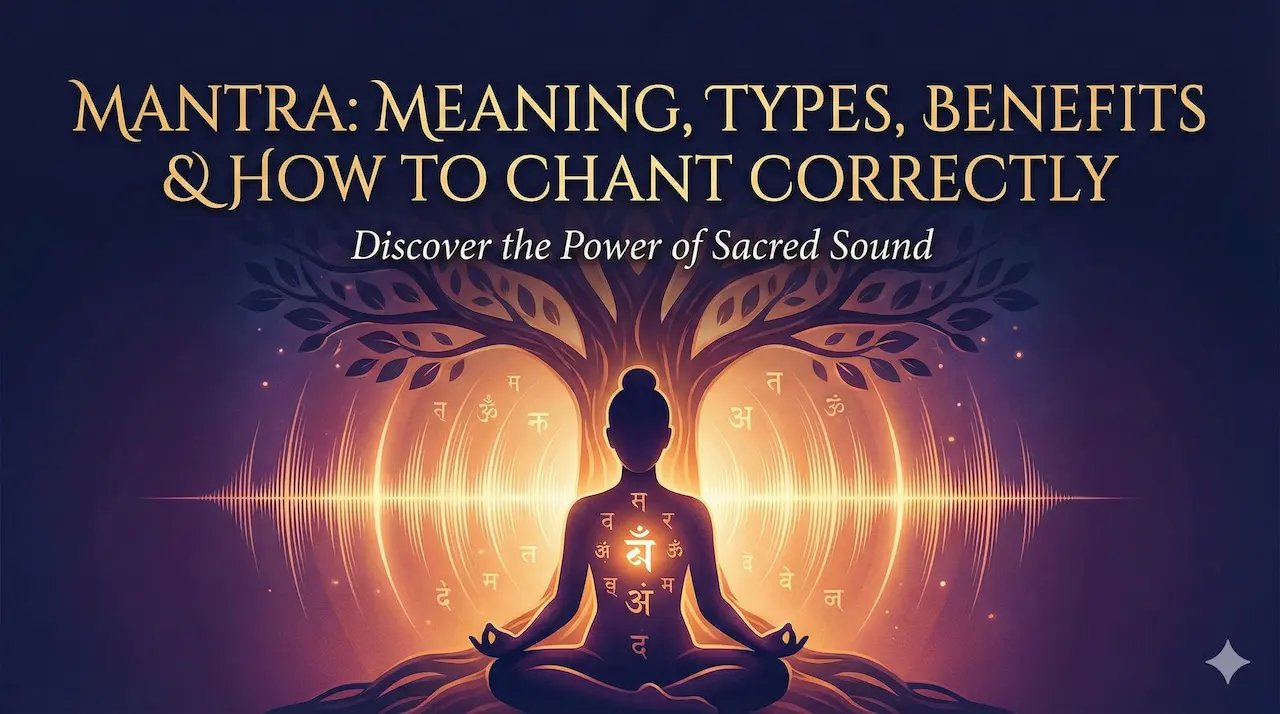

A mantra is a sacred Sanskrit sound, syllable, word or verse used in Hindu, Buddhist and Vedic traditions as a tool for mental focus, spiritual practice and inner transformation. The word itself tells you exactly what it does: Man means mind, Tra means to deliver or protect. A mantra is literally “an instrument that protects and frees the mind.”
But the mantra meaning goes far beyond this simple etymology. In the Vedic tradition, mantras are not merely words; they are vibrational frequencies encoded in Sanskrit sound. Each mantra carries a specific energy. The Gayatri Mantra invokes divine light and clarity of intellect. The Mahamrityunjaya Mantra invokes Shiva’s healing and liberation. Om Namah Shivaya is a call to Shiva’s qualities of dissolution and renewal. Each one does something specific, and that specificity is what makes mantra practice so powerful.
This complete guide to mantra meaning, types and benefits covers everything you need, whether you are encountering mantra for the first time or deepening an existing practice. It includes the Sanskrit and transliteration for the most important mantras, a full breakdown of all the major types, the science behind why mantra chanting works, the benefits by category, a step-by-step chanting guide and answers to the most common questions.
Explore specific mantra guides on abmantra.com:
Mantra Meaning: What Does the Word Really Mean?
The word mantra comes from the Sanskrit root words Man (mind, thought, consciousness) and Tra (to deliver, to protect, an instrument). A mantra is therefore an instrument that protects and delivers the mind from its ordinary agitated state into a state of focused stillness.
This definition is precise and deliberate. The mind’s natural state in ordinary waking life is what Vedic texts call vikshepa: distraction, agitation, the endless movement from thought to thought. A mantra gives the mind a specific, potent point of focus. By returning to the same sound again and again, the mind’s habitual movement toward distraction is interrupted and gradually replaced with a different quality of attention.
In the Vedic tradition, mantras are also understood as Shabda Brahman, meaning sound as divine reality. The Vedas are considered Apaurusheya (not of human origin), directly perceived by the ancient Rishis in deep states of meditation and transmitted as pure sound. This is why pronunciation and correct vibration matter so much in classical mantra practice: the sound itself is considered the primary vehicle of the mantra’s power, not merely the meaning of the words.
Source: The Vedas, specifically the Rigveda and Atharvaveda, which are the oldest recorded mantra collections. Mantra as Shabda Brahman is discussed extensively in the Mimamsa school of Vedic philosophy.
In everyday modern usage, “mantra” has also come to mean any guiding phrase or principle a person lives by (“my mantra is to stay positive”). This usage borrows the core idea: a repeated thought that shapes consciousness, while losing the precision and vibrational power of the original Vedic meaning.
The Science Behind Mantra Chanting: What Research Shows
For centuries, the Rishis and yogis of India described mantra practice as a technology for transforming consciousness. Today, modern neuroscience and clinical research have begun to provide a biological explanation for what practitioners have reported for thousands of years.
Mantra and the Default Mode Network
Neuroscientists have identified a brain network called the Default Mode Network (DMN), the collection of brain regions that activate when the mind is wandering, worrying, replaying past events or anticipating future threats. An overactive DMN is associated with anxiety, depression and rumination. MRI studies have shown that focusing on a mantra during meditation significantly quiets the DMN, shifting brain activity from the wandering, worrying mode to a focused, present-moment mode.
Source: Brewer JA et al., “Meditation experience is associated with differences in default mode network activity and connectivity.” Proceedings of the National Academy of Sciences, 2011.
The Om Vibration and the Vagus Nerve
Research published in the International Journal of Yoga found that chanting Om, specifically the extended nasal resonance of the “mmmm” sound, stimulates the Vagus Nerve, the long cranial nerve that connects the brain to the heart, lungs and digestive system. Vagal stimulation activates the parasympathetic nervous system (the “rest and digest” state), lowering heart rate, reducing cortisol levels and shifting the body away from the stress response.
Source: Krishnakumar D et al., “Meditation and Yoga can Modulate Brain Mechanisms that affect Behavior and Anxiety.” Ancient Science, 2015. Also: Harne BP, “Broadband EEG analysis during Om chant meditation.” J Med Imaging Health Inform, 2019.
Sanskrit Pronunciation and Brain Activation
A 2015 study by researchers at the National Brain Research Centre in India found that recitation of Sanskrit mantras activated brain regions associated with attention, spatial cognition and self-awareness more intensely than recitation of matched control texts in other languages. The structured phonological patterns of Sanskrit (its precise consonant clusters and vowel lengths) appear to recruit specific neural pathways in ways that ordinary language does not.
Source: Telles S et al., “Brain electrical oscillations in practitioners of a traditional oral form of learning.” Scientific Reports, 2015.
Types of Mantra: A Complete Classification
Not all mantras work the same way or serve the same purpose. The Vedic and Tantric traditions classify mantras into several distinct categories based on their form, their deity association, their purpose and their level of complexity. Understanding the types of mantra helps you choose the right practice for your situation and stage of development.
1. Vedic Mantras
The oldest category, drawn directly from the four Vedas (Rigveda, Samaveda, Yajurveda, Atharvaveda). These are the most structurally complex mantras, with specific pitch patterns (svaras) that are considered essential to their effect.
They are traditionally taught through the Guru-Shishya (teacher-student) lineage and require correct pronunciation.
Example: Gayatri Mantra, Purusha Sukta
2. Saguna Mantras
Saguna means “with form.” These mantras invoke a specific deity: Shiva, Vishnu, Rama, Krishna, Durga, Hanuman, Lakshmi, Saraswati; these are the most widely practised category in contemporary Hindu devotion.
Best for: those who connect more easily with a personal deity than an abstract concept.
Example: Om Namah Shivaya, Om Namo Bhagavate Vasudevaya
3. Nirguna Mantras
Nirguna means “without form.” These mantras meditate on the universal, formless absolute: pure consciousness, the self, the infinite. Associated with the Advaita Vedanta tradition.
Best for: those drawn to meditation on consciousness itself rather than a personal deity.
Example: So Hum, Aham Brahmasmi, Om Tat Sat
4. Beej Mantras (Seed Mantras)
Beej means seed. These are single-syllable sounds that carry the concentrated essence of a deity or cosmic force. They are used both independently and as seed sounds embedded within longer mantras.
Each deity has a primary beej: Om for Brahman, Hrim for Shakti, Klim for Krishna, Shrim for Lakshmi, Aim for Saraswati, Hum for Shiva, Ham for Hanuman.
Example: Om, Hrim, Shrim, Aim, Klim
5. Tantric Mantras
Drawn from the Tantric texts rather than the Vedas. Often combine beej sounds in specific sequences and may be directed toward specific outcomes: protection, healing, obstacle removal or the activation of particular energies.
Traditionally require initiation (diksha) from a qualified Guru for the most potent forms, though some are freely available.
Example: Om Aim Hrim Klim Chamundaye Viche
6. Dhyana Mantras
Meditation verses used to establish the form and qualities of a deity in the mind before puja or contemplative practice. They describe the deity’s appearance, attributes and cosmic significance in precise poetic Sanskrit.
Used at the opening of puja, before mantra japa and as a complete meditation in themselves.
Example: Hanuman Dhyana Shloka (Manojavam Marutatulyavegam…)
7. Stotra and Chalisa
Devotional hymns: longer compositions of multiple verses that praise a deity’s qualities and deeds. A stotra recited with understanding and feeling is as powerful as japa for many practitioners.
The Hanuman Chalisa (40 verses by Tulsidas) is the world’s most widely chanted stotra, recited daily by an estimated 50 million people.
Example: Hanuman Chalisa, Shiva Tandava Stotram
8. Navagraha Mantras
A specialised category of mantras associated with the nine planetary forces (Navagraha) of Vedic astrology (Jyotish): Sun, Moon, Mars, Mercury, Jupiter, Venus, Saturn, Rahu and Ketu.
Used in Jyotish remedial practice to balance the influence of specific planets in the birth chart.
Example: Om Suryaya Namah, Om Shanaischaraya Namah
The Most Important Mantras: Sanskrit, Meaning and Purpose
Here are the most widely practised mantras across the Vedic and Hindu tradition, with their complete Sanskrit text, Roman transliteration and meaning. Understanding a mantra’s meaning transforms the practice from mechanical repetition into genuine meditation.
1. Om (Pranava Mantra)
Purpose: The foundation of all mantra practice. Chanted alone as a complete meditation, or as the opening sound of nearly every other mantra. Three to five minutes of Om chanting at the start of any practice settles the nervous system and prepares the mind for deeper meditation.
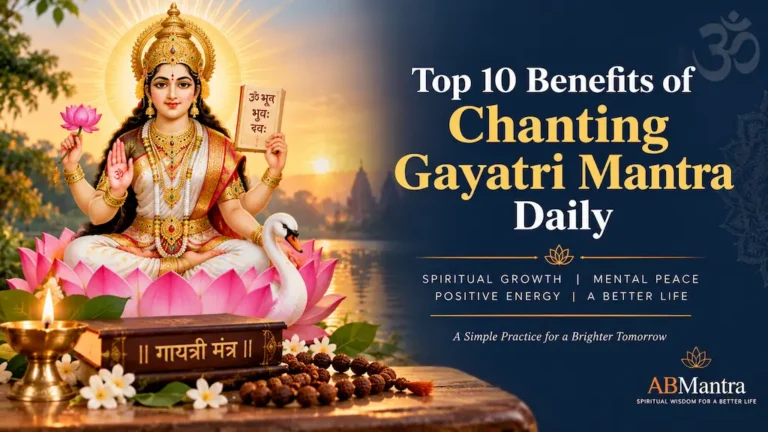
2. Gayatri Mantra
Purpose: The most sacred mantra in the Vedic tradition, drawn from the Rigveda (3.62.10). Traditionally chanted at sunrise. It is not a prayer for material things. It is a request for the highest gift: a clear, illuminated mind that can perceive truth. Best chanted 3, 11 or 108 times at dawn facing east.
3. Mahamrityunjaya Mantra
Purpose: The most powerful healing and protection mantra in the Vedic tradition, drawn from the Rigveda and Yajurveda. Chanted for serious illness, before surgery, when facing fear or danger, and as a daily protection mantra. The image of the ripe cucumber teaches the principle of non-clinging: liberation comes not through force but through ripeness.
4. Om Namah Shivaya (Panchakshara Mantra)
Purpose: One of the most accessible and powerful mantras for daily practice. Suitable for all practitioners regardless of spiritual background. Chanted 108 times daily, it builds Shiva’s qualities of inner stillness, equanimity and freedom from attachment. Among the most widely chanted mantras in the world.
5. So Hum (Breath Mantra)
Purpose: A breath-synchronised mantra used in pranayama and silent meditation. Because it aligns with the natural rhythm of breathing, it is exceptionally effective for calming the nervous system and for anyone new to mantra practice. The Vigyan Bhairav Tantra describes So Hum as one of the 112 paths to liberation.
Mantra Benefits: What Regular Practice Actually Does
The benefits of mantra practice are documented across three complementary sources: classical Vedic and Tantric texts that describe the effects of specific mantras; clinical research from the last three decades on meditation and sound practices; and the lived experience of millions of practitioners across thousands of years. The table below draws from all three.
| Benefit Area | What Happens | Classical and Scientific Context |
|---|---|---|
| Mental stillness and reduction of anxiety | The mind’s habitual movement toward worry and distraction slows. A clear, quiet awareness becomes more accessible over time. | DMN quieting confirmed by MRI studies. Vedic texts describe this as moving from Rajas (agitation) to Sattva (clarity) through consistent practice. |
| Stress and cortisol reduction | Physical stress markers including heart rate, cortisol levels and blood pressure measurably decrease after sustained mantra practice. | Vagus nerve stimulation from Om chanting activates the parasympathetic nervous system. Multiple clinical studies confirm cortisol reduction in regular meditators. |
| Improved focus and concentration | The capacity to hold attention on a single object for sustained periods strengthens with regular japa practice, and transfers to work, study and relationships. | Mantra japa is essentially attention training. Patanjali’s Yoga Sutras describe this as Dharana (concentration) progressing toward Dhyana (meditation). |
| Emotional regulation and resilience | Practitioners report a growing capacity to observe strong emotions without being overwhelmed by them; what the Gita calls Sthitaprajna (stable wisdom). | Increased activity in the prefrontal cortex (associated with emotional regulation) observed in long-term meditators in multiple neuroimaging studies. |
| Spiritual connection and devotion | Regular practice of Saguna mantras deepens the practitioner’s sense of personal connection with the deity invoked, what the Bhakti tradition calls Bhava (devotional feeling). | Described extensively in Narada Bhakti Sutras and the Bhagavata Purana as the progressive deepening of Bhakti through Smarana (remembrance) and Kirtan (chanting). |
| Jyotish (astrological) remedies | Specific mantras are prescribed as remedies for planetary afflictions in the Vedic birth chart, particularly for Saturn (Hanuman Mantra), Mars (Mangal Mantra) and Rahu/Ketu (Durga or Hanuman mantras). | Classical Jyotish texts including Brihat Parashara Hora Shastra and various Navagraha Stotra texts prescribe specific mantra remedies for each planetary period (Dasha) and transit. |
| Physical health and immunity | Regular mantra practice is associated with improvements in immune function, sleep quality and reduction in inflammatory markers, mediated primarily through stress reduction. | Meta-analyses of mindfulness-based interventions (which share key features with mantra practice) show consistent effects on immune function and inflammatory biomarkers. |
Primary sources: Patanjali’s Yoga Sutras (on concentration and meditation), Narada Bhakti Sutras (on devotional practice), Brihat Parashara Hora Shastra (on Jyotish remedies), and clinical research cited in the Science section above.
How to Chant Mantra Correctly: Complete Method for Beginners
The single most important thing about mantra chanting is this: begin. Every other refinement (posture, timing, mala beads, pronunciation) is secondary to the act of starting and continuing consistently. That said, following the correct method significantly deepens the practice.
What You Need
- A clean, quiet space: a corner of any room is sufficient
- A Rudraksha or Tulsi mala (108 beads) for counting repetitions
- A ghee diya and agarbatti if practising deity-specific mantras (optional for beginners)
- 15 to 20 minutes of uninterrupted time
Step-by-Step Chanting Method
- Choose one mantra and commit to it for a minimum of 40 days. Do not switch mantras during an active practice. The depth of a single mantra practised consistently far exceeds the breadth of many mantras sampled briefly.
- Set a fixed time: sunrise (Brahma Muhurta, 4:35 to 5:23 AM) is traditionally the most powerful time for mantra practice. If sunrise is not possible, choose any fixed daily time and keep it consistent.
- Sit with your spine straight: either cross-legged on the floor or on a chair with feet flat. An upright spine keeps you alert. Do not lie down.
- Take three slow, deep breaths before beginning. Let each exhale be complete. This settles the nervous system and marks the transition from ordinary activity to practice.
- Hold the mala in your right hand, with the index finger extended and not touching the beads. Use the thumb and middle finger to move one bead per mantra repetition. Begin from the bead next to the large central bead (Meru). Do not cross the Meru; when you reach it, turn the mala and go back.
- Chant clearly and steadily: neither too fast nor too slow. Each syllable should be distinct. For deity mantras, visualise the deity as you chant. For formless mantras, simply observe the sound.
- When the mind wanders (and it will), bring it gently back to the mantra without frustration. The act of returning is itself the practice, and it is the equivalent of a repetition in the gym. Each return strengthens the capacity for focus.
- Close with silence: after completing the full count, sit in silence for two to three minutes. Do not immediately return to activity. Let the vibration settle.
From our practice: The most consistent observation among practitioners who report genuine results from mantra practice is not about which mantra they chose or how perfect their pronunciation was. It is that they did it every single day. A mantra chanted sincerely for five minutes every morning for 40 consecutive days produces more visible change than an hour-long session once a week for a month. Consistency is the mechanism. The mantra does the rest.
Loud, Whisper or Silent: Which Is Best?
| Mode | Who It Is For | Effect and When to Use |
|---|---|---|
| Vaikhari (Aloud) | Beginners | The sound of your own voice keeps the mind anchored. Best for building consistency in the first weeks of a new practice. The physical vibration of chanting aloud is particularly effective for stress relief. |
| Upamshu (Whisper) | Intermediate practitioners | Draws the energy inward. The vibration is felt more in the chest and throat than projected outward. Suitable once a basic level of consistency is established. |
| Manasika (Mental / Silent) | Experienced practitioners | The most powerful mode, and the most difficult. The mantra is chanted completely in the mind without any lip or throat movement. Requires significant prior training in concentration. Strongly advised against for beginners as it is too easy for the mind to wander undetected. |
Mantra Practice: Important Rules and What to Avoid
- Choose one mantra and stay with it: The deepest mantra benefits come from sustained, committed practice of a single mantra. Constantly switching mantras prevents the depth of impression (Sanskrit: samskara) that produces lasting change.
- Maintain physical cleanliness: Bathe or wash hands and face before formal practice. This is not superstition; it marks the transition into a different quality of attention.
- Observe dietary awareness: For serious mantra sadhana, avoid non-vegetarian food, alcohol, onion and garlic. These are not hard rules for casual practice but they are recommended for 40-day sadhanas.
- Do not break a 40-day sadhana: If you begin a 40-day mantra practice and miss a day, the traditional guidance is to restart the 40-day count from the beginning. This rule is strict precisely because it motivates the consistency that makes the practice effective.
- The Bajrang Baan is not a daily mantra: Some highly potent mantras, particularly the Bajrang Baan and certain Tantric forms; these are reserved for genuine crisis situations and should not be chanted casually on a daily basis. For daily practice, Om Namah Shivaya, Om Hanumate Namah and the Gayatri Mantra are appropriate choices for most practitioners.
- Initiation (Diksha) for Tantric forms: The universal mantras (Om, Gayatri, Om Namah Shivaya, So Hum) require no initiation and are available to everyone. Tantric mantras, particularly complex beej combinations, are traditionally given by a Guru who assesses the student’s readiness. If approached without proper guidance, the results may be unpredictable.
Which Mantra Is Right for You? A Practical Selector
The best mantra for you depends on where you are in your practice and what you are seeking. Here is a practical guide based on classical guidance and modern experience.
| Your Situation | Recommended Mantra | Why |
|---|---|---|
| Complete beginner, never chanted before | Om or So Hum | Both are universal, require no initiation, are easy to pronounce and can be integrated into daily life without any elaborate setup. |
| Seeking mental clarity, better focus, decision-making | Gayatri Mantra (108 times at sunrise) | The Gayatri specifically asks for illuminated intellect. Consistently rated as the single most effective Vedic mantra for mental clarity by classical commentators. |
| Facing illness, fear, or need for protection | Mahamrityunjaya Mantra (11 or 108 times daily) | The great healing mantra. Specifically invokes Shiva’s power of liberation from fear, illness and the bondage of negative circumstances. |
| Building a daily devotional Hanuman practice | Om Hanumate Namah (108 times) + Hanuman Chalisa | The simplest and most universally accepted Hanuman mantra for daily practice. Hanuman is the most accessible deity for Kalyug; requires only sincerity, no elaborate ritual. |
| Saturn affliction / Sade Sati / Shani Dasha | Hanuman Mool Mantra every Saturday (108 times) | Prescribed in virtually every classical Jyotish text for Saturn-related difficulties. Hanuman saved Shani from Ravana’s captivity, creating a divine obligation. |
| Seeking Shiva’s qualities (stillness, dissolution, liberation) | Om Namah Shivaya (108 times daily) | The Panchakshara, one of the most complete and universally practised mantras. Works at every level of practice from complete beginner to advanced. |
| For a serious crisis with need for immediate protective intervention | Bajrang Baan (once, with complete sincerity) | Reserved for genuine emergencies. Not for daily casual practice. One sincere recitation in a true crisis invokes Hanuman’s most fierce protective energy. |
Frequently Asked Questions About Mantra
Can I chant mantra without initiation from a Guru?
Yes, for most mantras. The universal mantras — Om, Gayatri Mantra, Om Namah Shivaya, So Hum, Om Hanumate Namah, the Hanuman Chalisa — are freely available to everyone and require no formal initiation. They are the spiritual inheritance of all human beings. Formal initiation (Diksha) is advised for advanced Tantric practices, complex beej mantra sequences and certain deity-specific sadhanas. For everything else: begin today.
What is the best time to chant mantra?
Brahma Muhurta (approximately 4:35 to 5:23 AM, roughly 90 minutes before sunrise) is the most auspicious time in the Vedic tradition. The world is quiet, the mind is fresh from sleep and the quality of sattva (clarity, harmony) is at its natural peak. Sunrise itself is the second-best time, and sunset the third. That said: the best time is the time you will actually maintain consistently. A 7 PM practice done every single day is vastly more effective than an occasional 5 AM session.
What if I mispronounce the mantra?
Intention and consistency matter more than perfection, especially in the beginning. While Sanskrit pronunciation is a genuine science and correct sound matters (particularly for Vedic mantras with specific pitch patterns), the Bhakti tradition across all schools consistently emphasises that sincere devotion opens more doors than perfect pronunciation. Start by listening to a good audio recording and learning the mantra one syllable at a time. Begin with Om Namah Shivaya or Om Hanumate Namah where pronunciation is accessible for most speakers.
How many times should I chant a mantra?
The standard counts are 11, 27, 54 or 108 repetitions. 108 is the traditional complete mala count and is the standard for dedicated daily sadhana. 11 is a good starting count for beginners. 27 is one quarter of a mala and suits a shorter daily practice. The number 108 carries specific cosmological significance in the Vedic tradition — it is the ratio of the Sun’s distance to its diameter and the Moon’s distance to its diameter. For Jyotish mantra remedies, specific counts are often prescribed for a 40-day sadhana.
Can I chant mantra if I am not Hindu or not religious?
Yes. Sound is universal. The neurological and physiological benefits of mantra chanting — quieting the DMN, stimulating the vagus nerve, activating the parasympathetic nervous system — operate independent of any belief system. Many people approach mantra practice as a secular contemplative technique, similar to mindfulness meditation, and experience significant benefits. If you prefer a completely neutral approach, So Hum (synchronised with the breath) or simple Om chanting are ideal starting points with no religious connotation required.
What is the difference between a mantra and a prayer?
A prayer is typically a verbal request, asking a higher power for something specific. A mantra is primarily a vibrational tool: a specific sound or sound sequence that is repeated in order to produce a specific quality of attention or a specific effect on consciousness. Many mantras contain prayers within them (the Gayatri asks for illuminated intellect; the Mahamrityunjaya asks for liberation from fear and death), but the primary mechanism is the sound vibration, not the semantic content. This is why even a person who does not understand Sanskrit can experience genuine effects from mantra chanting.
What is a 40-day mantra sadhana?
A 40-day mantra sadhana is a committed daily practice of a single mantra, chanted at the same time and same place every day for 40 consecutive days. The number 40 comes from the Hanuman Chalisa’s internal reference to the period after which results become visible to the sincere practitioner. The rule is strict: if you miss a day, you restart the count from day one. This strictness is not punitive — it is what produces the consistency that makes the practice effective.
Conclusion: Your First Step in Mantra Practice
The mantra tradition is one of the oldest, most sophisticated and most thoroughly tested inner technologies that human beings have ever developed. It works because the relationship between structured sound and consciousness is real, measurable and reproducible, whether you understand the mechanism or not.
The path into mantra practice is simple: choose one mantra, sit for five minutes, chant it 11 times, return to it the next morning. By the end of the first week you will begin to understand from direct experience something that no amount of reading can convey. And from that direct experience, the deeper practice grows naturally.
Explore the complete mantra guides at abmantra.com for every specific mantra tradition, from the Hanuman Mantra and Hanuman Chalisa to the Surya Mantra and beyond. Each guide provides the complete Sanskrit, the meaning of every verse, the correct chanting method and the Jyotish context.
Disclaimer: Mantra chanting supports mental and emotional well-being and is a spiritual practice. It does not replace medical, psychological or professional care.
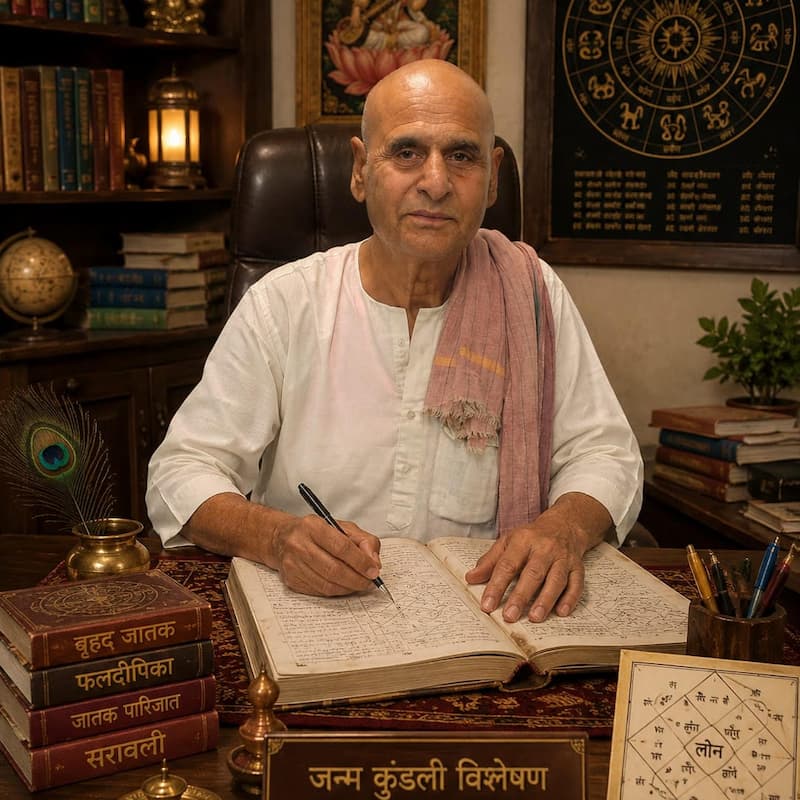
Narendra Kumar Chaubey is a Jyotisha Acharya with over 30 years of experience, based in Bihar and serving clients across India in Vedic astrology, mantra shastra, Vastu and ritual practice.
He completed his formal training at Kameshwar Singh Darbhanga Sanskrit University (KSDSU), one of India’s oldest and most respected institutions for Vedic and Sanskrit scholarship, where he studied Jyotisha shastra, mantra vidya and related classical sciences. KSDSU’s tradition of rigorous Sanskrit education tracing directly to the Mithila region’s centuries-old pandit lineage forms the foundation of his practice.
Over three decades, Narendra Kumar Chaubey has worked with thousands of individuals and families across Bihar and across India, offering guidance in:
- Kundli (birth chart) analysis: Identifying karmic patterns, planetary periods and life path guidance through classical Jyotisha
- Palmistry (Hasta Samudrika): Reading the hand according to the classical Samudrika Shastra tradition
- Vastu Shastra: Assessment and correction of living and working spaces according to directional and elemental principles
- Mantra and Pooja vidhi: Performing and guiding all categories of puja, havan, and mantra sadhana for personal, family and business situations
- Predictive Jyotisha: Transit analysis, muhurta (auspicious timing) selection and remedial guidance
He works across four languages Sanskrit, Hindi, English and Bhojpuri making classical knowledge accessible to practitioners across educational backgrounds and regions.
His writing for ABMantra brings the precision of classical Vedic training to practical mantra guidance: not general advice but specific prescriptions grounded in shastra, lineage and 30 years of direct practice with real situations.
For more info follow on: