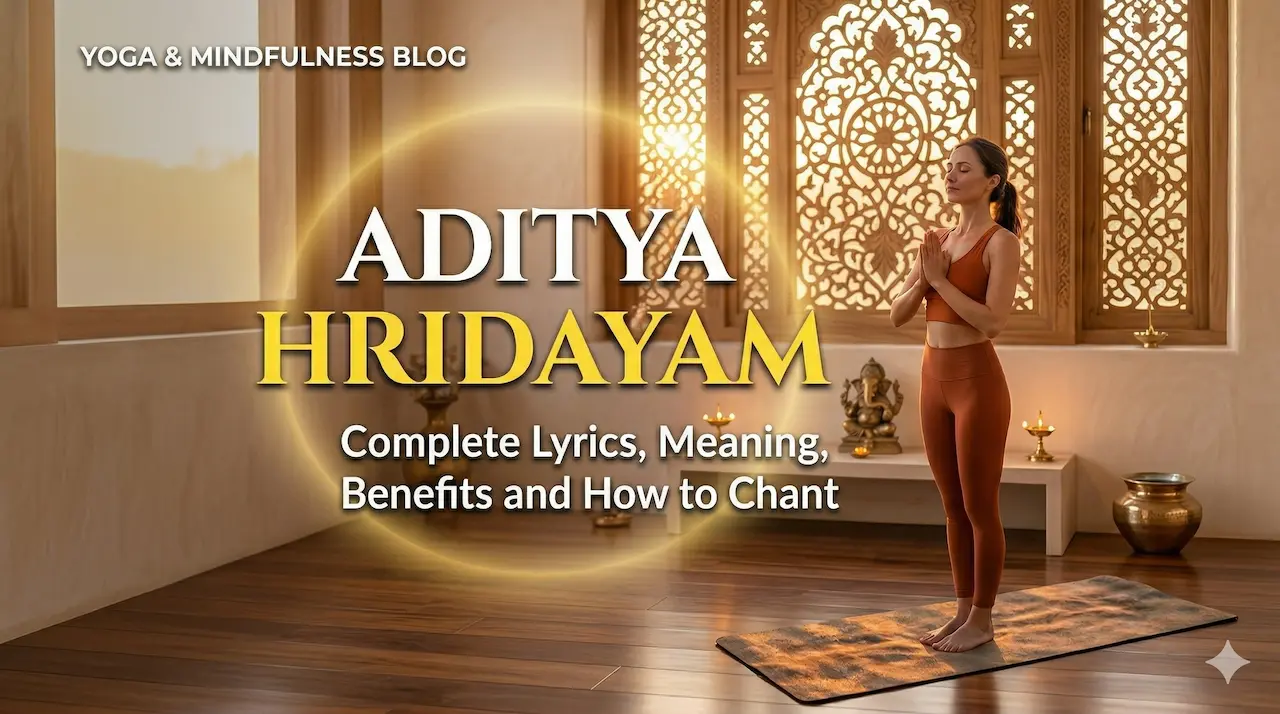

Before the most important battle of his life, Lord Rama stood on the battlefield exhausted, shaken and staring at the unconquerable Ravana across the field. It was at this moment that the great sage Agastya descended from the heavens, not with weapons or warriors, but with words. He taught Rama an ancient solar hymn and said: chant this and you will be victorious.
Rama chanted the Aditya Hridayam three times. Then he took up his bow and won.
This story from Valmiki’s Ramayana is the origin of one of the most powerful hymns in the Vedic tradition. The Aditya Hridayam, which translates as the Heart of Aditya (the Sun), is a 31-verse Sanskrit hymn that invokes Lord Surya in his complete form as the source of all light, life, wisdom and victory. It has been chanted by sages, warriors and seekers for thousands of years as a daily solar sadhana and as a recourse in moments of crisis.
This article gives you the complete Aditya Hridayam with Sanskrit lyrics, English transliteration, verse-by-verse meaning, a clear account of its benefits and a practical guide to chanting it correctly.
For a broader introduction to all forms of Surya Mantra including the Beej Mantra and chanting method, see our complete guide: Surya Mantra: Meaning, Benefits and Correct Chanting Method.
Origin and Story of the Aditya Hridayam
The Aditya Hridayam appears in the Yuddha Kanda, the sixth book of Valmiki’s Ramayana. The Yuddha Kanda is the longest of the seven books, describing the war between Rama’s forces and the army of Lanka. The hymn appears in Sarga 107, one of the pivotal chapters of the entire epic.
The context is the final battle between Lord Rama and Ravana. After days of fierce combat, Rama stands momentarily overwhelmed. Ravana appears fresh and fully armed, while Rama is fatigued. At this point the celestial sage Agastya, one of the foremost Vedic rishis and a direct seer of solar wisdom, arrives on the battlefield. He approaches Rama with urgency and teaches him this ancient hymn, saying it was kept secret in the tradition and is now being given out of compassion.
Agastya tells Rama to chant it three times while facing the Sun before returning to battle. Rama follows the instruction. He chants the Aditya Hridayam three times, feels his energy and resolve restored, and then defeats Ravana in the engagement that follows.
The text of the original Sarga 107 has been preserved in multiple manuscript traditions and is available through the IITK Valmiki Ramayana digital archive, which maintains the Sanskrit text across all major recensions.
Source: Valmiki Ramayana, Yuddha Kanda, Sarga 107. Available at: valmikiramayan.net (maintained by the Valmiki Ramayana Project)
This narrative context is significant. The hymn was not composed as a morning prayer for comfortable times. It was given specifically to someone who was tired and overwhelmed. The Aditya Hridayam is solar armour for difficult moments.
What Does Aditya Hridayam Mean?
| Sanskrit | Transliteration | Meaning |
| आदित्यहृदयम् | Aditya Hridayam | The Heart of Aditya (the Sun God) |
Aditya is one of the most ancient Vedic names for the Sun. It means the son of Aditi, the goddess of infinity and the boundless cosmic mother. Hridayam means heart or the essence of something, the deepest core.
Together, Aditya Hridayam means the very heart of the Sun God, that which is most essential and powerful in Surya. When you chant this hymn, you are not reciting a list of solar attributes from the outside. You are entering into the centre of solar consciousness itself.
The name also carries a medical resonance. In Ayurveda, the heart (hridaya) is the seat of prana and consciousness. A hymn placed at the heart of the Sun implies that the practice directly nourishes the practitioner’s own vital centre.
Aditya Hridayam: Key Verses with Sanskrit, Transliteration and Meaning
The Aditya Hridayam consists of 31 primary verses. Below are the most significant verses with Sanskrit text, Roman transliteration and English meaning, covering the full arc of the hymn from opening to closing.
Opening Verse: Agastya’s Arrival
| Sanskrit | Transliteration | Meaning |
| Tatah yuddhapariShrantam samare chintaya sthitam | Tatah yuddha-parishrantam samare chintaya sthitam | Then, seeing Rama exhausted from battle, standing lost in thought on the battlefield |
This opening verse establishes the human context. Rama, the avatar of Vishnu, is exhausted and struggling. This detail is deliberate. The hymn was given specifically to someone who was tired and overwhelmed. Its power is most accessible precisely when you need it most.
The Core Teaching Verse
| Sanskrit | Transliteration | Meaning |
| Aditya Hridayam Punyam Sarva Shatru Vinashanam | Jayavaham Japet Nityam Akshayyam Paramam Shivam | Aditya Hridayam Punyam Sarva Shatru Vinashanam, Jayavaham Japet Nityam Akshayyam Paramam Shivam | This sacred hymn of the Sun’s heart destroys all enemies and brings victory. Chant it daily — its merit is inexhaustible and bestows supreme auspiciousness. |
Sarva Shatru refers not only to external enemies but to all internal obstacles: self-doubt, fear, procrastination, destructive habits. The teaching is that these are enemies as real as any opponent on a battlefield, and this hymn addresses all of them.
Description of Surya: The Central Verses
| Sanskrit | Transliteration | Meaning |
| Sarvadevaatmako hyesha tejasvee rashmibhaavanah | Esh devaasura ganam loka paalayate prabhu | Sarva-devatmako hyesha tejasvi rashmi-bhavanah, Esha devaasura ganam loka paalayate prabhu | He is the soul of all the gods, full of brilliance and the source of light. This Lord governs and protects both the celestial and terrestrial worlds. |
The central section of the Aditya Hridayam is an extended meditation on the nature of Surya. He is described as the source of heat and cold, of rain and drought, of waking and sleep, of creation and dissolution. He is addressed by more than a dozen different names, each pointing to a specific quality.
The Names of Surya in the Aditya Hridayam
| Name in Hymn | Transliteration | Meaning and Significance |
| विवस्वान् | Vivasvan | The brilliant one; the Sun as pure luminosity |
| मार्तण्ड | Martanda | The cosmic egg; the Sun as the source of all life |
| भास्कर | Bhaskara | The one who leads to enlightenment through light |
| रवि | Ravi | The radiant one; the most common name of the Sun |
| सूर्य | Surya | The one who activates and sets all things in motion |
| पूषन् | Pushan | The nourisher; the Sun as provider of all sustenance |
| गभस्तिमान् | Gabhastiman | The one with powerful rays; solar energy as a tangible force |
| सुवर्णसदृश | Suvarna Sadrisha | Resembling gold; the Sun’s colour as the colour of pure consciousness |
The Victory Verses
| Sanskrit | Transliteration | Meaning |
| Jayajaya surya loka deepam trailokya pujitam | Trahi maam vipadah kshippram nashaya shatru mahardhadham | Jayajaya surya loka deepam trailokya pujitam, Trahi maam vipadah kshippram nashaya shatru mahardhadham | Victory, victory to Surya, the light of all the worlds, worshipped across all three realms. Protect me swiftly from danger and destroy the army of my enemies. |
The word Jaya is repeated twice, which in Sanskrit grammar indicates absolute certainty rather than mere hope. It is not a prayer for possible victory; it is a declaration that victory is already assured when the Sun is invoked.
The Closing Promise
| Sanskrit | Transliteration | Meaning |
| Tri-rachamya shuchir bhutva dhanuraadaya viryavan | Ity adityam jagannatha stutva vidhivad anagha, Tri-rachamya shuchir bhutva dhanuradaya viryavan | Having thus praised Aditya in the prescribed manner, the sinless Rama sipped water three times, became purified, and took up his bow with renewed strength. |
This closing verse describes what Rama did after receiving the teaching: chanting, purification through Achamana, then action. This is the model the tradition recommends for practitioners as well.
Key Verses at a Glance
| # | Sanskrit (Key Phrase) | English Meaning | When to Focus on This Verse |
| 1 | Aditya Hridayam Punyam Sarva Shatru Vinashanam | This sacred hymn of the Sun’s heart destroys all enemies | Opening verse — establishes the purpose of the hymn |
| 2 | Jayajayasurya loka deepam trailokya pujitam | Victory to the Sun, the light of the worlds, worshipped in all three realms | Victory verse — invoked before battle or any major challenge |
| 3 | Jayavaham Japet Nityam Akshayyam Paramam Shivam | Chanting this daily brings victory, is inexhaustible in merit, and bestows supreme auspiciousness | The core promise verse — the reason sages preserved this hymn |
| 4 | Sarva Mangala Mangalya Shiva Sarvartha Sadhike | The most auspicious of all auspicious things, the fulfiller of all purposes | Invocation of complete blessing across all areas of life |
Benefits of Chanting Aditya Hridayam
The Aditya Hridayam does not promise a single benefit. It is a comprehensive solar invocation that addresses multiple dimensions of human life simultaneously. The following benefits are drawn from the Vedic textual tradition, classical commentaries and the reports of long-term practitioners.
| Area of Life | Benefit | Vedic Basis |
| Inner Obstacles | Removes self-doubt, fear and hesitation before important decisions or events | Sarva Shatru Vinashanam (destroyer of all enemies) |
| Career and Success | Builds confidence, authority and the capacity to take decisive action | Jayavaham (that which brings victory) |
| Health and Vitality | Regular chanting is traditionally associated with improved eyesight, strong immunity and physical endurance | Sarva Roga Nashana (destroyer of all diseases) |
| Mental Clarity | Dissolves confusion and mental fog; practitioners report sharper focus and better decision-making | Param Shivam (supreme auspiciousness of mind) |
| Spiritual Growth | Connects the practitioner directly with Surya as the cosmic teacher (guru) | Aditya Hridayam Punyam (the sacred heart of the Sun) |
| Protection | Traditionally chanted for protection during travel, illness and difficult periods | Raksha (divine protection) referenced throughout |
Research published in the International Journal of Yoga has documented that structured mantra recitation produces measurable reductions in sympathetic nervous system activity, which aligns with the traditional claim that Aditya Hridayam reduces fear and restores calm resolve. The specific mechanism described in the Vedic tradition (solar vibration restoring prana to a depleted practitioner) maps closely onto what modern physiology calls vagal tone restoration.
Source: Kalyani, B.G. et al. (2011). Neurohemodynamic correlates of OM chanting. International Journal of Yoga, 4(1), 3-6. (PMID: 21654969)
How to Chant Aditya Hridayam: Step-by-Step Method
The following method is drawn from traditional Vedic practice and is suitable for both beginners and experienced practitioners.
Preparation
1. Wake before or at sunrise. Bathe or at minimum wash your hands, feet and face.
2. Sit or stand facing east. If outdoors, face the actual sun. If indoors, face the window through which morning light enters.
3. Take three slow, conscious breaths. Inhale fully, hold briefly, exhale completely.
4. Perform Achamana: sip a small amount of water three times from your right palm. This is the same purification Rama performed before and after chanting.
5. Set a clear intention. Traditional guidance is to mentally offer the practice to Lord Surya and state whatever you are seeking: clarity, health, victory over a particular challenge.
The Chanting Method
Chant the 31 verses in sequence at a measured, unhurried pace. Total recitation time is typically 15 to 25 minutes depending on pace. For beginners, the following graduated approach works well:
• Week 1 to 2: Listen to a traditional recording of the full hymn daily. Do not attempt to chant yet. Simply absorb the rhythm, the sound and the energy.
• Week 3 to 4: Chant along with the recording, following as best you can without worry about pronunciation accuracy.
• Week 5 onwards: Begin chanting independently, using the transliteration text as a reference. Accuracy will improve naturally over weeks.
From our practice: One of the most consistent pieces of feedback we receive from readers who begin the Aditya Hridayam is that the first two weeks feel like learning a foreign language and then, around day 15 to 18, something clicks. The rhythm becomes familiar and the chanting shifts from effort to ease. Persisting through those first two weeks is the single most important instruction we can offer beginners.
How Many Times to Chant
Agastya instructed Rama to chant the hymn three times before going into battle. Three is the traditional number for important occasions. For daily practice, one complete recitation is sufficient. On auspicious days such as Sundays, Ratha Saptami, Makara Sankranti or during illness, three rounds are recommended.
The 21-Day Crisis Practice
When facing a serious challenge, the tradition recommends the following for 21 consecutive days:
6. Chant the Aditya Hridayam three times at sunrise without interruption.
7. Offer water to the rising sun (Arghya) after chanting.
8. Observe silence for at least 10 minutes after the practice.
9. Avoid expressing anger or speaking harshly on the days of the practice.
Aditya Hridayam vs Shorter Surya Mantras: Which to Choose?
| Factor | Aditya Hridayam (31 verses) | Surya Beej Mantra (short) |
| Time required | 15 to 25 minutes | 5 to 10 minutes |
| Best for | Deep challenges, major life events, sustained sadhana | Daily quick practice, travel, busy mornings |
| Learning curve | Moderate; takes 4 to 6 weeks to memorise | Low; can be learned in a day |
| Depth of effect | Comprehensive across all life areas | Targeted primarily to vitality and solar energy |
| Crisis use | Specifically designed for moments of overwhelming challenge | Supportive but not the primary crisis practice |
| Can be combined? | Yes; chant Beej Mantra before as a warm-up | Yes; use as condensed version on time-constrained days |
For a detailed guide to the Surya Beej Mantra, its meaning and 108-chanting method, see our article on the Surya Beej Mantra.
Auspicious Occasions for Aditya Hridayam
• Ratha Saptami: The seventh day of the Magha month, considered the Sun’s birthday. Chanting on this day is said to clear accumulated karmic debt.
• Makara Sankranti: The solar new year. An ideal day to begin a 21-day or 40-day practice.
• Sundays: Ravivar, the day of Ravi. Weekly enhanced practice on Sundays builds cumulative solar connection over months.
• Eclipse days: The period immediately after a solar eclipse is a powerful window for solar mantras. Chanting the Aditya Hridayam at sunrise on the day after an eclipse is a traditional practice.
• Before any major challenge: Exams, surgeries, court dates, important presentations. The hymn’s battlefield origin makes it particularly apt for high-stakes situations.
Conclusion
The Aditya Hridayam has survived for thousands of years not because it was memorised and passed down as cultural heritage, but because it works. Generation after generation of practitioners have turned to it at moments of genuine need and found that chanting it consistently brought clarity, renewed energy and, as the tradition promises, victory.
You do not need to understand all 31 verses to begin. You need a quiet place at sunrise, a face turned toward the east, and the willingness to speak ancient words with sincere attention. The rest comes with practice.
Start with the first verse today. Add one or two more each week. Within a month, you will have the complete hymn. Within a year of daily practice, you will understand why a sage descended from the heavens to teach it to a warrior standing exhausted on a battlefield.
To understand the complete family of Surya Mantras including the Beej Mantra, 12 names and chanting method, read our main guide: Surya Mantra: Meaning, Benefits and Correct Chanting Method. For combining Surya Mantra with the yoga sequence, see our article on the Surya Namaskar Mantra and 12 Names.
Frequently Asked Questions
What is the Aditya Hridayam?
Aditya Hridayam is an ancient solar hymn from the Yuddha Kanda of Valmiki’s Ramayana. The sage Agastya taught it to Lord Rama on the battlefield just before his final battle with Ravana. It contains 31 verses describing the nature, qualities and glory of Lord Surya and promises victory, health and liberation to sincere practitioners.
How many verses does the Aditya Hridayam have?
The Aditya Hridayam consists of 31 primary verses (shlokas). Some editions include the framing verses describing Agastya’s arrival and Rama’s state of mind, bringing the total to around 33 to 34 verses depending on the manuscript tradition.
When should Aditya Hridayam be chanted?
Sunrise is the most auspicious time. The traditional instruction from Agastya to Rama was to chant it facing the Sun. Sunday mornings carry special significance. It can also be chanted during illness, before exams or interviews, during periods of difficulty, or as a daily evening prayer when morning practice is not possible.
Can beginners chant Aditya Hridayam?
Yes. Beginners can start by listening to the full recitation daily for the first week to absorb the rhythm and pronunciation before attempting to chant along. Many practitioners begin with the first three verses and gradually add more. Even listening with a quiet mind is considered meritorious.
What is the difference between the Surya Mantra and Aditya Hridayam?
The Surya Mantra refers to shorter chants like the Beej Mantra (Om Hraam Hreem Hraum Sah Suryaya Namah) that can be chanted in a few minutes. The Aditya Hridayam is a complete hymn of 31 verses that takes 15 to 25 minutes to recite and covers the full range of Surya’s qualities and names.
Is it necessary to fast before chanting Aditya Hridayam?
Fasting is not required. Traditional guidelines recommend chanting on a relatively empty stomach, particularly at sunrise before breakfast, and after bathing. The essential conditions are cleanliness, a quiet space, and the face turned toward the Sun or east.
Narendra Kumar Chaubey is a Jyotisha Acharya with over 30 years of experience, based in Bihar and serving clients across India in Vedic astrology, mantra shastra, Vastu and ritual practice.
He completed his formal training at Kameshwar Singh Darbhanga Sanskrit University (KSDSU), one of India’s oldest and most respected institutions for Vedic and Sanskrit scholarship, where he studied Jyotisha shastra, mantra vidya and related classical sciences. KSDSU’s tradition of rigorous Sanskrit education tracing directly to the Mithila region’s centuries-old pandit lineage forms the foundation of his practice.
Over three decades, Narendra Kumar Chaubey has worked with thousands of individuals and families across Bihar and across India, offering guidance in:
- Kundli (birth chart) analysis: Identifying karmic patterns, planetary periods and life path guidance through classical Jyotisha
- Palmistry (Hasta Samudrika): Reading the hand according to the classical Samudrika Shastra tradition
- Vastu Shastra: Assessment and correction of living and working spaces according to directional and elemental principles
- Mantra and Pooja vidhi: Performing and guiding all categories of puja, havan, and mantra sadhana for personal, family and business situations
- Predictive Jyotisha: Transit analysis, muhurta (auspicious timing) selection and remedial guidance
He works across four languages Sanskrit, Hindi, English and Bhojpuri making classical knowledge accessible to practitioners across educational backgrounds and regions.
His writing for ABMantra brings the precision of classical Vedic training to practical mantra guidance: not general advice but specific prescriptions grounded in shastra, lineage and 30 years of direct practice with real situations.
For more info follow on: