
In the Hindu solar calendar, most festivals are tied to the lunar cycle. Ratha Saptami is different. It marks a moment in the actual solar year: the day when Lord Surya turns his celestial chariot northward and begins the Uttarayana journey. It is simultaneously the Sun’s birthday, the first official day of the season’s warming, and the most powerful single day in the year for solar worship and mantra practice.
In 2026, Ratha Saptami falls on Sunday, January 25, which makes it particularly auspicious. Sunday is Ravivar, the weekly day of the Sun God. When Ratha Saptami falls on a Sunday, traditional practitioners consider it a once-in-several-years convergence of the day and the festival, amplifying the potency of every ritual performed.
This guide covers the confirmed 2026 dates and timings, the complete puja samagri list, a step-by-step Puja Vidhi, all the Surya Mantras chanted on this day with their meaning and timing, the regional traditions from Andhra Pradesh to Tamil Nadu, and practical guidance for those observing the festival at home.
For the complete guide to all Surya Mantras including pronunciation, meaning and daily practice method, see our main article: Surya Mantra: Meaning, Benefits and Correct Chanting Method.
Significance of Ratha Saptami in the Vedic Tradition
The word Ratha means chariot and Saptami means the seventh day. On this day, according to the Puranas, Lord Surya begins riding his golden chariot pulled by seven horses toward the northern hemisphere, a celestial movement that corresponds to the astronomical reality of the winter solstice transition.
The Bhavishya Purana and the Padma Purana both contain extensive passages on Ratha Saptami. They describe it as a day on which seven types of sins accumulated across seven lifetimes can be purified through a ritual bath, sincere puja and charitable giving. The number seven appears throughout the festival in several ways: the seven horses, the seven Arka leaves used in the bath, the seven names of the Sun chanted during the snan, and the seven types of donations associated with Surya in Jyotish.
Sources: Bhavishya Purana (Brahma Parva, chapters on Surya worship); Padma Purana (Uttara Khanda, Ratha Saptami mahatmya).
There is also a well-known Puranic story associated with the festival. A king named Yashovarma had a son who was terminally ill. A sage advised the son to perform the Ratha Saptami puja with complete devotion, as his illness was the result of accumulated karma from previous births. The son performed the puja and was restored to health. This story, narrated in the Markandeya Purana, is the origin of one of Ratha Saptami’s regional names: Arogya Saptami (the Saptami of health).
In December 2024, the Government of Andhra Pradesh officially declared Ratha Saptami a state festival, to be celebrated for three days, particularly at the Sri Suryanarayana Swamy temple in Arasavalli, Srikakulam. This recognition reflects the festival’s deep cultural roots in southern India.
Source: Government of Andhra Pradesh official gazette notification, December 2024.
Ratha Saptami 2026: Date and Puja Timings
The timings below are confirmed for New Delhi and the North Indian region. Times may vary by 15 to 45 minutes depending on your city. For precise local timings, refer to your regional panchang or DrikPanchang.com for your location.
| Ritual | Time (Delhi) | Guidance |
| Saptami Tithi Begins | 12:39 AM, January 24, 2026 | Tithi starts at midnight — most observers go by sunrise date |
| Saptami Tithi Ends | 11:10 PM, January 25, 2026 | Full Saptami Tithi observed on January 25 |
| Arunodaya (Pre-dawn) Snan | 5:26 AM to 7:13 AM | The most auspicious window; Arunodaya lasts approx. 96 minutes before sunrise |
| Sunrise (Arghyadan Time) | 7:13 AM (Delhi / North India) | Face east and offer the first Arghya as the sun clears the horizon |
| Surya Namaskar | Immediately after Arghya | Perform 7 or 12 rounds while facing the rising sun |
| Puja and Mantra Chanting | 7:15 AM to 8:30 AM | Full Surya Puja with 108 Beej Mantra repetitions and Aditya Hridayam recitation |
| Dana (Charity) | After puja, before noon | Donate wheat, jaggery, sesame seeds and red cloth on this day |
Note on Arunodaya: The Arunodaya period, the 96-minute pre-dawn window before sunrise, is considered the most auspicious time for the Ratha Saptami bath. This is also called Brahma Muhurta in general solar practice. Taking the Arka leaf bath during this window and then offering Arghya at the exact moment of sunrise is the traditional ideal.
Ratha Saptami Puja Samagri: Complete List with Significance
All samagri should be arranged the evening before Ratha Saptami so that the morning is free for practice rather than preparation. Items marked as donated are set aside before the puja and given away after the morning rituals.
| Item | Quantity | Purpose and Significance |
| Arka (Calotropis) leaves | 7 leaves | Placed on the head, shoulders, knees and feet during the sacred bath. Arka is the plant of Surya; its name is itself a synonym for the Sun in Sanskrit. |
| Copper kalash | 1 | For offering Arghya water to the Sun. Copper is the metal associated with Surya in the Vedic tradition and is believed to enhance the solar vibration of the offering. |
| Raw milk | 500 ml | Mixed with the Arghya water. Later used to prepare Payasam or Sakkarai Pongal as prasad. Milk represents purity and nourishment. |
| Red flowers | A handful | Offered to Surya during puja. Red is the colour associated with Surya and Mangala (Mars). Hibiscus and red lotus are traditionally preferred. |
| Sesame seeds (til) | A small handful | One of the oldest offerings to Surya mentioned in the Vedic texts. Sesame is also donated to Brahmins after puja as it carries Surya’s energy. |
| Jaggery (gud) | 100 grams | Offered as prasad and also donated as part of the day’s charity. Jaggery is the traditional Surya sweetener, preferred over refined sugar in all Vedic rituals. |
| Wheat grains | 250 grams | Donated to Brahmins or the needy after puja. Wheat is the grain of Surya and is specifically mentioned in classical Jyotish texts as the appropriate donation for strengthening the Sun. |
| Ghee diya (earthen lamp) | 1 | Lit facing the Sun during puja. The flame of a ghee lamp is considered the most sattvic form of light and is offered to Surya as fire is offered to fire. |
| Camphor (kapoor) | 2 to 3 pieces | Burned during the aarti at the close of puja. Camphor burns without residue, symbolising the complete offering of the self. |
| Red sandalwood (lal chandan) | Small quantity | Applied as tilak to the Surya image or Surya Yantra during puja. Red sandalwood carries the warm, solar quality of Surya’s energy. |
Ratha Saptami Puja Vidhi: Step-by-Step Guide
The following is the complete traditional puja sequence for Ratha Saptami. Each step is presented in the order it should be performed. The entire practice from bath to dana takes approximately two to three hours when done at a measured, unhurried pace.
Step 1: Arunodaya Snan (Sacred Bath Before Sunrise)
1. Wake at or before 5:26 AM (the beginning of the Arunodaya window). Do not eat or drink anything before completing the bath and Arghya.
2. Fill a bucket or bathtub with clean water. Place seven Arka leaves in the water: one for the head, two for the shoulders, two for the knees and two for the feet. If you have Ganga water or water from any sacred river, add a small amount.
3. Chant the Surya Saptanama (the seven names: Surya, Aryama, Bhaga, Tvashtha, Pusha, Mitra, Varuna) as you place each leaf on the corresponding body part before or during bathing.
4. After bathing, wear clean clothes. Yellow and red are the traditional Ratha Saptami colours. White is also appropriate. Avoid black on this day.
Step 2: Arghya at Sunrise
5. Go to an open space, terrace, garden or east-facing window where you can see the rising sun directly.
6. Fill the copper kalash with clean water and add a small amount of raw milk, red flowers and a few sesame seeds.
7. Stand with your feet together facing east. Hold the kalash in both hands, fingers interlaced around it, with your arms extended forward and slightly upward so that the water pours in an arc toward the sun.
8. Begin chanting: Om Aadidev Namastubhyam Praseed Mama Bhaskara, Divakar Namastubhyam Prabhakar Namostute. Chant once, then slowly pour the Arghya water toward the Sun.
9. Refill the kalash and offer Arghya two more times, chanting the Om Adityaya Vidmahe Sahasra Kiranaya Dhimahi, Tanno Surya Prachodayat on the second and third offerings.
10. After the three Arghya offerings, bow your head and stand in silence for one full minute, facing the Sun.
From our practice: The three Arghya offerings on Ratha Saptami carry a different quality from the daily single Arghya of a regular Surya practice. The first offering acknowledges the Sun as Aadidev, the primordial god. The second invokes him as the Thousand-Rayed Aditya. The third is offered in silence as a complete act of surrender. When you complete all three slowly and with full attention, the effect in the body is immediate and unmistakable, a warmth and clarity that the single daily Arghya builds toward gradually but this day delivers at once.
Step 3: Surya Namaskar
11. Immediately after the Arghya, while you are still facing the Sun, perform 7 rounds of Surya Namaskar.
12. Chant Om Suryaya Namah with each of the 12 poses in each round. For those who know the 12 individual names, use them in sequence.
13. On Ratha Saptami, 7 rounds is the traditional count, as seven is the number of this festival. Those with more time may perform 12 rounds.
Step 4: Main Puja
14. Return indoors to your home altar. Set up the Surya image or a Surya Yantra on a clean red cloth, facing east.
15. Light the ghee diya and camphor. Offer red flowers and red sandalwood paste (tilak) to the Surya image.
16. Chant the Surya Beej Mantra (Om Hraam Hreem Hraum Sah Suryaya Namah) 108 times on a mala.
17. Recite the complete Aditya Hridayam if time permits, or at minimum the first three verses.
18. Close the puja with Surya Aarti. The camphor is lit and waved before the image in a clockwise circular motion while family members gather and sing.
Step 5: Prasad and Dana
19. Prepare or distribute prasad: Kheer, sweet puri or any sweet rice preparation made with jaggery.
20. Set aside the donations: wheat, sesame seeds, jaggery, red cloth and copper items. These are given to a Brahmin, temple, or charitable institution before noon.
21. The fast (if observed) is broken after the dana with the Ratha Saptami prasad.
All Surya Mantras for Ratha Saptami: Complete Reference
Below are all six principal mantras used on Ratha Saptami with their Sanskrit text, English meaning and the exact moment each is chanted.
| Sanskrit Om Adityaya Vidmahe Sahasra Kiranaya Dhimahi, Tanno Surya Prachodayat Meaning We meditate on Aditya, the Sun of a thousand rays; may that Surya inspire and illuminate our intellectWhen to ChantChanted during the Arghya ritual while pouring water toward the Sun. This is the primary mantra for Ratha Saptami and should be chanted 3 times with each Arghya offering. |
Surya Arghya Mantra
| Sanskrit Om Hraam Hreem Hraum Sah Suryaya Namah Meaning I invoke the complete seed energy of Lord Surya through his three solar aspectsWhen to ChantChanted 108 times during the main puja session after Arghya. This is the foundation mantra for all Surya practice and carries special potency on Ratha Saptami, the Sun’s birthday. |
Surya Beej Mantra
| Sanskrit Om Aadidev Namastubhyam Praseed Mama Bhaskara, Divakar Namastubhyam Prabhakar Namostute Meaning O Aadidev, salutations to you; O Bhaskara, please be gracious to me; O Divakar, salutations; O Prabhakar, I bow to youWhen to ChantOne of the most commonly recited Arghya shlokas on Ratha Saptami. Appropriate for all ages including children. Chant once per Arghya offering while facing the Sun. |
Aadidev Namastubhyam (Arghya Shloka)
| Sanskrit Aditya Hridayam Punyam Sarva Shatru Vinashanam, Jayavaham Japet Nityam Akshayyam Paramam Shivam Meaning This sacred heart of Aditya destroys all enemies and brings victory; chanting it daily yields inexhaustible merit and supreme auspiciousnessWhen to ChantRecited after the Arghya and Beej Mantra practice. The complete 31-verse Aditya Hridayam is traditionally recited on Ratha Saptami, Makara Sankranti and Sundays. At minimum, the first three verses are recited. |
Aditya Hridayam (opening verses)
| Sanskrit Om Suryaya Namah Meaning Salutation to Lord Surya, the one who sets all things in motionWhen to ChantChanted during each of the 12 poses of Surya Namaskar when combined with the physical practice. Also chanted by family members who observe the day informally without the full puja. |
Om Suryaya Namah
| Sanskrit Surya, Aryama, Bhaga, Tvashtha, Pusha, Mitra, Varuna Meaning The seven names of the Sun from the Rigveda, each corresponding to one of the seven horses of Surya’s chariot and one of the seven days of the weekWhen to ChantRecited during the Saptami Snan (sacred bath) while placing the seven Arka leaves on the body. One name per leaf placement: head, right shoulder, left shoulder, right knee, left knee, right foot, left foot. |
Surya Saptanama Mantra
For the complete syllable breakdown, 108-count chanting method and full benefits of the Surya Beej Mantra, see our article: Surya Beej Mantra: Meaning, Benefits and How to Chant Om Hraam Hreem Hraum.
Ratha Saptami Celebrations Across India: Regional Traditions
Ratha Saptami is observed across the length of India, but its most elaborate celebrations are in the South, where the Surya temple tradition is strongest. Below is a region-by-region guide to how the festival is observed.
| Region | Distinctive Practice | Traditional Food Offering |
| Andhra Pradesh and Telangana | Grand temple celebrations at Sri Suryanarayana Swamy Temple in Arasavalli (Srikakulam), one of the most important Surya temples in India. Special abhishekam (ceremonial bathing of the deity) with milk, honey and sandalwood. Ratha Saptami was declared an official state festival by the Government of Andhra Pradesh in December 2024. | Naivedyam of Payasam, Sakkarai Pongal and Panakam (jaggery water) |
| Tamil Nadu | The Calotropis gigantea (Erukkam) leaf ritual during the sacred bath. Drawing kolam (rangoli) of a chariot with seven horses at the entrance of every house. Special puja at Suryanaar Kovil, one of the Navagraha temples. Milk is boiled facing the Sun until it overflows, symbolising solar abundance. | Sakkarai Pongal, Payasam, Venn Pongal |
| Karnataka | Ratha Saptami is linked to the Ratha Yatra of Veera Venkatesha at Sri Venkatramana Temple in Mangalore, known as Kodial Teru. The processional chariot (ratha) pulled through the streets is one of the most attended events in coastal Karnataka. | Payasam, Puliyogare (tamarind rice) offered as naivedyam |
| Tirumala (Andhra Pradesh) | One-day Brahmotsavam at Tirumala temple. Sri Malayappa Swamy (the processional deity of Venkateshwara) takes procession on seven different vahanas (mounts) through the Mada Streets in a single day, an event that draws tens of thousands of pilgrims. | Special ladoo prasadam distributed to all pilgrims |
| North India | Home-based puja emphasising the Arghya ritual at sunrise, Surya Namaskar and recitation of the Surya Beej Mantra. Donation of wheat, jaggery, sesame and red cloth. Observance of a partial or full fast. Ratha Saptami falls on a Sunday in 2026, making it especially auspicious for north Indian solar practitioners. | Kheer, Puri, seasonal fruits as prasad |
Ratha Saptami and Jyotish: Why This Day is Powerful for Solar Remedies
In Vedic astrology (Jyotish), Ratha Saptami is considered the single most auspicious day of the year for strengthening a weak or afflicted Sun in the natal chart. The reason is straightforward: the Sun is at the peak of its Vedic significance on its own birthday, just as a person is considered at their most accessible and generous on their birthday.
Any Surya-related Jyotish remedy performed on Ratha Saptami is believed to carry the effect of 40 days of regular practice. This makes it the ideal day to begin a new 40-day Surya sadhana, as the accumulated merit from the Ratha Saptami puja serves as a powerful foundation for the weeks that follow.
• Those with a weak Sun in the natal chart (low confidence, poor recognition at work, strained relationship with father or authority figures) benefit most from an intensive Ratha Saptami practice.
• Those with Sun in enemy signs (Libra or Aquarius) should perform the full Puja Vidhi, donate all seven Surya-associated items, and begin a 40-day Beej Mantra sadhana on this day.
• Even those without specific Sun afflictions benefit from observing Ratha Saptami as a solar reset: a day to honour the source of all vitality and set a clear intention for the year ahead.
For a full guide to Surya Mantra as a career and success remedy including the Jyotish framework, see our article: Surya Mantra for Success: Career, Business and Students Complete Guide.
Conclusion
Ratha Saptami is the Sun’s own day. Of all the days in the year to begin or deepen a Surya Mantra practice, this is the most supported, the most auspicious, and the one that the entire Vedic tradition points to as carrying the greatest accumulated solar merit.
In 2026 it falls on a Sunday, which means Ravivar and Ratha Saptami coincide for the first time in several years. Rise before dawn, take the Arka leaf bath, offer Arghya at sunrise, chant 108 rounds of the Beej Mantra, recite the Aditya Hridayam, and donate. Then begin a 40-day Surya sadhana that carries the energy of this day through to the spring.
The Sun rises without asking whether it is convenient. On Ratha Saptami, the invitation is to meet it at the same level of commitment.
Frequently Asked Questions
What is Ratha Saptami and why is it celebrated?
Ratha Saptami is a Vedic festival observed on the seventh day (Saptami) of the bright fortnight of the Hindu month of Magha. It marks the symbolic birthday of Lord Surya (the Sun God) and the turning of his celestial chariot northward, beginning the Uttarayana period. The festival celebrates the Sun’s role as the source of all life on earth and is one of the most important days in the solar worship calendar. In 2026, Ratha Saptami falls on Sunday, January 25, making it especially auspicious as Sunday is Ravivar, the weekly day of the Sun.
What is the significance of using Arka leaves in the Ratha Saptami bath?
The Arka plant (Calotropis gigantea, called Aak in Hindi and Erukkam in Tamil) is the plant most sacred to Lord Surya. Its name Arka is itself one of the synonyms for the Sun in Sanskrit. During the Ratha Saptami sacred bath, seven Arka leaves are placed on seven parts of the body: the head, both shoulders, both knees and both feet. Each placement corresponds to one of the seven horses of Surya’s chariot and one of the seven names from the Surya Saptanama. The belief is that bathing with Arka leaves purifies not only the current body but the karma accumulated across seven past lifetimes.
Can Ratha Saptami puja be done at home without a river?
Yes. The sacred bath can be performed at home by adding Arka leaves and a small quantity of Ganga water (if available) to your regular bath water. The Arghya can be offered by standing at a balcony or open space facing east, pouring water from a copper kalash toward the rising sun. The essential elements are the Arka leaf bath before sunrise, the water offering at sunrise, the chanting of the Arghya mantra, and some form of charitable donation during the day. Everything else is supplementary.
Which mantra is most powerful to chant on Ratha Saptami?
The Surya Arghya Mantra (Om Adityaya Vidmahe Sahasra Kiranaya Dhimahi, Tanno Surya Prachodayat) is the primary mantra for the Arghya ritual. The Surya Beej Mantra (Om Hraam Hreem Hraum Sah Suryaya Namah) is the most powerful for general Surya practice and should be chanted 108 times after the Arghya. For those with more time, the complete Aditya Hridayam recited once on Ratha Saptami is said to carry the merit of a full year of Sunday solar worship.
What should be donated on Ratha Saptami?
The traditional Ratha Saptami donations (Dana) include wheat grain, red cloth, jaggery, sesame seeds, ghee and copper items. These are the seven substances associated with Surya in Jyotish (Vedic astrology). Donations are made to Brahmins, temples or the needy before noon on the day of the festival. Donating food cooked with jaggery, particularly sweet rice or kheer, to schools or community centres is a modern adaptation that maintains the spirit of the tradition.
Is Ratha Saptami the same as Surya Jayanti?
Yes. Ratha Saptami is also known as Surya Jayanti, the birthday of Lord Surya. The name Ratha Saptami refers to the chariot (Ratha) turning of the Sun on the seventh day (Saptami), while Surya Jayanti refers to the same day as the Sun’s birth anniversary. Other regional names include Magha Saptami (the Saptami of Magha month), Arogya Saptami (the Saptami of health, because bathing on this day is said to remove all diseases) and Achala Saptami (the fixed Saptami).
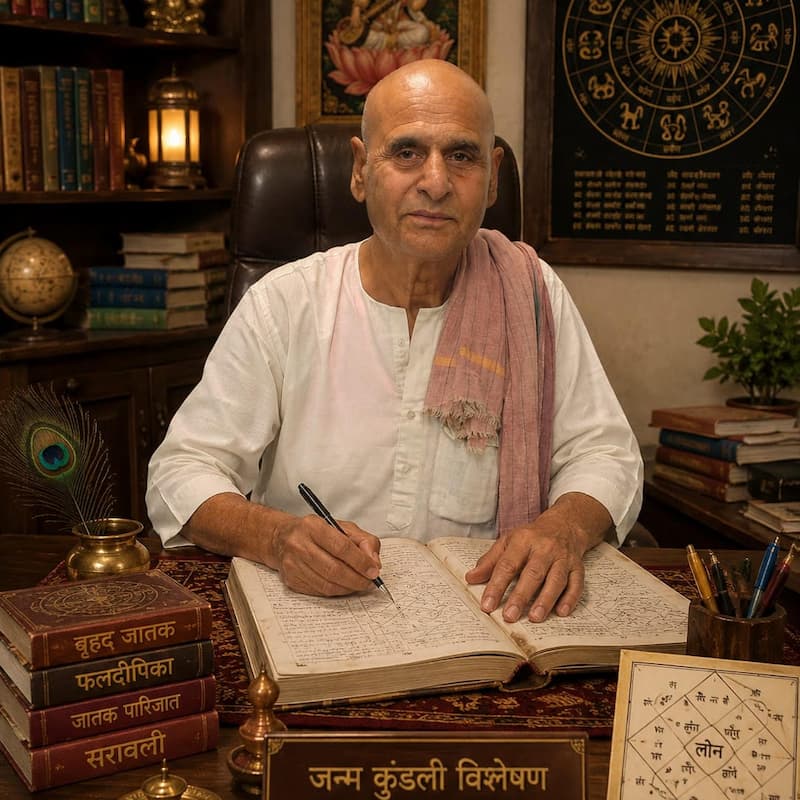
Narendra Kumar Chaubey is a Jyotisha Acharya with over 30 years of experience, based in Bihar and serving clients across India in Vedic astrology, mantra shastra, Vastu and ritual practice.
He completed his formal training at Kameshwar Singh Darbhanga Sanskrit University (KSDSU), one of India’s oldest and most respected institutions for Vedic and Sanskrit scholarship, where he studied Jyotisha shastra, mantra vidya and related classical sciences. KSDSU’s tradition of rigorous Sanskrit education tracing directly to the Mithila region’s centuries-old pandit lineage forms the foundation of his practice.
Over three decades, Narendra Kumar Chaubey has worked with thousands of individuals and families across Bihar and across India, offering guidance in:
- Kundli (birth chart) analysis: Identifying karmic patterns, planetary periods and life path guidance through classical Jyotisha
- Palmistry (Hasta Samudrika): Reading the hand according to the classical Samudrika Shastra tradition
- Vastu Shastra: Assessment and correction of living and working spaces according to directional and elemental principles
- Mantra and Pooja vidhi: Performing and guiding all categories of puja, havan, and mantra sadhana for personal, family and business situations
- Predictive Jyotisha: Transit analysis, muhurta (auspicious timing) selection and remedial guidance
He works across four languages Sanskrit, Hindi, English and Bhojpuri making classical knowledge accessible to practitioners across educational backgrounds and regions.
His writing for ABMantra brings the precision of classical Vedic training to practical mantra guidance: not general advice but specific prescriptions grounded in shastra, lineage and 30 years of direct practice with real situations.
For more info follow on: