

| Quick Answer: The primary Lakshmi mantra is: Om Shreem Mahalakshmiyei NamahaOM SHREEM MAHALAKSHMIYEI NAMAHA ॐ श्रीं महालक्ष्म्यै नमः Meaning: Om and salutations to the great Lakshmi, source of all abundance. Chant 108 times daily, preferably on Fridays, using a Kamalgatta or Sphatik mala. The Shri Suktam, 16 verses from the Rigveda’s Khila section, is the oldest and most authoritative invocation of Lakshmi and predates all other written Lakshmi texts. |
| Who This Article Is For: This article is for you if, you want the correct Sanskrit text with Hindi meaning, not just a transliteration | you struggle with recurring financial difficulty despite genuine effort | you want to understand the difference between the beej mantra, the Shri Suktam, and the Mahalakshmi Stotra and which to chant when | you have tried other remedies without clear results. This article is NOT for you if: you are looking for instant results or a one-time chant. |
Goddess Lakshmi appears in the Rigveda, the oldest of the four Vedas, as Shri: the embodiment of auspiciousness, abundance, and radiant grace. She predates most other goddess traditions in the written record. The Shri Suktam, 16 hymns dedicated to her, forms part of the Khila section appended to the Rigveda and remains the single most authoritative invocation of her energy.
This guide covers every major Lakshmi mantra. You will find the correct Sanskrit text, the Hindi meaning word by word, the right day and method to chant, and how to build a practice that produces results over time. Not overnight. Over time.
Who Is Goddess Lakshmi
Lakshmi derives from the Sanskrit root Lakshya, meaning goal, aim, or target. She is the force that moves a person toward their purpose. Her four hands represent the four purusharthas: Dharma (right action), Artha (prosperity), Kama (fulfillment of desires), and Moksha (liberation). She holds a lotus in two hands as a symbol of purity of action. Coins flow from her lower right palm because she gives. She does not hoard.
She has eight classical forms called the Ashta Lakshmi, each presiding over a different kind of wealth: Adi Lakshmi (primordial), Dhana Lakshmi (material wealth), Dhanya Lakshmi (agricultural abundance), Gaja Lakshmi (power and royalty), Santana Lakshmi (progeny), Veera Lakshmi (courage), Vidya Lakshmi (knowledge), and Vijaya Lakshmi (victory). Most modern Lakshmi mantras address her collectively. The Shri Suktam specifically invokes her golden, lotus-bearing, elephant-accompanied form: Gaja Lakshmi, which represents abundance arriving with dignity.
Chanting the general beej mantra Om Shreem addresses all eight forms simultaneously. If you know which form of wealth you need most, that knowledge shapes which mantra you prioritise.
The Primary Lakshmi Mantra: Full Text and Meaning
1. The Lakshmi Beej Mantra
| Sanskrit Text ॐ श्रीं महालक्ष्म्यै नमः Transliteration: Om Shreem Mahalakshmiyei Namaha |
Word-by-Word Meaning
| Word | Meaning |
| Om (ॐ) | The primordial sound. Universal invocation that opens the channel to divine energy. |
| Shreem (श्रीं) | The beej (seed) mantra of Lakshmi. Encodes the vibration of abundance, beauty and auspiciousness. |
| Mahalakshmiyei | To Mahalakshmi. Addresses her supreme, all-encompassing form rather than one specific aspect. |
| Namaha (नमः) | Salutation, surrender, devotion. I bow to you. I acknowledge your power. |
Shreem is the single most important syllable in this mantra. It is not a word that translates. It is a beej, a seed sound whose vibration resonates specifically with Lakshmi’s energy field. A 2015 publication on Hindu prayers (Partridge Publishing) describes Shreem as the sonic equivalent of Lakshmi’s presence. Chanting it brings the goddess’s energy into the immediate field of the practitioner. This is why chanting Shreem alone, 108 times, has a recognised effect in Shakta tradition.
2. The Mahalakshmi Ashtakam
| Opening Verse Namastestu Mahamaye Shripithe Sura-PujiteShankha Chakra Gadadhare Mahalakshmi Namostute नमस्तेऽस्तु महामाये श्रीपीठे सुरपूजिते।शंखचक्रगदाहस्ते महालक्ष्मि नमोऽस्तु ते॥ Meaning: Salutations to you, O great illusion, worshipped by the gods on the sacred seat. O Mahalakshmi, who holds the conch, discus and mace: I bow to you. |
The Mahalakshmi Ashtakam contains 8 verses from Indra’s prayer to Lakshmi found in the Padma Purana. It describes her in each verse by a different quality: as the remover of sin, as the grantor of all boons, as the eternal and unchanging foundation of prosperity. Advanced practitioners chant the full Ashtakam after the beej mantra as an expanded offering.
The Shri Suktam: The Oldest Lakshmi Invocation
The Shri Suktam predates the Mahalakshmi Ashtakam and the beej mantra tradition by centuries. It is appended to the Rigveda in the Khila section, the supplementary hymns, and contains 16 verses that progressively build an invocation of Lakshmi. They move from her earliest cosmic appearance through to her domestic and agricultural presence.
The first verse establishes the foundation of the entire practice:
| Shri Suktam Verse 1 Hiranyavarnam Harinim Suvarna-Rajata-SrajamChandraam Hiranmayim Lakshmi Jatavedo Ma Aavaha हिरण्यवर्णां हरिणीं सुवर्णरजतस्रजाम्।चन्द्रां हिरण्मयीं लक्ष्मीं जातवेदो म आवह॥ Meaning: O Jatavedo (fire god), invoke for me that Lakshmi who is of golden complexion, beautiful, adorned with gold and silver garlands, who is radiant like the moon, and who is made of gold itself. |
The verse is addressed to Agni, the fire, as the intermediary between human and divine. In traditional puja, a ghee lamp represents Agni. Lighting the lamp before chanting the Shri Suktam is therefore not decoration. It is the correct invocation structure. Without the lamp, you are addressing Lakshmi without the intermediary the tradition prescribes.
The Shri Suktam is best suited for practitioners whose situation involves a persistent absence of abundance rather than an active financial crisis. If money is simply not coming despite all correct action, the Shri Suktam is appropriate. If money is actively going out through losses and debts, address the Durbhagya Nashak Mantra first. Then use the Shri Suktam as the maintenance practice afterward.
| From Our Practice I began chanting the Shri Suktam during a period when nothing was technically wrong but nothing was moving either. No losses. No gains. A kind of spiritual financial flatline. The shift came around day 18. Not in my bank account but in my relationship to effort. I stopped feeling like I was pushing against something. That is the most accurate description I can give: the resistance lifted before the results changed. By day 40 a freelance project arrived that I had stopped expecting. The mantra does not create wealth from nothing. It removes whatever is blocking what your effort should already be producing. |
The Complete Daily Practice: Step by Step
What You Need
• A Kamalgatta mala (lotus seed, 108 beads) or Sphatik (crystal) mala. Both are appropriate for Lakshmi.
• An image or idol of Goddess Lakshmi seated on a lotus.
• A ghee lamp (diya). Agni is the intermediary for this mantra.
• Red roses or lotus flowers. Lakshmi is specifically associated with lotus.
• Yellow cloth for the altar. Yellow represents auspiciousness and Jupiter’s energy.
Daily Sequence
1. Wake before sunrise or practise in the early morning. Friday evenings are equally powerful.
2. Bathe before the practice. Offer clean hands and a clean body to the goddess.
3. Light the ghee lamp. Place red flowers or lotus at the image.
4. Offer rice coloured yellow with turmeric, not chemicals.
5. Begin with one chant of Om Gam Ganapataye Namaha. Always invoke Ganesha before Lakshmi to remove obstacles from the practice itself.
6. Chant Om Shreem Mahalakshmiyei Namaha 108 times using the mala. Move one bead per repetition. Your lips should move. Even a whisper is sufficient. Silent mental chanting reduces efficacy for beginners.
7. If you wish to deepen the practice, follow the beej mantra with the Shri Suktam: all 16 verses recited once.
8. Sit quietly for 5 minutes after completing the chant. Do not immediately rise. This settling period is when the vibration integrates.
The 40-Day Commitment
Forty days is the minimum for a complete Lakshmi sadhana. Start on a Friday. Your 40-day practice will then contain multiple Friday repetitions, amplifying the effect. Missing even one day requires starting from Day 1.
Those who cannot commit to 40 consecutive days can do a shorter practice on every Friday for 11 consecutive Fridays. This is the Friday Vrat tradition and is documented in the Vaishnava household lineage as a valid alternative to the continuous sadhana.
Which Lakshmi Mantra for Which Situation
| Your situation | Best mantra | Chanting period |
| Stable income but nothing growing | Shri Suktam: 16 verses once daily | 40 consecutive days |
| Repeated financial losses | Durbhagya Nashak Mantra first, then Lakshmi beej | 40 days each, sequential |
| Starting a new business | Om Shreem Mahalakshmiyei Namaha 108 times plus Vijaya Lakshmi prayer | 11 Fridays minimum |
| Job promotion or career growth | Lakshmi beej mantra 108 times on Fridays | 11 consecutive Fridays |
| Debt that is not clearing | Kuber mantra combined with Lakshmi beej | 21 days minimum |
| General abundance maintenance | Om Shreem: 108 times daily or on Fridays | Ongoing, no fixed period |
What Not to Do During a Lakshmi Mantra Practice
These are not superstitions. They are practical guidelines for maintaining the energetic environment the mantra is building.
- Do not keep your home dirty or cluttered during the practice period. Lakshmi does not dwell where Alakshmi, the goddess of disorder, is present.
- Do not lend money on Fridays. Traditional Vaishnava practice holds that money leaving the home on Lakshmi’s sacred day weakens the mantra’s accumulation effect.
- Do not discard coins carelessly. Touching them to your forehead before placing them down is the traditional acknowledgement that money is Lakshmi’s manifestation.
- Avoid harsh speech, excessive complaint, and expressions of scarcity during the 40-day period. The mantra works partly through recalibrating your relationship to abundance.
- Do not break the mala mid-practice. If your mala breaks, pause, get a new mala, and restart on the next Friday.
Frequently Asked Questions
My business has been failing for two years. Should I start with the beej mantra or the Shri Suktam?
Two years of business failure suggests something more than an absence of Lakshmi. It may involve active misfortune. Start with the Durbhagya Nashak Mantra for one 40-day cycle first. Once that is complete, begin the Lakshmi beej mantra for the next 40 days. Layering mantras without addressing the root cause first is less effective than treating them sequentially.
I am not Hindu. Can I chant the Lakshmi mantra?
Yes. The mantra works through vibration and intent, not religious membership. The Shreem beej has no sectarian restriction in traditional Shakta texts. Chant with sincerity and respect for the tradition. The only requirement the texts name is genuine devotion, Bhakti, and consistency of practice.
Can I chant the Lakshmi mantra at night?
Morning is ideal, before sunrise, because the sattvic quality of the atmosphere amplifies mantra vibration. Evening is acceptable and widely practised. Midnight chanting of Lakshmi mantras is not recommended. Midnight belongs to Kali’s energy, not Lakshmi’s. If morning is impossible, choose an evening time and keep it consistent each day.
My husband is the main earner and I want to chant for his financial success. Should I chant for myself or for him?
Chant the mantra for your household, not for one individual. Lakshmi blesses the home (griha), not a single person within it. Address her as the goddess of your home’s prosperity. There is no restriction on women chanting Lakshmi mantras for family welfare. This is in fact the most traditional form of Lakshmi worship recorded in the Vaishnava household lineage
Which mala is better: Kamalgatta or Sphatik?
Both are appropriate. Kamalgatta (lotus seed) is more specifically connected to Lakshmi’s lotus symbolism and preferred for wealth-related intentions. Sphatik (crystal) is purer and better suited for spiritual Lakshmi intentions: abundance of a non-material kind. For financial recovery specifically, use Kamalgatta. For general wellbeing and auspiciousness, Sphatik is excellent.
How soon will I see results?
Most practitioners notice a shift in their internal state around Day 18 to 21. The specific shift is a reduction in anxiety about money and a sense of being less opposed in your efforts. External changes in circumstances typically appear between Day 30 and 60 days after completing the full 40-day sadhana. Expecting visible results before Day 21 creates the mental restlessness that most interferes with the practice.
Begin on the Next Friday
The next Friday is your starting date. Before that day, clean your puja space. Obtain your mala. Write down specifically what you are asking Lakshmi to address. Not ‘I want more money’ but ‘I want the specific financial obstacle that has been present since [date] to begin resolving.’ Clarity of intention is part of what this sadhana requires.
On Friday morning, light the lamp. Offer the flowers. Invoke Ganesha once. Then chant Om Shreem Mahalakshmiyei Namaha 108 times.
Return the next morning. Return the morning after that. Do not skip.
Forty mornings from that Friday, assess what has changed. Not only in your bank account but in your relationship to your own capacity for abundance. That internal shift is what Lakshmi actually grants. The money follows the shift.
Sources:
- 9. Shri Suktam. Rigveda, Khila section. Translation and commentary: greenmesg.org
- 10. Om Shreem Mahalakshmiyei Namaha. EverybodyWiki, citing Hindu Prayers, Gods and Festivals by Tumuluru Kamal Kumar, Partridge Publishing, 2015, p.43
- 11. Ashta Lakshmi (eight forms). Wikipedia, citing Narayanan, V., The Hindu Tradition
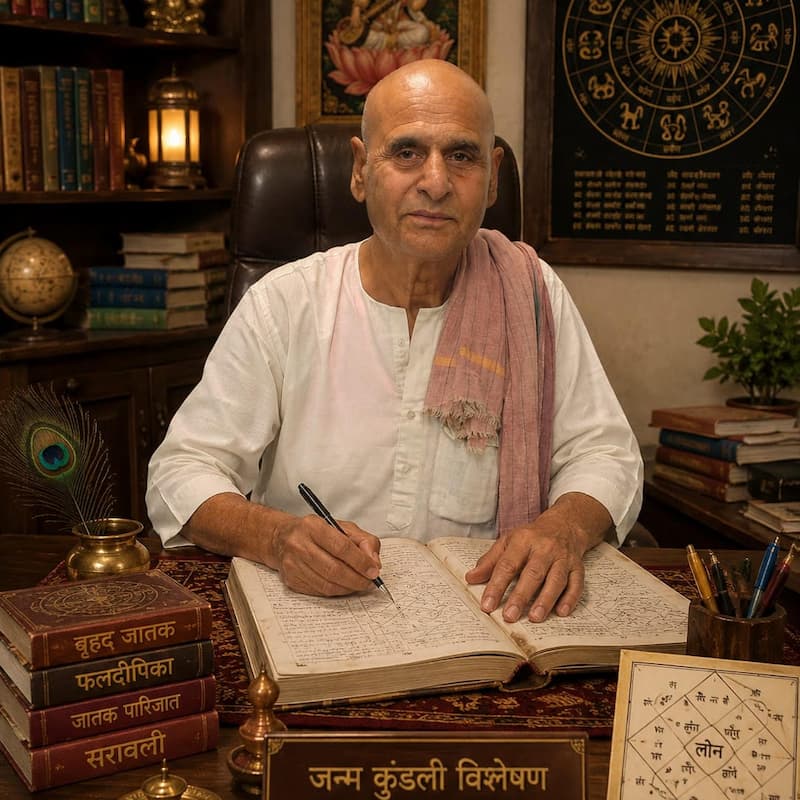
Narendra Kumar Chaubey is a Jyotisha Acharya with over 30 years of experience, based in Bihar and serving clients across India in Vedic astrology, mantra shastra, Vastu and ritual practice.
He completed his formal training at Kameshwar Singh Darbhanga Sanskrit University (KSDSU), one of India’s oldest and most respected institutions for Vedic and Sanskrit scholarship, where he studied Jyotisha shastra, mantra vidya and related classical sciences. KSDSU’s tradition of rigorous Sanskrit education tracing directly to the Mithila region’s centuries-old pandit lineage forms the foundation of his practice.
Over three decades, Narendra Kumar Chaubey has worked with thousands of individuals and families across Bihar and across India, offering guidance in:
- Kundli (birth chart) analysis: Identifying karmic patterns, planetary periods and life path guidance through classical Jyotisha
- Palmistry (Hasta Samudrika): Reading the hand according to the classical Samudrika Shastra tradition
- Vastu Shastra: Assessment and correction of living and working spaces according to directional and elemental principles
- Mantra and Pooja vidhi: Performing and guiding all categories of puja, havan, and mantra sadhana for personal, family and business situations
- Predictive Jyotisha: Transit analysis, muhurta (auspicious timing) selection and remedial guidance
He works across four languages Sanskrit, Hindi, English and Bhojpuri making classical knowledge accessible to practitioners across educational backgrounds and regions.
His writing for ABMantra brings the precision of classical Vedic training to practical mantra guidance: not general advice but specific prescriptions grounded in shastra, lineage and 30 years of direct practice with real situations.
For more info follow on: