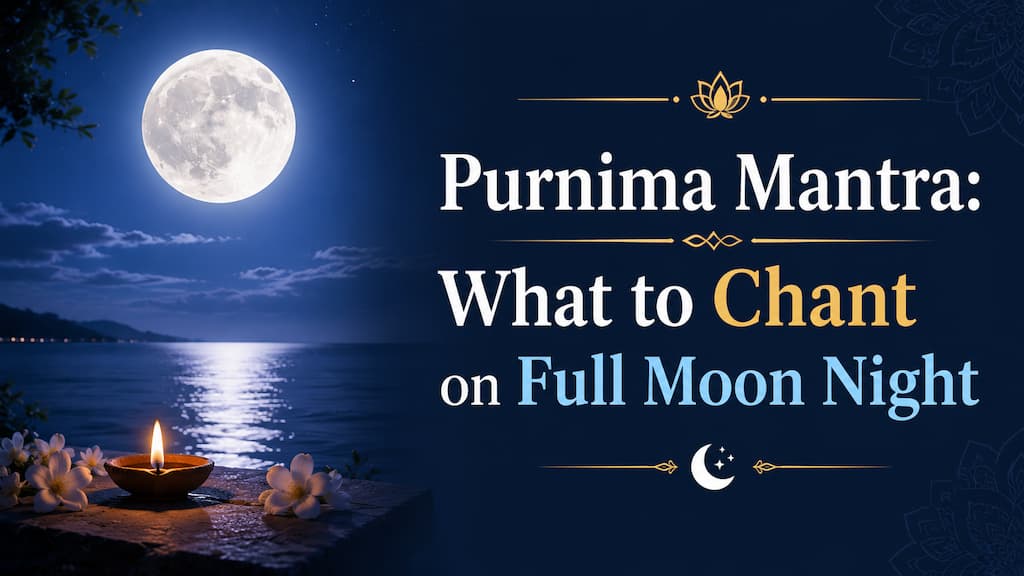

The Purnima mantra practice is something most people know exists but few know how to do properly. Most people know Purnima is auspicious. Fewer know what to actually do on the night. The standard advice – fast, offer prayers, do charity – is correct but incomplete. What makes Purnima different from any other day of Chandra mantra practice is not just timing. It is the specific combination of the Arghya (the physical milk offering to the Moon), the three Purnima mantras chanted in the right sequence, and the understanding of why this night specifically carries more concentrated lunar energy than any other. This guide covers the Purnima mantra practice from start to finish – what to chant, in what order, with what offering, and what the 15 Kalas have to do with all of it.
Why Purnima Is Not Just Another Good Day for Moon Practice
The Moon has 15 Kalas – 15 aspects or energies that map to the 15 lunar days (tithis) of each fortnight. On Amavasya (new moon), only one Kala remains. On the second tithi after Amavasya, two Kalas are present. This builds through the Shukla Paksha (waxing fortnight) until Purnima, when all 15 Kalas are simultaneously present.
The tradition holds that each Kala governs a specific quality: Amrit (nectar), Manada (honour), Pusa (nourishment), Pushti (prosperity), Tushti (contentment), Rati (love), Dhruti (patience), Shashini (the lunar light), Chandrika (the cool brightness), Kanta (beauty), Jyotsna (moonlight), Shri (grace), Priti (affection), Angada (ornament) and Purna (fullness). On Purnima, all 15 are active. The Moon is not simply bright – it is at the one moment of the month when its full range of qualities is accessible simultaneously.
Chanting on Purnima is not the same mantra at a better time. It is the mantra reaching a Moon that has all its resources available at once.
This is also why Purnima practice produces results faster than the same practice at other times. One Purnima practice session, done correctly, is generally understood in the tradition to carry the weight of 15 regular days of the same practice. That is not a figure of speech. It reflects the Kala structure directly – 15 Kalas present means 15 times the concentration of Chandra’s full energy in a single night.
The Three Purnima Mantras
Three specific mantras are traditionally chanted on Purnima in sequence. Most articles list the first and stop there. All three together form the complete Purnima invocation.
Mantra 1: Om Somaya Namah
Meaning: I bow to Soma – the Moon as the divine nourisher, the carrier of the nectar of bliss that sustains all living beings.
Role in the Purnima sequence: This is the opening invocation – the most widely known and most direct address to the Moon. It opens the Purnima practice. Chanted facing the Moon, 11 times, as the first act after moonrise.
Why Soma on Purnima specifically: Soma is the Moon’s identity as nourishment. On Purnima, with all 15 Kalas present, the Soma quality is at its annual peak. Chanting Om Somaya Namah at this moment invokes the nourishing Moon at the moment it has the most to give.
Mantra 2: Om Rohinikantaya Namah
Meaning: I bow to the beloved of Rohini – the Moon (Rohinikanta) in his most auspicious relationship.
Why this mantra matters on Purnima: The Moon’s 27 wives are the 27 Nakshatras, but Rohini is his favourite – the one he is said to love most and visit most often. Rohini is the Moon’s own Nakshatra: the sign of his exaltation (Taurus) contains Rohini, and Rohini is where the Moon is most himself. Om Rohinikantaya Namah invokes the Moon’s most harmonious and fully-expressed identity – the Chandra who is most at peace, most generous, most nourishing. On Purnima, when Chandra is at his fullest, this invocation of his most loving aspect amplifies the night’s grace.
This mantra is particularly potent on: Any Purnima when the Moon is transiting near Rohini Nakshatra, and on Sharad Purnima specifically (see the Sharad Purnima section below).
Mantra 3: Om Chandramase Namah
Meaning: I bow to Chandramas – the Moon as the measurer of time, the keeper of the lunar cycle, the one who governs the rhythm of the month.
Role in the sequence: This is the closing mantra of the three-mantra Purnima set. Where Om Somaya Namah addresses the Moon’s nourishing quality and Om Rohinikantaya Namah addresses his most harmonious aspect, Om Chandramase Namah addresses his cosmic function: the Moon as time itself, as the rhythm that governs the month, the menstrual cycle, the tides, the agricultural cycle, and the practitioner’s own emotional rhythms. Chanting this at the end of the Purnima sequence is an act of gratitude and acknowledgment – recognising the Moon not only as a source of personal benefit but as the cosmic timekeeper whose rhythm underlies all of life.
Count in the sequence: 11 times each mantra, in order: Om Somaya Namah, Om Rohinikantaya Namah, Om Chandramase Namah. Then: Chandra Beej Mantra 108 times. Then: the Arghya.
The Chandra Arghya: The Most Important Purnima Act
The Arghya is the physical offering to the Moon – a vessel of milk or water held up toward the moonlight and released while chanting. Of everything in the Purnima practice, the Arghya is the most specific to this night. You can chant the Chandra mantra any day of the month. The Arghya, offered directly to the visible full Moon at its peak, is a Purnima-only practice.
How to perform the Chandra Arghya:
- After moonrise, stand outdoors where you can see the Moon directly. Face the Moon.
- Hold a copper or silver vessel (a small Kalash or a copper tumbler works) filled with milk or clean water. Both hands hold the vessel at chest height.
- Slowly pour the milk toward the Moon while chanting: Om Somaya Namah – three times during the pouring.
- As the milk flows downward (catch it in a bowl or pour it onto earth or a plant), the practice teaches that you are offering the Moon’s own nourishment back to him – returning to the source what it gave you. This is the specific intention of the Arghya: reciprocity, not petition.
- After the Arghya: sit in silence for 5 minutes facing the Moon. No chanting, no movement. Just the presence of the Purnima light.
The Dhyana Shloka for Purnima
नमामि शशिनं भक्त्या शम्भोर्मुकुटभूषणम्।।
Namami Shashinam Bhaktya Shambhor Mukuta Bhushanam
Meaning: White as curds (dadhi), white as a conch shell (shankha), white as snow (tushara) – born from the ocean of milk (Kshirodarnava) – I bow with devotion to the Moon (Shashinam), who adorns Shiva’s crown.
How to use this on Purnima: Chant once at the beginning of the evening practice, before the three Purnima mantras begin. It establishes the visual meditation – the cool, white, luminous Moon as the object of devotion for the night. On Purnima, when the Moon is actually visible at its fullest, this shloka bridges the visual reality (you can see the Moon) and the devotional reality (you are now in a specific relationship with it).
The Complete Purnima Practice Sequence
| Step | When | What | Count |
|---|---|---|---|
| 1. Morning bath and fast | Sunrise | Bathe. Begin the Purnima Vrat (fast). White clothing. Donate white items (rice, milk, white cloth) before noon. | One time |
| 2. Daytime mantra | Any time during the day | Om Som Somaya Namah – informal chanting throughout the day as the fast is kept | As many times as possible |
| 3. Evening puja setup | 1 hour before moonrise | Arrange the puja space: Chandra image or yantra, white flowers, milk vessel for Arghya, ghee lamp, white sandalwood paste, fresh rice | Preparation |
| 4. Dhyana Shloka | At moonrise | Dadhishankhatusharabham… – once, while visualising the Moon | 1 time |
| 5. Three Purnima Mantras | After moonrise | Om Somaya Namah (11 times), Om Rohinikantaya Namah (11 times), Om Chandramase Namah (11 times) – in this order | 11 + 11 + 11 |
| 6. Chandra Beej Mantra | After the three mantras | Om Shraam Shreem Shraum Sah Chandramase Namah – the main count. On Purnima, 1,008 times is the traditional prescription. Minimum: 108 times. | 108 to 1,008 |
| 7. Chandra Arghya | After the Beej Mantra count | Hold milk vessel toward the Moon, pour while chanting Om Somaya Namah 3 times | 1 Arghya, 3 mantras during pouring |
| 8. Silence | After the Arghya | 5 minutes of stillness facing the Moon. No chanting. | 5 minutes |
| 9. Break the fast | After the puja | Prasad: kheer (rice pudding made with milk), white sweets. The kheer is placed in moonlight before being eaten – a specific Purnima practice that the Sharad Purnima section addresses in detail. | Prasad |
The Major Purnimas: Different Nights, Different Emphasis
There are 12 or 13 Purnimas in a year (13 in years with Adhik Maas, the extra lunar month). Each has a different presiding deity or festival association. The mantra practice is the same across all of them; what changes is the secondary deity focus and the specific ritual additions.
| Purnima | Month | Primary festival/deity | What to add to the standard practice |
|---|---|---|---|
| Sharad Purnima | Ashvin (October) | Lakshmi, Chandra – the most potent Purnima of the year for Moon practice | Place a bowl of kheer (rice cooked in milk with sugar) in direct moonlight for at least 2 hours before eating. The tradition holds that on Sharad Purnima, the Moon’s rays carry Amrita (nectar) that enters food placed directly in the moonlight. Also: Om Shreem Mahalakshmyai Namah 108 times (Lakshmi is specifically present on this night). |
| Kartik Purnima | Kartik (November) | Vishnu, Satyanarayan, Tulsi | Satyanarayan Puja is traditionally performed on this Purnima. Lighting diyas on rivers or water bodies at dusk (Dev Diwali). Om Namo Bhagavate Vasudevaya 108 times in addition to the Chandra mantras. |
| Guru Purnima | Ashadha (July) | Guru (teacher), Vyasa | Guru Vandana (salutation to one’s teacher) is the primary practice. Chandra mantras are chanted as part of the general Purnima practice but the Guru’s mantra (if received) takes precedence on this night. |
| Buddha Purnima | Vaishakh (May) | Vishnu’s Dashavatar connection, Buddha Jayanti | Standard Purnima practice. Om Namo Bhagavate Vasudevaya for the Vishnu dimension. Meditation and silence are specifically appropriate on this night. |
| Magh Purnima | Magh (February) | Vishnu, river bathing, ancestral merit | Snan (ritual bath) in a sacred river or at home with Ganga Jal added to bathwater is the primary Magh Purnima practice. Ancestor offerings (Pitru Tarpana) are performed before the evening Chandra puja. |
| Phalgun Purnima | Phalgun (March) | Holika Dahan, Chandra | Holika Dahan at night. The Chandra puja is performed before the bonfire. Some traditions hold that Chandra Dev was born on this Purnima. |
Sharad Purnima: Why This One Is Different
If you can observe only one Purnima of the year with full practice, Sharad Purnima is the one. The tradition’s reasoning is specific, not generic.
Sharad Purnima falls in Ashvin (October), just after the monsoon season ends. The sky is clear of clouds for the first time in months. The Moon rises full and unobstructed into a transparent autumn sky. On this specific night, the tradition holds that the Moon’s rays carry Amrita – the nectar of immortality – most directly to the earth. Raj Rishi Charak, the Ayurvedic physician, is said to have verified this by placing medicated milk in moonlight on Sharad Purnima and observing that specific healing properties developed in the milk that were not present on other nights.
Whether or not one accepts this literally, the practice tradition is clear: kheer placed in direct moonlight on Sharad Purnima and then eaten is considered the most potent single nourishment act of the lunar year. The combination of Lakshmi worship (she is specifically present on this night in the tradition), the Chandra Arghya with milk, and the moonlit kheer makes this the most densely layered of all Purnima practices.
The kheer has to actually sit in the moonlight, not near a window. Outdoors, in direct moonlight, for at least two hours. That is the practice – not approximate it.
The Akshaya Punya Principle
Hindu Blog mentions Akshaya Punya in connection with Purnima but does not explain it. It is worth understanding because it changes why you do the Purnima practice, not just how.
Akshaya means “that which does not diminish” – inexhaustible, undecaying. Punya means merit, the positive karmic credit generated by virtuous acts. The tradition holds that acts of virtue performed on Purnima generate Akshaya Punya – merit that does not decay with time and that continues to generate positive results across future lives as well as the current one. The same act of charity on an ordinary day generates Punya that diminishes and eventually exhausts itself. On Purnima, the Punya generated by the same act of charity is held to be permanent.
This is why the Monday donation (white items to those in need) is particularly important when it coincides with Purnima. The convergence of Moon’s day and Moon’s night creates the maximum Punya-generating window in the monthly cycle.
I have observed Purnima practice in my own home for 30 years, and the single change that produces the most consistent result is the outdoor Arghya. Not the mantra count (though that matters), not the fast (though that helps) – the act of standing outside at moonrise with a copper vessel of milk and offering it directly to the Moon’s light. Something happens in that act that indoor practice does not replicate. The Moon is actually there. You are in direct physical relationship with the thing you are chanting to. The mantra becomes less of a recitation and more of a conversation.
For clients who cannot manage the 1,008-count Beej Mantra on Purnima (which is about 2.5 to 3 hours of practice), I always tell them the same thing: the Arghya is non-negotiable, the full count is optional. Five minutes outdoors with a vessel of milk, three repetitions of Om Somaya Namah while pouring, five minutes of silence afterward – this, done with genuine attention, is worth more than an hour of indoor distracted chanting. The physical reality of Purnima is part of the practice. The Moon is there. Use it.
Sharad Purnima specifically: I have eaten the moonlit kheer every year for 30 years and I can tell you that the quality of the night’s sleep after it is genuinely different from other nights. That may be the power of the practice, or the power of expectation, or both. I am not interested in separating them. The tradition preserved this practice for a reason. The kheer in the moonlight and the sleep that follows are specific enough that I notice when I miss the practice.
Frequently Asked Questions
- Wikipedia – Purnima: the full moon day in the Hindu lunar calendar, the 12 annual Purnimas and the 13th in Adhik Maas years, major festivals associated with each Purnima, and the ritual traditions of fasting, bathing and charity
- Wikipedia – Sharad Purnima: the Ashvin full moon as Kojagari Purnima, the kheer placed in moonlight tradition, Lakshmi worship, and the Amrita-ray belief
- Brihat Parashara Hora Shastra – the 15 Chandra Kalas and their correspondence to the 15 Shukla Paksha tithis; the Moon’s maximum Shadbala at Purnima; the Akshaya Punya principle for virtuous acts performed on auspicious tithis
- Wikipedia – Chandra: Rohini as the Moon’s favourite Nakshatra wife; the Moon’s 27 Nakshatra wives; Soma as the nourishing nectar the Moon carries and distributes through its rays
Moon Mantra Benefits: complete Chandra Mantra guide for mind, emotions and healing
Chandra Beej Mantra: Om Shraam Shreem Shraum complete meaning and practice
Moon Mantra for Mental Peace: the 3am mind, Visha Yoga and Shakata Yoga guide
Chandra Mantra for Weak Moon: astrological remedy and diagnosis guide
Narendra Kumar Chaubey is a Jyotisha Acharya with over 30 years of experience, based in Bihar and serving clients across India in Vedic astrology, mantra shastra, Vastu and ritual practice.
He completed his formal training at Kameshwar Singh Darbhanga Sanskrit University (KSDSU), one of India’s oldest and most respected institutions for Vedic and Sanskrit scholarship, where he studied Jyotisha shastra, mantra vidya and related classical sciences. KSDSU’s tradition of rigorous Sanskrit education — tracing directly to the Mithila region’s centuries-old pandit lineage — forms the foundation of his practice.
Over three decades, Narendra Kumar Chaubey has worked with thousands of individuals and families across Bihar and across India, offering guidance in:
- Kundli (birth chart) analysis — identifying karmic patterns, planetary periods and life path guidance through classical Jyotisha
- Palmistry (Hasta Samudrika) — reading the hand according to the classical Samudrika Shastra tradition
- Vastu Shastra — assessment and correction of living and working spaces according to directional and elemental principles
- Mantra and Pooja vidhi — performing and guiding all categories of puja, havan, and mantra sadhana for personal, family and business situations
- Predictive Jyotisha — transit analysis, muhurta (auspicious timing) selection and remedial guidance
He works across four languages — Sanskrit, Hindi, English and Bhojpuri — making classical knowledge accessible to practitioners across educational backgrounds and regions.
His writing for ABMantra brings the precision of classical Vedic training to practical mantra guidance: not general advice but specific prescriptions grounded in shastra, lineage and 30 years of direct practice with real situations.