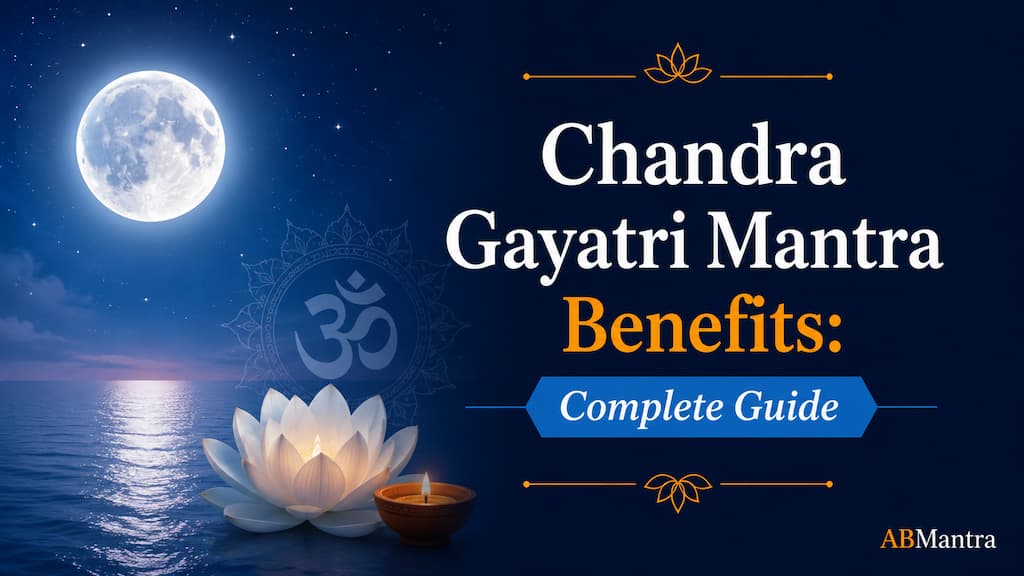

The Chandra Gayatri Mantra benefits s are specific to the Gayatri meter itself. The Chandra Gayatri Mantra does something that the Chandra Beej Mantra and Om Som Somaya Namah do not. Every Gayatri mantra ends with Prachodayat – “illuminate and guide my intellect.” That final line is not ceremonial. It is the reason the Gayatri meter exists. The Gayatri form, across all deities, is specifically the prayer for Dhi – the higher intelligence, the discriminating faculty that separates understanding from confusion. When you chant the Chandra Gayatri, you are asking Chandra to nourish your emotional mind AND direct that nourishment specifically toward the illumination of your intellect. No other Chandra mantra makes this request. Understanding the Chandra Gayatri Mantra benefits requires understanding what the Gayatri meter is asking for and why.
The Four Forms: Which Chandra Gayatri Is Correct?
Open four different websites and you will find four different Chandra Gayatri mantras. None of the websites explains why they differ. This is the question the article addresses first because it is the practical question every practitioner faces before beginning.
There are four forms in circulation, each from a different lineage or tradition. All four are valid. They address different aspects of Chandra’s identity.
तन्नो चन्द्रः प्रचोदयात्।।
Tanno Chandrah Prachodayat
Form 1 – The primary form (most widely used). Addresses Chandra as Kshiraputra: the son of the milk ocean (who emerged during the churning of the Kshira Sagara). Meditates on Amritatva: the quality of immortal nectar. This form is the most widely prescribed across Jyotisha traditions for astrological remedy, student practice, and Monday worship. When in doubt, use this form.
तन्नो सोमः प्रचोदयात्।।
Tanno Somah Prachodayat
Form 2 – The night and Kala form. Addresses Chandra as Nishakar (maker of night) and Kalanath (lord of the arts and skills). Ends with Somah rather than Chandrah. This form is used specifically when the intention is artistic or creative development, or when the practitioner wants to work with the Moon’s Kalanath quality: the governance of all aesthetic expression and skill. The word Kala here means both “time” and “the arts” – both are Chandra’s domain.
तन्नो चन्द्रः प्रचोदयात्।।
Tanno Chandrah Prachodayat
Form 3 – The beauty and radiance form. Addresses Chandra as Padmadwaja (whose flag bears the lotus) and Hemarupa (whose form is golden). Despite the Moon being associated with silver and white, this form invokes Chandra’s luminous, golden-radiant quality – the light aspect rather than the cool nourishing aspect. Used for beauty, physical radiance, skin health, and the Moon’s governance of the body’s luminous quality.
तन्नो सोमः प्रचोदयात्।।
Tanno Somah Prachodayat
Form 4 – The nectar-river form. Addresses Chandra as Amritganga (the river of nectar) and Kalarupa (embodiment of all the arts and time cycles). This form is used in traditions that emphasise the Moon’s relationship with the divine nectar (Amrita) that flows from Shiva’s matted hair alongside the Ganga. Less common in mainstream Jyotisha practice; more common in Shaiva-adjacent traditions.
The Three-Line Structure: What the Gayatri Actually Does
This is the section most articles on the Chandra Gayatri skip entirely. Every Gayatri mantra, across all deities, follows the same three-line structure – and each line does a specific thing. Understanding the structure tells you what you are actually asking for when you chant.
Using Form 1 as the example:
Line 1 – Vidmahe (Recognition): Om Kshiraputraya Vidmahe
Vidmahe means “we know” or “we seek to know.” The first line of a Gayatri mantra identifies the deity by their most specific and meaningful name or quality. For Chandra, the choice of Kshiraputra (son of the milk ocean) is deliberate: it connects Chandra to the Samudra Manthan (the cosmic churning from which he emerged along with Lakshmi, Dhanvantari and the divine nectar), establishing his identity as a being of cosmic origin carrying the nourishment of the ocean. Vidmahe at the end of this line is not passive – it is an active declaration: I am coming to know this deity directly, not through description.
The first line sets the address. You are not directing this mantra to “the Moon” in general – you are directing it to the specific aspect of Chandra that emerged from the cosmic ocean carrying divine nourishment.
Line 2 – Dhimahi (Meditation): Amritattvaya Dhimahi
Dhimahi means “we meditate upon.” The second line identifies the essential quality – the Tattva – of the deity that you are going to meditate on. For Chandra, the choice of Amritatva (the quality of Amrita – immortal nectar, the undying nourishment) is the deepest possible identification. Amrita is not simply a substance in the mythology; it is the quality of that which does not decay, that which genuinely sustains and nourishes without diminishing. This is Chandra’s most essential function in the cosmos: to carry and distribute this undying nourishing quality through his rays to all living beings every night. Dhimahi asks the practitioner to hold this quality in sustained meditative attention – not simply to know it intellectually but to dwell in it.
The second line is where the practice lives. Vidmahe identifies; Dhimahi meditates. The difference between a Gayatri recitation and a Gayatri practice is whether the practitioner is genuinely dwelling in Amritatva during the Dhimahi line or simply reciting syllables.
Line 3 – Prachodayat (Aspiration): Tanno Chandrah Prachodayat
Prachodayat means “may [the deity] inspire, guide, and illuminate.” Tanno means “our.” The third line is the specific request that defines the Gayatri meter – and this is what every Gayatri mantra asks for, regardless of which deity it addresses. Not wealth, not protection, not health. Specifically: the illumination of the Dhi. The Dhi (धी) is the higher intellectual faculty – the discriminating intelligence that perceives accurately, understands deeply, and navigates wisely. The Prachodayat line asks Chandra to specifically direct his illuminating quality toward this faculty. May Chandra’s light not only nourish my emotional mind (Manas) but specifically illuminate my higher understanding (Dhi).
This is why the Chandra Gayatri is specifically recommended for students, scholars, writers, healers, and anyone whose work requires both emotional attunement (Chandra’s Manas quality) and clear discrimination (the Dhi the Gayatri illuminates). The Gayatri asks for both simultaneously, in one mantra.
The Chandra Gayatri is the mantra I prescribe most consistently for two specific types of clients: students approaching significant examinations, and healers – doctors, therapists, counsellors, nurses – who work at the intersection of emotional attunement and clinical judgment. Both groups need what the Chandra Gayatri specifically asks for: the Amritatva quality applied to the Dhi.
For students: the Moon governs memory and the receptive mind that takes in new knowledge. A strong, well-illuminated Moon produces what most students recognise as “flow” – the state in which studying is effortless, retention is natural, and the relationship between concepts is visible without forced effort. The Chandra Gayatri, chanted 11 times before the study session rather than after it, primes this receptive state. I have prescribed this to students facing board examinations for 25 years. The ones who maintain a consistent Monday practice of 108 times through their examination period consistently report that the study feels cleaner – less resistance, less mental fatigue, better retention.
For healers specifically: the Dhimahi line – meditating on Amritatva – produces what I can only describe as a quality of sustained nourishing attention. The healer who chants this mantra regularly finds that they are more able to remain genuinely present with a patient without taking on the patient’s distress. This is the Amritatva quality at work: the nectar that nourishes without depleting. The healer gives but does not run dry. In 30 years I have never found a more appropriate mantra for the compassion fatigue that health professionals quietly carry.
Chandra Gayatri Mantra Benefits
The benefits of the Chandra Gayatri Mantra are best understood by tracking the three-line structure. Each line generates a specific benefit as it is practiced.
From the Vidmahe line (Kshiraputra – recognition of origin)
- Connection to ancestral and cosmic nourishment: Recognising Chandra as the son of the milk ocean establishes a relationship with the original source of divine nourishment. Practitioners report that consistent Kshiraputra meditation produces a quality of feeling genuinely sustained – not by external circumstances but by something deeper. This is the cosmic milk ocean as inner resource.
- Resolution of maternal patterns: Kshiraputra imagery (the Moon born from the ocean of milk) works specifically on the maternal-nourishment dimension of the Moon’s influence. For practitioners whose relationship with maternal nourishment is complicated, the Vidmahe line offers a different image: a nourishment that is cosmic in origin, always available, not dependent on the human mother having provided it.
From the Dhimahi line (Amritatva – meditation on immortal nectar)
- Reduction of fear and existential anxiety: Amritatva – the quality of that which does not decay or end – is the specific antidote to the existential fear of loss that an afflicted Moon produces. Sustained meditation on Amritatva gradually reduces the emotional charge of the fear of ending, diminishing, or losing what one loves. This is different from suppression; it is a genuine exposure to a quality of consciousness that transcends the temporary.
- Physical nourishment and vitality: The Amrita quality governs the Moon’s physical dimension: bodily fluids, the lymphatic system, the immune system’s nourishing functions, and the overall vital fluid quality of the body. Sustained Dhimahi meditation on Amritatva supports the body’s own nourishing systems – the tradition holds that Chandra’s Amrita rays, brought into the body through meditative attention during the Dhimahi line, literally nourish the physical tissues.
- Creative inspiration and imaginative depth: Amritatva is also the quality of inexhaustible creative resource – the fountain that does not run dry. Artists, writers and musicians who practice the Chandra Gayatri consistently report increased access to their creative depth. This is the Amritatva quality working on the creative-imaginative dimension of the Moon’s influence.
From the Prachodayat line (illumination of Dhi)
- Improved memory and learning capacity: The Dhi illumination specifically affects the Moon’s governance of memory. The Chandra Gayatri is among the most traditionally prescribed mantras for students precisely because the Prachodayat line asks Chandra to direct his illuminating quality specifically toward the learning faculty.
- Clarity in decision-making: The Dhi is the discriminating intelligence – the faculty that perceives the right action in a given situation. When the Moon is weak or the emotional mind is agitated, this faculty is clouded by emotional noise. The Prachodayat line specifically asks Chandra to cut through this and illuminate the higher understanding directly.
- Integration of feeling and knowing: This is the benefit that most distinguishes the Chandra Gayatri from purely intellectual practices. The Gayatri does not ask Chandra to suppress the emotional mind in favour of clear thinking. It asks him to illuminate the intellect through the emotional mind – to bring the Dhi into alignment with the Manas, so that feeling and knowing work together rather than against each other. This integration is Chandra’s specific gift when the Gayatri is practiced consistently.
Chandra Gayatri vs Other Chandra Mantras: When to Use Which
| Mantra | Primary function | Best for | Not the best choice when |
|---|---|---|---|
| Chandra Gayatri (Kshiraputraya form) |
Dhi illumination + Moon strengthening. The three-line structure meditates on Amritatva and asks for Dhi illumination specifically. | Students, intellectuals, healers, creative workers. Opening practice (11 times) before study or intellectual work. Monday morning formal practice. | Acute emotional distress or 3am anxiety – the Gayatri’s meditative quality requires a stable mind to engage fully. In acute emotional states, Om Som Somaya Namah is more immediately appropriate. |
| Chandra Beej Mantra (Shraam Shreem Shraum) |
Concentrated planetary energy. Works at the chart level on the Moon’s astrological strength. | Astrological remedy for weak or afflicted Moon. Moon Mahadasha support. Kemadruma Yoga. Main Monday count (108 times). | When the practitioner wants specifically intellectual or creative benefit – the Gayatri is more precise for this. |
| Om Som Somaya Namah | Gentle nourishing resonance with Chandra as Soma. Immediate and accessible. | Before sleep. Emotional distress. Children. Informal practice throughout the day. For practitioners who want the simplest possible approach. | Serious astrological remedy – the simple name mantra is too light for chart-level Moon weakness. |
| Om Chandramase Namah / Om Rohinikantaya Namah | Purnima-specific mantras addressing Chandra as timekeeper and as beloved of Rohini. | Purnima practice. The Arghya (milk offering to the Moon). Specifically on full moon night. | Daily practice – these are ceremony-specific rather than regular Japa mantras. |
Practice Guide
| Practice | Time | Count | Notes |
|---|---|---|---|
| Pre-study / pre-work practice | Before beginning intellectual work at any time | 11 times | Chant Form 1 (Kshiraputraya). No mala needed. Eyes closed, 30 seconds of silence after the 11th repetition before beginning work. |
| Monday morning formal practice | Brahma Muhurta or sunrise | 108 times | After the Dhyana Shloka (once) and before or after the Chandra Beej Mantra. White crystal or pearl mala. |
| Children’s daily practice | Before school or homework | 11 times | Form 1. No mala required. Parent can chant alongside for the first few weeks. |
| Healer / caregiver practice | Before beginning work with patients or clients | 11 times | With specific focus on the Dhimahi line – genuinely dwell in Amritatva for the 3 seconds of each repetition’s second line. |
| 40-day Purashcharan | Monday Brahma Muhurta, daily | 108 times daily (4,320 total) | Begin on a Monday in Shukla Paksha. Complete without breaking the daily count. Traditional completion: donate white items on the final Monday. |
- Wikipedia – Gayatri Mantra: the 24-syllable Gayatri meter, the Vidmahe-Dhimahi-Prachodayat three-line structure, the Dhi (higher intellect) as the specific object of the Prachodayat aspiration, the original Savitri Gayatri and how Navagraha Gayatris inherit its structure
- Wikipedia – Chandra: Kshiraputra as the Moon’s identity born from the Samudra Manthan (churning of the milk ocean); Amrita and the Moon’s role in distributing it through lunar rays; the Moon as Oshadhipati (lord of herbs) and Soma (divine nourisher)
- Brihat Parashara Hora Shastra – the Chandra Gayatri Mantra as the prescribed Gayatri-meter remedy for Moon-related chart issues; the 40-day Purashcharan protocol; Monday (Soma-vara) as the primary practice day; Pearl (Moti) and white items as Chandra’s specific gemstone and charity
- Wikipedia – Samudra Manthan: the churning of the cosmic milk ocean from which Chandra emerged alongside Lakshmi, Dhanvantari and Amrita – the Puranic origin story that the Kshiraputra name in the primary Chandra Gayatri references
Moon Mantra Benefits: all Chandra Mantras including the Gayatri in the complete Monday practice
Chandra Beej Mantra: Om Shraam Shreem Shraum complete meaning and astrological remedy
Moon Mantra for Mental Peace: when the Gayatri is and is not the right choice
Gayatri Mantra meaning: the original Savitri Gayatri whose three-line structure all Navagraha Gayatris inherit
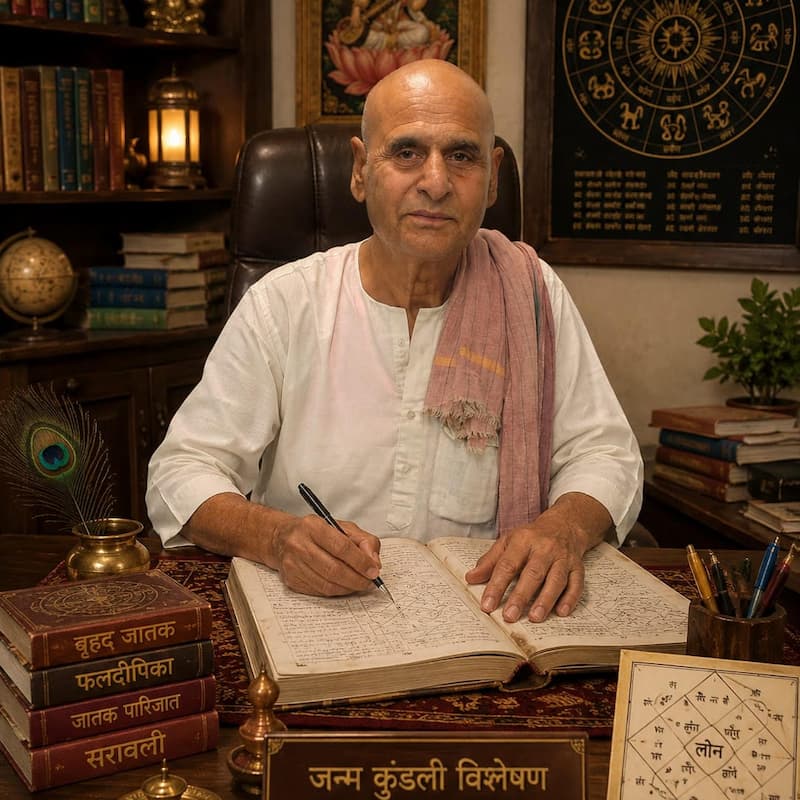
Narendra Kumar Chaubey is a Jyotisha Acharya with over 30 years of experience, based in Bihar and serving clients across India in Vedic astrology, mantra shastra, Vastu and ritual practice.
He completed his formal training at Kameshwar Singh Darbhanga Sanskrit University (KSDSU), one of India’s oldest and most respected institutions for Vedic and Sanskrit scholarship, where he studied Jyotisha shastra, mantra vidya and related classical sciences. KSDSU’s tradition of rigorous Sanskrit education tracing directly to the Mithila region’s centuries-old pandit lineage forms the foundation of his practice.
Over three decades, Narendra Kumar Chaubey has worked with thousands of individuals and families across Bihar and across India, offering guidance in:
- Kundli (birth chart) analysis: Identifying karmic patterns, planetary periods and life path guidance through classical Jyotisha
- Palmistry (Hasta Samudrika): Reading the hand according to the classical Samudrika Shastra tradition
- Vastu Shastra: Assessment and correction of living and working spaces according to directional and elemental principles
- Mantra and Pooja vidhi: Performing and guiding all categories of puja, havan, and mantra sadhana for personal, family and business situations
- Predictive Jyotisha: Transit analysis, muhurta (auspicious timing) selection and remedial guidance
He works across four languages Sanskrit, Hindi, English and Bhojpuri making classical knowledge accessible to practitioners across educational backgrounds and regions.
His writing for ABMantra brings the precision of classical Vedic training to practical mantra guidance: not general advice but specific prescriptions grounded in shastra, lineage and 30 years of direct practice with real situations.
For more info follow on: