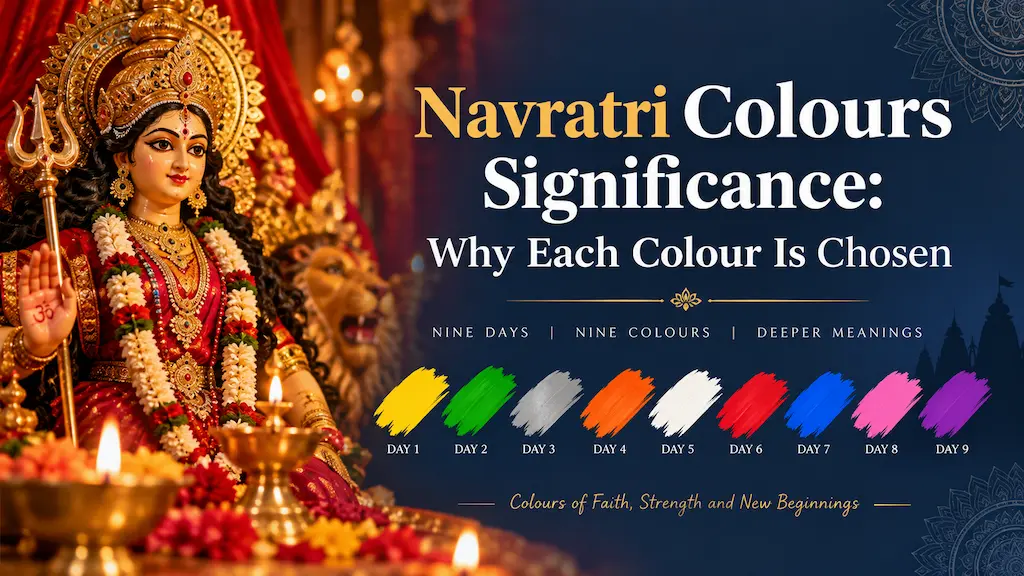

If you have looked up the Navratri colours before, you have noticed something confusing: different websites give different colours for the same day. One source says Day 1 is yellow. Another says royal blue. A third says orange. A fourth says white. All of them state their list confidently, none of them explain why they differ from other sources, and most readers conclude that one list must be right and the others wrong. This article gives the actual answer – why the lists differ, where the colour tradition comes from, and what each colour genuinely means in the Shakta tradition that Navratri belongs to.
Why the Navratri Colour Lists Differ
The nine-colour daily sequence associated with Navratri is not an ancient tradition with a single canonical source. It has no definitive origin in the Devi Bhagavata Purana, the Devi Mahatmyam or any primary Navratri scriptural text. The colour sequence became widely associated with Navratri in the late 20th century and gained significant prominence in the 2000s, partly through fashion industry marketing (saree and lehenga brands promoting themed daily purchases) and partly through the spread of WhatsApp-circulated Navratri calendars whose original sources were never verified.
Different colour lists circulate because different organisations, temples and regional traditions independently created their own sequences – each drawing on genuine Shakta colour symbolism but applying it to the nine days in a different order. The sequences that exist today are all legitimate in their symbolic logic; they differ in how that logic has been applied.
What IS ancient and canonical is the Shakta tradition’s deep understanding of what each individual colour means. Every colour in the Navratri palette carries genuine spiritual significance in the tradition – the dispute is only about which colour goes with which day, not about what any individual colour means. Understanding the colour symbolism itself is therefore more important than memorising any particular sequence.
The Origin of Colour in the Shakta Tradition
In the Shakta and Tantric traditions, colour is not decorative. Colour is vibration – a specific frequency of light that carries a corresponding quality of energy. The Tantric tradition developed an elaborate colour-energy system over centuries in which specific colours are understood to activate, invoke or align the practitioner with specific divine qualities.
This is the framework within which the Navratri colours operate. When a devotee wears yellow on a day associated with joy and learning, they are not following a fashion trend. They are performing a Bhavana – a deliberate alignment of their outer environment with an inner quality they wish to cultivate. The colour worn becomes a continuous reminder throughout the day of the quality being invoked.
The three primary sacred colours in the Shakta tradition are red, white and yellow. These three – the colours of the goddess in her three fundamental aspects (Kali = dark/black, Lakshmi = red/gold, Saraswati = white) – appear across all Navratri colour systems and are the most consistently assigned across different sources.
What Each Navratri Colour Means in the Shakta Tradition
Red – Shakti in Its Most Active Form
Red is the primary colour of Shakti – the divine feminine energy in its most concentrated, active expression. In the Tantric colour system, red is the colour of Lalita Tripura Sundari (the highest goddess of the Sri Vidya tradition), the colour of the Muladhara chakra (the root, the foundation of all energy), and the colour of the three Bindus (points of energy) in the Sri Chakra. Red appears across all Navratri day sequences and is most frequently associated with Katyayani (the warrior), Brahmacharini (the heat of tapasya) and Shailputri (the root foundation). Whichever day your tradition assigns red, its meaning is consistent: active divine power, the fire of righteous action, the energy of the goddess in her most purposeful and concentrated form.
Yellow – Radiance, Knowledge and Auspicious Beginning
Yellow is the colour of Savitur (the solar generating principle), of Saraswati in her Vasant Panchami form, and of the Gayatri Mantra’s dawn practice. In the Hindu tradition, yellow (specifically the saffron-gold of turmeric and marigold) is the colour of auspiciousness – of things beginning well, of the warmth that sustains rather than burns. Yellow is universally used at the start of major religious events because it carries the quality of joyful, life-sustaining radiance. Most Navratri sequences place yellow on Day 1 or on a day associated with creative beginning (Kushmanda’s Day 4 being particularly apt – the goddess who created the universe with a smile, with the warmth and generosity that yellow embodies).
White – Purity, Sattva and the Moon’s Grace
White is Saraswati’s permanent colour, the colour of the Moon in Rohini, and the Sattvic colour in the Guna system. White in the Shakta tradition is not the absence of colour – it is the presence of all colours simultaneously. The white-dressed goddess carries all qualities in potential, undifferentiated, pure. White is the colour of Brahmacharini (the purity of the ascetic form), of Mahagauri (the purity that emerges after darkness), and of Skandamata (the purity of maternal love). It appears in all Navratri colour sequences, assigned to different days by different traditions but always to a form of the goddess whose primary quality is the purifying, clarifying dimension of Shakti.
Green – Life, Growth and Mercury’s Intelligence
Green is the colour of the living earth – of chlorophyll, of growth, of the intelligence that converts sunlight into life. In Jyotisha, green is Mercury’s colour, and Mercury governs intelligence, skill, communication and adaptability. The green assigned in Navratri sequences typically accompanies a form of the goddess associated with creative intelligence or graceful adaptability – Chandraghanta (the graceful married form after the harshness of Brahmacharini’s austerity) or Kushmanda (cosmic creative intelligence). Green’s Navratri meaning is always in this range: the fresh, intelligent, growing dimension of divine energy.
Orange – Renunciation and the Dawn Light
Orange is the colour of the renunciate’s robe – the saffron that Hindu monks and sannyasis wear as the colour of the fire that burns away attachment. But orange also carries the warmth and vitality of the dawn sky, the moment just before the sun appears fully. In the Navratri context, orange is the colour that bridges withdrawal (like the renunciate) and active engagement (like the dawn’s energy). It is most consistently placed on days associated with forms whose energy carries this dual quality – simultaneously withdrawn and intensely alive.
Blue – The Infinite and the Dissolution of Fear
Blue in the Hindu tradition is Vishnu’s colour and the colour of the infinite sky and ocean – the vastness that contains all things without being defined by any of them. In the Shakta system, deep blue and black are associated with Kali and Kalaratri – the dark, formless, infinite aspect of the goddess that dissolves fear by revealing that what appears as darkness is actually infinite space. The blue assigned to Kalaratri’s day in most colour sequences carries this meaning: the fear-dissolving, infinite-revealing quality of the goddess’s darkest and most liberating form.
Grey – The Space Between
Grey is the colour of Shiva’s ash-smeared body – the vibhuti that ascetics rub on their skin as a reminder that everything returns to ash, that form is temporary, that the ground of all existence is the undifferentiated field from which things arise and to which they return. In Navratri sequences, grey most commonly appears on the day of Chandraghanta – the form that bridges Brahmacharini’s pure austerity and the creative engagement that follows. Grey’s Navratri meaning is balance, the productive neutrality that holds between extremes, and the wisdom of the ash that remains when the fire of tapasya has completed its work.
Pink – Grace After Darkness
Pink in the Shakta tradition is the colour of the Kamakhya temple’s interior – a warm, intimate, fertile red softened to approachability. Pink carries the warmth of red without its intensity – the grace that follows after the fiercer energies have done their work. It is most consistently assigned to Mahagauri – the luminously white form of the goddess that appears after Kalaratri’s darkness. The paradox of Mahagauri in pink (rather than white) is resolved by understanding that this is not the white of purity-before-experience but the warmth of grace-after-transformation.
Purple and Violet – Completion and the Highest Vibration
Purple and violet carry the highest frequency in the visible light spectrum – they stand at the point where visible light ends and ultraviolet (beyond vision) begins. In Tantric colour symbolism, violet corresponds to the Sahasrara (crown chakra) – the centre of spiritual completion and the dissolution of the individual into the universal. Siddhidatri, the ninth and final form, is almost universally assigned purple or violet across different Navratri colour traditions. The consistency here is striking: even where other colour assignments vary, purple for Day 9 appears across nearly all sources. The completion the ninth goddess represents corresponds naturally to the colour of the highest vibration and the crown of all qualities.
The question I receive most often about Navratri colours is which list to follow. My answer has not changed in 30 years: follow whichever list your family or temple uses – and understand what the colour means. The understanding matters far more than the correct sequence.
What I have observed is that the colour awareness changes the quality of the day’s puja. A practitioner who wears yellow on a Day 1 knowing that yellow carries the radiance of auspicious beginning, and who holds that quality consciously through the day, is engaging with Navratri differently from one who wears yellow because the calendar said so. The colour becomes a Bhavana – a sustained contemplation held through the ordinary activities of the day. This sustained contemplation is itself a practice, additional to the formal puja, and it produces a quality of awareness across the nine days that formal puja alone does not.
The one colour I prescribe with specific Jyotisha reasoning: red on the day of Katyayani (Day 6 in the most widely used sequence). Katyayani governs Jupiter in the Navadurga’s planetary correspondence. Jupiter’s colours are yellow and gold in Jyotisha. Yet the tradition assigns red to Katyayani’s warrior form. The teaching here: on this day, the Jupiter-governed quality of wisdom and benevolence is expressed through the Mars-coloured action of righteous ferocity. The red worn on Katyayani’s day is specifically the red of purposeful action in service of dharma – not aggressive, not angry, but directed and unmistakable. Wearing red on this day with that specific understanding activates a quality in the practitioner that no other day’s colour activates.
Navratri 2026 Colour Sequence: The Most Widely Used
| Day | Date 2026 | Goddess | Colour | Core spiritual meaning |
|---|---|---|---|---|
| 1 | 11 Oct | Shailputri | Yellow | Auspicious beginning, the warmth of joyful radiance, vitality of new starts |
| 2 | 12 Oct | Brahmacharini | Red | The heat of tapasya, active Shakti, the fire of sustained discipline |
| 3 | 13 Oct | Chandraghanta | Green | Fresh growth after austerity, the intelligence of graceful adaptation, Mercury’s creative skill |
| 4 | 14 Oct | Kushmanda | Orange | The dawn energy of cosmic creativity, warmth and vitality, the renunciate’s transforming fire |
| 5 | 15 Oct | Skandamata | White | Maternal purity, Sattvic grace, the completeness of unconditional care |
| 6 | 16 Oct | Katyayani | Red | The purposeful red of righteous action – Shakti in the service of justice |
| 7 | 17 Oct | Kalaratri | Blue | The infinite depth of the night sky, the fear-dissolving vastness, Kali’s liberating darkness |
| 8 | 18 Oct | Mahagauri | Pink | Grace after darkness, the warm luminosity that follows transformation |
| 9 | 19 Oct | Siddhidatri | Purple | The highest vibration, crown completion, the place where visible light and infinite meet |
| 10 | 20 Oct | Vijayadasami | No assigned colour – traditional dress | The colour of celebration is the colour of your tradition’s most auspicious dress |
- Wikipedia – Navadurga: the nine forms’ iconography and attributes; the Devi Bhagavata Purana as the primary scriptural source for the Navadurga sequence; no colour sequence prescribed in the primary scriptures
- Wikipedia – Shaktism: the Shakta tradition’s colour symbolism including red as the primary colour of Shakti; the three primary colours (red, white, yellow) in the Shakta deity system
- Wikipedia – Sahasrara: the crown chakra’s violet/purple colour correspondence; the highest-frequency visible light as the symbolic colour of spiritual completion
- Tantric tradition – the Shakta colour-energy system in which specific colours carry specific divine qualities; the Bhavana practice of sustained contemplation through colour alignment; red as Lalita Tripura Sundari’s primary colour; white as Saraswati’s permanent colour
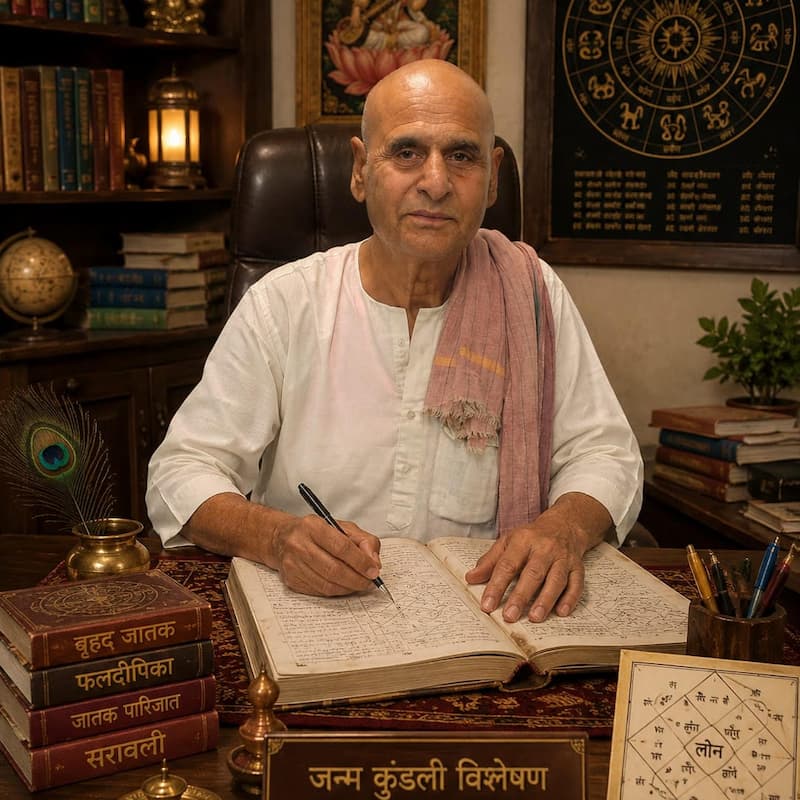
Narendra Kumar Chaubey is a Jyotisha Acharya with over 30 years of experience, based in Bihar and serving clients across India in Vedic astrology, mantra shastra, Vastu and ritual practice.
He completed his formal training at Kameshwar Singh Darbhanga Sanskrit University (KSDSU), one of India’s oldest and most respected institutions for Vedic and Sanskrit scholarship, where he studied Jyotisha shastra, mantra vidya and related classical sciences. KSDSU’s tradition of rigorous Sanskrit education tracing directly to the Mithila region’s centuries-old pandit lineage forms the foundation of his practice.
Over three decades, Narendra Kumar Chaubey has worked with thousands of individuals and families across Bihar and across India, offering guidance in:
- Kundli (birth chart) analysis: Identifying karmic patterns, planetary periods and life path guidance through classical Jyotisha
- Palmistry (Hasta Samudrika): Reading the hand according to the classical Samudrika Shastra tradition
- Vastu Shastra: Assessment and correction of living and working spaces according to directional and elemental principles
- Mantra and Pooja vidhi: Performing and guiding all categories of puja, havan, and mantra sadhana for personal, family and business situations
- Predictive Jyotisha: Transit analysis, muhurta (auspicious timing) selection and remedial guidance
He works across four languages Sanskrit, Hindi, English and Bhojpuri making classical knowledge accessible to practitioners across educational backgrounds and regions.
His writing for ABMantra brings the precision of classical Vedic training to practical mantra guidance: not general advice but specific prescriptions grounded in shastra, lineage and 30 years of direct practice with real situations.
For more info follow on: