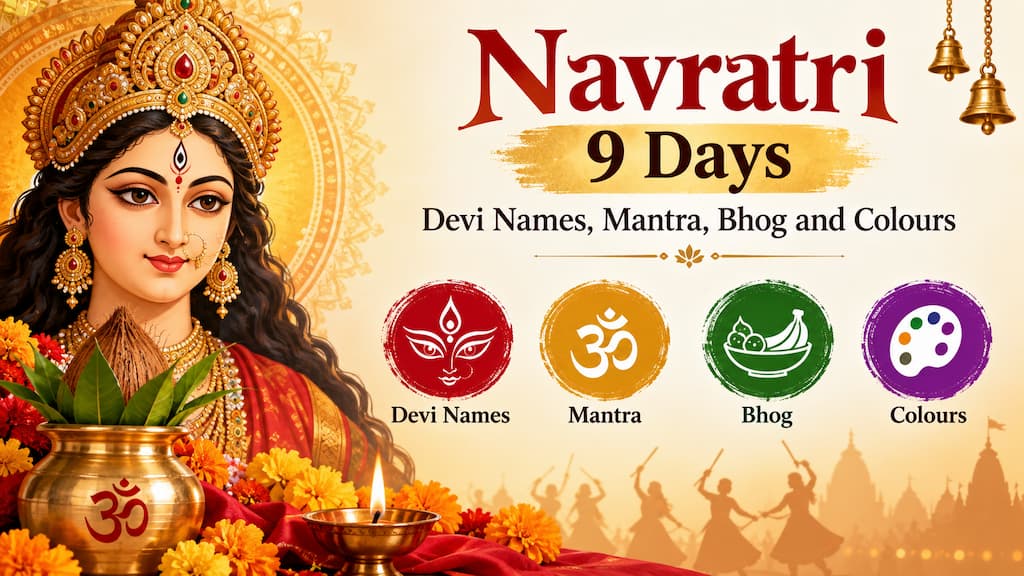

Every article about Navratri tells you there are 9 days. Fewer explain that there are actually 10 – and that the 10th day, Vijayadasami, has its own complete tradition, its own mantra, and is the reason the festival ends the way it does. This article covers all 9 forms of the Navadurga with their mantra, Bhog (offering) and the specific reason each offering is made to that form, the significance of each day’s colour, the 10th day explained properly, and a complete guide for observing Navratri at home.
The Four Navratris: Which One and When
Most people know one Navratri – the Sharad Navratri in September-October. There are actually four Navratris per year. Two are widely observed; two are secret (Gupta) Navratris observed primarily by Tantric practitioners.
| Navratri | Month | 2026 dates | Primary focus | 10th day |
|---|---|---|---|---|
| Chaitra Navratri | Chaitra (March-April) | 19 March to 28 March 2026 | Ram Navami on Day 9 – birth of Lord Rama. Celebrated more in North India. | Ram Navami (Day 9 is the main event; Day 10 is post-celebration) |
| Ashadha Gupta Navratri | Ashadha (June-July) | June-July 2026 | The first Gupta (hidden) Navratri. Tantric tradition. Worship of the Mahavidyas alongside Navadurga. | Not widely observed |
| Sharad/Shardiya Navratri | Ashwin (September-October) | 11 October to 20 October 2026 | The main Navratri. Durga Puja in Bengal. Most widely observed across all traditions. | Vijayadasami / Dussehra (20 October 2026) |
| Magha Gupta Navratri | Magha (January-February) | January-February 2027 | The second Gupta Navratri. Less widely observed. Saraswati worship alongside Navadurga. | Not widely observed |
When people say “Navratri” without qualification, they almost always mean the Sharad Navratri. The first day of Navratri in the Sharad cycle is the Pratipada (first tithi) of Shukla Paksha in Ashwin month – which falls in October 2026. In North India, the question “which date is the first Navratri” typically means this first day of Sharad Navratri.
The 10th Day: Vijayadasami Explained
The Navratri lasts nine nights. The 10th day is Vijayadasami – the day of victory. Understanding what the 10th day marks clarifies why the nine nights of worship take the form they do.
Vijayadasami commemorates two simultaneous victories. In the North Indian tradition: Ram’s victory over Ravana after the nine nights of prayer to Durga before battle. In the Bengali and Pan-Indian Shakta tradition: Durga’s final victory over the buffalo demon Mahishasura after nine days of battle. Both stories converge on the same point – nine nights of intense effort and divine assistance culminating in the 10th day’s decisive victory.
What happens on Vijayadasami:
- In Bengal and Odisha: Durga visarjan – the immersion of the Durga idol in a river or water body, accompanied by prayers and the sindoor ceremony (women apply sindoor to the goddess and to each other)
- In North India: Ravan Dahan – the burning of Ravana’s effigy, symbolising the destruction of the ten-headed ego
- In South India: completion of the Ayudha Puja – tools and instruments are returned to use after nine days of offering
- Across traditions: the Shami tree (Prosopis cineraria) is worshipped on this day – the Pandavas hid their weapons in a Shami tree during their year of incognito exile and retrieved them on this day before the Kurukshetra war
The Shami mantra chanted on Vijayadasami:
अर्जुनस्य धनुर्धारी रामस्य प्रियदर्शिनी।।
Arjunasya Dhanurdhari Ramasya Priyadarshinee
Meaning: The Shami tree removes (Shamayate) sin (Papam). The Shami tree destroys (Vinashinee) enemies (Shatru). It bore the bow of Arjuna (Arjunasya Dhanurdhari) and is the beloved vision (Priyadarshinee) of Rama. Chanted once before the Shami tree on Vijayadasami morning.
Navratri Day 1 to 9: The Nine Forms of Durga
The nine forms of Navadurga are not arbitrary. They follow a specific spiritual sequence – from the most grounded and elemental (Shailputri, the daughter of the earth) to the most transcendent (Siddhidatri, the giver of divine perfections). Each form represents a stage in the journey from material rootedness to spiritual completion.
Day 1 – Maa Shailputri (शैलपुत्री)
Name meaning: Shail (mountain, specifically the Himalayas) + Putri (daughter) = Daughter of the Mountain. She is the reincarnation of Sati as Parvati, born to Himalaya as his daughter. Her vehicle is the bull Nandi; she holds a trident and lotus.
Colour: Yellow – the colour of joy, of the mustard fields in bloom, of the energy with which spring and new beginnings arrive. Yellow on Day 1 is the colour of starting well.
Bhog: Cow’s ghee – and specifically this means plain ghee offered in a small vessel before the image, or ghee-based sweets.
Why ghee for Shailputri: Shailputri governs the Moon in Jyotisha. Ghee is the Moon’s specific food – the most sattvic and nourishing of all food substances, clarified from milk (which the Moon governs). Offering ghee to Shailputri on Day 1 is offering the Moon’s own nourishment to the form of the goddess that governs it. The tradition holds that this offering frees the devotee from illness and blesses the household with health throughout the year.
108 times on Day 1. Offer ghee before the image while chanting.
Day 2 – Maa Brahmacharini (ब्रह्मचारिणी)
Name meaning: Brahma (the absolute / intense penance) + Charini (one who walks in / one who practices) = She who walks the path of penance for Brahman. This is Parvati in her form as the intense ascetic who performed 5,000 years of tapasya – standing on one leg, surviving on leaves, then on water alone, then on nothing – to win Shiva as her husband. She walks barefoot, holds a Japamala (rosary) and Kamandalu (water pot).
Colour: Red – the colour of the fire of tapasya, of determination, of the will that burns away all obstacles.
Bhog: Sugar (Shakkar) and Panchamrit
Why sugar: Sugar represents the sweetness that emerges at the end of sustained, patient effort. After 5,000 years of the harshest possible penance, Brahmacharini received what she sought. Sugar is the offering that acknowledges this: great sweetness is the fruit of great discipline. Offering sugar asks Brahmacharini to grant the practitioner both the will to persist and the sweetness of the fruit that persistence eventually produces.
108 times on Day 2. Offer sugar mixed with panchamrit before the image.
Day 3 – Maa Chandraghanta (चन्द्रघंटा)
Name meaning: Chandra (Moon) + Ghanta (bell) = She whose forehead bears a half-moon shaped like a bell. This is Parvati after her marriage to Shiva – she placed the crescent moon on her forehead as an adornment. This is the goddess of married grace and fierce protective love. She rides a tiger and carries ten arms of weapons, but her eyes carry the peace of a woman settled in love. Her bell-shaped moon produces a divine sound that destroys all evil.
Colour: Green – the colour of life, of the fertile earth, of the new growth that marriage and union bring. After the ascetic red of Brahmacharini, the green of Chandraghanta is the return to the living world.
Bhog: Milk and Kheer
Why milk and kheer: Milk is cooling, nourishing, generous – the perfect offering for the goddess whose fierce protective form contains deep inner coolness. After the fire of penance (Day 2), the milk of completion is the natural offering. Kheer – rice cooked in milk with sugar – is among the most complete of all Naivedya offerings, combining grains, milk and sweetness.
108 times on Day 3. Offer milk in a small vessel.
Day 4 – Maa Kushmanda (कूष्मांडा)
Name meaning: Ku (small, little, weak) + Ushma (warmth, solar energy) + Anda (egg, the cosmic egg) = She who created the cosmic egg with a small portion of her solar energy – specifically, with a smile. When the universe was formless darkness, Kushmanda smiled. Her radiance filled the void and created the world. She is the goddess of cosmic creation. Her vehicle is the lion; she holds eight arms with weapons, a rosary and a nectar-filled Kamandalu. The word Kushmanda also means ash gourd (the vegetable) – her name is linguistically connected to this gourd which represents the round, seed-filled cosmic egg.
Colour: Orange – the radiance of the cosmic smile that created the universe. Orange is the colour of solar energy, of the warmth that makes life possible.
Bhog: Malpua or Petha (ash gourd sweet)
Why petha specifically: Kushmanda’s name literally contains the ash gourd (Kushmanda = ash gourd in Sanskrit). Petha is made from ash gourd. The offering of petha to Kushmanda is the most literally precise Bhog in all of Navratri – offering the very substance whose name she carries. Some traditions offer Malpua (sweet fried pancake) as an alternative.
108 times on Day 4. Offer petha or malpua.
Day 5 – Maa Skandamata (स्कंदमाता)
Name meaning: Skanda (Kartikeya – the war god, son of Shiva and Parvati) + Mata (mother) = Mother of Skanda. When Parvati bore Kartikeya, she took this form – the universal mother goddess. She sits on a lion with the infant Skanda on her lap, holding lotus flowers in two of her four arms. There is a specific beauty to this form: the most powerful warrior’s mother, holding her child with the same arms that can also wield weapons.
Colour: White – the purity and completeness of maternal love. White contains all colours – just as the mother’s love contains all forms of care.
Bhog: Banana
Why banana: The banana is the most complete single natural food – it contains carbohydrate, natural sugar, minerals, and comes in its own packaging. It represents the completeness of maternal nourishment: everything a child needs, given without condition. Banana offered to Skandamata is the practitioner’s acknowledgment of what they received from their own mother – and a prayer to receive the same quality of complete, unconditional nourishment from the divine mother.
108 times on Day 5. Offer bananas before the image.
Day 6 – Maa Katyayani (कात्यायनी)
Name meaning: Daughter of sage Katyayana – she manifested in his ashram when the gods collectively prayed for a warrior form to destroy Mahishasura the buffalo demon. She is the most specifically martial of all nine forms: created solely for battle, sustained by divine energy from Brahma, Vishnu and Shiva simultaneously, riding a lion and holding four arms with a sword and lotus. In the Vaishnava tradition, she is also the goddess to whom the Gopis of Vrindavan prayed for a year to receive Krishna as their husband – making her also the goddess of devoted longing.
Colour: Red – the warrior’s energy, the fire of righteous anger directed at genuine injustice.
Bhog: Honey
Why honey: Honey is produced by bees through fierce, diligent, somewhat aggressive activity – constant work, protection of the hive, and the transformation of flower nectar into something entirely different from its origin. Katyayani is the goddess of directed fierce energy. Honey is the offering that represents what fierce, purposeful effort can produce: something entirely sweet. Offering honey to Katyayani asks her to help the practitioner channel their own anger and fierce energy toward something constructive and ultimately sweet.
108 times on Day 6. Offer honey in a small vessel or on a leaf.
Day 7 – Maa Kalaratri (कालरात्रि)
Name meaning: Kala (time / dark) + Ratri (night) = Dark Night, Night of Time, or She who is as dark as the night of time. This is the most terrifying form in all of Navratri – black-skinned, three eyes blazing like fire, dishevelled hair, wearing a garland of skulls, breathing flames from her nostrils. She appeared when Parvati removed her golden outer skin to enter battle against the demons Shumbha and Nishumbha, who could not be killed by any being of light. Darkness was the only weapon that could reach them. Kalaratri rides a donkey – deliberately choosing the most humble of vehicles to show that true power needs no adornment. Despite her terrifying appearance, her right hands make gestures of blessing and protection. She is called Shubhankari (the auspicious one) because facing her removes all fear.
Colour: Blue – the deep blue-black of the night sky, of the infinite depth of the cosmos, of the darkness that is not the absence of light but the fullness of all things before light differentiates them.
Bhog: Jaggery (Gur)
Why jaggery: Jaggery is dark, raw, unrefined – like Kalaratri herself. Unlike refined white sugar which has had everything complex removed from it, jaggery retains all the minerals, the darkness, the complexity of the sugarcane. It represents the practitioner’s willingness to engage with the unrefined, the dark, the complex – rather than wanting only the refined and pleasant. Offering jaggery to Kalaratri is the offering of one’s willingness to face what is difficult without flinching.
108 times on Day 7. Offer jaggery in a small piece before the image.
Day 8 – Maa Mahagauri (महागौरी)
Name meaning: Maha (great, the highest) + Gauri (white, fair, radiant) = The greatly radiant white one. After years of austerity – standing in the cold, living on leaves, meditating through seasons – Parvati’s skin became dark from exposure. When Shiva found her and bathed her in the waters of the Ganga, she became luminously white – whiter than she had ever been. The darkness of the tapasya had burned away everything inessential; what emerged was pure radiance. Mahagauri rides a white bull and carries a trident and damaru (Shiva’s drum), returning to Shiva’s instruments now that she has earned the right to carry them.
Colour: Pink – the warm radiance after purification, the light that is not cold white but warm with the residue of all that was gone through to achieve it.
Bhog: Coconut
Why coconut: The coconut is the most complete offering in the Hindu tradition – it is broken open before the deity as the ultimate act of self-offering, the hard outer shell (ego) broken to reveal the pure white interior (the soul). Offering a whole coconut to Mahagauri on Day 8 is the offering of the self in completeness – the willingness to be broken open so that what is pure within can emerge. The coconut’s white interior directly mirrors Mahagauri’s radiant white form.
108 times on Day 8. This is also the day of Kanya Puja in many traditions – see below.
Day 9 – Maa Siddhidatri (सिद्धिदात्री)
Name meaning: Siddhi (divine perfections, supernatural achievements, spiritual completions) + Datri (giver) = She who gives all Siddhis. Siddhidatri is the culminating form – she encompasses all eight previous forms within her. She is worshipped by gods, sages, Gandharvas, Kinnaras, Yakshas and human devotees alike. She sits on a lotus (or rides a lion) and holds a chakra, mace, conch and lotus in four arms. The eight specific Siddhis she grants are: Anima (the ability to become infinitely small), Mahima (infinitely large), Garima (infinitely heavy), Laghima (infinitely light), Prapti (omnipresence), Prakamya (realisation of all desires), Ishitva (lordship over all) and Vashitva (control over all).
Colour: Purple/Violet – the highest vibration in the visible spectrum, the colour of spiritual completion and the meeting point of the active (red) and the contemplative (blue). Violet is what the nine days have been building toward.
Bhog: Sesame seeds (Til) or Kheer
Why sesame: Til (sesame) is used in the most significant completion ceremonies of the Hindu tradition – in ancestor offerings (Tarpana), in the final Homa of important rituals, and in Makar Sankranti (the completion of the solar year’s darkest period). Sesame marks endings that are also beginnings. Offering til to Siddhidatri on the final day of Navratri is the acknowledgment that this nine-day cycle is complete – and the Siddhis are requested as the fruit of the complete practice.
108 times on Day 9. Offer sesame seeds or kheer. This is also the day of Kanya Puja in many traditions.
The Navratri sequence of nine forms is not simply a list of nine goddesses to be worshipped in order. It is a map of inner development – a nine-stage journey that the practitioner travels alongside the goddess. Shailputri is the beginning: grounded, rooted, connected to the earth. Siddhidatri is the completion: all perfections granted, all forms encompassed. Between them, the seven intermediate forms represent seven specific inner qualities that must be cultivated, confronted or transcended to move from beginning to completion.
From a Jyotisha perspective, the nine forms correspond to nine planetary energies: Shailputri governs the Moon, Brahmacharini Mars, Chandraghanta Venus, Kushmanda the Sun, Skandamata Mercury, Katyayani Jupiter, Kalaratri Saturn, Mahagauri Rahu, and Siddhidatri Ketu. This means that worshipping each form in sequence is also a complete Navagraha puja across nine days – each day’s mantra strengthens the relationship with that day’s planet as well as that form of the goddess. I have found this Jyotisha dimension of Navratri to be particularly potent for clients who are in difficult planetary periods: the nine days of Navratri done with awareness of the planetary correspondence can address specific chart difficulties alongside the devotional practice.
The Bhog specifically matters more than most practitioners realise. The offering is not a formality. Ghee for Shailputri, sugar for Brahmacharini, honey for Katyayani, jaggery for Kalaratri – each is chosen for a specific reason that directly reflects the quality of the goddess being invoked. When a practitioner understands WHY they are offering what they are offering, the offering becomes a teaching rather than a ritual requirement. The Bhog system of Navratri is one of the most elegant encoding systems in the Hindu tradition – nine offerings that, when understood properly, map the entire spiritual journey from nourishment (ghee) to completion (sesame).
The Navratri 9 Days at a Glance
| Day | Form | Colour | Bhog | Planet | Mantra |
|---|---|---|---|---|---|
| 1 | Shailputri | Yellow | Cow’s ghee | Moon | Om Devi Shailputryai Namah |
| 2 | Brahmacharini | Red | Sugar + Panchamrit | Mars | Om Devi Brahmacharinyai Namah |
| 3 | Chandraghanta | Green | Milk and Kheer | Venus | Om Devi Chandraghantayai Namah |
| 4 | Kushmanda | Orange | Malpua or Petha | Sun | Om Devi Kushmandayai Namah |
| 5 | Skandamata | White | Banana | Mercury | Om Devi Skandamatayai Namah |
| 6 | Katyayani | Red | Honey | Jupiter | Om Devi Katyayanyai Namah |
| 7 | Kalaratri | Blue | Jaggery (Gur) | Saturn | Om Devi Kalaratryai Namah |
| 8 | Mahagauri | Pink | Coconut | Rahu | Om Devi Mahagauryai Namah |
| 9 | Siddhidatri | Purple | Sesame (Til) | Ketu | Om Devi Siddhidatryai Namah |
| 10 | Vijayadasami | No specific colour – traditional festival dress | Shami tree worship, idol immersion | All planets – the victory of all nine | Shami Shamayate Papam… |
How to Celebrate Navratri at Home: Day by Day
Morning Practice (every day)
- Bathe before sunrise. Wear the day’s colour if possible – or simply white if you prefer one consistent colour throughout.
- Clean the puja space. Change the flowers from the previous day – fresh flowers for each of the nine forms.
- Light a ghee diya and incense before the Durga image or the specific day’s form.
- Chant the day’s mantra 108 times on a red mala. A coral or red sandalwood mala is traditional for Durga mantras.
- Offer the day’s specific Bhog with the mantra: “Om Devi [Name]yai Namah – Naivedyam Samarpayami.”
The Akhanda Diya
Many households maintain an Akhanda Diya – an uninterrupted ghee lamp that burns for the full nine days without being extinguished. If you are observing this, set it up on Day 1 before the main puja begins and ensure there is always enough ghee to keep it burning. This represents the continuous presence of the goddess throughout the nine nights. If it goes out by accident, relight it immediately with a prayer and continue – the tradition understands that accidents happen.
Vrat (Fasting)
The Navratri fast involves avoiding grains (wheat, rice) and non-vegetarian food. What is eaten: fruits, milk, curd, sabudana (sago), Kuttu (buckwheat) flour, Singhara (water chestnut) flour, sendha namak (rock salt), potatoes, sweet potatoes, peanuts. Many practitioners observe the full nine-day fast; others fast only on Days 1, 8 and 9 (the most significant days). Both are valid. The point is not the food restriction itself but the simplification of physical engagement to make more attention available for worship.
Kanya Puja: The Ninth Day Ritual
On Ashtami (Day 8) or Navami (Day 9) – depending on regional tradition – Kanya Puja (also called Kanjak) is performed. Nine young girls between ages 2 and 10 are invited to the home, representing the nine forms of Navadurga. Their feet are washed. Kumkum tilak is applied to each girl’s forehead. They are seated and fed a full meal of halwa, puri, chana (chickpeas) and seasonal fruits. Gifts – new clothes, bangles, money – are offered to each girl. The girls are then sent home with the prasad.
This ritual is not merely symbolic. In Shakta understanding, the divine feminine energy is most directly present in young girls before puberty – their bodies carry the quality of Shakti in its most natural and undistorted form. Serving them is serving the goddess directly.
- Wikipedia – Navadurga: the nine forms of Durga in sequence, their iconography, vehicles and significance; the Devi Bhagavata Purana as the primary source for the Navadurga narrative
- Wikipedia – Navaratri: the four annual Navratri cycles, the Sharad Navratri as primary, the Kanya Puja tradition, regional variations across Bengal, South India and North India
- Wikipedia – Vijayadasami: the 10th day traditions – Ravan Dahan, Durga visarjan, Ayudha Puja completion, Shami tree worship; the Pandava connection through the Mahabharata
- Devi Bhagavata Purana (Srimad Devi Bhagavatam) – the primary Puranic source for the Navadurga sequence, their specific forms, the circumstances of each form’s appearance, and the Bhog (offering) associated with each goddess
Saraswati Puja: Vasant Panchami worship guide with mantra and puja vidhi
Vishwakarma Puja: complete guide including why celebrated on 17 September
Navagraha Mantra: the nine planetary mantras that correspond to Navratri’s nine forms
Janmashtami Puja Vidhi: complete worship guide for Krishna’s birth celebration
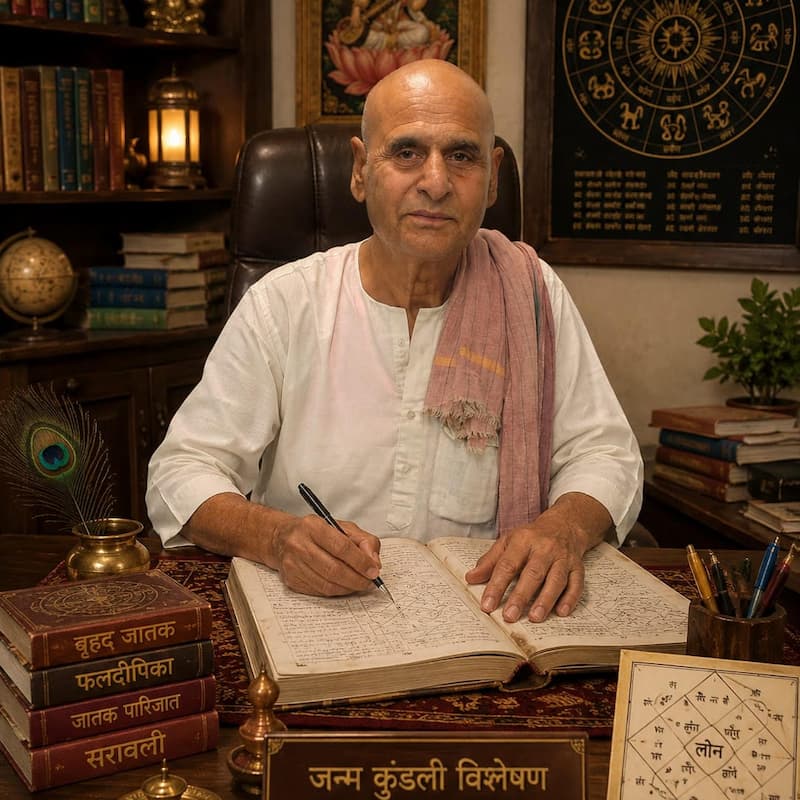
Narendra Kumar Chaubey is a Jyotisha Acharya with over 30 years of experience, based in Bihar and serving clients across India in Vedic astrology, mantra shastra, Vastu and ritual practice.
He completed his formal training at Kameshwar Singh Darbhanga Sanskrit University (KSDSU), one of India’s oldest and most respected institutions for Vedic and Sanskrit scholarship, where he studied Jyotisha shastra, mantra vidya and related classical sciences. KSDSU’s tradition of rigorous Sanskrit education tracing directly to the Mithila region’s centuries-old pandit lineage forms the foundation of his practice.
Over three decades, Narendra Kumar Chaubey has worked with thousands of individuals and families across Bihar and across India, offering guidance in:
- Kundli (birth chart) analysis: Identifying karmic patterns, planetary periods and life path guidance through classical Jyotisha
- Palmistry (Hasta Samudrika): Reading the hand according to the classical Samudrika Shastra tradition
- Vastu Shastra: Assessment and correction of living and working spaces according to directional and elemental principles
- Mantra and Pooja vidhi: Performing and guiding all categories of puja, havan, and mantra sadhana for personal, family and business situations
- Predictive Jyotisha: Transit analysis, muhurta (auspicious timing) selection and remedial guidance
He works across four languages Sanskrit, Hindi, English and Bhojpuri making classical knowledge accessible to practitioners across educational backgrounds and regions.
His writing for ABMantra brings the precision of classical Vedic training to practical mantra guidance: not general advice but specific prescriptions grounded in shastra, lineage and 30 years of direct practice with real situations.
For more info follow on: