
Saraswati Puja is the annual worship of Goddess Saraswati – the deity of learning, speech, music and all creative knowledge – performed on Vasant Panchami: the fifth day of the bright fortnight of Magha, which marks the arrival of spring. Most articles tell you that this festival celebrates wisdom. This one tells you what to actually do: the puja vidhi step by step, the mantras with their complete meanings, what each item in the samagri list is for, and what Saraswati’s four arms are holding and why.
Vasant Panchami 2027: Date and Timing
Vasant Panchami in 2027 falls on 11 February 2027 (Thursday). The Panchami tithi begins in the early hours of 11 February and extends into the early hours of 12 February. Because the Panchami tithi prevails during the Purvahna Kala (the morning period from sunrise to midday) on 11 February, that day is taken as Vasant Panchami across most regional Panchangs. Some Panchangs — particularly DrikPanchang — may list 12 February. Confirm with your local Panchang for the exact Panchami tithi start and end time in your city. The most auspicious window for Saraswati Puja is during the Purvahna Kala – the morning period from sunrise until midday. Check your regional Panchang for the exact Panchami tithi start and end time for your city, as this varies by latitude.
The morning window is specifically prescribed because Saraswati is a Sattvic deity – her worship is most potent in the sattvic time of day, which is the morning hours before the heat and activity of midday. Evening worship is also performed but morning is primary.
Who Is Goddess Saraswati: The Iconography Explained
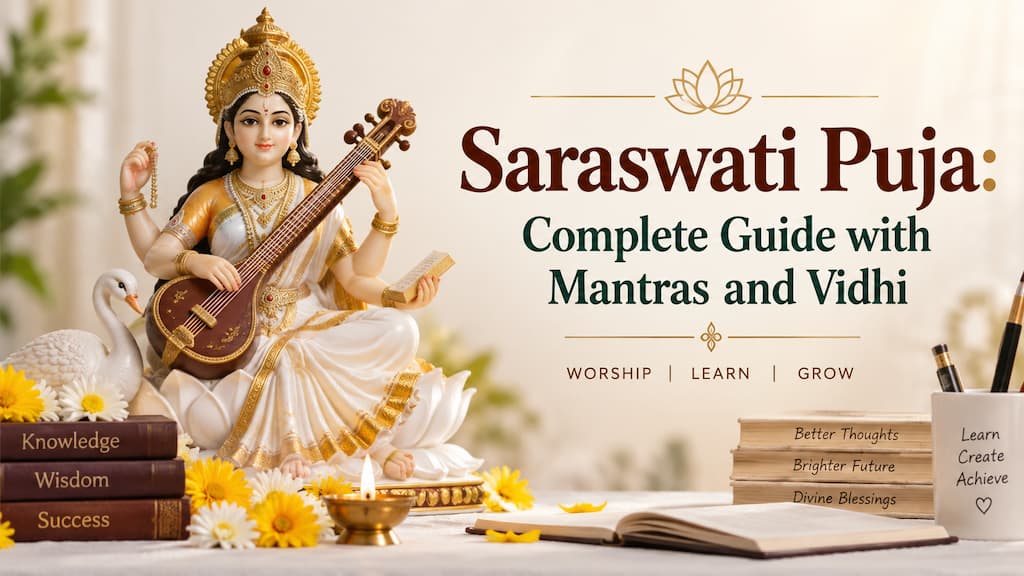
Saraswati is depicted seated on a white lotus or a white swan, dressed in white, with four arms. Each element is specific and meaningful – not decorative.
The white lotus: Saraswati sits on the lotus rather than touching the muddy water below it. The lotus grows in mud but remains untouched by it. This is the teaching of Saraswati’s nature: the pursuit of knowledge requires engagement with the world but must not be contaminated by ego, desire for power, or attachment to outcome. The lotus is the right relationship between the knower and the known.
The white swan (Hamsa): The Hamsa has the legendary ability to separate milk from water when the two are mixed – drinking the milk and leaving the water. This is Viveka, discrimination: the capacity to separate truth from falsehood, essence from appearance, the real from the superficial. Saraswati’s vehicle is the symbol of the discriminating intelligence that genuine learning requires.
The Veena: The stringed instrument in two of her arms represents the harmonic order of creation – that the universe is fundamentally musical, built on frequency, vibration and relationship. It also represents the discipline required to create something genuinely beautiful: the Veena requires years of practice before it sounds like anything but noise. Saraswati holds it because she understands this.
The Pustaka (book): Sacred texts – the storehouse of accumulated human understanding across generations. She holds them close to indicate that learning is not original to any individual mind but is received, protected, transmitted.
The Mala (rosary): Concentration, repetition, and devotion. The mala is not for counting prayers mechanically but for the training of attention – the capacity to return to the same point again and again until understanding deepens.
The Kamandalu (water pot): The fourth item, carried by some forms of Saraswati, represents the purifying quality of genuine knowledge – the water that cleanses the mind of the accumulated debris of ignorance and conditioning.
Together, the four arms of Saraswati hold everything genuine learning requires: harmonic understanding (Veena), accumulated transmission (Pustaka), discrimination (Hamsa), and purification (Kamandalu).
Saraswati Puja Samagri: Complete Materials List
| Item | Hindi/Sanskrit | Purpose |
|---|---|---|
| Saraswati idol or image | सरस्वती मूर्ति | The primary deity. White or light-coloured idol with Veena. Placed on a clean white cloth on the puja chowki. |
| Yellow flowers | पीले फूल (गेंदा, चमेली) | Saraswati’s primary offering – yellow is the colour of Vasant (spring), representing the mustard fields in full bloom at this time of year. Marigold and jasmine are traditional. |
| White flowers | सफेद फूल | For the goddess herself – her own colour of purity and wisdom. |
| Books and pens | पुस्तक और कलम | Placed before the idol as offerings. Students do not read these on Puja day – the books are in the goddess’s care. |
| Musical instruments | वाद्य यंत्र | Musicians place their instruments before the goddess. The instrument is not touched on Puja day – it is offered. |
| Panchamrit | पंचामृत | Five sacred liquids for Abhishek: milk, curd, ghee, honey, sugar. |
| White sandalwood paste | सफेद चंदन | For tilak on the idol – Saraswati’s sandalwood is white, not red. |
| Yellow cloth | पीला वस्त्र | For dressing the idol on Vasant Panchami. Yellow is Saraswati’s Vasant Panchami colour. |
| Kesar (saffron) | केसर | For saffron rice or halwa as Naivedya. Yellow saffron offerings are specific to Vasant Panchami. |
| Fruits | फल | Seasonal fruits as Naivedya – coconut, banana, seasonal offerings. |
| Kheer or halwa | खीर / हलवा | Primary sweet Naivedya. Kesar halwa is the Vasant Panchami specific offering. |
| Kumkum, haldi, akshat | कुमकुम, हल्दी, अक्षत | For tilak and offerings at each puja step. |
| Ghee diya | घी दीपक | For Deepa offering. Ghee lamp, not oil – Saraswati’s Sattvic nature requires ghee. |
| Incense (dhoop and agarbatti) | धूप और अगरबत्ती | For Dhupa offering. White or jasmine incense is most appropriate. |
| Slate and chalk or writing implement | स्लेट और चाक | For the Haate Khori (Vidyarambha) ceremony for young children. |
Saraswati Puja Vidhi: Step-by-Step
Morning Preparation
- Bathe before sunrise. Wear yellow or white clothing.
- Clean the puja room or space. Place the Saraswati idol on a wooden chowki covered with a clean white cloth.
- Arrange the samagri. Place books, pens, and instruments beside or before the idol.
- Draw a lotus or auspicious design (Rangoli) at the entrance of the puja space.
Opening the Puja
- Ganesh Puja (brief): Begin every puja with Ganesh invocation. Om Gam Ganapataye Namah – 11 times. Offer akshat and a flower.
- Sankalpa: Hold water, akshat and a flower in the right palm. State your intention: “I perform this Saraswati Puja on the occasion of Vasant Panchami for the bestowal of Saraswati Devi’s blessings on knowledge, learning and all creative endeavour.” Release the water.
- Avahana (Invocation): Invoke Saraswati into the idol: Om Saraswatyai Namah – Iha Agachha Iha Tishtha (Come here, remain here). Offer akshat and flowers.
The Panchamrit Abhishek
Bathe the idol in each of the five sacred substances, chanting Om Aim Saraswatyai Namah throughout:
- Milk (Dugdha): Om Aim Saraswatyai Namah – Dugdha Snanam Samarpayami
- Curd (Dadhi): Om Aim Saraswatyai Namah – Dadhi Snanam Samarpayami
- Ghee: Om Aim Saraswatyai Namah – Ghrita Snanam Samarpayami
- Honey (Madhu): Om Aim Saraswatyai Namah – Madhu Snanam Samarpayami
- Sugar (Shakkar): Om Aim Saraswatyai Namah – Sharkara Snanam Samarpayami
After the bath: dry the idol gently. Apply white sandalwood paste. Dress the idol in yellow cloth.
The Sixteen Offerings (Shodashopachara)
Offer in sequence, chanting Om Saraswatyai Namah between each:
- Asana (seat) – flower offered to the idol’s base
- Padya – water for feet
- Arghya – water for hands
- Achamana – water for sipping
- Snana – Panchamrit bath (done above)
- Vastra – yellow cloth offered
- Gandha – white sandalwood paste applied
- Pushpa – flowers offered (yellow and white)
- Dhupa – incense circled 7 times
- Deepa – ghee lamp circled 5 times
- Naivedya – kesar halwa, kheer, fruits offered
- Tambula – betel leaf and nut
- Pradakshina – circumambulate 4 times
- Namaskara – full prostration before the goddess
Haate Khori: The Vidyarambha Ceremony
For young children beginning their formal education – or for any practitioner undertaking a new area of learning – the Haate Khori (Bengal) or Vidyarambha (South India) is the formal inauguration of learning before the goddess.
The elder or priest guides the child’s hand to write the first letter: typically Om (ॐ) or the first letter of the regional script. This is done on a slate with chalk, or with the child’s finger in rice or turmeric spread on a plate. The writing is done slowly and with full attention – not rushed. Then: Om Saraswatyai Namah is chanted and the written letter offered to the goddess with a flower.
Adults beginning a new area of study – a new instrument, a new language, a new professional qualification – can perform the same ceremony. Write the first word or phrase of what you are learning. Offer it to Saraswati before you proceed.
Saraswati Puja Mantras: Complete Guide
Mantra 1: The Beej Mantra
Word by word:
Om: The primordial cosmic sound, encompassing all existence.
Aim (ऐं): Saraswati’s specific Beej syllable. Aim is composed of A (Brahma – the source of creation) + I (Saraswati – the power of knowledge and speech) + the anusvara nasal hum (completion). Aim encodes the specific vibrational quality of Saraswati’s energy: the creative intelligence that transforms raw awareness into articulate knowledge, into music, into speech, into meaning. The tradition holds that Aim specifically governs Vak (speech) and Medha (intellectual retention).
Saraswatyai: To Saraswati – in the dative case, meaning the mantra is directed toward her.
Namah: I bow, I surrender, I recognise this energy as greater than my personal will.
Why Aim is Saraswati’s beej: The AI sound (the diphthong that forms Aim) is the highest-pitched vowel in Sanskrit – it encodes the quality of fine, subtle, discriminating attention. The capacity to perceive fine distinctions is the foundation of all learning. Saraswati’s beej is literally the sound of refinement.
When to chant: 108 times in the morning puja. Before any period of study or creative work (11 times minimum). Students preparing for examinations: 108 times daily for 40 days.
Mantra 2: Ya Kundendu Tusharahara Dhavala – The Saraswati Stotram
या वीणावरदण्डमण्डितकरा या श्वेतपद्मासना॥
या ब्रह्माच्युतशङ्करप्रभृतिभिर्देवैः सदा वन्दिता।
सा मां पातु सरस्वती भगवती निःशेषजाड्यापहा॥
Ya Veena Varadanda Manditakara Ya Shvetapadmasana
Ya Brahmaachyuta Shankara Prabhritibhir Devaih Sada Vandita
Sa Mam Patu Saraswati Bhagavati Nihshesha Jadyapaha
Meaning, word by word:
Ya Kundendu: She who is as white as the Kunda flower (a small white jasmine) and as white as the moon (Indu).
Tusharahara Dhavala: White as a garland of snow (Tushara = snow, Hara = garland, Dhavala = white).
Ya Shubhravastravrita: Clothed in pure white garments (Shubhra = pure white, Vastra = cloth, Avrita = covered/clothed).
Ya Veena Varadanda Manditakara: Whose hands are adorned by the Veena and the boon-giving staff (Varadanda = the wand/staff that grants boons).
Ya Shvetapadmasana: Seated on a white lotus (Shveta = white, Padma = lotus, Asana = seat).
Ya Brahmaachyuta Shankara Prabhritibhir Devaih Sada Vandita: Who is always revered (Sada Vandita) by Brahma, Achyuta (Vishnu’s name meaning “the unfailing one”), Shankara (Shiva), and other deities (Prabhritibhir Devaih = by the deities and more).
Sa Mam Patu: May that (Sa = she) protect me (Mam = me, Patu = protect).
Saraswati Bhagavati: Goddess Saraswati (Bhagavati = the blessed goddess, the one who possesses all divine opulences).
Nihshesha Jadyapaha: The remover of all dullness (Nihshesha = completely, without remainder; Jadya = dullness, torpor, intellectual inertia; Apaha = the one who removes).
The last compound – Nihshesha Jadyapaha – is the specific request: Remove all dullness. Not just some dullness. All of it, completely. Jadya is intellectual torpor – the heavy, foggy quality of a mind that cannot engage, cannot retain, cannot understand. This is what students fear most: sitting before books and nothing going in. This Stotram asks Saraswati to remove this condition completely.
When to chant: Once at the beginning of the puja as the formal prayer. Before any examination. It can also be chanted at the beginning of any period of learning as the opening invocation.
Mantra 3: Saraswati Gayatri Mantra
तन्नो देवी प्रचोदयात्।।
Tanno Devi Prachodayat
Meaning:
We know (Vidmahe) Vagdevi – the goddess of speech (Vak = speech, Devi = goddess). We meditate (Dhimahi) on the king of desire (Kamaraja – here referring to the highest aspiration, the desire for knowledge itself as the supreme desire). May that goddess illuminate and guide (Prachodayat) our intellect (Tanno Devi).
The choice of Vagdevi: Saraswati is specifically addressed here as the goddess of Vak – the creative power of the word. Vak in the Vedic tradition is not simply speech but the fundamental creative force: the universe itself was created through Vak. The mantras are Vak, the Vedas are Vak, all articulate knowledge is Vak. Saraswati as Vagdevi governs this entire domain.
When to chant: 11 times as the closing of the morning puja, or as the opening practice before any writing, teaching, or speech.
In 30 years of Jyotisha consultation, Saraswati Puja is the one festival for which I give the same advice to every client regardless of their chart: do the Haate Khori with a new intention. Most people associate this ceremony only with young children beginning school. It is not only for children. Any time you are beginning something that requires genuine learning – a new language, a new field of work, a new artistic practice, a new body of knowledge – the Haate Khori ceremony is available. Write the first word of what you are going to learn. Offer it to Saraswati before you begin. This one act changes the relationship between you and the learning.
What it does, practically: it acknowledges that the knowledge you are about to receive is not something you are manufacturing from your own mind. You are receiving it. It already exists – in texts, in teachers, in the tradition itself. Your role is the receptive learner, not the independent originator. Saraswati is the keeper of this reservoir of received knowledge. The Haate Khori is the act of asking to receive from it.
The specific mantra I recommend for students in examination season is not the elaborate Stotram but the simplest one: Om Aim Saraswatyai Namah, chanted 108 times each morning for 40 days before the examination period begins. The Aim beej specifically governs Medha – intellectual retention. Not the acquisition of new knowledge but the capacity to access what has already been studied when the examination requires it. Students report that the anxiety of the blank mind – sitting before the examination paper and feeling that nothing comes – reduces markedly with consistent Aim mantra practice. This is what Saraswati’s beej addresses most directly.
Saraswati Puja Across India: Regional Practices
| Region | Name | Distinctive practice |
|---|---|---|
| West Bengal | Saraswati Puja | Large community pandals like Durga Puja. Students offer books before the idol. Anjali (flower offering with mantra) in the morning. No reading on the puja day – a strictly observed tradition in schools and colleges. Yellow sari is traditional for women. |
| Tamil Nadu and Kerala | Saraswati Puja / Vidyarambham | Part of the Navratri cycle. Books, musical instruments and work tools placed in the puja room on Maha Navami and worshipped. On Vijayadasami (Dussehra): the tools are taken back and returned to use after Vidyarambham ceremony for children. |
| Karnataka and Andhra Pradesh | Saraswati Puja / Ayudha Puja | Ayudha Puja: not only books and instruments but all tools and machinery – vehicles, agricultural tools, computers – are cleaned and worshipped. The professional dimension of Saraswati Puja is most developed here. |
| North India | Vasant Panchami Puja | Yellow dominates – yellow clothing, yellow sweets, yellow flowers. Kite flying in some areas. Schools and temples perform the puja. The seasonal dimension (spring arrival) is more prominent than in South India. |
| Bihar and Eastern UP | Saraswati Puja / Vasant Panchami | New earthen pots with yellow flowers as offerings. The Mithila tradition (this practitioner’s tradition) includes a specific Saraswati Stotram recitation and the first writing ceremony for children using a pointed stick in sand or rice. |
| Odisha | Saraswati Puja (Sree Panchami) | Sree Panchami is observed with great attention to the Vidyarambha for children. Yellow is the prominent colour. The goddess is worshipped in both temples and homes with the full Shodashopachara. |
The Meaning of Saraswati Puja: What the Festival Actually Teaches
Most articles about Saraswati Puja focus on what to do. The festival’s depth is in what it teaches about the relationship between the practitioner and knowledge.
Saraswati is not the goddess of information. She is the goddess of understanding. The distinction matters. A person can accumulate vast quantities of information without ever developing genuine understanding – without the Viveka (discrimination) of the Hamsa, without the harmonic perception of the Veena player, without the patience that comes from knowing that the Pustaka (book) holds knowledge that one has not yet earned the capacity to receive.
The practice of placing books before the goddess and not reading them on Puja day is a teaching in itself. It is an annual reminder that knowledge is not a possession but a relationship. You do not own what you know. You hold it in trust, temporarily, and pass it on. Saraswati is the permanent keeper. The practitioner is always, regardless of how much they have learned, the student.
The Hindi saying that appears in many Saraswati Puja articles – “Vidya baantne se badhti hai” (knowledge grows by being shared) – is not a motivational slogan. It describes how Saraswati’s domain actually works. Knowledge is the only thing that increases when you give it away. Everything else decreases. This is the lesson that Saraswati Puja embeds in the household, in the school, in the community, once a year, through the specific acts of offering, refraining, and beginning.
- Wikipedia – Saraswati: the four arms and their symbolic items, the Hamsa vehicle and its Viveka quality, Vagdevi as the goddess of speech and creative word, the white lotus and its meaning, Brahma as her consort
- Wikipedia – Vasant Panchami: the fifth day of Shukla Paksha in Magha as the date, the significance of yellow, Haate Khori (Bengal) and Vidyarambham (South India), regional variations
- Wikipedia – Ayudha Puja: the South Indian practice of worshipping all tools and instruments as part of the Saraswati Puja cycle in the Navratri tradition
- Ya Kundendu Tusharahara Dhavala – the classical Saraswati Stotram attributed to Adi Shankaracharya, widely preserved in the Stotra literature; the compound Nihshesha Jadyapaha as the specific request for the removal of all intellectual torpor
Narendra Kumar Chaubey is a Jyotisha Acharya with over 30 years of experience, based in Bihar and serving clients across India in Vedic astrology, mantra shastra, Vastu and ritual practice.
He completed his formal training at Kameshwar Singh Darbhanga Sanskrit University (KSDSU), one of India’s oldest and most respected institutions for Vedic and Sanskrit scholarship, where he studied Jyotisha shastra, mantra vidya and related classical sciences. KSDSU’s tradition of rigorous Sanskrit education tracing directly to the Mithila region’s centuries-old pandit lineage forms the foundation of his practice.
Over three decades, Narendra Kumar Chaubey has worked with thousands of individuals and families across Bihar and across India, offering guidance in:
- Kundli (birth chart) analysis: Identifying karmic patterns, planetary periods and life path guidance through classical Jyotisha
- Palmistry (Hasta Samudrika): Reading the hand according to the classical Samudrika Shastra tradition
- Vastu Shastra: Assessment and correction of living and working spaces according to directional and elemental principles
- Mantra and Pooja vidhi: Performing and guiding all categories of puja, havan, and mantra sadhana for personal, family and business situations
- Predictive Jyotisha: Transit analysis, muhurta (auspicious timing) selection and remedial guidance
He works across four languages Sanskrit, Hindi, English and Bhojpuri making classical knowledge accessible to practitioners across educational backgrounds and regions.
His writing for ABMantra brings the precision of classical Vedic training to practical mantra guidance: not general advice but specific prescriptions grounded in shastra, lineage and 30 years of direct practice with real situations.
For more info follow on: