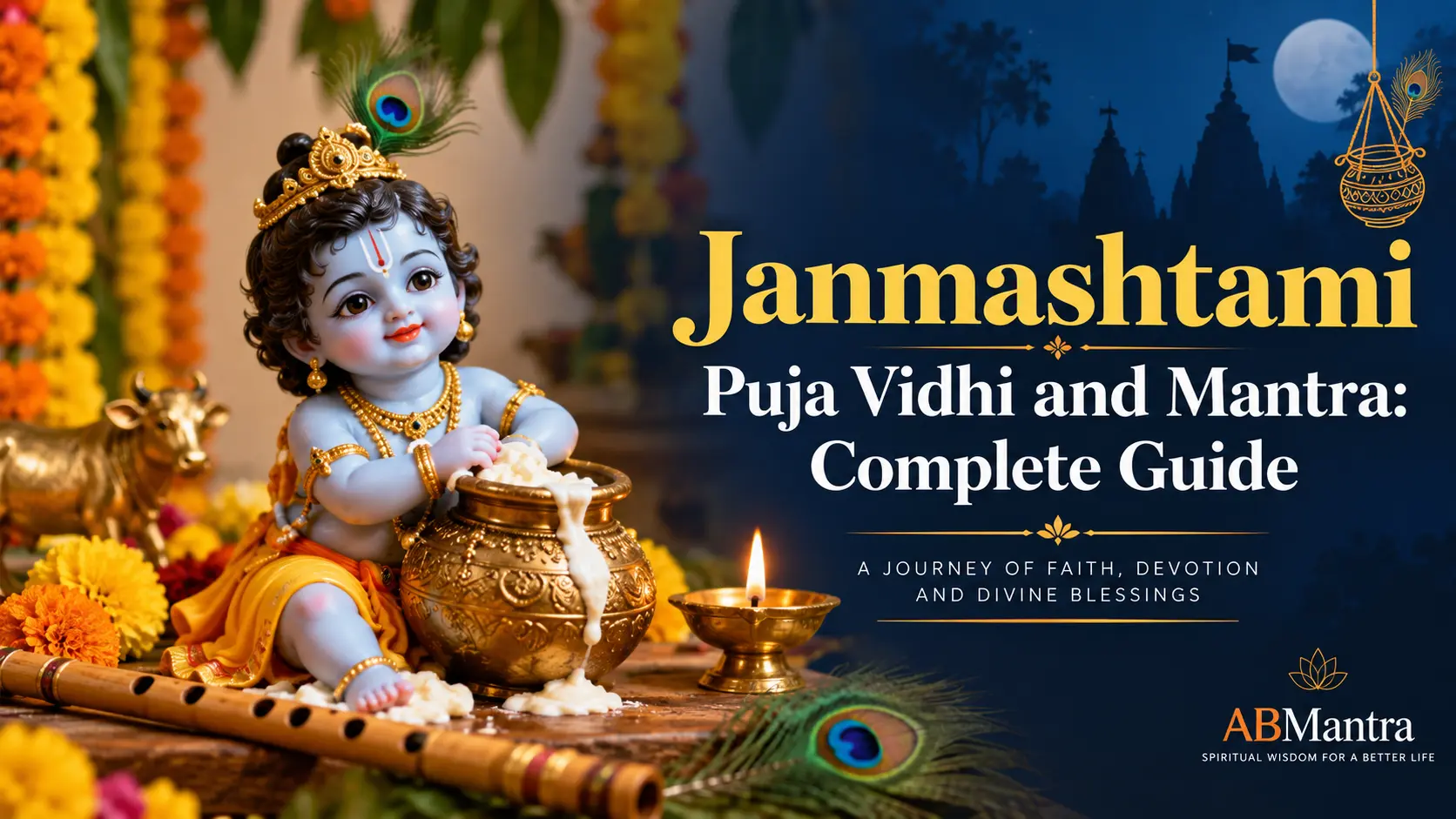

The entire Janmashtami puja vidhi – the fasting, the vigil, the decoration, the flowers, the Panchamrit bath – builds toward a single 48-minute window at midnight called the Nishita Kala. This is not a tradition of convenience. Krishna was born at midnight under a specific astrological alignment that has not been replicated since: Ashtami tithi, Rohini Nakshatra and the Nishita Kala all present simultaneously. The puja that does not include this midnight moment has missed its centre. This guide covers what to do from morning preparation through to the Nishita Kala, all the Krishna Janmashtami mantras with their complete meanings, and what specifically happens at midnight.
Why Midnight: The Nishita Kala and the Ashtami-Rohini Alignment
Three conditions were present at the moment of Krishna’s birth. Each matters independently. Together they create what the tradition calls Jayanti Yoga – the most auspicious birth alignment in the Vedic calendar.
Ashtami tithi: The 8th day of the dark fortnight (Krishna Paksha) of Bhadrapada. Eight runs through Krishna’s identity everywhere – the 8th avatar of Vishnu, the 8th child of Devaki and Vasudeva, born on the 8th lunar day. In the Vedic tradition, eight is the number of completion in the cycle of manifestation: four directions multiplied by two (the visible and the invisible world). Krishna arrives on the 8th day as the one who completes the cycle of divine descent into the world.
Rohini Nakshatra: The Moon was in Rohini – his own favourite Nakshatra, the one he is most naturally at home in. Rohini is the 4th of 27 Nakshatras and is described as the most beautiful and abundant. It governs creativity, fertility and grace. The Moon in Rohini at the moment of Krishna’s birth directly connects him to the Moon’s most harmonious and nourishing qualities. His name means “dark” (like the dark Moon of the Krishna Paksha), yet his presence illuminates everything around him.
Nishita Kala: The midnight window, specifically the 48 minutes around the exact midnight point. In the Panchang system, Nishita Kala is not simply midnight – it is the precise astronomical window when the night is at its deepest and the transition toward dawn is still invisible. This is the time the tradition identifies as most potent for Vishnu worship in general, and for Krishna’s birth celebration specifically.
The distinction between Vaishnava tradition and Smarta tradition: Vaishnava practice (ISKCON and Gaudiya tradition) observes Janmashtami strictly on the Ashtami tithi. Smarta tradition observes it when Ashtami and Rohini coincide. In years when they fall on different days, the two communities may observe on different dates. Check your tradition’s calendar.
The Krishna Janmashtami Mantras: Complete Guide
Mantra 1: Om Namo Bhagavate Vasudevaya – The Primary Janmashtami Mantra
Why this is called the Dvadasakshari: Count the syllables – Om-Na-Mo-Bha-Ga-Va-Te-Va-Su-De-Va-Ya. That is 12. Dvadasa = twelve, Akshari = syllabled. 12 corresponds to the 12 months, the 12 Adityas (solar forms), the 12-year Jupiter cycle and the 12 Jyotirlingas. A mantra of 12 syllables addresses all 12 dimensions of the Sun’s annual cycle – the same cycle that governs all time. This is why the Dvadasakshari is considered complete in itself.
Word by word:
Om: The primordial cosmic sound. Body, speech and mind of all enlightened beings.
Namo (Namah): I bow, I surrender, I recognise this energy as greater than my personal will. Namah contains: Na (not) + Ma (mine) – “not mine.” The surrender that releases the ego’s claim.
Bhagavate: To the Bhagavan. Bhaga means divine opulence; Vat/Van means one who possesses. Bhagavan is the one who possesses all six divine opulences simultaneously and completely: Jnana (all knowledge), Shakti (all power), Yashas (all fame), Shri (all beauty and wealth), Vairagya (complete renunciation) and Aishvarya (all sovereignty). Krishna is Bhagavan because he holds all six without exception. Every other being possesses some of these, partially. Only the Supreme holds all six in full.
Vasudevaya: To Vasudeva. Two meanings simultaneously: the son of Vasudeva (Krishna’s father – and the mantra is specifically for Krishna’s birthday), and Vasudeva as a name of the Supreme itself – from Vasu (who dwells in all beings) + Deva (the divine). Vasudeva is the one who dwells in all things as the innermost self.
Complete meaning: I bow to the Bhagavan – the one who possesses all divine opulences – who is the son of Vasudeva and who dwells in all beings as the innermost divine presence.
Every syllable of this mantra carries a specific weight. Om opens the channel. Namo dissolves the ego’s resistance. Bhagavate addresses Krishna in his fullness. Vasudevaya places him specifically in this world, in this family, born on this night.
When to chant: Throughout Janmashtami day as ongoing Japa. During the Panchamrit Abhishek – one repetition per ablution. 108 times at the Nishita Kala (the most important single practice of the night).
Mantra 2: Vasudeva Sutam Devam – The Dhyana Shloka
देवकीपरमानन्दं कृष्णं वन्दे जगद्गुरुम्।।
Devaki Paramananda Krishnam Vande Jagadgurum
Meaning: I bow to Krishna – the divine son of Vasudeva (Vasudeva Sutam Devam), the one who vanquished Kansa and the wrestler Chanura (Kansa Chanura Mardanam), the supreme joy of Devaki (Devaki Paramanandam), the Jagadguru – the world teacher.
Why this shloka for Janmashtami: Each phrase specifically identifies Krishna by the circumstances of his birth. Vasudeva Sutam – born to Vasudeva, in a prison, in the middle of the night, in chains. Devaki Paramanandam – the supreme joy of Devaki, who had watched seven of her children killed. Kansa Chanura Mardanam – the one who came specifically to destroy tyranny. This dhyana shloka holds the complete narrative of Janmashtami in 4 lines. Chanting it at midnight is not remembering a story – it is participating in the moment of that birth.
When to chant: Once at the beginning of the formal puja as the meditation verse. Once at the stroke of midnight at the Nishita Kala.
Mantra 3: Hare Krishna Mahamantra
हरे राम हरे राम राम राम हरे हरे।।
Hare Rama Hare Rama Rama Rama Hare Hare
The 16-word, 32-syllable structure: The Kali-Santarana Upanishad prescribes this mantra specifically for the age of Kali (the current age) as the most accessible and complete form of divine invocation. Hare calls upon Radha – the Hladini Shakti, the energy of divine bliss, who intercedes with Krishna on the devotee’s behalf. Krishna is the all-attractive. Rama is the source of all pleasure. Together, the three names encompass the complete divine energy: the feminine divine (Hare/Radha), the masculine divine (Krishna), and the bliss principle (Rama).
On Janmashtami specifically: This mantra is the vigil mantra. It is chanted continuously through the evening and the waiting hours before midnight – as kirtan (group chanting with melody), as personal Japa, and as the collective chant that builds toward the birth moment. At midnight, when the conch sounds and the Abhishek begins, the Mahamantra naturally gives way to Om Namo Bhagavate Vasudevaya. Both mantras serve Janmashtami – the Mahamantra for the waiting, the Dvadasakshari for the arrival.
When to chant: Continuously through the evening vigil. 108 times minimum as personal Japa before midnight.
Mantra 4: Kleem Krishnaya Namaha – The Beej Mantra
Why Kleem is Krishna’s specific beej: Kleem is the beej syllable of attraction and divine love. It is composed of K (Kamadeva, the principle of desire in its divine form) + L (Indra, the governing principle of the manifest world) + ee (the sustaining quality of divine love) + the anusvara hum (completion into infinite resonance). Krishna’s name means “the all-attractive” – and Kleem is the sonic form of that attraction principle. Chanting Kleem Krishnaya Namaha invokes Krishna’s quality of drawing all hearts toward the divine, of making the spiritual path not a discipline but a magnetism.
When to chant: 108 times in the morning puja as the formal opening invocation. Before the main puja as the beej activation.
Mantra 5: Shri Krishna Sharanam Mama – The Midnight Surrender
Meaning: Shri Krishna is my refuge. I take complete shelter in Shri Krishna.
Why this at midnight specifically: The Nishita Kala is the moment of complete surrender in the Janmashtami practice. The devotee has fasted, chanted and waited through the evening. At midnight, when the conch sounds and the birth is celebrated, the appropriate utterance is not a petition but a declaration: you are my refuge. After the night of waiting, after the year of ordinary life – this is the annual moment of absolute surrender. Shri Krishna Sharanam Mama is the simplest and most complete expression of it.
When to chant: At the exact moment of midnight – the first words spoken at the Nishita Kala. Repeated continuously through the Abhishek.
Janmashtami is the night I tell every client and student to observe fully – not just the morning puja but the complete vigil through to the Nishita Kala. The Panchamrit Abhishek performed at midnight and the Abhishek performed at seven in the evening are not the same act, even if the physical steps are identical. The waiting creates something in the practitioner that the morning puja cannot. I cannot fully explain this in Jyotisha terms, though the astrological alignment of the Nishita Kala is a real and specific thing. What I can say is what I observe: clients who maintain the complete vigil – the fasting, the evening kirtan, the waiting through the hours, the midnight Abhishek – report an inner shift in the days following Janmashtami that those who only do the morning puja do not.
The specific mantra for the midnight moment is Shri Krishna Sharanam Mama – not because it is the most powerful in technical terms but because it is the most honest at that hour. After the vigil, what arises naturally is not an elaborate petition. It is a simple acknowledgment: I cannot do this on my own. You are my refuge. That honesty, at midnight, after fasting and waiting, is exactly what the Janmashtami puja is designed to produce.
From a Jyotisha perspective: the Rohini Nakshatra at the time of Krishna’s birth makes this the most Moon-aligned of all major festivals. Rohini is the Moon’s own Nakshatra – the one where he is most at home, most nourishing, most generous. Clients with a weak Moon or afflicted Moon in their chart receive specific additional benefit from the complete Janmashtami vigil: the Rohini-Nishita Kala alignment effectively acts as a concentrated Moon strengthening for the coming year. For these clients I prescribe: Chandra Beej Mantra 108 times before midnight alongside the Dvadasakshari – addressing both Krishna and the specific planetary quality of the night.
Janmashtami Puja Samagri: What You Need
| Item | Purpose |
|---|---|
| Krishna idol (Laddu Gopal or Bal Krishna) | The primary deity. Placed on a clean yellow or blue cloth on the puja chowki. |
| Panchamrit (5 items) | For the Abhishek: milk, curd, ghee, honey, sugar – offered separately at each step. |
| Tulsi leaves | Mandatory for every step. Without Tulsi, Krishna puja is incomplete per the Padma Purana. |
| Yellow and blue cloth | Yellow (Pitambara) or blue for the idol’s dress after the Abhishek. |
| Yellow flowers | Marigold and champa – for each step of offerings. |
| Butter (makhan) and mishri | Krishna’s specific food offering – the prasad associated with his Vrindavan childhood. |
| Kheer | Primary sweet Naivedya for Janmashtami. |
| Conch shell (shankha) | Blown at midnight to announce the birth – the divine sound. |
| Ghee diya (5-wick) | For aarti. 5-wick lamp is traditional for Vishnu and Krishna. |
| Kumkum, chandan, akshat | For tilak and offerings at each step. |
| Peacock feather and small flute | For decoration of the idol – Krishna’s crown ornament and inseparable instrument. |
| Small swing (jhula) | For the Jhula ceremony after the midnight Abhishek. |
| Rice flour | For drawing Krishna’s footprints (Charan Chinh) from the door to the puja space. |
| Fruits | Seasonal fruits as Naivedya – coconut, banana, pomegranate. |
| Copper or silver vessel | For the Panchamrit Abhishek – holds each liquid as it is poured over the idol. |
Janmashtami Puja Vidhi: Complete Step-by-Step
Morning (Before Sunrise)
- Bathe. Begin the Janmashtami Vrat (fast). Light a ghee lamp before the Krishna idol.
- Draw Krishna’s footprints in rice flour leading from the main door to the puja space – small feet, as if a child is arriving at your home.
- Arrange the puja space: chowki, idol, all samagri in position. Set up the Jhula (swing) if you have one.
- Chant Kleem Krishnaya Namaha 108 times as the morning opening practice.
Evening Puja (Before Midnight)
- Ganesh invocation: Om Gam Ganapataye Namah – 11 times. Remove all obstacles before the main puja.
- Sankalpa: Hold water, akshat and Tulsi in the right palm. State the intention: “I perform this Krishna Janmashtami Puja on the occasion of Ashtami Krishna Paksha of Bhadrapada, for the blessings of Bhagavan Sri Krishna and the welfare of my family.” Release the water.
- Dhyana: Chant Vasudeva Sutam Devam once. Visualise Krishna as a luminous dark child, the prison dissolving around him, the chains falling from Vasudeva’s hands, the doors opening – arriving.
- Avahana (Invocation): Om Shri Kleem Krishnaya Namah – Iha Agachha Iha Tishtha. Offer akshat and Tulsi with yellow flowers.
- Panchamrit Abhishek (evening): Bathe the idol in each substance separately while chanting Om Namo Bhagavate Vasudevaya throughout:
Milk – Om Namo Bhagavate Vasudevaya – Dugdha Snanam Samarpayami
Curd – Dadhi Snanam Samarpayami
Ghee – Ghrita Snanam Samarpayami
Honey – Madhu Snanam Samarpayami
Sugar – Sharkara Snanam Samarpayami
Pure water – Shuddhodaka Snanam Samarpayami - Dry the idol gently. Apply chandan. Dress in yellow or blue cloth. Place the peacock feather and flute.
- 16-step Shodashopachara offerings: Offer flowers, chandan, dhupa (incense – circled 7 times), deepa (ghee lamp – circled 5 times), Naivedya (butter, mishri, kheer, fruits), and Tambula (betel). After each: Om Namo Bhagavate Vasudevaya – [item name] Samarpayami.
- Evening kirtan: Hare Krishna Mahamantra continuously through the waiting hours. This is the vigil – the night of waiting that the midnight puja requires.
The Nishita Kala: The Midnight Birth Moment
This is the heart of the entire night. Check your Panchang for the exact Nishita Kala window for your city.
- Blow the conch shell (shankha) – the divine sound that announces the birth of Krishna to the three worlds.
- Ring the bells continuously for one minute.
- Chant Shri Krishna Sharanam Mama – the first words at the birth moment.
- Perform the Panchamrit Abhishek again – the birth bathing ceremony replicated. Same sequence as the evening Abhishek, with Om Namo Bhagavate Vasudevaya chanted throughout.
- Dress the idol in new clothes. Place the peacock feather crown.
- Chant Om Namo Bhagavate Vasudevaya – 108 times on a Tulsi mala.
- Chant Vasudeva Sutam Devam – once, as the birth shloka at the birth moment.
- Place the idol in the Jhula (swing). Gently rock it 5 times while chanting Om Namo Bhagavate Vasudevaya. This is the Jhula ceremony – receiving the newborn Krishna in the swing of parental love.
- Perform the full aarti with the 5-wick ghee lamp.
- Distribute prasad – butter, mishri, kheer – and break the fast.
- Wikipedia – Krishna Janmashtami: the Ashtami tithi, Rohini Nakshatra and Nishita Kala as the three conditions of Krishna’s birth; Jayanti Yoga; regional traditions; the Vaishnava-Smarta distinction in date observance
- Kali-Santarana Upanishad – the scriptural source prescribing the Hare Krishna Mahamantra as the specific mantra for the Kali Yuga; the 16-word 32-syllable structure and its completeness
- Padma Purana – the mandatory status of Tulsi in Krishna worship; the statement that Tulsi offering satisfies Krishna even when other offerings are imperfect
- Srimad Bhagavatam (Bhagavata Purana), Skandha 10 – the complete account of Krishna’s birth: Devaki, Vasudeva, Kansa, the midnight birth in the prison, the Rohini Nakshatra and the divine circumstances; the Dvadasakshari mantra as the primary Vaishnava salutation
Saraswati Puja: complete Vasant Panchami worship guide with mantras
Vishwakarma Puja: why celebrated on 17 September, complete guide
Navagraha Mantra: all 9 planetary mantras including the Moon (Rohini Nakshatra)
Moon Mantra Benefits: the Rohini Nakshatra connection to Janmashtami
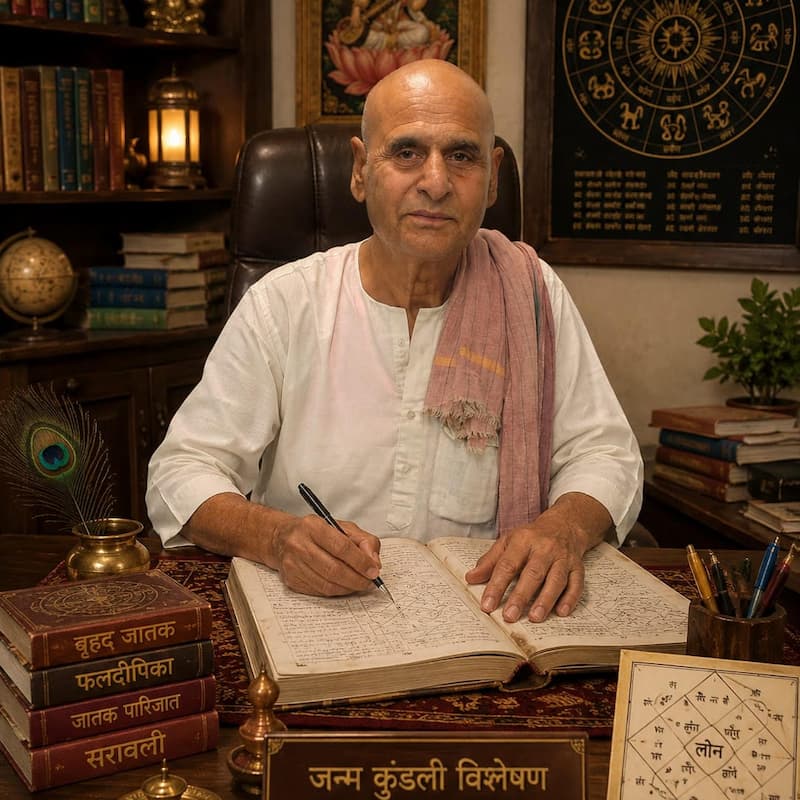
Narendra Kumar Chaubey is a Jyotisha Acharya with over 30 years of experience, based in Bihar and serving clients across India in Vedic astrology, mantra shastra, Vastu and ritual practice.
He completed his formal training at Kameshwar Singh Darbhanga Sanskrit University (KSDSU), one of India’s oldest and most respected institutions for Vedic and Sanskrit scholarship, where he studied Jyotisha shastra, mantra vidya and related classical sciences. KSDSU’s tradition of rigorous Sanskrit education tracing directly to the Mithila region’s centuries-old pandit lineage forms the foundation of his practice.
Over three decades, Narendra Kumar Chaubey has worked with thousands of individuals and families across Bihar and across India, offering guidance in:
- Kundli (birth chart) analysis: Identifying karmic patterns, planetary periods and life path guidance through classical Jyotisha
- Palmistry (Hasta Samudrika): Reading the hand according to the classical Samudrika Shastra tradition
- Vastu Shastra: Assessment and correction of living and working spaces according to directional and elemental principles
- Mantra and Pooja vidhi: Performing and guiding all categories of puja, havan, and mantra sadhana for personal, family and business situations
- Predictive Jyotisha: Transit analysis, muhurta (auspicious timing) selection and remedial guidance
He works across four languages Sanskrit, Hindi, English and Bhojpuri making classical knowledge accessible to practitioners across educational backgrounds and regions.
His writing for ABMantra brings the precision of classical Vedic training to practical mantra guidance: not general advice but specific prescriptions grounded in shastra, lineage and 30 years of direct practice with real situations.
For more info follow on: