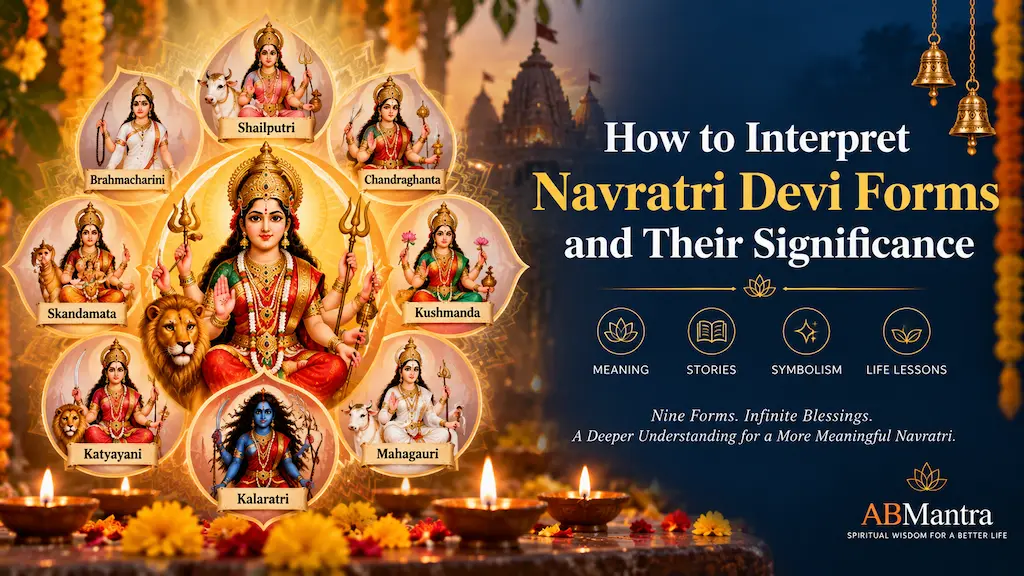

The nine forms of the Navadurga are not simply nine goddesses to be worshipped in a fixed sequence over nine days. They are nine stages of a single journey – a map of the inner development that the nine nights of Navratri are designed to facilitate. Most descriptions of the Navratri Devi forms focus on what each goddess looks like, what she holds, what colour is associated with her day. This guide focuses on what each form means, why the nine forms appear in this specific order, and what quality each form is asking the worshipper to develop in themselves. Reading the Navratri Devi forms significance in this way – as a sequential inner journey rather than a calendar of nine separate deities – changes what Navratri is and what it can do.
The Nine Forms as a Single Journey
The Devi Bhagavata Purana presents the nine Navadurga forms not as nine different goddesses but as nine aspects of one goddess – the Adishakti, the primordial feminine energy – revealing herself in sequence. The sequence is not arbitrary. It follows a specific inner logic: from the most earthly and elemental to the most transcendent and complete.
Shailputri, the first form, is as grounded as a deity can be – the daughter of a mountain, associated with the earth, with roots, with the most basic quality of stability. Siddhidatri, the ninth form, grants all Siddhis (divine perfections) and is worshipped by all gods, sages and evolved beings. The journey from Day 1 to Day 9 is the journey from the most earthly rootedness to the most complete divine perfection.
Between these two poles, seven intermediate forms represent seven specific inner qualities that must be cultivated, confronted or transcended to complete the journey. Understanding the sequence is more important than understanding each form in isolation.
The Three Triads: The Hidden Structure of the Nine Forms
Within the sequence of nine, three distinct triads are visible. Each triad of three forms represents a phase of the inner journey. Recognising the triads reveals a structure that daily descriptions of the nine forms consistently miss.
Triad 1 – Days 1 to 3: Establishing the Foundation
Shailputri, Brahmacharini, Chandraghanta. The first triad traces the journey of the soul from its most elemental earthly form through sustained spiritual discipline to the first genuine transformation.
Shailputri (Day 1): The daughter of the Himalaya – the most elemental starting point. Before any spiritual journey can begin, there must be a foundation. Shailputri is that foundation: earth, stability, rootedness, the body as a viable vehicle for the practice that follows. The Nandi bull she rides is the symbol of dharmic strength – slow, consistent, carrying what needs to be carried without complaint. The inner quality she calls forth: the willingness to simply begin, with stability, without rushing.
Brahmacharini (Day 2): 5,000 years of penance. Living first on leaves, then on water, then on nothing at all. The most extreme form of sustained effort in the entire tradition. Brahmacharini is not simply the goddess of discipline – she is the goddess of what sustained discipline eventually produces. The inner quality she calls forth: the discovery that the practitioner is capable of more than they initially believed possible. Not comfort but the willingness to move through discomfort toward something real.
Chandraghanta (Day 3): Parvati after marriage to Shiva – the ascetic energy of Brahmacharini transformed by union into something that is simultaneously fierce (the tiger) and graceful (the crescent moon ornament). The first triad ends not with pure austerity but with transformation through relationship. The inner quality she calls forth: the integration of the fruits of discipline into ordinary life – the ability to carry the results of practice into the everyday.
What the first triad teaches: a genuine spiritual journey requires a stable foundation (Day 1), sustained effort through difficulty (Day 2), and the integration of what that effort produces into one’s living reality (Day 3). Without all three, the journey does not properly begin.
Triad 2 – Days 4 to 6: Engaging with Creation
Kushmanda, Skandamata, Katyayani. The second triad moves outward – from inner foundation to engagement with the world: creative power, nurturing others, and righteous action.
Kushmanda (Day 4): The cosmic creatrix – the goddess who created the universe with a smile. Kushmanda’s inner quality is not simply creativity but the specific creativity that arises from abundance rather than effort. When the inner foundation (Triad 1) is properly established, something genuinely creative becomes possible. The inner quality she calls forth: the recognition that creative power comes from an inner surplus, not from straining. The universe was created from a smile – effortless, generous, arising from fullness.
Skandamata (Day 5): The mother of Kartikeya – the warrior goddess with an infant on her lap. The combination is deliberate and surprising: the same four arms that can hold weapons also hold the child with complete tenderness. The inner quality she calls forth: the integration of strength and nurturing – the recognition that genuine care is not soft and weakness is not strength. The person who can both protect and nourish with equal capacity is Skandamata’s teaching made real in a human life.
Katyayani (Day 6): Created specifically to destroy Mahishasura – the most explicitly warrior form of the second triad, distinct from Kalaratri’s terrifying darkness because Katyayani’s ferocity is purposeful, directed, righteous anger in service of justice. The Gopis of Vrindavan also prayed to her for a year to receive Krishna as their husband – so she governs both fierce action and devoted longing. The inner quality she calls forth: the ability to direct fierce energy constructively, without losing direction, without the energy collapsing into aimless aggression.
What the second triad teaches: genuine engagement with the world requires creative generosity (Day 4), the integration of strength and care (Day 5), and the ability to act decisively in service of what is right, even when that action requires fierce energy (Day 6).
Triad 3 – Days 7 to 9: Return to Source
Kalaratri, Mahagauri, Siddhidatri. The most demanding triad – the confrontation with darkness, the purification that results, and the completion that purification makes possible.
Kalaratri (Day 7): The most terrifying form in all of Navratri – black-skinned, fire-breathing, wearing a garland of skulls, riding a donkey. She appeared when Parvati removed her golden outer skin to fight demons who could not be killed by any being of light. The outer beauty was the obstacle; what remained when it was removed was the dark, undecorated truth. The inner quality she calls forth is the most demanding of all nine: the willingness to encounter one’s own darkness – the parts of oneself that are genuinely frightening – without flinching. The tradition calls her Shubhankari (the auspicious one) because facing what is dark and difficult in oneself is the most auspicious act available.
Mahagauri (Day 8): After years of austerity, Parvati’s skin had become dark with exposure. When Shiva bathed her in Ganga water, she became luminously white – not the original white she started with, but a white that comes after darkness, after having been through Kalaratri and survived it. Mahagauri is not simply purity – she is purity that has been earned through confronting darkness. The inner quality she calls forth: the recognition that genuine inner radiance is not the same as never having encountered darkness. It is what remains after the darkness has been faced and integrated.
Siddhidatri (Day 9): The giver of all eight Siddhis. She sits on a lotus, encompassing all eight previous forms. The completion that the tradition promises to the practitioner who has genuinely traveled the journey – not the eight forms skipped but the eight forms lived. The inner quality she calls forth is not a quality to develop but a recognition to receive: that the journey has changed the practitioner, and the person who arrives at Day 9 having genuinely engaged with all nine forms is measurably different from the person who arrived at Day 1.
What the third triad teaches: genuine spiritual completion requires the courage to face one’s own shadow (Day 7), the patient emergence of what is pure after darkness has been confronted (Day 8), and the reception – not the achievement – of what the complete journey produces (Day 9). Siddhis are given, not earned. They arrive as the natural consequence of the journey, not as a prize for effort.
The most important shift in how I teach Navratri came from recognising that the sequence of nine forms is not experienced identically by every practitioner. The form that carries the most charge – the one where something shifts more noticeably during the puja – is different for different people, and it is almost never random. It corresponds almost always to the stage of the inner journey where that practitioner is currently working.
A person in the middle of a difficult personal discipline (a major life change they have committed to, a creative project that requires sustained effort) will feel the Brahmacharini puja on Day 2 differently from someone who has recently come through such a period. A person who has been avoiding something genuinely difficult in their inner life will often experience the Kalaratri puja on Day 7 with unusual intensity – sometimes resistance, sometimes unexpected emotion. This is not coincidence and not imagination. It is the form’s energy making contact with the specific place in the practitioner where that energy is needed.
My practical recommendation: during Navratri, note which day’s puja produces the strongest response in you – whether that is a feeling of ease and rightness, or discomfort, or unexpected emotion. That response is pointing at the stage of the inner journey that is most active for you right now. Spend extra time with that form’s mantra in the weeks following Navratri. The 9-day festival is an annual pointing device. It shows you where you are on the journey. The practice that follows is the journey itself.
The Vahana Symbolism: What Each Vehicle Teaches
| Form | Vahana (Vehicle) | Inner significance |
|---|---|---|
| Shailputri | Nandi the bull | Slow, consistent dharmic strength. The bull carries what needs to be carried without complaint. The foundation of all spiritual work. |
| Brahmacharini | No vehicle – walks barefoot | The only form without a vehicle. Brahmacharini travels on her own feet, through her own effort, without external support. The teaching: in genuine tapasya, there is no vehicle – only the practitioner and the path. |
| Chandraghanta | Tiger | Power under control. The tiger is fierce but directed. After the barefoot austerity of Brahmacharini, Chandraghanta mounts a tiger – she has earned the fierce energy and knows how to direct it. |
| Kushmanda | Lion | Solar authority. The lion is the king of animals – the vehicle of sovereignty, of the creative power that generates rather than follows. Kushmanda’s cosmic creative power rides sovereign authority. |
| Skandamata | Lion (holding infant Skanda) | Also a lion – but here the lion carries the mother and child. The same authority that Kushmanda uses for cosmic creation here serves the nurturing of the next generation. |
| Katyayani | Lion | Three consecutive goddesses on a lion: Kushmanda (creation), Skandamata (nurturing), Katyayani (righteous battle). The second triad’s lion represents the solar authority that creation, care and righteous action all require. |
| Kalaratri | Donkey | The most deliberately humble vehicle – the complete opposite of the previous three goddesses on lions. The most terrifying form chooses the most humble transport. True power needs no impressive vehicle. Kalaratri’s darkness and ferocity carry their own authority; the donkey is the teaching that genuine power does not require display. |
| Mahagauri | White bull | Return to the Nandi energy of Day 1 – but white, purified. The journey began with Shailputri on the dharmic bull. It returns here to the same animal, transformed. The white bull carries the purified Mahagauri – the purity that comes after darkness, not before it. |
| Siddhidatri | Lion or lotus | Two vehicles for the final form – the lion of sovereign authority and the lotus of spiritual purity. Siddhidatri encompasses the entire journey: the authority of the second triad and the purity of the third triad, united in the form that grants all perfections. |
How to Identify Which Devi Form You Need Most
The nine forms address nine different situations in a practitioner’s life. Rather than approaching all nine equally, many experienced practitioners focus particular attention on the form most relevant to their current situation. The following descriptions are intended as practical guidance.
You need Shailputri when you are beginning something and struggling to find a stable footing. A new practice, a new life chapter, a new discipline that keeps slipping. The foundational work has not been done, and the absence of a stable foundation is the specific problem.
You need Brahmacharini when you are in the middle of something genuinely difficult and are considering giving it up before it is complete. Not because the path is wrong but because the effort has gone on long enough that the mind is looking for permission to stop. Brahmacharini’s answer to this is not inspiring – she did 5,000 years of penance. She offers perspective, not comfort.
You need Chandraghanta when the hard work is done but the integration has not happened – when the discipline or the effort has produced something real but it has not yet become part of ordinary life. The gap between spiritual practice and daily function is what Chandraghanta bridges.
You need Kushmanda when creative energy is blocked – when you know you have something to make or express or build but cannot access the generosity and ease that genuine creativity requires. The block is usually not lack of skill but lack of inner abundance.
You need Skandamata when there is a conflict between your own strength and your capacity to nurture. Either you are strong but struggle to be genuinely caring, or you are caring but have lost access to your strength. The integration of both is Skandamata’s specific teaching.
You need Katyayani when there is something that requires decisive, fierce action and you are not taking it. The anger or determination is present but undirected, or directed but without sufficient force. Katyayani is for the moment when what is required is action, not more understanding.
You need Kalaratri when you are avoiding something in yourself that you know is there. This is the most uncomfortable form to consciously work with, which is exactly why it is the most useful for the person in this situation. The practice of sitting with Kalaratri’s image and mantra on Day 7 with the genuine intention of seeing what you have been avoiding is among the most powerful practices in the entire Navratri sequence.
You need Mahagauri when you are emerging from a period of darkness – when the difficult thing has been faced and something lighter is beginning but has not fully arrived. Mahagauri is the grace of what comes after. She cannot be approached before Kalaratri; she arrives as Kalaratri’s consequence.
You need Siddhidatri when the journey has been traveled but the recognition has not arrived. The completion is present but not received. Siddhidatri gives what has been earned by the journey – she cannot be petitioned from the beginning but can be approached with genuine gratitude at the end.
- Devi Bhagavata Purana (Srimad Devi Bhagavatam) – the primary Puranic source for the Navadurga sequence; the understanding that all nine forms are aspects of one Adishakti; the specific circumstances of each form’s appearance and the qualities she represents; “honoring even one form invokes her universal presence”
- Wikipedia – Navadurga: the nine forms, their iconography, vehicles and attributes; the sequence and its relationship to the nine-night battle narrative; Shubhankari as Kalaratri’s specific epithet
- Wikipedia – Navaratri: the festival as a nine-stage devotional journey; the Sharad Navratri as the most widely observed; the connection between the Navadurga sequence and the Devi’s battle against Mahishasura
- Markandeya Purana (Devi Mahatmyam / Durga Saptashati) – the narrative of Durga’s battle in which the nine forms appear as the goddess changes form through the nine nights of combat; the inner reading of the battle as the soul’s confrontation with its own obscuring energies
Narendra Kumar Chaubey is a Jyotisha Acharya with over 30 years of experience, based in Bihar and serving clients across India in Vedic astrology, mantra shastra, Vastu and ritual practice.
He completed his formal training at Kameshwar Singh Darbhanga Sanskrit University (KSDSU), one of India’s oldest and most respected institutions for Vedic and Sanskrit scholarship, where he studied Jyotisha shastra, mantra vidya and related classical sciences. KSDSU’s tradition of rigorous Sanskrit education tracing directly to the Mithila region’s centuries-old pandit lineage forms the foundation of his practice.
Over three decades, Narendra Kumar Chaubey has worked with thousands of individuals and families across Bihar and across India, offering guidance in:
- Kundli (birth chart) analysis: Identifying karmic patterns, planetary periods and life path guidance through classical Jyotisha
- Palmistry (Hasta Samudrika): Reading the hand according to the classical Samudrika Shastra tradition
- Vastu Shastra: Assessment and correction of living and working spaces according to directional and elemental principles
- Mantra and Pooja vidhi: Performing and guiding all categories of puja, havan, and mantra sadhana for personal, family and business situations
- Predictive Jyotisha: Transit analysis, muhurta (auspicious timing) selection and remedial guidance
He works across four languages Sanskrit, Hindi, English and Bhojpuri making classical knowledge accessible to practitioners across educational backgrounds and regions.
His writing for ABMantra brings the precision of classical Vedic training to practical mantra guidance: not general advice but specific prescriptions grounded in shastra, lineage and 30 years of direct practice with real situations.
For more info follow on: