
Quick Answer
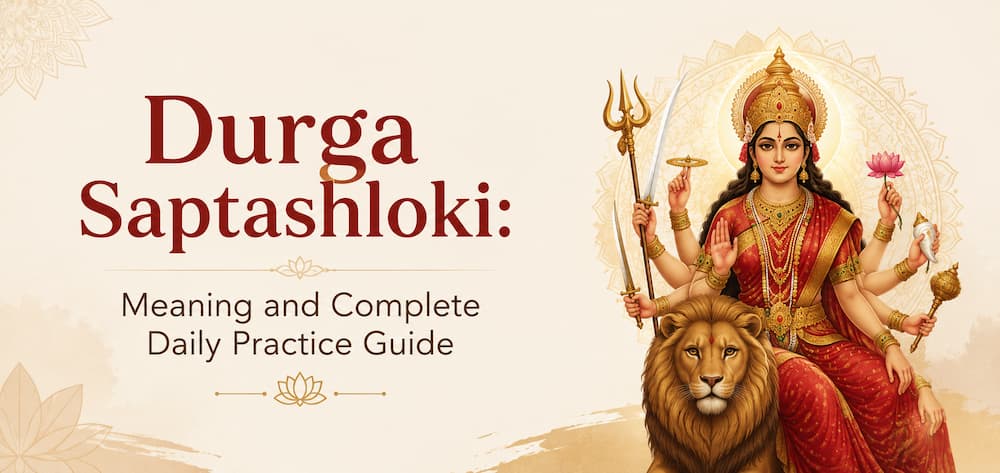
Durga Saptashloki means Seven Verses of Durga (Sapta = seven, Shloki = verses). It is a collection of seven specific shlokas selected from the Devi Mahatmya (700-verse Durga Saptashati), arranged as a condensed daily prayer.
The seven verses were selected by Shiva himself, according to the tradition, so that devotees who cannot recite all 700 verses of the Devi Mahatmya could access the complete blessing of the goddess through just seven. Each shloka addresses a different dimension of Durga’s power: removing fear, granting wealth, providing protection from enemies, destroying disease, removing ancestral sins, granting liberation, and destroying all obstacles.
Chant: All 7 shlokas in sequence, once daily. Navratri is the most auspicious time. Daily recitation as a morning practice is the most effective for continuous protection and prosperity.
Who This Article Is For
This article is for you if: you want to understand what each of the seven shlokas means and what specific blessing each one carries | you want to know how the Durga Saptashloki differs from the Durga Saptashati (700 verses) | you want a practical daily Durga practice that is complete without requiring an hour of recitation.
Also see: Durga Mantra: Navarna Mantra with word-by-word meaning
If you have been told to chant the Durga Saptashloki but do not know what each shloka means or does, you have been given the practice without the map. This article gives you the complete map: the source, the meaning of each of the seven shlokas, and the specific purpose each one serves.
Here is what most Durga Saptashloki articles miss: the seven shlokas are not randomly selected from the 700 verses of the Devi Mahatmya. Each one was chosen because it represents a complete invocation in itself : a complete statement of Durga’s power in one of its seven primary forms. Together they form what the tradition calls a sampoorna (complete) invocation: no dimension of Durga’s protection is left uninvoked. Understanding this changes how you chant each verse.
The Source: Devi Mahatmya and the Seven Selected Shlokas
The Durga Saptashloki exists because of a specific request made by Lord Shiva. The origin is narrated at the beginning of the Saptashloki text itself, in the Shiva-Devi dialogue that precedes the seven shlokas:
The Shiva-Devi Dialogue: Why the Saptashloki Exists
Shiva Uvacha (Lord Shiva said):
Devi Tvam Bhakta Sulabhe Sarva Karya Vidhayini
Kalau Hi Karya Siddhyartham Upayan Broohi Yatnatah
Meaning: O Devi, you who are easily accessible to devotees and who accomplish all tasks : tell us carefully the means by which tasks may be fulfilled in Kali Yuga.
Devi Uvacha (the Goddess replied):
Shrunu Deva Pravakshyami Kalau Sarveshtasadhanam
Maya Tavaiva Snehenapyambastutih Prakashyate
Meaning: O Deva, listen. I will tell you the means of accomplishing all desires in Kali Yuga. Out of my love for you, I reveal this Amba Stuti (hymn to the Mother).
Why this matters: The Durga Saptashloki is not a random selection of seven shlokas. It is the Goddess’s own answer to Shiva’s question: what can people in Kali Yuga chant to receive the complete benefit of the 700-verse Devi Mahatmya without being able to chant all 700 verses? The Saptashloki is that answer. Chanting these seven shlokas carries the Devi’s own sanction as the Kali Yuga equivalent of the complete Saptashati.
The Viniyoga: Begin Every Recitation With This
The Viniyoga is the formal dedication that precedes the Saptashloki chanting. It names the seer (Rishi), the metre (Chhanda) and the deities (Devata) of the stotra, establishing the correct energetic context before chanting begins. Traditionally, every serious recitation of the Saptashloki begins with the Viniyoga:
Sanskrit:
Om Asya Shri Durga Saptashloki Stotra Mantrasya
Narayana Rishih Anushtup Chhandah
Shri Mahakali Mahalakshmi Mahasaraswatyo Devatah
Shri Jagadamba Prityarthe Pathe Viniyogah
Meaning: Om. Of this Shri Durga Saptashloki Stotra Mantra, the seer is Narayana, the metre is Anushtup, the deities are Shri Mahakali, Mahalakshmi and Mahasaraswati. This is chanted for pleasing
A note on Mahamaya: The first shloka of the Saptashloki addresses Devi as Mahamaya: “Jnanina mapi chetamsi Devi Bhagavati hi sa, Baladakrishya mohaya Mahamaya prayachhati.” Mahamaya means the Great Illusion: the divine power that draws even the minds of the wise into the cosmic play. This is the Saptashloki’s opening declaration: the Goddess who rules all of existence is the same Mahamaya who holds the entire cosmos in her creative dream. Chanting begins from this recognition.
This is chanted for pleasing Shri Jagadamba (Mother of the Universe).
In practice: Chant the Viniyoga once before beginning the seven shlokas. It takes approximately 20 seconds. Do not skip it : the Viniyoga connects the individual recitation to the unbroken lineage of practitioners who have chanted these verses before you.
The Devi Mahatmya is a section of the Markandeya Purana (4th to 5th century CE) consisting of 700 shlokas across 13 chapters. It narrates the three great battles in which the goddess Chandika (Durga) defeats the demons Madhu-Kaitabha, Mahishasura, and Shumbha-Nishumbha. The complete reading of all 700 verses is called the Saptashati path and is traditionally performed over three days during Navratri.
The tradition records that Shiva, understanding that most devotees could not undertake the complete Saptashati daily, asked Durga to identify seven shlokas from the 700 that would carry the complete blessing of the full recitation. Durga agreed and selected seven specific verses : one from the opening invocation, and six from the eleventh chapter (Narayani Stuti) : that together invoke her complete grace.
| Shloka | Source in Devi Mahatmya | Primary invocation |
|---|---|---|
| 1 | Opening invocation (Mangalacharana) | Durga as the remover of fear and granter of auspiciousness |
| 2 | Chapter 11, verse 3 | Durga as destroyer of poverty and sorrow in all their forms |
| 3 | Chapter 11, verse 6 | Sarvamangala: Durga as the source of all auspiciousness |
| 4 | Chapter 11, verse 11 | Durga as the protector of those who take refuge in her |
| 5 | Chapter 11, verse 23 | Durga as all-pervading power who protects from all fears |
| 6 | Chapter 11, verse 25 | Durga as destroyer of disease and granter of desires |
| 7 | Chapter 11, verse 28 | Durga as destroyer of all suffering and enemies in three worlds |
All Seven Shlokas with Meaning
Shloka 1: The Opening : Removing Fear and Granting Auspiciousness
Shloka 1
Sanskrit:
Devi Twam Bhaktha Sulabhe Sarva Karya Vidhayini
Kalau Hi Karya Siddhyardham Upayam Bruhi Yatnataha
Meaning: O Devi, you who are easily accessible to devotees and who fulfills all tasks : in this Kali Yuga, for the accomplishment of all purposes, tell us the method (with effort).
Purpose: This shloka opens the relationship with the goddess by acknowledging her accessibility. She is not distant or indifferent. She is Bhaktha Sulabhe : easily attained by those who come to her with devotion. The opening shloka is an acknowledgement of this accessibility before any specific request is made.
Shloka 2: Removing Poverty and Sorrow
Shloka 2
Sanskrit:
Durge Smruta Harasi Bheetim Ashesh Jantho
Swasthai Smruta Mati Mateem Shubhaam Dadasi
Daaridrya Dukha Bhaya Harini Ka Twadanya
Sarvopakaara Karanaya Sada Ardra Chitta
Meaning: O Durga, when remembered by those in fear, you remove their fear completely. When remembered by those who are well, you grant them auspicious intellect. Who else but you removes poverty, suffering and fear? Your heart is always soft and compassionate toward all beings.
Purpose: This is the poverty and fear removal shloka. The ArshaVidyAnanda commentary notes: “We may be experiencing poverty : of wealth, of ideas, starved of love or always thinking we are not enough. Whatever be the nature of our poverty, Durga, who else than you can take it away?” The verse addresses all forms of poverty simultaneously.
Shloka 3: Sarvamangala : The Source of All Auspiciousness
Shloka 3
Sanskrit:
Sarvamangala Mangalye Shive Sarvartha Sadhike
Sharanye Trayambike Gauri Narayani Namostute
Meaning: O the auspicious one who brings auspiciousness to all, O Shiva’s consort who fulfills all purposes, O the three-eyed one who is the refuge of all, O Gauri, O sister of Narayana : I bow to you.
Purpose: This is perhaps the most widely chanted of the seven shlokas. It invokes Durga in five names simultaneously: Sarvamangala (source of all auspiciousness), Shive (auspicious one), Trayambike (three-eyed), Gauri (golden/pure) and Narayani (sister of Vishnu/Narayana). Each name invokes a different quality of the goddess. Chanting all five names in sequence creates a complete invocation of her multi-dimensional nature.
Shloka 4: Protection of the Refugee
Shloka 4
Sanskrit:
Sharanagata Deenartha Paritrana Parayane
Sarvasya Arti Hare Devi Narayani Namostute
Meaning: O Goddess, you are dedicated to protecting those who seek your refuge and those in distress. O you who removes the suffering of all : O Narayani, I bow to you.
Purpose: The shloka of Sharanagati (complete surrender). The key phrase is Sharanagata Deenartha Paritrana Parayane : you are dedicated to protecting those who take refuge and those in distress. The word Parayane means completely devoted to, dedicated to. This is not a passive protection but an active dedication to the protection of those who come to her.
Shloka 5: Protection from All Fears
Shloka 5
Sanskrit:
Sarva Svarupe Sarveshe Sarva Shakti Samanvite
Bhayebhyas Trahi No Devi Durge Devi Namostute
Meaning: O you who are present in all forms, ruler of all, endowed with all powers : O Goddess Durga, protect us from all fears. I bow to you.
Purpose: The comprehensive protection shloka. Sarva Svarupe (present in all forms) establishes that there is no form in which Durga is not present : she is not limited to a particular divine form but pervades all manifestation. From this position of omnipresence, she is asked to protect from all fears (Bhayebhyas).
Shloka 6: Destroying Disease and Fulfilling Desires
Shloka 6
Sanskrit:
Rogana Sheshana Pahamasi Tushta
Rushta Tu Kaman Sakalan Abhishtam
Twam Ashrithanam Na Vipanna Ranam
Twam Ashritya Hyashrayatam Prayanti
Meaning: When pleased, you destroy all diseases. When displeased, you thwart all aspirations and desires. Those who take refuge in you never fall into ruin. Those who take you as their refuge attain blessings.
Purpose: The disease destruction and desire fulfillment shloka. The verse is notable for its honest statement: Tushta (when pleased, she destroys disease) and Rushta (when displeased, she thwarts desires). This dual nature is not a threat but a teaching: the relationship with the goddess requires sincerity and ongoing devotion, not a one-time transaction.
Shloka 7: Destroying All Obstacles and Enemies
Shloka 7
Sanskrit:
Sarva Baadha Prashamana Trilokyasya Akhileshwari
Evameva Twaya Karyam Asmat Vairi Vinashanam
Meaning: O you who remove all suffering in the three worlds, ruler of all : in the same way, destroy our enemies.
Purpose: The final shloka is the most direct request of the seven: destroy our enemies and remove all suffering from the three worlds. This shloka is the Phala Shruti of the Saptashloki : the verse that completes the invocation and asks for the concrete removal of what opposes the devotee. Vairi Vinashanam means the destruction of enemies. In the tradition, this includes not just external enemies but internal ones: the inner enemies of the ego (Arishadvargas): desire, anger, greed, delusion, pride and jealousy.
The Seven Shlokas and Their Seven Purposes
| Shloka | Key Sanskrit phrase | What to chant it for |
|---|---|---|
| 1 | Bhaktha Sulabhe (easily attained by devotees) | Opening the relationship with the goddess. Beginning any new endeavour or practice. |
| 2 | Daaridrya Dukha Bhaya Harini (remover of poverty, suffering and fear) | Financial difficulty, poverty, persistent fear or sorrow. Any form of deprivation. |
| 3 | Sarvamangala Mangalye (source of all auspiciousness) | New beginnings, marriages, business launches, any situation requiring auspiciousness. |
| 4 | Sharanagata Deenartha Paritrana (protector of those who surrender) | Complete surrender. When you have exhausted all other resources and come to her with nothing but sincerity. |
| 5 | Sarva Svarupe Sarveshe (present in all forms, ruler of all) | Protection from all fears simultaneously. When the fear is formless, undefined or multiple. |
| 6 | Rogana Sheshana Pahamasi (destroyer of all diseases) | Illness, chronic disease, health recovery. Fulfillment of specific desires. |
| 7 | Vairi Vinashanam (destruction of enemies) | External opposition, court cases, enemies, and the internal enemies of ego and negative patterns. |
Complete Daily Practice Method
The Durga Saptashloki can be chanted as a complete daily morning practice in approximately 10 to 15 minutes. This makes it the most accessible complete Durga practice in the tradition : more accessible than the full Saptashati (which takes 3 hours) but carrying the same complete invocation.
- Bathe before the practice if possible. Sit facing east or north.
- Light a ghee lamp and offer red flowers to Durga’s image.
- Begin with the Navarna Mantra three times: Om Aim Hreem Kleem Chamundaye Vichche. This opens the energetic channel to Durga before the Saptashloki begins.
- Chant all seven shlokas in sequence. Do not skip any : the seven form a single complete invocation and each depends on the others for its full effect.
- Close with Om Durgayai Namah three times.
- Sit in silence for 5 minutes.
During Navratri
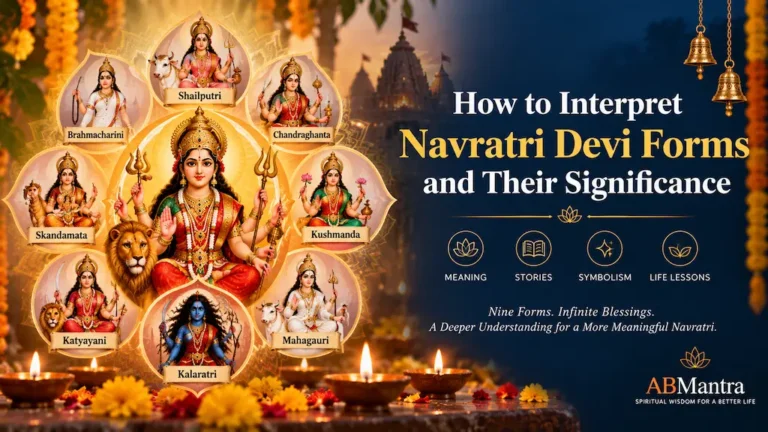
The nine days of Navratri are the most powerful time for Durga Saptashloki practice. Each of the nine days corresponds to one of the nine forms of Durga (Navadurga). During Navratri, chant the Saptashloki in the morning and the specific Navadurga mantra for that day’s form in the evening.
Chanting the complete Saptashloki nine times on the Ashtami (eighth day of Navratri) is a particularly powerful practice : nine complete invocations on the day of Mahagauri, the form of Durga that removes all accumulated sin and misfortune.
From Our Practice
From Our Practice
My introduction to the Durga Saptashloki was through the second shloka: Daaridrya Dukha Bhaya Harini Ka Twadanya : who else but you removes poverty, suffering and fear?
The phrase that stayed with me was from a commentary I encountered: “poverty of wealth, poverty of ideas, starved of love, always thinking we are not enough.” The tradition does not limit poverty to money. Every form of felt lack is addressed in this shloka.
I began chanting the complete seven shlokas daily for Navratri one year and continued for 90 days after. What shifted was not dramatic. It was a progressive reduction in the quality of contraction that accompanies persistent worry : a loosening of the grip that fear and lack had on my internal state. By the 40th day, the same external situations that had felt suffocating felt navigable. The situations had not changed. The capacity to be in them had.
The seventh shloka : Vairi Vinashanam : I eventually understood as primarily about the inner enemies. The external enemies are real and the practice addresses them. But the six inner enemies of the Arishadvargas are the ones that make external enemies dangerous. Remove the inner enemies and external opposition loses much of its power.
Frequently Asked Questions
❓ What is the difference between Durga Saptashloki and Durga Saptashati?
The Durga Saptashati (also called Devi Mahatmya or Chandi Path) is the complete 700-verse text from the Markandeya Purana. Reciting it in full takes approximately 3 hours and is typically done over three days during Navratri. The Durga Saptashloki is seven specific verses selected from those 700, arranged as a daily condensed practice. The tradition holds that these seven verses carry the complete blessing of the full 700 when chanted with sincere understanding and devotion.
❓ Can I chant only one of the seven shlokas, or must I chant all seven together?
Individual shlokas can be chanted separately for specific purposes : Shloka 6 for health, Shloka 2 for poverty, Shloka 7 for enemies, for example. However, the tradition recommends chanting all seven as a unit for the complete invocation. When you chant only individual shlokas, you invoke one dimension of Durga’s power. When you chant all seven, you invoke the complete goddess. For a 10-minute daily practice, all seven together is both practical and complete.
❓ Can women chant the Durga Saptashloki during periods?
Yes. The Shakta tradition from which the Durga Saptashloki comes has no menstruation restriction for Devi mantras. Durga herself is the supreme feminine power : restricting women from invoking her during their most feminine biological experience has no basis in the Shakta texts. If you are in a daily practice when your cycle begins, continue without interruption.
❓ How many times should I chant the Saptashloki daily?
Once through all seven shlokas is the standard daily practice. During Navratri or for specific situations requiring intensified practice, chant three times or nine times. For the Ashtami (eighth day of Navratri), nine complete recitations is the traditional prescription. Chanting more than once does not require starting over from the beginning each time : simply continue through the seven shlokas in a continuous flow.
❓ Is the Durga Saptashloki the same as the Saptashloki Chandi?
Yes. The same seven verses are referred to by both names in different regional traditions. Chandi is another name for Durga, specifically in her fierce battlefield form. Saptashloki Chandi and Durga Saptashloki refer to the same seven-verse collection from the Devi Mahatmya.
❓ I face serious opposition from enemies at work. Which of the seven shlokas should I focus on?
Shloka 7 (Sarva Baadha Prashamana, Vairi Vinashanam) is the direct enemy-destruction shloka. Chant all seven daily but sit with Shloka 7 for an extra moment : slow down, hear the word Vairi Vinashanam clearly. Also add the Navarna Mantra (Om Aim Hreem Kleem Chamundaye Vichche) 108 times daily for the 21 days of most intense opposition. The Navarna Mantra and Shloka 7 together address both the immediate energetic opposition and the karmic obstruction behind it.
Begin Tomorrow Morning
Seven shlokas. Ten minutes. A complete invocation of all seven dimensions of Durga’s grace.
Tomorrow morning, light your lamp, offer red flowers, chant the Navarna Mantra three times to open the channel, then move through the seven shlokas in sequence. Close with Om Durgayai Namah three times. Sit quietly for 5 minutes.
Return the next morning. Maintain this for 40 days. By then the shlokas will no longer be something you chant : they will be the way you begin your day, which is what the tradition intends. Not a practice added to your life but a foundation from which the rest of it proceeds.
Sources
- The Meaning of Durga Saptashloki. ArshaVidyAnanda, April 2024. Poverty of all forms addressed in Shloka 2; Shiva selecting the seven verses; commentary on individual shloka meanings
- Durga Saptashloki Lyrics and Meaning. Hinduism Outlook, March 2023. Sanskrit text, transliteration and translation of all 7 shlokas; Shiva’s request to Durga for condensed version
- Durga Saptashloki: Seven Verses from Devi Mahatmyam. Koushik K, 2019. Commentary per Bhaskararaya Makhin and Nagoji Bhatta on individual shloka purposes
- Sacred Verses of Saptashloki Durga. Karuna Astrology on Medium, October 2024. Devi Mahatmya source chapters for each of the seven shlokas
Also Read on ABMantra
Narendra Kumar Chaubey is a Jyotisha Acharya with over 30 years of experience, based in Bihar and serving clients across India in Vedic astrology, mantra shastra, Vastu and ritual practice.
He completed his formal training at Kameshwar Singh Darbhanga Sanskrit University (KSDSU), one of India’s oldest and most respected institutions for Vedic and Sanskrit scholarship, where he studied Jyotisha shastra, mantra vidya and related classical sciences. KSDSU’s tradition of rigorous Sanskrit education tracing directly to the Mithila region’s centuries-old pandit lineage forms the foundation of his practice.
Over three decades, Narendra Kumar Chaubey has worked with thousands of individuals and families across Bihar and across India, offering guidance in:
- Kundli (birth chart) analysis: Identifying karmic patterns, planetary periods and life path guidance through classical Jyotisha
- Palmistry (Hasta Samudrika): Reading the hand according to the classical Samudrika Shastra tradition
- Vastu Shastra: Assessment and correction of living and working spaces according to directional and elemental principles
- Mantra and Pooja vidhi: Performing and guiding all categories of puja, havan, and mantra sadhana for personal, family and business situations
- Predictive Jyotisha: Transit analysis, muhurta (auspicious timing) selection and remedial guidance
He works across four languages Sanskrit, Hindi, English and Bhojpuri making classical knowledge accessible to practitioners across educational backgrounds and regions.
His writing for ABMantra brings the precision of classical Vedic training to practical mantra guidance: not general advice but specific prescriptions grounded in shastra, lineage and 30 years of direct practice with real situations.
For more info follow on: