
Quick Answer
The primary Yajnopavita (Janeu) Mantra:
Yajnopavitam Paramam Pavitram
Prajapater Yat Sahajam Purastaat
Aayushyamagreya Pratimuncha Shubhram
Yajnopavitam Balamsthu Tejah
Meaning: The sacred thread is supremely pure. It was born with Prajapati (the Lord of Creation) from the beginning. May this auspicious thread, which increases life, be placed on me. May the Yajnopavita give me strength and brilliance.
In the Mithila tradition: This mantra is chanted specifically at the moment of wearing (or replacing) the Janeu. The Maithil Brahmin tradition has additional regional variations that include specific Maithili language prayers alongside the Sanskrit text.
Who This Article Is For
This article is for you if you are from the Mithila region (Bihar, Jharkhand, or the Madhesh region of Nepal) and want to understand the Janeu mantra in your specific tradition | you want to know the complete Yajnopavita mantra and its meaning | you want to understand what the Janeu represents and the correct way to wear, change and maintain it.
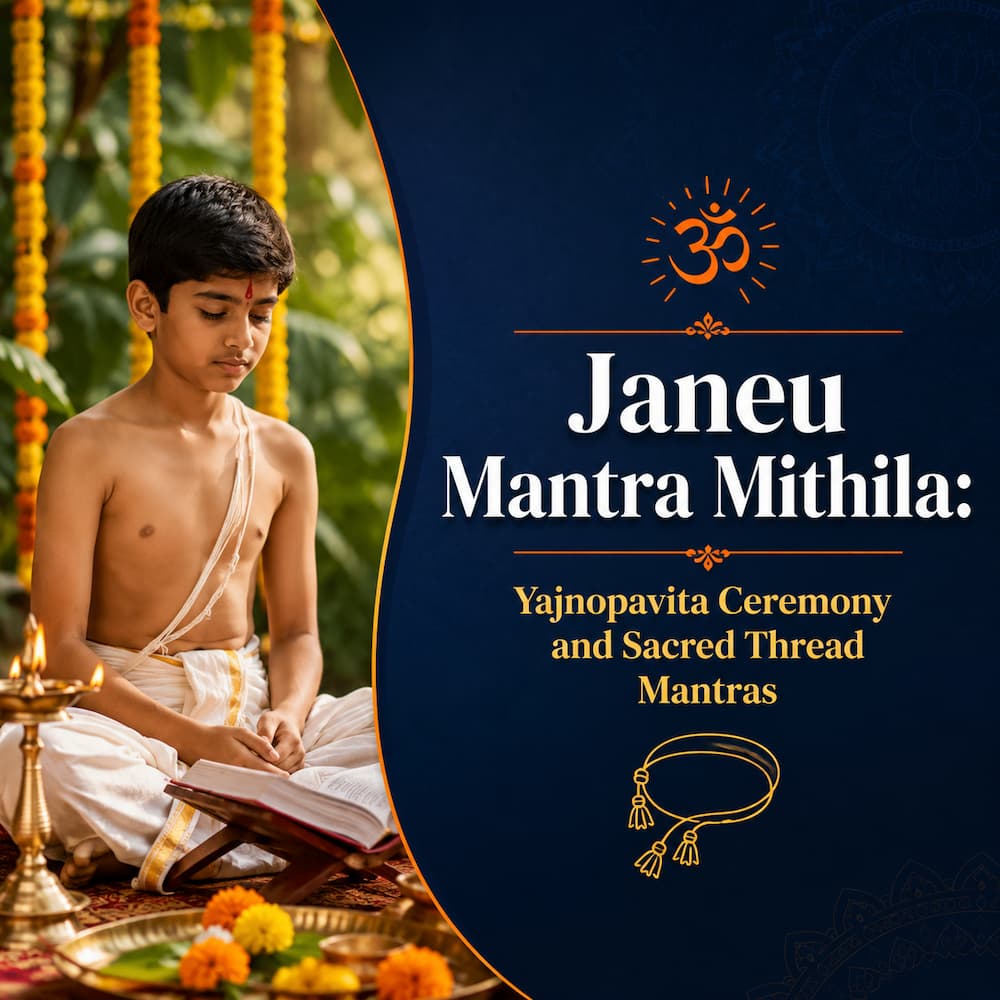
The Janeu (यज्ञोपवीत, also written Janeva, Janeo or Yajnopavita) is the sacred thread worn across the chest by twice-born Hindu men : specifically Brahmin, Kshatriya and Vaishya men who have undergone the Upanayana (sacred thread ceremony). In the Mithila tradition of Bihar and the Madhesh region of Nepal, the Janeu carries specific cultural and spiritual significance that reflects the region’s long history as one of India’s foremost centres of Vedic learning.
Here is what most Janeu mantra articles miss: they give only the wearing mantra without explaining what the Janeu actually represents, why the Mithila tradition has its own specific customs around it, and the correct daily practice for maintaining the Janeu’s sanctity after the initial ceremony. The Upanayana ceremony and the ongoing practice of wearing the Janeu are two different things : the ceremony is a one-time event, but the daily relationship with the Janeu continues for life.
What the Janeu Is and What It Represents
The Yajnopavita: Classical Meaning
Yajnopavita breaks into Yajna (sacrifice, sacred rite) + Upavita (that which is worn over). The sacred thread is literally “that which is worn for the sake of sacred rites.” It marks the wearer as someone who has taken on the responsibility of Yajna : the ongoing dedication of life to the sacred order.
The three strands: The Janeu consists of three strands twisted together. The three strands represent three different things in different interpretive traditions:
In the Vedic tradition: the three Vedas (Rigveda, Yajurveda, Samaveda)
In the devotional tradition: the three deities (Brahma, Vishnu, Shiva)
In the ethical tradition: the three debts (Rishi Rina, Deva Rina, Pitru Rina) : the debt to the teachers, to the gods and to the ancestors that every twice-born person is born carrying and works to discharge through their life
The Dvijatva (twice-born) concept: The Upanayana ceremony is called Dvijatva : the second birth. The first birth is physical. The second birth is spiritual : the moment at which the young person enters into conscious relationship with the Vedic tradition and takes on the Savitri (Gayatri Mantra) as their lifelong daily practice. The Janeu is the physical mark of this second birth, worn continuously as a reminder of the commitment made at Upanayana.
The Mithila Tradition
Mithila : the region of North Bihar and the Madhesh region of Nepal associated with King Janaka, the father of Sita : has been a centre of Sanskrit learning since ancient times. The Mithila school of Navya-Nyaya philosophy and the Mithila tradition of Vedic scholarship produced some of the most rigorous intellectual traditions in Indian history. The Maithil Brahmin community that has been the custodian of this learning has specific customs around the Janeu that reflect this scholarly tradition.
| Aspect | Mithila tradition specifics |
|---|---|
| Upanayana age | The Upanayana ceremony is typically performed before the age of 8 for Brahmin boys in the Maithil tradition. Earlier ages are preferred : the tradition holds that the younger the Dvijatva, the deeper the integration of the Gayatri Mantra and Vedic practice. |
| The Madhuparka ceremony | Specific to the Mithila Upanayana: a honey-and-milk mixture (Madhuparka) is offered to the boy before the Janeu is placed. This is a specifically Maithil custom not universal to all regional traditions. |
| The Surya Darshana | The newly Yajnopavita-wearing boy is taken outside immediately after the ceremony to see the Sun directly. This is the symbolic first act of the Gayatri practice : the first conscious salutation to Savitr that the Yajnopavita commits him to for life. |
| Maithili prayers | The Mithila tradition supplements the Sanskrit Yajnopavita mantra with Maithili vernacular prayers from the boy’s mother and grandmother. These prayers are the mothers’ blessing on the son entering his spiritual life : a specifically Maithil dimension not present in the Sanskrit-only ceremony. |
| Janeu change day | The Janeu is changed on Shravani Purnima (Raksha Bandhan period) in most traditions. In the Mithila tradition, the Janeu change ceremony (Avani Avittam or Upakarma in other traditions; Sravani in the Mithila context) includes specific community worship and the recitation of the Yajnopavita mantra in the presence of the household elders. |
The Complete Janeu Mantra: Text and Meaning
Yajnopavita Mantra: Complete Sanskrit and Meaning
Sanskrit:
Yajnopavitam Paramam Pavitram
Prajapater Yat Sahajam Purastaat
Aayushyamagreya Pratimuncha Shubhram
Yajnopavitam Balamsthu Tejah
Devanagari:
यज्ञोपवीतं परमं पवित्रं
प्रजापतेर्यत्सहजं पुरस्तात्
आयुष्यमग्रयं प्रतिमुञ्च शुभ्रं
यज्ञोपवीतं बलमस्तु तेजः
Word by word:
Yajnopavitam: the sacred thread (Yajna + Upavita)
Paramam: supremely, most
Pavitram: pure, sanctifying
Prajapater: of Prajapati (the Lord of all created beings)
Yat: which
Sahajam: born with, natural, innate
Purastaat: from the beginning, from ancient times
Aayushyam: life-giving, that which increases life
Agreya: foremost, of the highest quality
Pratimuncha: please place upon me, invest me with
Shubhram: auspicious, white, pure
Yajnopavitam: the sacred thread (repeated for emphasis)
Balam: strength
Asthu: may there be
Tejah: brilliance, radiance, spiritual power
Complete meaning: The sacred thread is supremely pure. It was innately born with Prajapati from the very beginning of creation. May this auspicious thread : foremost in its quality of sustaining life : be placed upon me. May the Yajnopavita give me strength and spiritual brilliance.
The Janeu in Daily Life: Correct Practice
| Situation | Correct practice |
|---|---|
| Morning | Before any other activity, touch the Janeu consciously. Chant the Gayatri Mantra 3 times minimum while touching it. This is the daily renewal of the Dvijatva commitment. |
| Bathing | The Janeu should remain on the body during bathing. Traditional practice loops it over the right ear during bathing : this keeps it elevated and away from water while the rest of the body is washed. Do not remove it to bathe. |
| Toilet | The Janeu is looped over the right ear before entering a toilet space and returned to normal position afterward. This is the universally consistent Janeu rule across all regional traditions. |
| Sleeping | The Janeu remains on during sleep. There is no removal for sleep in any traditional Yajnopavita practice. |
| When to change | The Janeu is changed on Shravani Purnima (typically in August). In the Mithila tradition, this is the Sravani ceremony. At any other time, change only if the Janeu breaks. When it breaks, it should be changed immediately with the Yajnopavita mantra. The broken thread is offered to flowing water (a river) or buried in the earth : not placed in regular waste. |
| After a death in the family | A new Janeu is worn after the Ashoucha (mourning period) ends : typically 10 to 13 days depending on family tradition. The Ashoucha period is one of the few times certain ceremonies around the Janeu may be suspended. |
From Our Practice
From Our Practice
I am from Bihar and my own Upanayana was performed in the Maithil tradition. What I remember most clearly from the ceremony is not the Sanskrit chanting : which I was too young to understand : but the moment when my grandmother, who could not recite the Sanskrit mantras, placed her hands on my head and spoke her blessing in Maithili. That Maithili blessing, which exists in no Sanskrit text and was unique to her and to that moment, is part of the Mithila Upanayana tradition that no formal instruction can capture.
The Janeu I received that day I wore until Shravani Purnima, when it was replaced in the Sravani ceremony. What the practice of wearing the Janeu produced over the years was not dramatic spiritual experiences but something more quiet and persistent: a daily physical reminder of the commitment made at Upanayana. Each morning when I touched it while chanting the Gayatri, the commitment was renewed not in words but in the simple physical act of feeling the thread against my chest.
For those of us from the Mithila tradition, the Janeu is not just a religious item : it is a thread connecting us to King Janaka’s court, to the scholars who debated Navya-Nyaya in the pathshalas of Darbhanga and Madhubani, to the tradition of Maithili culture that has preserved something of the Vedic world in its living practice for more than three thousand years. This is the weight the three strands carry.
Frequently Asked Questions
❓ My son’s Upanayana is coming. What is the minimum Sanskrit required for the Yajnopavita ceremony in the Mithila tradition?
The minimum is the Yajnopavita mantra itself (Yajnopavitam Paramam Pavitram…) and the Gayatri Mantra (Om Bhur Bhuvah Swah, Tat Savitur Varenyam, Bhargo Devasya Dhimahi, Dhiyo Yo Nah Prachodayat). These two form the non-negotiable core. A qualified Maithil Brahmin priest conducting the ceremony will also chant the Sankalpa, the Pranapratishttha and the specific Upanayana Vedic mantras : these do not need to be memorised by the boy, only by the officiating priest. The boy’s requirement is the Gayatri and the Yajnopavita mantra.
❓ My Janeu broke. I am travelling and cannot find a new one immediately. What should I do?
The tradition acknowledges the reality of travel and emergency. If a new Janeu cannot be obtained immediately, tie the broken thread back as best you can and hold the intention of replacement as soon as possible. Do not simply remove the broken Janeu and go without. When you obtain a new Janeu, chant the Yajnopavita mantra as you put it on. If you have access to a priest, they should accompany the replacement. If not, chanting the mantra yourself is valid.
❓ What is the Sravani ceremony in the Mithila tradition?
Sravani is the Mithila tradition’s name for the annual Janeu change ceremony, corresponding to what other traditions call Avani Avittam (South India) or Upakarma (broader tradition). It falls on or around Shravani Purnima : the full moon of the Shravana month (typically July-August). The ceremony involves: releasing the old Janeu to flowing water, chanting the Yajnopavita mantra while wearing the new one, and chanting the Gayatri Mantra a set number of times as a renewed commitment. In the Mithila tradition, the Sravani ceremony is ideally performed as a community gathering rather than individually : families gather, the elder men lead the ceremony, and all Yajnopavita-wearing males in the household participate together.
❓ Can women wear the Janeu?
The classical tradition restricted the Upanayana and Yajnopavita to Brahmin, Kshatriya and Vaishya males. Historical evidence from the Vedic period suggests women also underwent Upanayana in earlier times : female students (Brahmavadinis) are mentioned in the Rigveda and the Upanishads. Modern Hindu reform movements from the 19th century onward have reintroduced Upanayana for girls and women. In the Mithila tradition specifically, some reform-oriented families now perform Upanayana for daughters alongside sons. The question remains contested in traditional versus reform contexts; families in the Mithila region navigate this according to their own tradition and conviction.
❓ What is the spiritual significance of looping the Janeu over the right ear before using the toilet?
The right ear is considered the most sacred point on the body in the Vedic tradition : specifically, the point where the Sun’s energy enters the body. The Brahmarandhra (the top of the head) and the right ear are considered two of the most sacred physical points. Looping the Janeu over the right ear while in an impure space (the toilet) is not merely a practical matter of keeping it clean : it is the act of placing the sacred thread on the most sacred part of the body as protection during the period of ritual impurity. The mantra Apo Hishtha Mayobhuvah (the waters are our shelter) is traditionally chanted silently during this transition in many traditional households.
❓ I have not been chanting the Gayatri Mantra daily since my Upanayana. How do I restart?
Begin tomorrow morning. Touch your Janeu. Chant the Yajnopavita mantra once: Yajnopavitam Paramam Pavitram… Then chant the Gayatri Mantra 3 times. That is the minimum. Expand to 27 times over the first week. Expand to 108 times over the first month. The lapse in practice does not require a special ceremony of recommencement in most traditions : the simple act of beginning again is its own renewal. In the Mithila tradition, if you want to formally recommence after a long absence, a brief personal Sankalpa (commitment statement) before the Gayatri practice is the appropriate acknowledgement.
The Thread That Connects
The Janeu is three strands of cotton twisted into one thread. It is simple, fragile and replaceable. What it represents is none of those things: the three Vedas, the three debts, the three deities, the second birth into conscious relationship with the sacred tradition of this land.
In the Mithila tradition specifically, the Janeu connects the wearer to one of the oldest continuous intellectual and spiritual traditions in human history. King Janaka’s court, where Yajnavalkya debated the nature of the self in the Brihadaranyaka Upanishad, is the same land where Maithil Brahmins have worn the Janeu and chanted the Gayatri for three thousand years. The thread is simple. What it threads together is not.
Sources
- Wikipedia : Upanayana: the sacred thread ceremony, Dvijatva concept, historical evidence of female Upanayana
- Wikipedia : Yajnopavita: the sacred thread, three-strand significance, Sravani ceremony, regional variations
- Wikipedia : Mithila: the region, King Janaka, the Navya-Nyaya tradition and Maithil Brahmin scholarship
- Brihadaranyaka Upanishad 3.1-9 : the debate of Yajnavalkya at Janaka’s court: the classical documentation of Mithila as a centre of Vedic philosophical inquiry
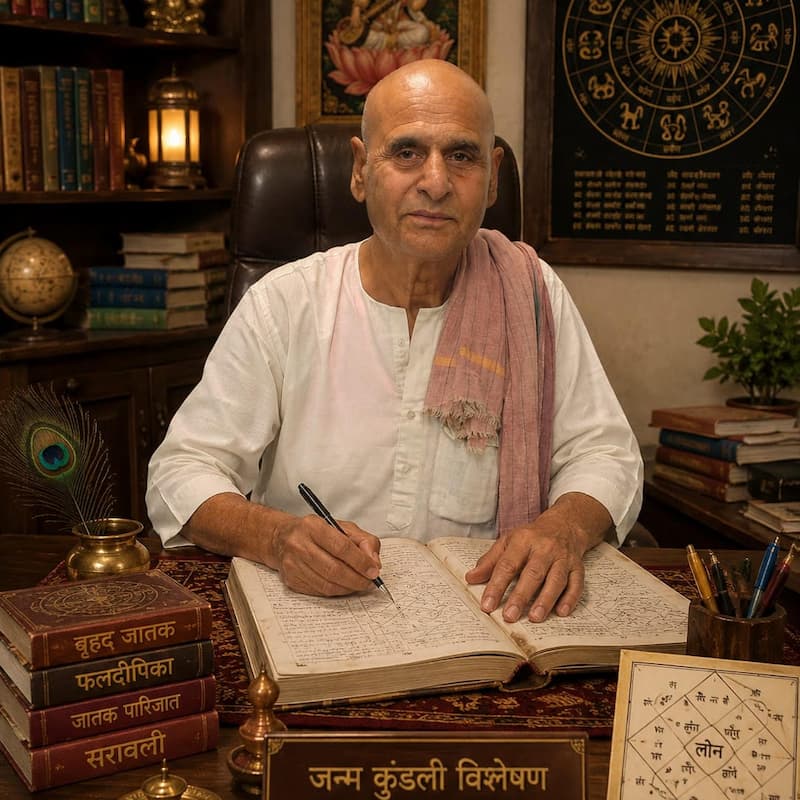
Narendra Kumar Chaubey is a Jyotisha Acharya with over 30 years of experience, based in Bihar and serving clients across India in Vedic astrology, mantra shastra, Vastu and ritual practice.
He completed his formal training at Kameshwar Singh Darbhanga Sanskrit University (KSDSU), one of India’s oldest and most respected institutions for Vedic and Sanskrit scholarship, where he studied Jyotisha shastra, mantra vidya and related classical sciences. KSDSU’s tradition of rigorous Sanskrit education tracing directly to the Mithila region’s centuries-old pandit lineage forms the foundation of his practice.
Over three decades, Narendra Kumar Chaubey has worked with thousands of individuals and families across Bihar and across India, offering guidance in:
- Kundli (birth chart) analysis: Identifying karmic patterns, planetary periods and life path guidance through classical Jyotisha
- Palmistry (Hasta Samudrika): Reading the hand according to the classical Samudrika Shastra tradition
- Vastu Shastra: Assessment and correction of living and working spaces according to directional and elemental principles
- Mantra and Pooja vidhi: Performing and guiding all categories of puja, havan, and mantra sadhana for personal, family and business situations
- Predictive Jyotisha: Transit analysis, muhurta (auspicious timing) selection and remedial guidance
He works across four languages Sanskrit, Hindi, English and Bhojpuri making classical knowledge accessible to practitioners across educational backgrounds and regions.
His writing for ABMantra brings the precision of classical Vedic training to practical mantra guidance: not general advice but specific prescriptions grounded in shastra, lineage and 30 years of direct practice with real situations.
For more info follow on: