

|
Quick Answer Yes, you can chant most mantras during periods. But the answer differs by mantra type and tradition. Here is the complete breakdown: |
|
Who This Article Is For This article is for you if: you have been told you cannot chant mantra during periods and want to know if that is actually true | you are mid-sadhana and your cycle has begun | you want to know which specific mantras are restricted and which are not, with the actual traditional reasoning. For the Maha Mrityunjaya Mantra specifically, see: Can we chant Maha Mrityunjaya Mantra during periods. |
If you have been told you cannot chant mantra during periods and something in you resisted that instruction, your instinct deserves a proper answer. Not a vague advice to consult a spiritual teacher. A clear, tradition-based answer with the actual reasoning behind every rule. That is what this article gives you.
The short answer is that most mantras have no restriction during menstruation. The restriction that exists is specific: it applies to formal Vedic rituals performed as part of a twice-born vow or structured anushthan, not to personal daily mantra practice. Most women who have been told to stop chanting were given a rule designed for a completely different context.
Why This Confusion Exists: Ritual vs Personal Practice |
The rule about menstruation in Hindu tradition was never about mantras being harmful to women. It was about maintaining the energetic continuity of a formal vow.
Classical Dharmashastra texts distinguish between two completely different types of spiritual activity. The first is ritual practice (puja, yajna, formal anushthan) performed as part of a structured vow. The second is personal japa: informal, continuous practice that belongs to the individual’s relationship with the deity.
The menstruation restriction appears only in ritual practice. Personal japa has no such restriction. Visti Larsen, translating classical Vedic texts at SriGaruda.com (February 2024), states this directly: “Personal japa or mantra practice are not restricted at any time for anyone for any form of divinity.”
|
Classical Source: Vaishnava Chintamani “O King, there are no rules regarding the time and place for chanting the Name of Vishnu. Of this, there is no doubt. There are rules concerning the time for giving charity, performing sacrifices, bathing, and chanting certain Vedic Japa mantras, but on this earth, there are no rules regarding the time to chant the Name of Vishnu.” This text predates the social customs that became confused with scriptural rules by several centuries. |
Can We Chant Mantra During Periods: Mantra-by-Mantra Breakdown |
Different traditions have different positions. The table below gives the complete breakdown by mantra type with the traditional reasoning for each ruling.
The 40-Day Sadhana Question: What to Do Mid-Practice |
This is the most anxious question in this topic. You are on Day 18 of a 40-day sadhana. Your period begins. Do you have to start over?
The rule requiring restart from Day 1 applies when you miss a day through negligence or personal choice. A natural physical cycle that the tradition itself acknowledges and provides specific guidance for is a completely different situation.
|
What to do during the break Switch from physical chanting (mala, audible repetition) to mansik japa: mental chanting. Sit quietly, close your eyes, and repeat the mantra inwardly for the same count. Mansik japa is not a lesser practice. Classical texts describe it as the highest form of japa because it requires the deepest level of mental concentration with no external support. Resume physical mala chanting after your cycle ends. Continue from the day count you had reached when you paused. |
The Real Reason This Confusion Spread |
The widespread belief that women cannot chant mantras during menstruation is not primarily from the classical texts. It comes from a conflation of two things: the ritual purity rules of upper-caste Brahmin household practice, and broader social norms around menstruation in Indian culture that developed over centuries.
Here is the counterintuitive truth: the Shakta tradition, from which most goddess mantras come, was specifically designed to be accessible to women. The Devi Mahatmya, the Durga Saptashati, the Tantric texts were all composed in a tradition that celebrated the feminine divine. Telling a woman she cannot invoke the Divine Mother during her most feminine biological process contradicts the very premise of the tradition.
Dr. David Frawley (Pandit Vamadeva Shastri), one of the most respected Vedic scholars, has consistently stated that the menstruation restriction in mantra practice belongs to specific ritual contexts and does not apply to personal japa. The body’s condition does not separate a person from the divine.
|
From Our Practice When I first began a 40-day Lakshmi sadhana, my cycle began on Day 11. I stopped chanting for 5 days as I had been instructed. On Day 16 I resumed the mala count from Day 11 and completed the sadhana on what would have been Day 45. What I noticed: the 5 days of mansik japa during my cycle were the most concentrated days of the entire practice. Removing the mala and the audible chant forced a level of internal attention I had not achieved in the physical practice. The pause was not an interruption. It was, unexpectedly, the deepest part of the 40 days. ABMantra Editorial Team |
What You Should Not Do During Your Period |
Frequently Asked Questions |
Begin Again Today |
If your period began during a sadhana, switch to mansik japa now. Sit for the same amount of time. Chant the same mantra the same number of times, inwardly. Do not count this as a missed day.
If your period has caused you to stop a practice entirely, restart it on the day your cycle ends. Not next Tuesday. Not next month. The day it ends.
The goddess you are invoking, whether Lakshmi, Durga, Saraswati or Gayatri, is the feminine divine. She does not withdraw from you during your most feminine biological process. The tradition, read correctly, confirms this.
|
Sources and Citations
|
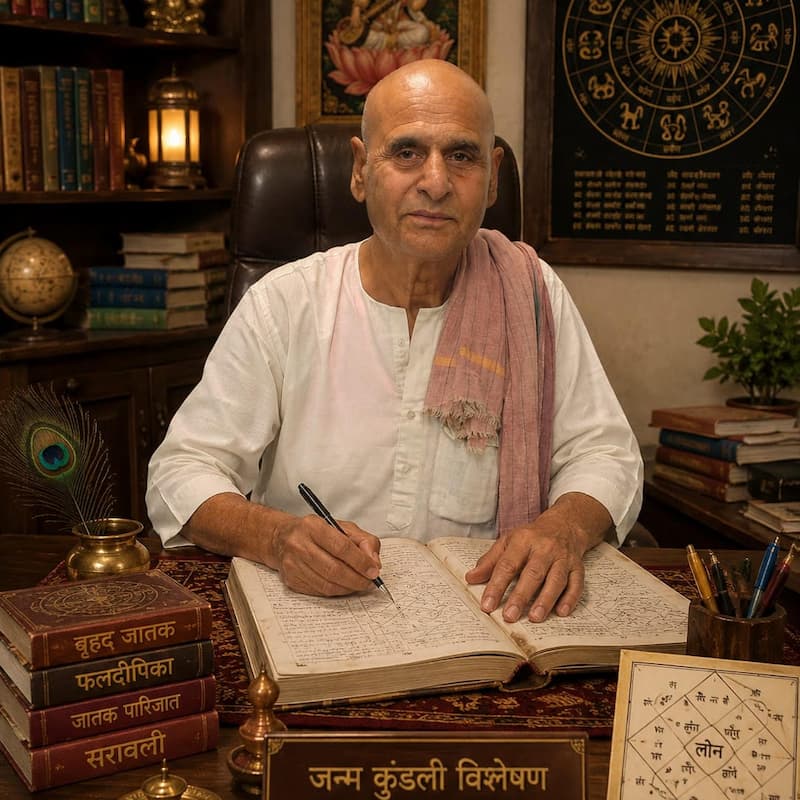
Narendra Kumar Chaubey is a Jyotisha Acharya with over 30 years of experience, based in Bihar and serving clients across India in Vedic astrology, mantra shastra, Vastu and ritual practice.
He completed his formal training at Kameshwar Singh Darbhanga Sanskrit University (KSDSU), one of India’s oldest and most respected institutions for Vedic and Sanskrit scholarship, where he studied Jyotisha shastra, mantra vidya and related classical sciences. KSDSU’s tradition of rigorous Sanskrit education tracing directly to the Mithila region’s centuries-old pandit lineage forms the foundation of his practice.
Over three decades, Narendra Kumar Chaubey has worked with thousands of individuals and families across Bihar and across India, offering guidance in:
- Kundli (birth chart) analysis: Identifying karmic patterns, planetary periods and life path guidance through classical Jyotisha
- Palmistry (Hasta Samudrika): Reading the hand according to the classical Samudrika Shastra tradition
- Vastu Shastra: Assessment and correction of living and working spaces according to directional and elemental principles
- Mantra and Pooja vidhi: Performing and guiding all categories of puja, havan, and mantra sadhana for personal, family and business situations
- Predictive Jyotisha: Transit analysis, muhurta (auspicious timing) selection and remedial guidance
He works across four languages Sanskrit, Hindi, English and Bhojpuri making classical knowledge accessible to practitioners across educational backgrounds and regions.
His writing for ABMantra brings the precision of classical Vedic training to practical mantra guidance: not general advice but specific prescriptions grounded in shastra, lineage and 30 years of direct practice with real situations.
For more info follow on: