
Quick Answer
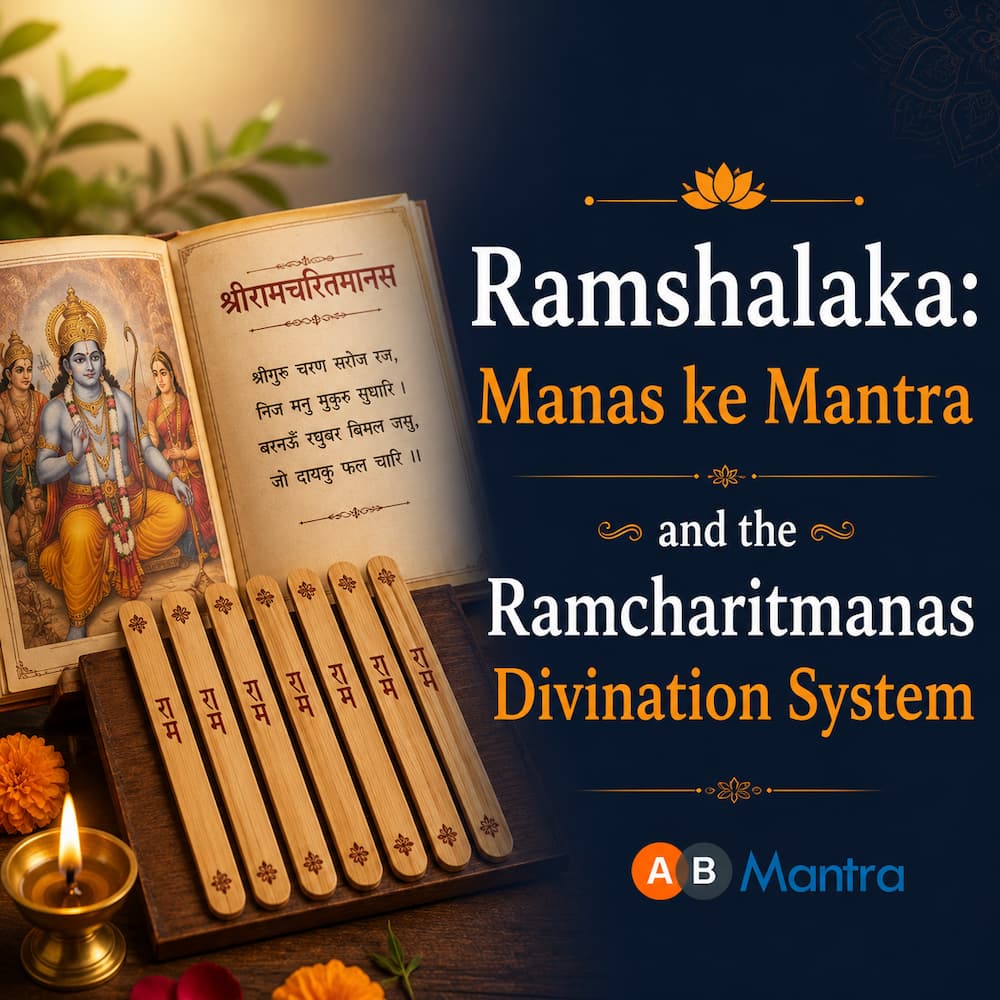
Ramshalaka is a traditional divination system based on the Ramcharitmanas (Tulsidas’s Hindi version of the Ramayana). When you ask a sincere question and use the Ramshalaka method, you receive a specific verse (mantra/chaupai) from the Manas as your answer.
The basic method: Hold your question clearly in mind. Close your eyes. Open the Ramcharitmanas at random. Place your finger on any line without looking. Open your eyes. The verse your finger points to is your Ramshalaka answer.
The traditional formal method: A specific grid of 15 Sanskrit syllables is used. You ask your question, pick a number from 1 to 15, count specific steps through the grid, and arrive at a specific Kand (chapter) and verse of the Ramcharitmanas. The verse you arrive at is your answer.
Who This Article Is For
This article is for you if you have heard of Ramshalaka and want to understand what it is and how it works | you want to know the classical method for using it versus the simplified popular version | you want to understand how to interpret the verse you receive.
Also see: What is a powerful mantra: how mantras work in the Vedic tradition and Types of mantras: Vedic, Beej, Tantric and more
The Ramshalaka (also written Ram Shalaka or Ramshalaka) is one of the most beloved divination traditions in the Hindu world : specifically associated with the Ramcharitmanas, the 16th-century Hindi retelling of the Ramayana composed by Goswami Tulsidas. Unlike Sanskrit mantras which require learned practice, the Ramshalaka is available to anyone who can open a book and can think a sincere question. Its accessibility is its most distinctive quality: Lord Ram’s answer to your question is available to anyone who genuinely seeks it.
Here is what most Ramshalaka articles miss: they describe the basic random-page method and call it Ramshalaka. The actual Ramshalaka system is more structured than random page-opening. It uses a specific 15-syllable grid that was traditionally held in memory by priests and devotees, and the counting through the grid produces a specific reference to a specific verse in a specific Kand of the Manas. This traditional structured method is what has been used in temples and households for centuries, and it produces results that experienced practitioners consider significantly more precise than random page-opening.
What Ramshalaka Actually Is
The History and Tradition of Ramshalaka
Origin: The Ramshalaka system is attributed to Goswami Tulsidas himself, who is said to have incorporated the divination grid into the Ramcharitmanas tradition as a means of giving access to Ram’s guidance to ordinary people who could not read Sanskrit or understand the classical Ramayana texts.
Shalaka: Shalaka means a small stick or pointer in Sanskrit : specifically a divining stick or oracle pointer. Ram-Shalaka is literally “Ram’s pointer” : Lord Ram pointing to the answer through his own words in the Manas.
Why the Ramcharitmanas: The Ramcharitmanas is understood in the Ramayana tradition as Ram’s own speech transcribed by Tulsidas : not a human composition but a divine revelation in the Hindi vernacular. When the Ramshalaka directs you to a verse, the tradition holds that Ram himself is speaking that verse as an answer to your question.
The grid: The traditional Ramshalaka uses a grid of 15 syllables arranged in a specific pattern. You begin at a syllable determined by your question or by a number you choose (1 to 15), count through the grid according to the system’s rules, and arrive at a cell that points to a specific location in the Manas. Traditional Ramshalaka grids are printed in many Ramcharitmanas editions and are available in most Ram temple contexts.
The Two Methods: Simplified and Traditional
| Method | Procedure | Appropriate for |
|---|---|---|
| Simplified (Pratishtha method) | Hold the question. Say “Jai Shri Ram” three times. Open the Manas at random. Point to a line with eyes closed. Read that verse and its context as your answer. | Daily guidance, informal questions, moments of doubt or uncertainty. This is the most accessible form and is widely practiced. |
| Traditional (Shalaka grid method) | The traditional 15-cell grid. You choose a number from 1 to 15, the grid navigation produces a specific Kand reference, and you read that verse in the complete Ramcharitmanas. | Significant life questions: marriage, major career decisions, health concerns, important disputes. This is the method used in traditional Ram temple contexts. |
| Online Ramshalaka | Many websites and apps now provide digital Ramshalaka : you click and receive a verse. These use either random verse selection or simplified grid systems. | Accessible for those who do not have a physical Ramcharitmanas. Traditionalists consider the physical book more potent but acknowledge the sincerity of the question is the primary factor. |
The Traditional Grid: How It Works
The Ramshalaka grid consists of 15 syllables arranged in a 3×5 grid. Each cell in the grid corresponds to a specific location in the Ramcharitmanas. The practitioner:
- Holds the question clearly in mind and takes three deep breaths
- Chants “Jai Shri Ram” or a personal Ram mantra three times
- Chooses a number from 1 to 15 (either intuitively or by counting bead movements on a mala)
- The grid navigation from the chosen starting point determines which Kand (chapter: Bal Kand, Ayodhya Kand, Aranya Kand, Kishkindha Kand, Sundar Kand, Lanka Kand or Uttara Kand) and which specific Doha or Chaupai (verse type) is indicated
- The indicated verse is read as Ram’s specific answer to the question
The most important principle of the traditional method: the question must be sincere and specific. “Will things get better?” is too vague for the Ramshalaka to respond to clearly. “Should I accept the job offer I have received this week?” or “Is this the right time to marry?” are the types of questions the tradition holds the Ramshalaka answers with precision.
How to Interpret the Verse You Receive
Reading Your Ramshalaka Answer
What the verse refers to: The verse you receive is always from a specific narrative moment in the Ramayana. Understanding what is happening in that narrative moment is the primary interpretive key.
General interpretive principles:
Verses from Ram’s childhood (Bal Kand, Ayodhya Kand): Often indicate new beginnings, innocence, trust in the divine, or the need to return to first principles
Verses from the exile (Aranya Kand): Often indicate a period of trial, the importance of patience, or that what seems like a setback is part of a larger divine plan
Verses about Hanuman (particularly Sundar Kand): Almost always auspicious : Hanuman’s success in Lanka is one of the most positive signs the Ramshalaka can give
Verses about Sita’s captivity: Indicate a period of separation from what is desired, but with the assurance that Ram (the divine) is actively working toward reunion
Verses from the battle with Lanka: Indicate conflict is being resolved, victory is coming but requires continued effort
Verses from the return and coronation (Uttara Kand): The most auspicious : indicating successful completion, return to the desired situation, joy
The most important principle: Read the verse in its context in the story. What is happening at that moment in the Ramayana? That narrative moment is the answer. A verse spoken by Ram when he is separated from Sita speaks of separation and patient faith. A verse spoken when Hanuman finds Sita speaks of divine intervention succeeding when effort had reached its limit.
From Our Practice
From Our Practice
I grew up in a household in Bihar where the Ramshalaka was consulted regularly. My mother used it before significant family decisions. My grandfather could navigate the traditional grid from memory, having used it his whole life. What I observed consistently was this: the verse that arrived was almost always precisely relevant to the question, in a way that felt like genuine response rather than coincidence. Not because the grid is magical but because the Ramcharitmanas contains every major human situation : loss, longing, patience, devotion, battle, victory, grief, joy : and the tradition’s structure for accessing these situations tends to produce relevance.
The most important thing I tell people who are new to Ramshalaka is: the verse is not a fortune-telling answer. It is Ram speaking about a situation from his own story that mirrors yours. The question is: what does Ram’s response to that situation in the story teach you about your own? That reading : comparative, meditative, narrative : is what the Ramshalaka is actually for.
Frequently Asked Questions
❓ I got a verse about Sita’s suffering in Lanka. Does this mean bad things will happen to me?
Not as a prediction of misfortune. Read the narrative moment: Sita is separated from Ram, in Ravana’s captivity. But she knows Ram is coming. She knows the divine is with her even in the darkest moment. The verse about Sita in Lanka speaks of separation from what you desire, the patience that the divine requires of you in this moment, and the absolute assurance that Ram : the divine working in your life : has not abandoned you and is actively moving toward resolution. This is among the most instructive Ramshalaka answers: not comfortable, but honest and ultimately hopeful.
❓ Can I use Ramshalaka in English?
The traditional Ramshalaka uses the Hindi Ramcharitmanas. English translations of the Ramcharitmanas exist and can be used : the sincerity of the question and the trust in Ram’s guidance are the essential elements, not the language. For the traditional grid method, you will need the grid itself (printed in many Ramcharitmanas editions) and the ability to locate the indicated verse in whatever translation you are using. The simplified method (random page-opening) works equally well in English translation.
❓ Is Ramshalaka the same as Ramacharitmanas parayana?
No, they are different practices. Ramshalaka is divination : consulting Ram for guidance on a specific question by receiving a specific verse. Parayana is recitation : reading or chanting the Ramcharitmanas continuously from beginning to end as a devotional and purifying practice. Both involve the Ramcharitmanas but serve completely different purposes. Parayana is typically done during festival periods (Navratri, Ram Navami) or as a dedicated sadhana. Ramshalaka is consulted when guidance is needed for a specific situation.
❓ How often can I consult the Ramshalaka?
The tradition recommends restraint: the Ramshalaka is for genuine questions at genuine crossroads, not for daily or repeated consultation. Consulting it more than once for the same question (because you did not like the first answer) is specifically cautioned against : it indicates the consultation was not truly open to Ram’s guidance. Most traditional practitioners consult it no more than once per significant question and accept the answer as Ram’s genuine response even when it is not the answer hoped for.
❓ I received a verse I cannot understand. What should I do?
Three steps: First, look up where that verse falls in the Ramayana story : what is happening at that moment? Second, read the surrounding verses for context. Third, sit with the verse in quiet contemplation for 10 to 15 minutes before seeking an interpretation. The meaning often arrives through sustained attention rather than immediate analysis. If the verse remains unclear after these steps, consult a scholar or practitioner familiar with the Ramcharitmanas tradition : the tradition has a rich interpretive literature and specific communities (particularly in Varanasi, Ayodhya and Vrindavan) maintain expertise in Ramshalaka interpretation.
❓ What is the most auspicious verse to receive in a Ramshalaka consultation?
The tradition considers verses from the Sundar Kand (the chapter where Hanuman finds Sita and confirms that Ram’s victory is coming) the most auspicious Ramshalaka responses. Specifically, verses about Hanuman’s successful arrival in Lanka or Sita’s response to seeing Ram’s ring are understood as among the most positive signs the Ramshalaka can give: the divine has found the solution, the obstacle is being resolved, the reunion with what you are seeking is assured. Verses from the coronation of Ram (Uttara Kand) are equally auspicious.
Ask Ram Today
If you have a question that you have been carrying without resolution : a decision you need to make, a direction you need clarity on, a situation you do not know how to approach : open the Ramcharitmanas. Say “Jai Shri Ram” three times. Open at random. Place your finger on a line. Read that verse.
Read it slowly. Read it again. Ask: what is happening in the story at this moment? What is Ram’s response to that situation? What does that response teach you about your own?
The Ramshalaka does not predict the future. It shows you Ram’s response to a situation like yours. That response, understood correctly, is its own kind of guidance.
Sources
- Wikipedia : Ramcharitmanas: Tulsidas’s composition, the seven Kands, its role in North Indian devotional tradition
- Wikipedia : Tulsidas: the author, the period of composition, Tulsidas’s relationship to Ram’s guidance in his own life
- Wikipedia : Sundar Kanda: the most auspicious of the seven Kands in both Ramshalaka and parayana traditions
- Ramcharitmanas divination tradition. Traditional documentation from Varanasi and Ayodhya Ram temple contexts (oral tradition): the grid structure, counting method and verse interpretation principles
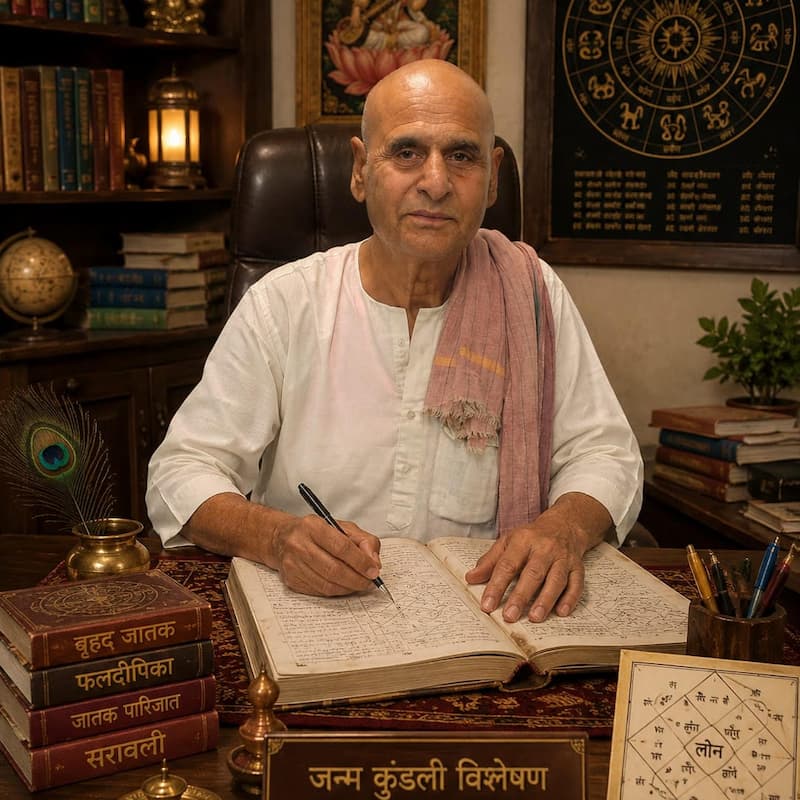
Narendra Kumar Chaubey is a Jyotisha Acharya with over 30 years of experience, based in Bihar and serving clients across India in Vedic astrology, mantra shastra, Vastu and ritual practice.
He completed his formal training at Kameshwar Singh Darbhanga Sanskrit University (KSDSU), one of India’s oldest and most respected institutions for Vedic and Sanskrit scholarship, where he studied Jyotisha shastra, mantra vidya and related classical sciences. KSDSU’s tradition of rigorous Sanskrit education tracing directly to the Mithila region’s centuries-old pandit lineage forms the foundation of his practice.
Over three decades, Narendra Kumar Chaubey has worked with thousands of individuals and families across Bihar and across India, offering guidance in:
- Kundli (birth chart) analysis: Identifying karmic patterns, planetary periods and life path guidance through classical Jyotisha
- Palmistry (Hasta Samudrika): Reading the hand according to the classical Samudrika Shastra tradition
- Vastu Shastra: Assessment and correction of living and working spaces according to directional and elemental principles
- Mantra and Pooja vidhi: Performing and guiding all categories of puja, havan, and mantra sadhana for personal, family and business situations
- Predictive Jyotisha: Transit analysis, muhurta (auspicious timing) selection and remedial guidance
He works across four languages Sanskrit, Hindi, English and Bhojpuri making classical knowledge accessible to practitioners across educational backgrounds and regions.
His writing for ABMantra brings the precision of classical Vedic training to practical mantra guidance: not general advice but specific prescriptions grounded in shastra, lineage and 30 years of direct practice with real situations.
For more info follow on: