
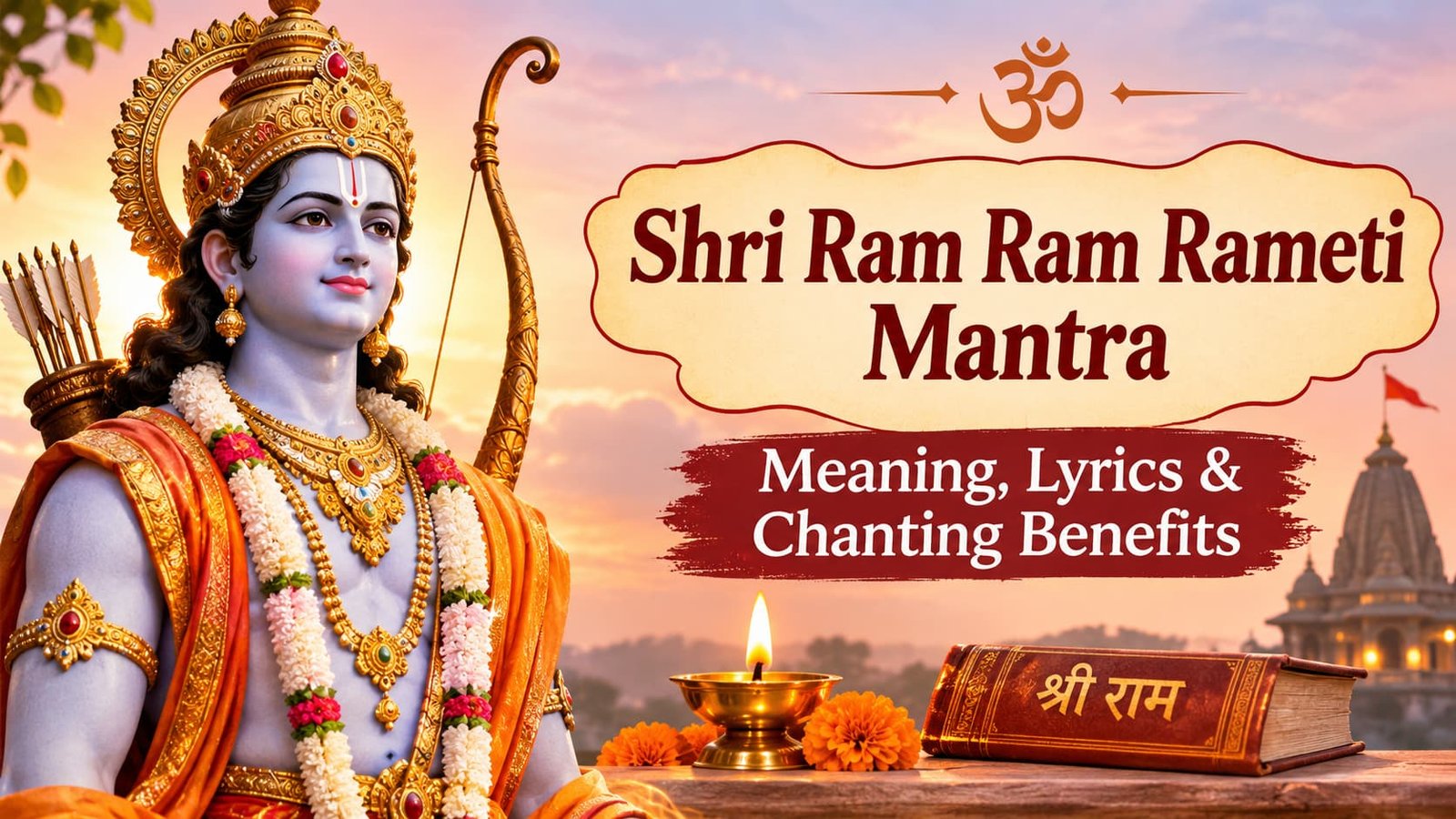
श्री राम राम रामेति रमे रामे मनोरमे ।
सहस्रनाम तत्तुल्यं रामनाम वरानने ॥
Śrī Rāma Rāma Rāmeti Rame Rāme Manorame,
Sahasranāma Tat-tulyaṃ Rāma-nāma Varānane.
“I chant Rama, Rama, Rama and delight in Rama, the joy of the mind. O lovely-faced one, the name of Rama equals the thousand names of Vishnu.”
Lord Shiva spoke this verse to Parvati when she wanted a short way to finish the thousand names of Vishnu. Most households hear these two lines at the end of a Vishnu Sahasranama path, right before the final arpanam. Yet few people know the full Ram Rameti Rameti mantra meaning and benefits: which chapter of the Padma Purana holds the verse, why three repetitions of Rama equal a thousand names, or where the short and long vowels shift the meaning.
What Is Shri Ram Ram Rameti Meaning in English?
Shri Ram Ram Rameti means “I chant Rama, Rama, Rama and find delight in Rama, who charms the mind. O Parvati, the name of Rama equals the thousand names of Vishnu.” Shiva speaks it in the Padma Purana, and devotees chant it three times as a short form of the Vishnu Sahasranama.
Scriptural Context: The Shiva-Parvati Dialogue in the Padma Purana
Ask ten devotees where this verse comes from, and most will say the Vishnu Sahasranama. That answer is only half right. The verse belongs to the Uttara Khanda of the Padma Purana, where Shiva speaks and Parvati listens. He addresses her as Varānanā, the lovely-faced one.
Where the verse appears
Verse numbering changes between printed editions, which confuses many readers. The Sanskrit edition hosted on Wisdom Library places it at Padma Purana 6.254.20 (Uttara Khanda). Gaudiya Vaishnava texts cite it as Uttara Khanda 72.335, within the Brihad Vishnu Sahasranama section, as in the Chaitanya Charitamrita commentary on Madhya Lila 9.32. Both references point to the same verse.
The popular recitation of the Vishnu Sahasranama from the Mahabharata also carries it in its closing section. There, Parvati asks “kenopāyena laghunā viṣṇor nāma sahasrakam”, meaning “by what easy method can the thousand names be recited?” Shiva answers with this verse.
The story behind the verse
In the Padma Purana chapter, the verse leads straight into a meal. Shiva tells Parvati to say “Rama” and then eat with him. The narrator Vasishtha confirms that she spoke the name and shared the meal. The popular telling adds a detail families love: Parvati would not eat until she had finished her daily Sahasranama, so Shiva gave her this shortcut.
A few verses later, Parvati asks a natural follow-up question. If one name equals a thousand, what are Rama’s other names? Shiva then begins listing them. The verse works as a bridge between devotion to Vishnu and devotion to Rama as his avatar.
Mantra profile at a glance
| Element | Details |
|---|---|
| Source | Padma Purana, Uttara Khanda (Shiva-Parvati samvad) |
| Speaker (in place of a Rishi) | Lord Shiva, as Ishvara |
| Chandas (meter) | Anushtup: four padas of eight syllables each |
| Devata | Shri Rama, as the avatar of Vishnu |
| Bija | The verse carries no separate bija. Rama upasana uses the beej mantra रां (Rāṃ), as in “Rāṃ Rāmāya Namaḥ” |
| Mala | Tulsi mala of 108 beads plus one sumeru |
| Traditional count | 3 recitations as the Sahasranama equivalent, or 108 for full jaap |
Ram Rameti Rameti Mantra Word-by-Word Meaning
The table below follows the reading most Hindi and English commentaries use. Watch the vowel length. Rame with a short “a” and Rāme with a long “ā” are two different words.
| Sanskrit | Transliteration | Meaning |
|---|---|---|
| श्री | Śrī | Auspicious, revered; an honorific before the divine name |
| राम राम | Rāma Rāma | Rama, Rama: the name repeated in japa |
| रामेति | Rāmeti (Rāma + iti) | “Rama,” thus: marks the name as the words being chanted |
| रमे | Rame (short a) | I delight, I take joy (verb root ram, “to rejoice”) |
| रामे | Rāme (long ā) | In Rama |
| मनोरमे | Manorame | Charming to the mind; or “O charming one,” addressed to Parvati |
| सहस्रनाम | Sahasranāma | The thousand names (of Vishnu) |
| तत्तुल्यं | Tat-tulyaṃ | Equal to that |
| रामनाम | Rāma-nāma | The name of Rama |
| वरानने | Varānane | O lovely-faced one (Parvati) |
Grammar allows a second reading. Some scholars take rame and manorame as words addressed to Parvati, giving “O Ramā, O charming one.” Both readings keep the core message intact. The name of Rama carries the weight of the full Sahasranama.
The name itself comes from the same root. Commentators explain Rāma as “the one in whom yogis delight.” So Shiva literally takes delight in the Delightful One.
Why Does Chanting Rama Three Times Equal 1000 Names?
A popular teaching uses the Katapayadi letter-number system. “Ra” counts as 2 and “Ma” as 5, so Rama equals 2 × 5 = 10. Saying Rama three times gives 10 × 10 × 10 = 1000, the Sahasranama. That math is later tradition, not scripture.
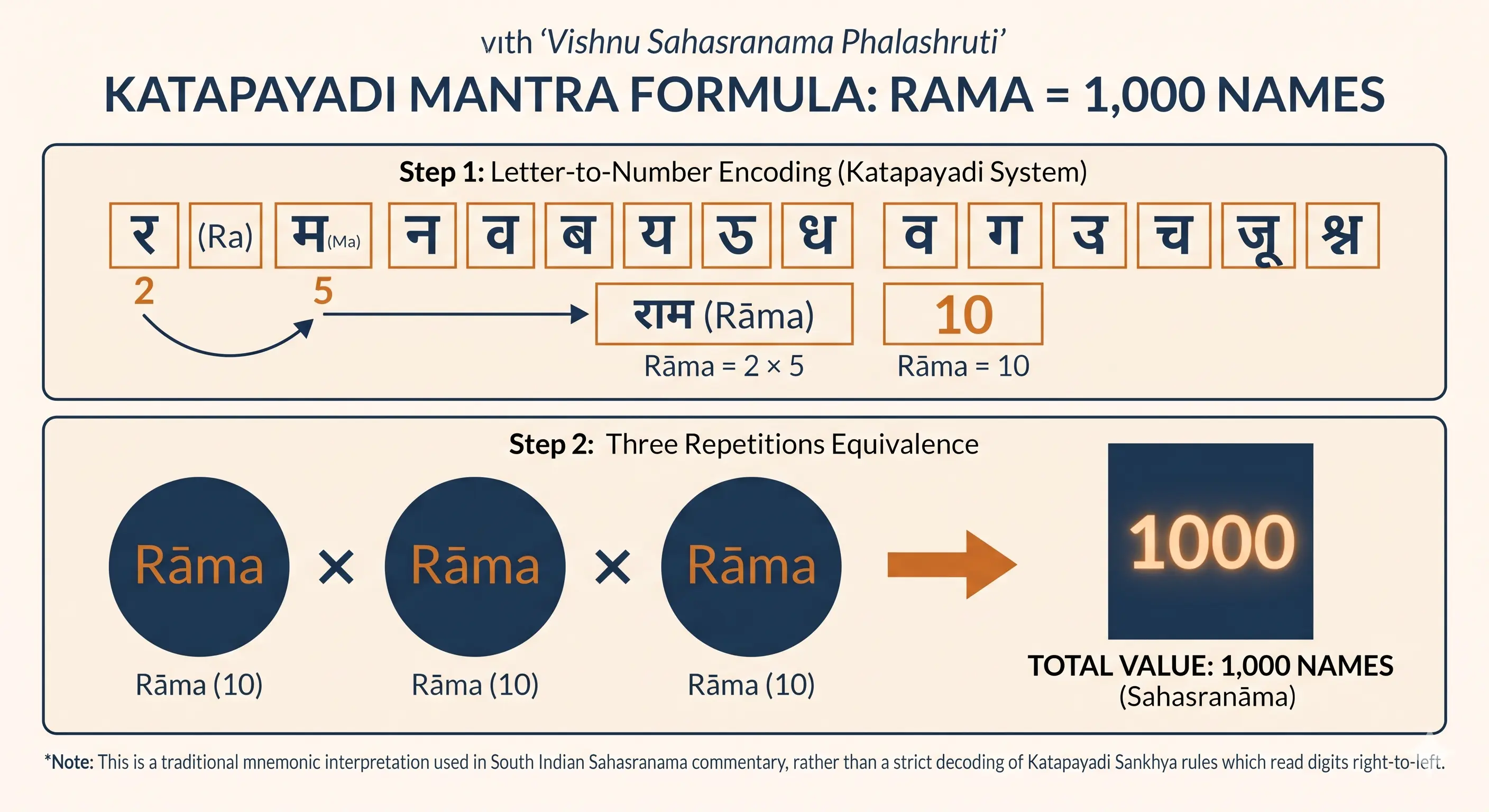
Strict Katapayadi decoding reads digits right to left, so this multiplication is a devotional device rather than formal decoding. Treat it as a memory aid. The real authority for the equivalence is Shiva’s own statement in the verse.
Ram Rameti Rameti Mantra Meaning and Benefits: What the Phalashruti Says
Search online for this verse and half the pages promise sudden wealth or an instant job offer. The Sanskrit text itself makes no such claim. Its phalashruti sits inside one plain phrase: sahasranāma tat-tulyaṃ, meaning Rama nama equals the thousand names of Vishnu. Whatever spiritual merit a devotee seeks from the full Sahasranama path, Shiva links directly to chanting Rama’s name.
People who chant the Ram Rameti Rameti mantra daily describe benefits that are practical and easy to test for yourself:
- A path that fits a working day. A full Sahasranama path takes 20 to 30 minutes. Three recitations of this verse take under a minute, so your sankalp survives a 7 a.m. office cab. The full stotra waits for the weekend.
- The repeated “Rāma” sound slows the breath and gives a wandering mind one clear anchor.
- Children usually learn these two lines years before the full stotra, which makes the verse a gentle first step into Vishnu bhakti.
- Shared across traditions. Smarta households chant it after the Sahasranama, while Gaudiya Vaishnavas cite it through the Chaitanya Charitamrita.
If Rama bhakti is new to you, pair this verse with the Hanuman Chalisa lyrics and chanting guide. Hanuman is the model of a devotee absorbed in Rama nama.
Ram Rameti Jaap Vidhi: Mala Rules and Daily Method
The Ram Rameti Rameti mantra is nama japa, so the rules stay simple. Follow these steps for a clean daily practice:
- Pick a fixed time. Brahma muhurta, roughly 96 minutes before sunrise, suits jaap best, though sandhya at dusk works well for most working families.
- Sit facing east or north on a woollen or kusha asana, light a ghee diya before an image of Shri Ram Darbar or a tulsi plant, and place one tulsi leaf as your offering. In a flat without a puja room, a shelf on the east wall serves the purpose.
- Take a short sankalp: your name, gotra and the count you will complete today.
- Hold the tulsi mala in your right hand over the middle finger and move beads with the thumb. Keep the index finger away from the mala, and keep the mala inside a cloth gomukhi bag. Our step-by-step guide to using a japa mala shows the grip in detail.
- Count one full verse per bead, not each separate “Rama,” so one mala of the Ram Rameti Rameti mantra equals 108 complete recitations.
- Never cross the meru (sumeru) bead. At the 108th bead, turn the mala around and start the next round in reverse.
- Close with three slow recitations and offer the merit to Shri Rama with folded hands.
When you cannot finish the full Sahasranama
Read our Vishnu Sahasranama benefits and recitation guide on unhurried days. On rushed mornings, chant the Ram Rameti mantra three times with full attention. Shiva gave it for exactly this purpose. Keep the full path for Ekadashi vrat days, Thursdays, and Ram Navami.
Chanting in an office, a metro or a hospital ward
Mental japa (manasika japa) needs no mala, no asana and no spoken sound. Move your lips silently or simply hold the verse in your mind. Many devotees keep a small tulsi mala in a gomukhi bag for the commute. Others count on the finger joints, using the 12 segments of four fingers per round.
Practitioner Note: Narendra Kumar Chaubey
The most common slip I hear in satsangs sits in the very first line. Devotees say “rame rame manorame” with two short vowels. The verse needs “rame rāme”: first the short rame, “I delight,” then the long rāme, “in Rama.” Drop the long ā and Shiva’s statement of joy loses its object. Before you start a mala, say the line slowly five times and hold the long ā for a full extra beat. Once the vowel is in your mouth, speed comes on its own.
Frequently Asked Questions
Can I chant Ram Rameti Rameti instead of the full Vishnu Sahasranama every day?
How many times should I chant the Ram Rameti mantra?
Do I need diksha or a guru to chant this verse?
Which mala is best for Ram Rameti jaap?
Is Ram Rameti a mantra or a shloka?
Sources
- Padma Purana, Uttara Khanda 6.254.20 (Sanskrit text): Wisdom Library
- Chaitanya Charitamrita, Madhya Lila 9.32, citing Padma Purana Uttara Khanda 72.335: Prabhupada Books
- Mahabharata, Anushasana Parva: Vishnu Sahasranama, closing phalashruti (Parvati’s question and Ishvara’s reply)
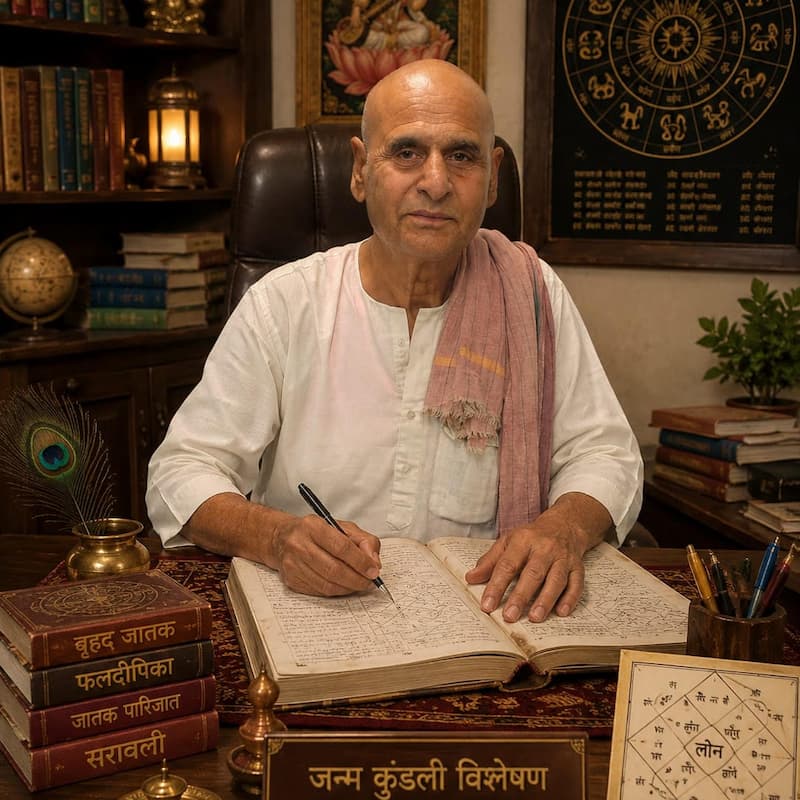
Narendra Kumar Chaubey is a Jyotisha Acharya with over 30 years of experience, based in Bihar and serving clients across India in Vedic astrology, mantra shastra, Vastu and ritual practice.
He completed his formal training at Kameshwar Singh Darbhanga Sanskrit University (KSDSU), one of India’s oldest and most respected institutions for Vedic and Sanskrit scholarship, where he studied Jyotisha shastra, mantra vidya and related classical sciences. KSDSU’s tradition of rigorous Sanskrit education tracing directly to the Mithila region’s centuries-old pandit lineage forms the foundation of his practice.
Over three decades, Narendra Kumar Chaubey has worked with thousands of individuals and families across Bihar and across India, offering guidance in:
- Kundli (birth chart) analysis: Identifying karmic patterns, planetary periods and life path guidance through classical Jyotisha
- Palmistry (Hasta Samudrika): Reading the hand according to the classical Samudrika Shastra tradition
- Vastu Shastra: Assessment and correction of living and working spaces according to directional and elemental principles
- Mantra and Pooja vidhi: Performing and guiding all categories of puja, havan, and mantra sadhana for personal, family and business situations
- Predictive Jyotisha: Transit analysis, muhurta (auspicious timing) selection and remedial guidance
He works across four languages Sanskrit, Hindi, English and Bhojpuri making classical knowledge accessible to practitioners across educational backgrounds and regions.
His writing for ABMantra brings the precision of classical Vedic training to practical mantra guidance: not general advice but specific prescriptions grounded in shastra, lineage and 30 years of direct practice with real situations.
For more info follow on:
