
Quick Answer
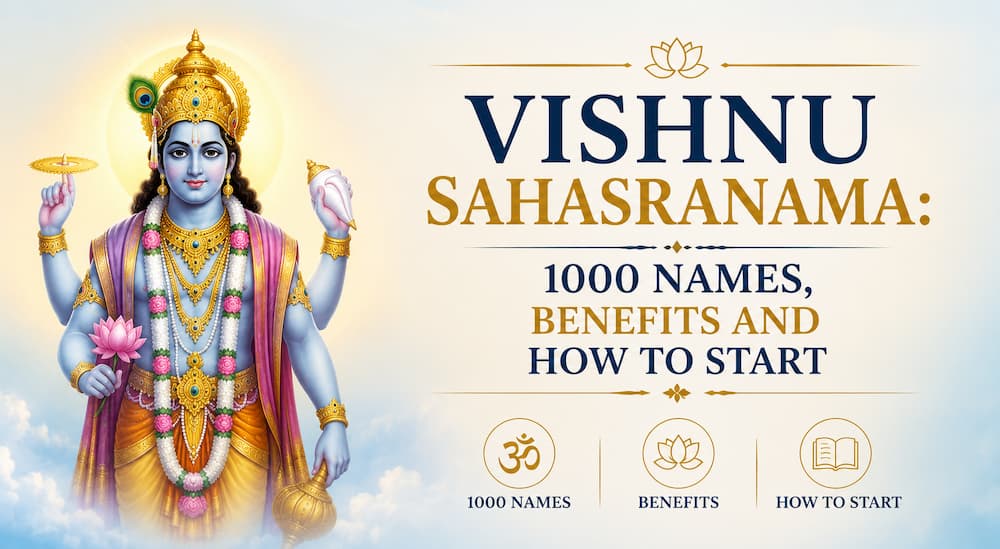
The Vishnu Sahasranama is a 1,000-name hymn to Lord Vishnu found in the Anushasana Parva of the Mahabharata. It is not a mantra to be memorised in one sitting but a hymn to be chanted regularly : ideally daily for 45 minutes to one hour.
For those who cannot chant the full Sahasranama daily, the tradition prescribes two equivalents:
Ekashloki (single verse equivalent): Om Namo Bhagavate Vasudevaya : the name Vaasudeva alone is held in the Phalashruti to equal the merit of chanting all 1,000 names.
Most commonly chanted starting name: Om Vishnave Namah : the invocation that opens the practice.
Best time: Friday mornings after bathing. Any day at Brahma Muhurta. On Ekadashi (11th day of lunar fortnight).
Who This Article Is For
This article is for you if you have heard about the Vishnu Sahasranama and want to know what it is, where it comes from and what the tradition says about its benefits | you want to begin the practice and need to know how to start | you cannot chant all 1,000 names and want to know what the tradition prescribes as the equivalent.
Also see: Om Namo Narayanaya: meaning, method and complete practice and Vishnu mantras and the Vaishnava tradition
The Vishnu Sahasranama is the heart and quintessence of the Mahabharata. These are the exact words of Vedavyasa, who is himself considered an avatar of Vishnu and the compiler of the Vedas. When the compiler of the greatest scripture in the tradition describes a hymn within it as the heart of that scripture, the claim demands serious attention.
Here is what most Vishnu Sahasranama articles miss: they present it as a list of benefits : health, wealth, protection : without explaining what the Sahasranama actually is and why it produces these effects. The Sahasranama is not a list of 1,000 arbitrary names. Each name is a precise description of a cosmic function that Vishnu embodies. Chanting each name is not religious sentiment : it is the deliberate alignment of the practitioner’s awareness with each of these 1,000 cosmic functions in sequence. The cumulative effect of this alignment, done consistently, is what the tradition describes as the Sahasranama’s benefits.
The Origin Story: Why the Sahasranama Was Revealed
The Vishnu Sahasranama was revealed on the battlefield of Kurukshetra, in the Anushasana Parva (Book of Instructions) of the Mahabharata. Bhishma Pitamaha : the grandsire of both the Kauravas and Pandavas, one of the greatest warriors and dharma-scholars of the tradition : lay mortally wounded on a bed of arrows. He possessed the boon of choosing the moment of his own death and was using it to transmit final teachings to Yudhishthira.
Yudhishthira asked a single question: what is the highest and most accessible path to peace, liberation and dharma for human beings? Bhishma’s answer was the Vishnu Sahasranama. The hymn was revealed in the presence of Krishna himself and recorded by Vyasa. This context is not decorative. It is why the Sahasranama carries the weight it does in the tradition: it is the final teaching of one of dharma’s greatest exemplars, given at his moment of departure, witnessed by the divine himself.
The Structure of the Vishnu Sahasranama
| Section | Content | Significance |
|---|---|---|
| Opening invocation (13 shlokas) | Dhyana (meditation) verse, salutation to Bhishma, Yudhishthira’s question and Bhishma’s preliminary response | Establishes the context and opens the practice |
| Main body (107 shlokas) | The 1,000 names of Vishnu arranged in 107 Sanskrit verses | Each name is a precise description of a divine quality or cosmic function |
| Uttara Parvam (22 closing shlokas) | The Phalashruti : the enumeration of benefits of chanting, including the single-name equivalents | States that Vaasudeva alone equals all 1,000 names; establishes the merit of chanting |
The Ten Most Significant Names and Their Meaning
| Name | Sanskrit | Meaning and cosmic function |
|---|---|---|
| Vishnu | विष्णु | The all-pervading one. He who pervades all of existence and is present in every atom of the universe. |
| Narayana | नारायण | He who is the refuge of all beings. Nara = beings, Ayana = refuge. The ultimate shelter. |
| Vasudeva | वासुदेव | He who dwells in all beings and in whom all beings dwell. The immanent divine presence in all existence. |
| Madhusudana | मधुसूदन | Slayer of the demon Madhu. Destroyer of the ego’s intoxication and delusion. |
| Trivikrama | त्रिविक्रम | He who measured all three worlds in three steps (the Vamana avatar). Omnipresence across all dimensions of existence. |
| Hari | हरि | The remover of sins, sorrow and ignorance. He who takes away what binds. |
| Achyuta | अच्युत | The infallible one. He who never falls from his divine nature. Reliability and constancy of the divine. |
| Janardana | जनार्दन | He who bestows boons on devotees. The responsive divine that answers sincere prayer. |
| Govinda | गोविन्द | Lord of the senses; protector of cows. He who illuminates and guides the senses toward dharma. |
| Ananta | अनन्त | The infinite one. He who has no beginning and no end. The limitless quality of the divine. |
The Benefits of Chanting Vishnu Sahasranama
The Phalashruti section of the Sahasranama itself lists the benefits of regular chanting. These are not modern marketing claims but the tradition’s own statement of what the practice produces:
Benefits from the Phalashruti (the tradition’s own statement)
Removal of sins and negative karma: Regular chanting is described as destroying accumulated negative karma from this and previous lifetimes. This is the spiritual equivalent of what modern practitioners might call a deep purification of the subconscious.
Mental peace and clarity: The alignment of awareness with 1,000 divine qualities, done in sequence, produces a quality of mental stability that is not produced by any single-name mantra practice. Many practitioners describe this as the most effective meditation they have found.
Protection from negative forces: Each name of Vishnu is a description of a protecting divine quality. Chanting all 1,000 systematically creates what the tradition calls a Kavach : a complete protective shield : around the practitioner’s energetic field.
Health and longevity: The tradition holds that the 72,000 nadis of the body are cleansed through the specific vibrations of the Sahasranama’s sound sequence. This is the vibrational understanding of its health benefits.
Material prosperity: The names include those specifically governing material abundance (Madhusudana, Govinda, Dhanada). Chanting these consistently is the tradition’s prescription for material stability.
Liberation (Moksha): The Phalashruti states that one who chants the Sahasranama regularly with devotion and understanding attains liberation from the cycle of birth and death. This is the ultimate stated benefit.
How to Begin the Practice
Complete Beginning Method
For beginners : the 40-day method:
Day 1 to 10: Learn and chant the Dhyana shloka (opening meditation verse) and the first 10 names. Build familiarity with pronunciation.
Day 11 to 20: Add the next section. Continue learning.
By Day 40, most practitioners can chant the complete Sahasranama from memory or with a text.
Daily practice once established:
Time: 45 minutes to one hour for the complete chanting.
Best time: Brahma Muhurta (before sunrise) or any early morning after bathing.
Day: Friday is the most auspicious. Ekadashi (11th of each lunar fortnight) is also highly prescribed.
Posture: Seated, spine straight. Face east.
What to say before starting: Om Namo Bhagavate Vasudevaya (3 times). This is the traditional opening invocation that connects the practitioner to Vishnu before the Sahasranama begins.
The Single-Name Equivalent: When You Cannot Chant the Full Sahasranama
What the Phalashruti Says About Shorter Alternatives
The Phalashruti of the Vishnu Sahasranama makes a remarkable statement: the name Vaasudeva (the name of Krishna as the son of Vasudeva) alone contains the merit of chanting all 1,000 names. This is not a modern convenience being offered. It is the tradition’s own declaration, in the closing section of the Sahasranama itself, that the divine is fully accessible through a single sincere name.
The statement does not make the 1,000-name practice unnecessary. It makes the divine accessible to those who cannot perform the complete practice. For daily practitioners with limited time, chanting Om Namo Bhagavate Vasudevaya 108 times is the complete equivalent in terms of merit.
From Our Practice
From Our Practice
The Vishnu Sahasranama is the one practice I recommend without reservation to every person who comes to me, regardless of what they are facing. It is not a targeted remedy for a specific problem. It is a complete systematic alignment with the entire spectrum of divine qualities as Vishnu embodies them. Whatever the problem : career, relationship, health, karma : one of the 1,000 names specifically addresses it.
I began the Sahasranama practice myself at age 14 under my Guru’s instruction. I have maintained it for over 30 years. The quality of mental stability it produces is unlike any other mantra practice I have encountered or prescribed. The closest analogy is this: most mantras are like treating a specific disease with a specific medicine. The Vishnu Sahasranama is like strengthening the entire immune system. When the system is strong, the specific diseases become less likely and less severe.
The clients who take up the Sahasranama practice and maintain it for a full year consistently report a shift in their relationship to difficulty : not that difficulties disappear, but that they meet them from a different quality of inner stability. That stability is the primary benefit the tradition promises, and in my observation over many years, it is what the practice reliably produces.
Frequently Asked Questions
❓ I cannot pronounce Sanskrit. Can I still benefit from chanting the Vishnu Sahasranama?
Yes. Listening to the Sahasranama chanted by a proficient practitioner is described in the Phalashruti as equally meritorious to chanting it oneself. The tradition explicitly states that the divine grace of the Sahasranama extends to all who hear it with attention and devotion, not only to those who can chant it correctly. Begin by listening daily to a recording by a proficient Sanskrit scholar. Over months of daily listening, pronunciation familiarity develops naturally.
❓ Can women chant the Vishnu Sahasranama? Are there restrictions during periods?
Yes, women chant the Vishnu Sahasranama. The tradition states clearly that there is no restriction based on gender, caste or age. Regarding periods: the listening practice (rather than chanting) is recommended during the menstrual period, as this is the approach most traditional families follow. In many households and temple traditions, women chant throughout the cycle without restriction. Both approaches are traditionally supported.
❓ How long does it take to chant the Vishnu Sahasranama once?
An experienced practitioner chanting at a steady, clear pace takes approximately 45 minutes to one hour. A beginner chanting with reference to a text takes 60 to 90 minutes. Speed is not a virtue in this practice : each name should be pronounced clearly enough that it lands in awareness. Rushed chanting that becomes a blur of sound defeats the practice’s purpose. Begin slowly, learn the names properly, and let the pace increase naturally over months of practice.
❓ What is the difference between the Vishnu Sahasranama and the Vishnu Sahasranamavali?
The Vishnu Sahasranama is the complete hymn with the 107 shlokas arranged as a stotra (hymn). The Vishnu Sahasranamavali is the same 1,000 names extracted from the shlokas and listed in individual salutation form (Om [Name] Namah), used for archana (flower offering) in puja where each name receives a separate flower. The names are the same. The format differs: Sahasranama is chanted as a hymn, Sahasranamavali is used for puja archana.
❓ Which is more powerful: Vishnu Sahasranama or the Gayatri Mantra?
The tradition does not rank them against each other because they do different things. The Gayatri Mantra is the foundational daily practice of Vedic tradition, developing the intellect and establishing the practitioner’s relationship with the divine light of consciousness. The Vishnu Sahasranama is a comprehensive systematic alignment with the full spectrum of Vishnu’s divine qualities. Many practitioners maintain both: Gayatri at Brahma Muhurta (20 minutes), Sahasranama after bathing (45 to 60 minutes). The combination is the most complete daily practice the tradition prescribes.
❓ Does the Vishnu Sahasranama have to be chanted in Sanskrit or can I chant a transliteration?
The tradition holds that the Sanskrit sound is the practice itself : the vibrational effect of the specific Sanskrit phonemes is what produces the Sahasranama’s effects. Chanting from a Roman transliteration with correct pronunciation is perfectly valid. Reading the meaning in Hindi or English while listening to the Sanskrit is also valid and deepens the practice. What should be avoided is substituting an English translation of the meaning for the Sanskrit sound. The meaning enriches the practice. The Sanskrit sound is the practice.
Begin This Friday
Friday is Vishnu’s day. This Friday morning, after bathing, sit facing east. Chant Om Namo Bhagavate Vasudevaya three times. Then chant Om Vishnave Namah 108 times. This is your beginning.
Obtain a recording of the Vishnu Sahasranama by a proficient practitioner. Listen to it while following the text during the first weeks. Familiarity with the sounds builds over months of listening before active chanting becomes natural.
The Sahasranama is not a crisis tool : it is a lifetime practice. Bhishma Pitamaha gave it to Yudhishthira not as a remedy for a specific problem but as the path of life. Begin it as a path, not as a solution. Maintain it as a daily commitment rather than an occasional resource. The tradition’s promise is that what this practice produces builds over years, not over days. The practitioner who begins this Friday and maintains it for five years will be a fundamentally different person in the quality of their inner life. That transformation is the Sahasranama’s real benefit.
Sources
- Sri Vishnu Sahasranamam: 1000 Names, Benefits and How to Chant. Exotic India Art, November 2023. Anushasana Parva source confirmed; Bhishma-Yudhishthira dialogue context; no caste or gender restriction
- Vishnu Sahasranama from Mahabharata: Complete Translation and Benefits. Chantly, October 2025. Bhishma on bed of arrows; Vyasa witnessed and recorded in Anushasana Parva; benefits span material to moksha
- Sri Vishnu Sahasranamam: Lyrics, Meanings, Benefits. Amit Ray, March 2026. Sahasranama as compact dense hymn; each name as attribute or cosmic function; Vaasudeva single name equal to all 1,000
- Benefits of Vishnu Sahasranama. Vaikunthanath. 72,000 nadis cleansed by Sahasranama vibrations; Anushasana Parva Chapter 149; 142 shlokas total
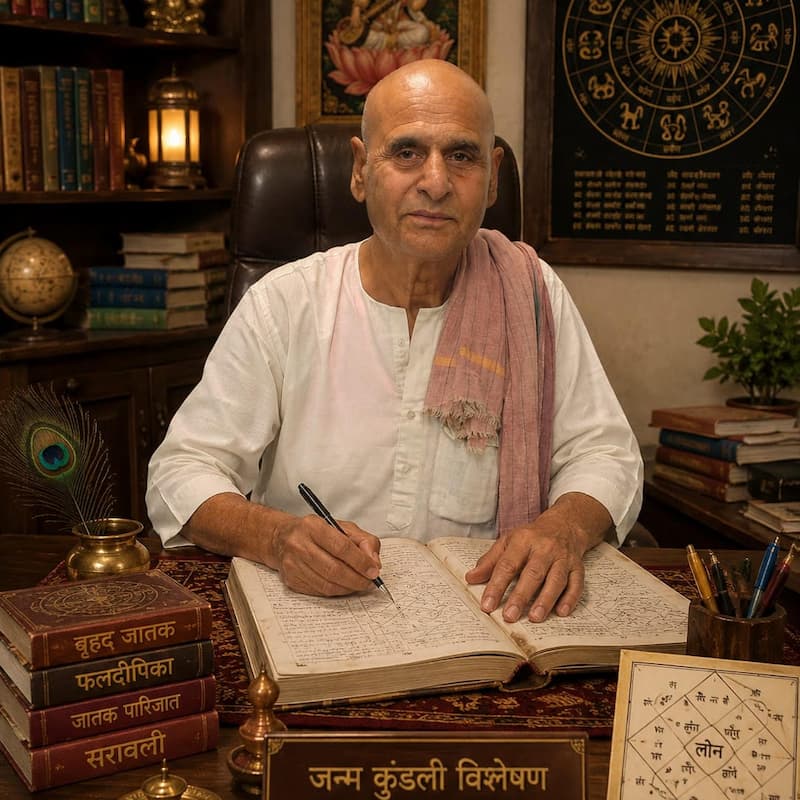
Narendra Kumar Chaubey is a Jyotisha Acharya with over 30 years of experience, based in Bihar and serving clients across India in Vedic astrology, mantra shastra, Vastu and ritual practice.
He completed his formal training at Kameshwar Singh Darbhanga Sanskrit University (KSDSU), one of India’s oldest and most respected institutions for Vedic and Sanskrit scholarship, where he studied Jyotisha shastra, mantra vidya and related classical sciences. KSDSU’s tradition of rigorous Sanskrit education tracing directly to the Mithila region’s centuries-old pandit lineage forms the foundation of his practice.
Over three decades, Narendra Kumar Chaubey has worked with thousands of individuals and families across Bihar and across India, offering guidance in:
- Kundli (birth chart) analysis: Identifying karmic patterns, planetary periods and life path guidance through classical Jyotisha
- Palmistry (Hasta Samudrika): Reading the hand according to the classical Samudrika Shastra tradition
- Vastu Shastra: Assessment and correction of living and working spaces according to directional and elemental principles
- Mantra and Pooja vidhi: Performing and guiding all categories of puja, havan, and mantra sadhana for personal, family and business situations
- Predictive Jyotisha: Transit analysis, muhurta (auspicious timing) selection and remedial guidance
He works across four languages Sanskrit, Hindi, English and Bhojpuri making classical knowledge accessible to practitioners across educational backgrounds and regions.
His writing for ABMantra brings the precision of classical Vedic training to practical mantra guidance: not general advice but specific prescriptions grounded in shastra, lineage and 30 years of direct practice with real situations.
For more info follow on: