
Quick Answer
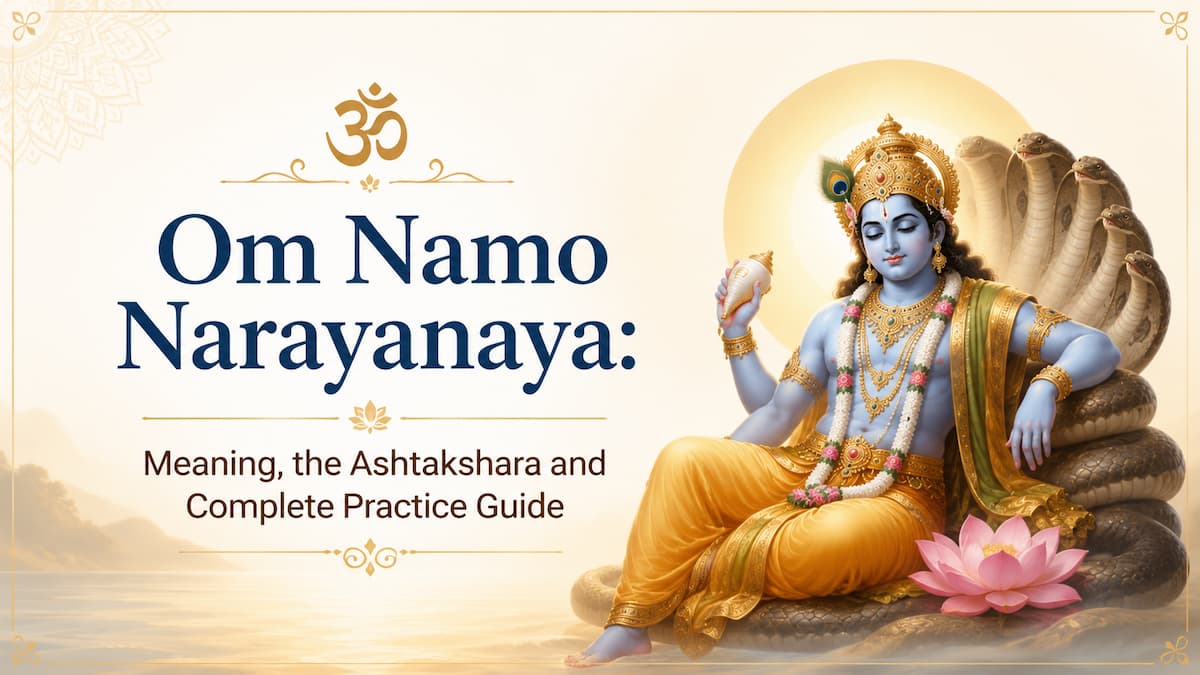
Om Namo Narayanaya (ॐ नमो नारायणाय) means: Om. I bow to Narayana.
It is an eight-syllable (Ashtakshara) mantra from the Sama Veda and the Tarasara Upanishad, dedicated to Lord Vishnu in his form as Narayana. It is one of the most universally accessible mantras in the Vedic tradition: no initiation is required, no restriction applies to any person, and no time of day is prohibited.
Chant 108 times daily, ideally twice a day (morning and evening), for 40 consecutive days for a complete practice. After each session, sit in silence for at least 10 minutes to connect with the mantra’s effect.
Who This Article Is For
This article is for you if: you want to know what Om Namo Narayanaya actually means word by word | you are looking for a mantra that has no restrictions and can be chanted by anyone at any time | you want to understand why Narayana is one of the most significant names in Vedic tradition and what it means philosophically.
Also see: Maha Mrityunjaya Mantra guide and What is Beej Mantra
If you have heard Om Namo Narayanaya chanted and wondered what it means and why it carries such a quality of peace, this article gives you the complete answer. The mantra is eight syllables long. Every syllable has a specific meaning. Together they form a statement that the Vaishnava Chintamani describes as unrestricted by time, place, or condition : the Name of Vishnu available to all of humanity without exception.
Here is what most articles on Om Namo Narayanaya miss entirely: the word Narayana has two different etymologies in the classical texts, and both are correct. The difference between them changes what the mantra means philosophically. Understanding both makes the practice fundamentally different from simply repeating eight syllables.
Om Namo Narayanaya Meaning: Word by Word
| Syllable / Word | Sanskrit root | Meaning | Deeper significance |
|---|---|---|---|
| Om (ॐ) | A + U + M | The primordial sound. The vibrational foundation of all existence. | A = Brahma (creation), U = Vishnu (preservation), M = Shiva (dissolution). The three functions of the cosmos united in one sound. It is also the Pranava : the sound that precedes all other sounds. |
| Namo (नमो) | Nam (to bow, to surrender) | Salutation. I bow. I surrender. I acknowledge your sovereignty. | Namo is more than a greeting. It is the practice of Sharanagati (complete surrender) compressed into one word. The Vaishnava tradition holds that the act of genuine Namo : bowing without reservation : is itself a complete spiritual practice. |
| Narayanaya (नारायणाय) | Nara + Ayana (primary) Nara + Jana (secondary) |
To Narayana. The dative form : addressed to, offered to. | Two etymologies exist. See the section below for the complete explanation. This is the word that makes the mantra philosophically profound. |
The Two Meanings of Narayana: The Key to the Mantra
Most articles give one meaning of Narayana. The classical texts give two, and both are simultaneously correct.
Etymology 1: The Resting Place of Waters
Nara (नर) = water. Ayana (अयन) = resting place, shelter, ultimate refuge.
Narayana is the one who rests in the waters, the one whose resting place is the cosmic ocean. This is why Vishnu is depicted lying on Shesha, the thousand-headed serpent, floating on the ocean of bliss (Kshira Sagara, the milk ocean). He is the ground of all existence, the support beneath all manifest reality, resting serenely while the entire universe arises from and returns to him.
Etymology 2: The Refuge of All Living Beings
Nara (नर) = all living beings (an alternative meaning of Nara in classical Sanskrit). Ayana (अयन) = ultimate refuge, final destination, goal.
Narayana is the ultimate refuge of all living beings. This is the interpretation used in the Mahabharata and the Bhagavata Purana. It means: every soul, without exception, has Narayana as its final resting place. The mantra is not asking Vishnu for something. It is recognising where everything already rests.
Why Both Etymologies Matter for Practice
When you chant Om Namo Narayanaya with the first meaning in mind, you are bowing to the cosmic ground of all existence : the vast, serene presence beneath the turbulence of daily life. This is a meditative practice: connecting with the stillness beneath the movement.
When you chant it with the second meaning in mind, you are recognising that every person you encounter, every being you see, is also resting in Narayana. This is the Vaishnava tradition’s basis for universal compassion: if Narayana is the refuge of all living beings, then all living beings carry the divine. The mantra as a practice of seeing the divine in all beings.
The tradition recommends holding both meanings simultaneously. This is what makes Om Namo Narayanaya a meditation rather than simply a prayer.
Why This Is Called the Ashtakshara Mantra
Ashtakshara means eight syllables (Ashta = eight, Akshara = syllable, also meaning indestructible). The eight syllables are: Om : Na : Mo : Na : Ra : Ya : Na : Ya.
The number eight is not arbitrary. In the Vedic tradition, eight represents completeness in all eight directions of space (the Ashta Disha): north, south, east, west, northeast, northwest, southeast, southwest. The Ashtakshara Mantra is understood as invoking Vishnu’s presence across all eight directions simultaneously : creating a complete sphere of protection around the practitioner.
The Narayana Upanishad (Krishna Yajurveda) states: “He is the one Narayana; there is no second. He alone controls all these worlds.” The Ashtakshara is this statement compressed into eight syllables.
The Source Texts: Where This Mantra Comes From
| Text | What it says about Om Namo Narayanaya |
|---|---|
| Sama Veda | The mantra’s earliest Vedic appearance. The Sama Veda is the Veda of melodies and chanting : Om Namo Narayanaya appears in the context of devotional recitation. |
| Tarasara Upanishad | Dedicates an entire section to the Ashtakshara. States that the mantra leads the practitioner across (Tara = to cross) the ocean of existence (Samsara). The text is structured around the mantra’s power to grant liberation. |
| Narayana Upanishad (Krishna Yajurveda) | Establishes Narayana as the supreme reality beyond all manifestation. The Ashtakshara mantra is described as the direct invocation of this supreme principle. |
| Vaishnava Chintamani | “There are no rules regarding the time and place for chanting the Name of Vishnu. Of this, there is no doubt.” : the foundational statement of the mantra’s universal accessibility. |
| Vishnu Purana | Documents the Ashtakshara Mahatmya (the greatness of the eight-syllable mantra) and describes it as the mantra that encompasses all other Vishnu mantras. |
Om Namo Narayanaya vs Om Namah Shivaya: The Complete Comparison
This is one of the most common questions practitioners ask. Both are among the most powerful mantras in the Vedic tradition. Both are eight syllables. Both are universally accessible. Here is the clear distinction.
| Feature | Om Namo Narayanaya | Om Namah Shivaya |
|---|---|---|
| Deity | Vishnu as Narayana: the preserver, the sustainer, the ground of existence | Shiva: the transformer, the dissolver, the consciousness beyond form |
| Primary quality invoked | Preservation, protection, dharma, peace, compassion, devotion (Bhakti) | Transformation, liberation, destruction of what no longer serves, pure consciousness |
| Philosophical tradition | Vaishnavism: Vishnu as the supreme reality, the personal God | Shaivism: Shiva as pure consciousness, Advaita (non-dual) tradition |
| When to choose this mantra | When you need stability, protection, peace, and preservation of what is good in your life | When you need transformation, release, the dissolution of old patterns or identities |
| For daily general practice | Both are equally valid. The one that resonates more naturally with your temperament is the correct choice. | Both are equally valid. The one that resonates more naturally with your temperament is the correct choice. |
| Text reference | Sama Veda, Tarasara Upanishad, Narayana Upanishad | Shiva Purana, Panchakshara Upanishad, Tirumurai |
The Advaita tradition, following Adi Shankaracharya, holds that Shiva and Vishnu are ultimately the same supreme reality perceived through two different lenses. A practitioner who chants both is not contradicting themselves. They are approaching the same mountain from two paths.
The Complete 40-Day Practice
The Vedic tradition prescribes 108 repetitions twice daily for 40 consecutive days. This is the Ashtakshara sadhana as described in the Tarasara Upanishad commentary tradition.
The Practice
- Bathe before the morning session. The evening session does not require bathing.
- Sit comfortably, spine upright. Face east in the morning, any direction in the evening.
- Hold your mala in the right hand, beads resting on the middle finger.
- Close your eyes. Take three slow breaths. Let the breath settle.
- Chant Om Namo Narayanaya 108 times. Move one bead per repetition.
- After the 108th repetition: sit in silence for at least 10 minutes. Do not open your eyes immediately. Do not reach for your phone. The 10 minutes of silence after chanting is described in the tradition as the time when the mantra’s vibration integrates into the body. Skipping this step significantly reduces the practice’s effect.
- Repeat in the evening, following steps 3 to 6.
- Continue for 40 days without a single break.
The Silence After Chanting: Why It Is Not Optional
Most practitioners skip the silence after the mantra count and move immediately to the next activity. The Yogapedia and Tarasara Upanishad tradition are both explicit: sit in silence for at least 10 minutes after the 108 repetitions.
The mantra creates a vibration. The silence is where that vibration settles into the system. Ending the practice immediately after the final repetition is like planting a seed and then immediately digging it up to see if it has sprouted. The integration requires stillness.
Who Can Chant Om Namo Narayanaya: The Complete Answer
The answer from the classical texts is unambiguous. The Vaishnava Chintamani states there are no rules regarding time and place for chanting the Name of Vishnu. This applies to:
- All genders. Women and men both. No restriction.
- All castes and backgrounds. The Name of Vishnu has no caste restriction in the Vaishnava tradition.
- All ages. Children and the elderly both.
- Any time of day or night. Morning is optimal. Late night is valid. There is no prohibited window.
- During menstruation. No restriction in the Vaishnava tradition.
- Without initiation. The Name itself is the initiation in the Vaishnava understanding.
- Non-Hindus. The mantra addresses the supreme consciousness. That consciousness does not require the practitioner to belong to any particular tradition.
From Our Practice
From Our Practice
I have chanted many mantras over seven years of daily practice. Om Namo Narayanaya is the one I return to when I cannot find the settled state needed for the others.
There is a quality in Narayana : the resting place, the ground : that the mantra itself produces. Not immediately. Not in the first week. But by the second week of the 40-day practice, the 10 minutes of silence after the 108 repetitions begins to feel different from ordinary silence. There is something underneath the quiet that the mantra makes available.
The best description I have heard came from a fellow practitioner who said: Om Namah Shivaya feels like it is asking something of you. Om Namo Narayanaya feels like it is returning you to something you already are. That distinction is experiential, not theoretical. But 40 days of practice makes it unmistakable.
Frequently Asked Questions
❓ I want to start a mantra practice but do not know which one to choose. Should I start with Om Namo Narayanaya or Om Namah Shivaya?
Start with whichever you are drawn to. If you feel more drawn to Vishnu, devotion, protection and preservation, begin with Om Namo Narayanaya. If you feel more drawn to Shiva, transformation, and pure consciousness, begin with Om Namah Shivaya. Both are universally accessible and equally powerful. If you genuinely feel no pull toward either, begin with Om Namo Narayanaya : it is the more forgiving of the two in the sense that its energy is sustaining rather than transforming, which is a gentler starting point for new practitioners.
❓ Can I chant Om Namo Narayanaya if I am also chanting other mantras like the Gayatri or Maha Mrityunjaya?
Yes. Om Namo Narayanaya combines with other mantras without conflict. The Vaishnava tradition is the one tradition in Hinduism that explicitly states the Name of Vishnu has no time, place or combination restriction. Many practitioners chant the Gayatri Mantra at dawn, the Maha Mrityunjaya Mantra for protection, and Om Namo Narayanaya as their core devotional practice. These address different dimensions: intellect (Gayatri), protection from death (Maha Mrityunjaya), and devotional alignment with the sustaining principle (Narayanaya).
❓ I have been told I need a guru to chant Om Namo Narayanaya. Is that true?
The tradition has two positions. YantraChants, citing Vaishnava sources, notes that the full Om Namo Narayanaya with the Pranava (Om) should ideally be received from a qualified guru for the deepest practice. However, the simpler form Namo Narayanaya (without Om) is freely chanted without initiation. The Vaishnava Chintamani’s statement that the Name of Vishnu has no restrictions applies to the devotional use of the name : which the vast majority of practitioners are doing. Formal Panchanga initiation is a different level of engagement for committed Vaishnava practice.
❓ What is the difference between Om Namo Narayanaya and Om Namo Bhagavate Vasudevaya?
Both are Vishnu mantras. Om Namo Narayanaya (8 syllables) invokes Narayana, the cosmic ground of existence. Om Namo Bhagavate Vasudevaya (12 syllables, the Dvadasakshara Mantra) invokes Vasudeva, Vishnu in his personal form as the son of Vasudeva and father of all creation. Narayanaya addresses the transcendent aspect (Vishnu as the impersonal ground). Vasudevaya addresses the personal, relational aspect (Vishnu as the one who loves and is loved). Both lead to the same reality. The Dvadasakshara is also the mantra for Lord Dhanvantari in the healing context.
❓ I am going through a difficult period and feel disconnected from everything. Which Vishnu mantra helps most?
Om Namo Narayanaya. The mantra’s central meaning is that Narayana is the resting place of all living beings. Chanting it during a period of disconnection is precisely the practice the tradition prescribes for this feeling. You are not asking Narayana to come to you. You are chanting your way back to where you already rest. Begin with 21 repetitions tonight if 108 feels like too much. Return tomorrow with more. The mantra’s quality of peace is accessible even in the first sitting, before the 40-day practice has built its full momentum.
❓ Does chanting Om Namo Narayanaya help with financial problems?
Indirectly, yes. Vishnu’s qualities include the preservation of dharma and the maintenance of right order in life, which includes material wellbeing. The Vishnu Purana describes Narayana as the bestower of all kinds of benefits including wealth. However, if financial difficulty is your primary concern, the Kuber Mantra (for wealth management) and the Lakshmi Mantra (for wealth attraction) are more directly targeted remedies. Om Namo Narayanaya works on the foundation: alignment with dharma and the sustaining principle. Wealth tends to follow when that foundation is right.
Begin Today
Sit down now, wherever you are. Close your eyes. Take three slow breaths.
Chant Om Namo Narayanaya 21 times. Slowly. Let the M of Om and the M of Namo and the final Ya resonate before moving to the next repetition. After the 21st repetition, sit quietly for 5 minutes.
That is the beginning. Tomorrow, 108 times. The day after, 108 times again.
The mantra does not require you to believe in Vishnu in any particular way. It requires you to bow : Namo : to the ground of existence. And that ground is always already there, waiting to receive you, wherever you are sitting right now.
Sources:
- Om Namo Narayanaya: Meaning and Purpose. Yogapedia, December 2023. Sama Veda and Tarasara Upanishad source; 40-day practice and 10-minute silence prescription
- Om Namo Narayanaya Mantra: Vishnu Chant for Peace. Mahakatha, April 2026. Nara etymology (water and living beings), Narayana Upanishad citation
- Om Namo Narayanaya: Meaning, Power and Sri Vishnu Yantra. YantraChants. Vaishnava Chintamani no-restriction principle; Sharanagati as the core of Namo
- Om Namo Narayanaya Mantra: Meaning and Benefits. AstroVed. Ashtakshara definition; eight directions protection; Vishnu Purana on complete benefits
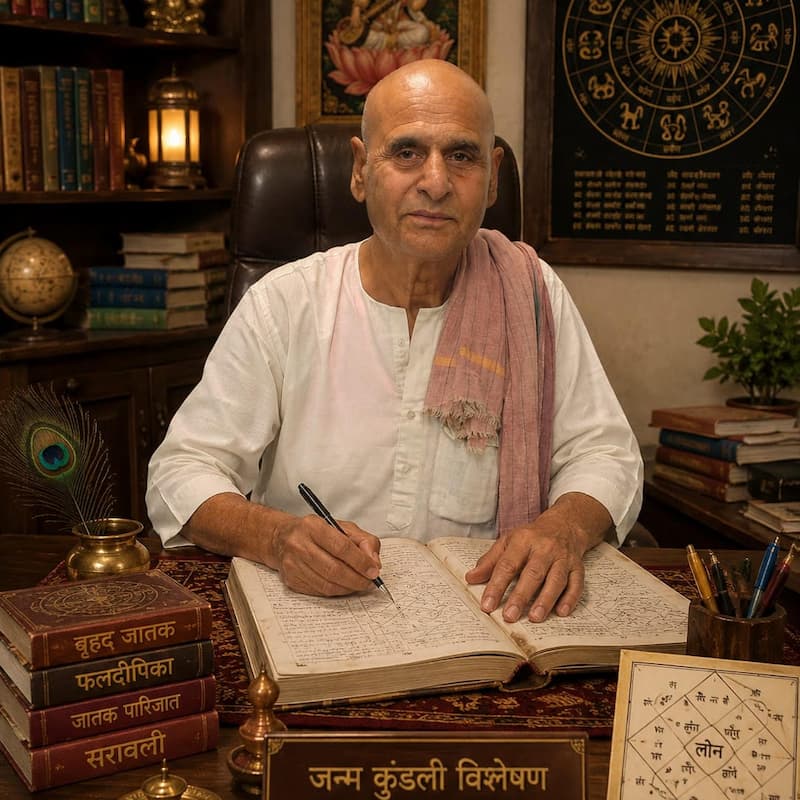
Narendra Kumar Chaubey is a Jyotisha Acharya with over 30 years of experience, based in Bihar and serving clients across India in Vedic astrology, mantra shastra, Vastu and ritual practice.
He completed his formal training at Kameshwar Singh Darbhanga Sanskrit University (KSDSU), one of India’s oldest and most respected institutions for Vedic and Sanskrit scholarship, where he studied Jyotisha shastra, mantra vidya and related classical sciences. KSDSU’s tradition of rigorous Sanskrit education tracing directly to the Mithila region’s centuries-old pandit lineage forms the foundation of his practice.
Over three decades, Narendra Kumar Chaubey has worked with thousands of individuals and families across Bihar and across India, offering guidance in:
- Kundli (birth chart) analysis: Identifying karmic patterns, planetary periods and life path guidance through classical Jyotisha
- Palmistry (Hasta Samudrika): Reading the hand according to the classical Samudrika Shastra tradition
- Vastu Shastra: Assessment and correction of living and working spaces according to directional and elemental principles
- Mantra and Pooja vidhi: Performing and guiding all categories of puja, havan, and mantra sadhana for personal, family and business situations
- Predictive Jyotisha: Transit analysis, muhurta (auspicious timing) selection and remedial guidance
He works across four languages Sanskrit, Hindi, English and Bhojpuri making classical knowledge accessible to practitioners across educational backgrounds and regions.
His writing for ABMantra brings the precision of classical Vedic training to practical mantra guidance: not general advice but specific prescriptions grounded in shastra, lineage and 30 years of direct practice with real situations.
For more info follow on: