
Quick Answer
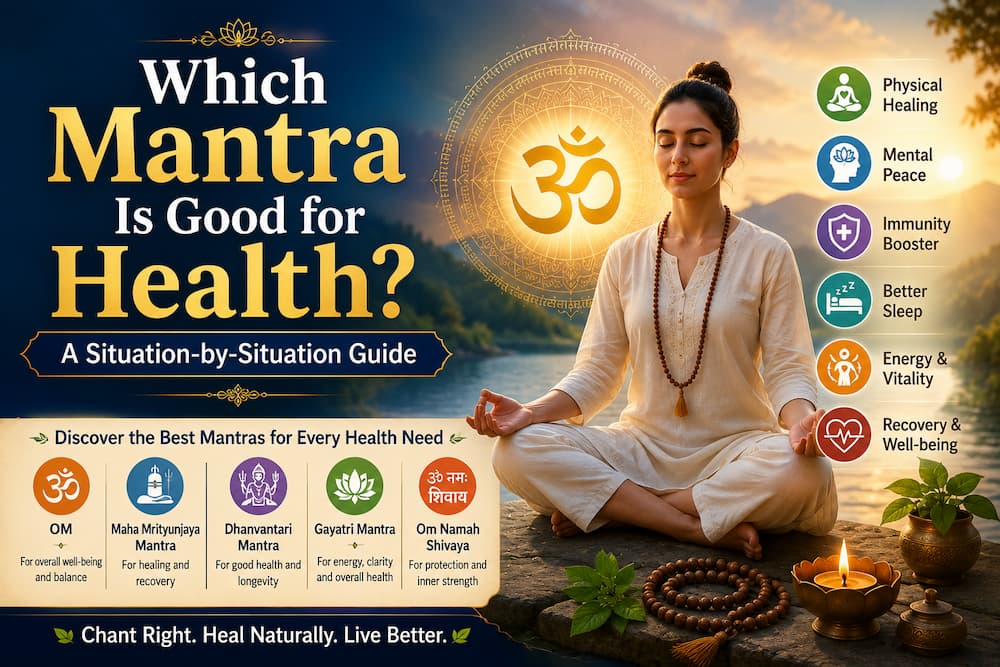
The right mantra for health depends on your specific situation:
Recovering from serious illness or surgery: Maha Mrityunjaya Mantra (RV 7.59.12): the primary Vedic healing mantra, chanted for protection from death and accelerated recovery.
Seeking divine healing and Ayurvedic support: Dhanvantari Mantra: dedicated to Lord Dhanvantari, the deity of Ayurveda and divine physician.
Building daily vitality and immunity: Surya Mantra (Om Hreem Hreem Suryaya Namah): solar energy for strength, vitality and immune function.
Mental health, anxiety and emotional healing: Gayatri Mantra: purifies the mind and restores clarity. Chant 108 times at dawn.
General health maintenance: Om Namah Shivaya: the universal Shiva mantra that works on all five sheaths of the body simultaneously.
Who This Article Is For
This article is for you if: someone you love is seriously ill and you want to know which mantra to chant | you have a chronic health condition and want to support your treatment spiritually | you want to build a daily health practice using mantra | you are confused by the many mantras recommended for health and want a clear situation-based answer.
Important note: This is a spiritual practice guide. Mantra chanting supports healing and wellbeing alongside medical treatment. It does not replace the advice of a qualified medical professional. Consult your doctor for any health condition.
If someone in your family is ill right now, you do not want a long philosophical explanation. You want to know: which mantra, which deity, how many times, and when to start. This article gives you exactly that, organised by situation.
Here is what most health mantra articles miss: there is no single best mantra for health. The tradition is precise about this. Different mantras address different dimensions of health: the physical body, the energy body, the mind, the karmic field. This article maps the right mantra to each situation.
How the Vedic Tradition Understands Health and Illness
In the Vedic system, the human being exists in five sheaths (Pancha Kosha): the physical body (Annamaya Kosha), the energy body (Pranamaya Kosha), the mental body (Manomaya Kosha), the wisdom body (Vijnanamaya Kosha) and the bliss body (Anandamaya Kosha). Disease (roga) is understood as an imbalance that begins in one or more of these sheaths before manifesting physically.
Mantra chanting works primarily on the Pranamaya Kosha, the energy body that interpenetrates and governs the physical body. When prana flows freely and in balance, the physical body heals. When prana is blocked or depleted, illness follows.
What the Tradition Says About Healing
Sanatan Bliss (April 2026), citing Vedic texts: “In the Vedic tradition, healing was never purely physical. Disease (roga) was understood as an imbalance of energies, karma, and relationship with the divine. Mantra chanting works on the pranamayakosha (energy body), which directly influences physical health.”
This is why mantras chanted by a family member for a sick person can have an effect. The Pranamaya Kosha is not bounded by the skin. It extends into the environment and responds to sound vibrations in the surrounding space.
Mantra 1: Maha Mrityunjaya Mantra : For Serious Illness and Recovery
Maha Mrityunjaya Mantra
Sanskrit:
Om Tryambakam Yajamahe Sugandhim Pushtivardhanam
Urvaarukamiva Bandhanaan Mrityormukshiya Maamritaat
Devanagari:
ॐ त्र्यम्बकं यजामहे सुगन्धिं पुष्टिवर्धनम्।
उर्वारुकमिव बन्धनान् मृत्योर्मुक्षीय मामृतात्॥
Meaning: We worship the three-eyed Shiva who nourishes all beings. May he liberate us from death as a cucumber is released from its vine, into immortality.
| Situation | Count | When to chant | Who can chant |
|---|---|---|---|
| Active illness, hospitalisation, surgery | 108 times daily | Morning, before sunrise if possible | Patient if able, or family member on their behalf |
| Post-surgery recovery | 108 times daily | Morning and evening | Patient and family together |
| Chronic illness, ongoing condition | 108 times daily, continuous | Any fixed daily time | Patient |
| Fear of serious illness, preventive | 21 times daily minimum | Morning | Anyone |
| Someone else is critically ill | 108 times daily | Any time | Family member, chanting on their behalf |
Chanting for Someone Who Cannot Chant
The Maha Mrityunjaya Mantra can be chanted by a family member on behalf of a sick person. The tradition holds that mantra vibrations affect the Pranamaya Kosha of the person in the surrounding space, not only the person chanting.
Place a glass of water near you while chanting. After completing 108 repetitions, offer the water to the sick person to drink. This practice of charging water with mantra vibration is described in several Shaivite texts.
Mantra 2: Dhanvantari Mantra : For Ayurvedic Healing and Recovery from Disease
Lord Dhanvantari is the deity of Ayurveda and the divine physician of the gods. He emerged from the cosmic ocean during the churning of the sea (Samudra Manthan) carrying the pot of amrita. He is the patron deity of all healing arts and is particularly suited for chronic disease and conditions requiring sustained healing over time.
Dhanvantari Mantra
Om Namo Bhagavate Vasudevaya Dhanvantaraye Amritakalasha Hastaya Sarvamaya Vinashanaya Trailokyanathaya Sri Mahavishnave Namaha
Meaning: Om. I bow to the divine Vasudeva Dhanvantari who holds the pot of nectar. He destroys all diseases. He is the lord of the three worlds. I bow to the great Vishnu.
Method: 108 times daily at sunrise, facing east. Continue for 40 consecutive days for a complete healing sadhana.
| Situation | Dhanvantari mantra is specifically suited for |
|---|---|
| Chronic illness | Diabetes, arthritis, thyroid conditions, digestive disorders: conditions requiring long-term healing |
| Before medical treatment | Before taking Ayurvedic medicines, before surgery, before starting any new treatment protocol |
| Recovery support | Post-treatment recovery where the body needs sustained rebuilding |
| Mental and emotional health | Depression, anxiety, emotional wounds that have a physical manifestation |
| Dhanteras (annual) | The most auspicious day to chant this mantra: Dhanteras, the day before Diwali, is Dhanvantari’s festival |
Mantra 3: Surya Mantra : For Vitality, Immunity and Strength
Surya Beej Mantra for Health
Sanskrit: Om Hreem Hreem Suryaya Namah
Devanagari: ॐ ह्रीं ह्रीं सूर्याय नमः
Meaning: Om. Through the Hreem beej, I bow to Surya, the source of light, energy and life.
Best for: Low energy, fatigue, weak immunity, recovery of physical strength, conditions worsened by cold and darkness.
When: At sunrise, facing east, ideally while looking toward the rising sun. 108 times.
The Surya Mantra addresses health at the most fundamental level: solar energy is the original source of all prana in the physical world. Chanting it at sunrise, facing the rising sun, aligns the practitioner’s energy field with the sun’s pranic output at its daily peak.
Mantra 4: Gayatri Mantra : For Mental Health and Emotional Healing
In the health context, the Gayatri Mantra is the primary mantra for mental health, emotional clarity, and healing of conditions rooted in mental disturbance: anxiety, depression, confusion, grief and chronic stress. In Vedic medicine, mental clarity is not separate from physical health. A mind that is clear and settled produces a body that heals efficiently.
| Mental or emotional health situation | How the Gayatri mantra addresses it |
|---|---|
| Anxiety and constant worry | The sattvic quality of the Gayatri mantra, chanted at Brahma Muhurta, progressively calms the reactive mind over 21 to 40 days of consistent practice |
| Depression and loss of purpose | The mantra asks for divine light to illuminate the intellect. Practitioners report a gradual return of directedness and meaning within the first 21 days |
| Grief after bereavement | The morning practice creates a structure of stillness that grief needs but cannot create for itself. The mantra holds the griever |
| Stress from overwork or pressure | 108 repetitions at dawn produces measurable parasympathetic activation. The effect on cortisol levels is cumulative over consistent practice |
| Recovery from trauma | Long-term (40 days minimum). The mantra works on the Vijnanamaya Kosha, the wisdom body, which holds the pattern of trauma beneath the mental and emotional layers |
The Science Reference
A 2015 study at the National Brain Research Centre, Manesar, found that chanting Sanskrit mantras produces measurable changes in brainwave patterns, shifting the brain toward alpha and theta states associated with deep relaxation and accelerated healing.
This is not proof that any specific mantra cures any specific disease. It is evidence that the physiological mechanism through which mantra chanting affects health is real and measurable.
Mantra 5: Om Namah Shivaya : For General Health and Daily Wellbeing
Om Namah Shivaya
Sanskrit: Om Namah Shivaya
Devanagari: ॐ नमः शिवाय
Syllable meaning: Na (earth element), Ma (water), Shi (fire), Va (air), Ya (space).
Full meaning: I bow to Shiva, the auspicious one who pervades all five elements of existence.
Best for: Daily maintenance of health, general vitality, prevention, and as a foundation practice that supports all other health mantras.
Count: 108 times daily, any time of day.
Which Health Mantra for Which Situation: Complete Reference
| Your health situation | Primary mantra | Secondary mantra | Duration |
|---|---|---|---|
| Serious illness, hospitalisation | Maha Mrityunjaya Mantra | Om Namah Shivaya | Daily, continuous |
| Chronic illness (diabetes, arthritis, heart) | Dhanvantari Mantra | Maha Mrityunjaya Mantra | 40 days minimum |
| Post-surgery recovery | Maha Mrityunjaya Mantra | Surya Mantra (at sunrise) | Until full recovery |
| Low energy, fatigue, weak immunity | Surya Mantra | Om Namah Shivaya | 21 to 40 days |
| Anxiety, depression, mental health | Gayatri Mantra (dawn) | Om Namah Shivaya | 40 days minimum |
| Grief, emotional healing | Gayatri Mantra | Maha Mrityunjaya Mantra | 40 days minimum |
| General health maintenance | Om Namah Shivaya | Surya Mantra | Ongoing daily practice |
| Child’s health (parent chanting) | Dhanvantari Mantra | Maha Mrityunjaya Mantra | As long as needed |
| Elderly parent’s health | Maha Mrityunjaya Mantra | Dhanvantari Mantra | Daily, continuous |
From Our Practice
From Our Practice
In 2019, my uncle was diagnosed with stage 3 kidney disease. The doctors were honest: dialysis was likely within 18 months.
Our family began a rotation of the Maha Mrityunjaya Mantra: one family member chanting 108 times every morning, alternating through the week so the mantra was being chanted daily without any single person bearing the full weight of the practice.
Eighteen months later, at his follow-up, his kidney function had stabilised. The doctors described it as unexpectedly slow progression. He has not needed dialysis.
I do not present this as proof of anything. The kidneys could have stabilised for other reasons. What I present it as is this: we chanted. He received the best medical care available. The two were not in conflict. They were parallel tracks. The mantra practice did not replace his treatment. It was something we could do when there was nothing else we could do. And that matters in itself.
Frequently Asked Questions
❓ My mother is in the ICU. Which mantra should I start chanting right now?
The Maha Mrityunjaya Mantra. Start immediately. You do not need a mala, a puja setup or a specific direction. Sit where you are, close your eyes and begin: Om Tryambakam Yajamahe Sugandhim Pushtivardhanam, Urvaarukamiva Bandhanaan, Mrityormukshiya Maamritaat. Chant it 11 times now. Then 108 times tonight. Return tomorrow morning.
❓ Can I chant health mantras for someone who is not Hindu?
Yes. The healing mantras work through vibrational resonance, not through religious belief. The sick person does not need to believe in or participate in the practice for it to have an effect on the energetic environment around them. The sincerity of the person chanting is what matters.
❓ I have been chanting the Maha Mrityunjaya Mantra for 3 weeks. Should I see improvement by now?
Three weeks is within the early phase of the practice. The Vedic tradition prescribes a minimum of 40 days for a complete healing sadhana. Most practitioners report a qualitative shift in how the sick person feels before any measurable physical improvement appears. If you are in week 3, continue without interruption through day 40 before assessing.
❓ Which is more powerful for health: the Maha Mrityunjaya Mantra or the Dhanvantari Mantra?
They address different dimensions of health. The Maha Mrityunjaya Mantra addresses the fear of death and supports the body’s will to live: it is most powerful in acute crisis and serious illness. The Dhanvantari Mantra addresses the healing process itself: most powerful for chronic conditions and sustained recovery. For serious illness, use both: Maha Mrityunjaya in the morning, Dhanvantari in the evening.
❓ Can mantra chanting replace medical treatment for serious illness?
No. Mantra chanting is a parallel practice, not a replacement for medical care. The Vedic tradition itself produced Ayurveda as a complete medical system and never presented mantra as sufficient alone for serious physical disease. The correct approach is both: the best available medical treatment and a consistent mantra practice.
❓ My child has been sick for months. As a parent, which mantra should I chant?
The Dhanvantari Mantra for chronic illness, or the Maha Mrityunjaya Mantra if the illness is serious. Chant 108 times every morning before the child wakes. After completing the count, place your hand gently on the child’s back and sit quietly for 5 minutes.
Begin Tonight
If someone in your life is ill, you do not need to wait for an auspicious day. You do not need a mala or a puja room. You need 10 minutes and the willingness to sit quietly and chant.
Find the right mantra for your situation in the reference table above. Begin with 11 repetitions tonight if 108 feels too large. Return tomorrow morning with 108.
The tradition does not ask you to understand how it works before it works. It asks only that you begin.
Important Health Notice
This article is a spiritual practice guide. The mantras described here are traditional practices with centuries of documented use in the Vedic and Ayurvedic traditions. They are intended to support health and wellbeing alongside qualified medical care.
Mantra chanting does not cure disease and should not replace medical diagnosis or treatment. If you or someone you love is experiencing a health condition, please consult a qualified medical professional.
Sources and Citations
- Mantras for Healing. Sanatan Bliss, April 2026. Vedic understanding of disease as pranamaya kosha imbalance
- Top 7 Vedic Mantra for Good Health. Mrunal Pawar, July 2025. Dhanvantari mantra text, Surya mantra and healing mechanisms
- Powerful Mantras for Health, Healing and Recovery. Hindutone, February 2025. Situation-based guide to healing mantras
- Top 11 Mantras for Health and Healing. Aatm Yogashala, March 2026. Citing National Brain Research Centre 2015 study on Sanskrit mantra and brainwave patterns
Narendra Kumar Chaubey is a Jyotisha Acharya with over 30 years of experience, based in Bihar and serving clients across India in Vedic astrology, mantra shastra, Vastu and ritual practice.
He completed his formal training at Kameshwar Singh Darbhanga Sanskrit University (KSDSU), one of India’s oldest and most respected institutions for Vedic and Sanskrit scholarship, where he studied Jyotisha shastra, mantra vidya and related classical sciences. KSDSU’s tradition of rigorous Sanskrit education tracing directly to the Mithila region’s centuries-old pandit lineage forms the foundation of his practice.
Over three decades, Narendra Kumar Chaubey has worked with thousands of individuals and families across Bihar and across India, offering guidance in:
- Kundli (birth chart) analysis: Identifying karmic patterns, planetary periods and life path guidance through classical Jyotisha
- Palmistry (Hasta Samudrika): Reading the hand according to the classical Samudrika Shastra tradition
- Vastu Shastra: Assessment and correction of living and working spaces according to directional and elemental principles
- Mantra and Pooja vidhi: Performing and guiding all categories of puja, havan, and mantra sadhana for personal, family and business situations
- Predictive Jyotisha: Transit analysis, muhurta (auspicious timing) selection and remedial guidance
He works across four languages Sanskrit, Hindi, English and Bhojpuri making classical knowledge accessible to practitioners across educational backgrounds and regions.
His writing for ABMantra brings the precision of classical Vedic training to practical mantra guidance: not general advice but specific prescriptions grounded in shastra, lineage and 30 years of direct practice with real situations.
For more info follow on: