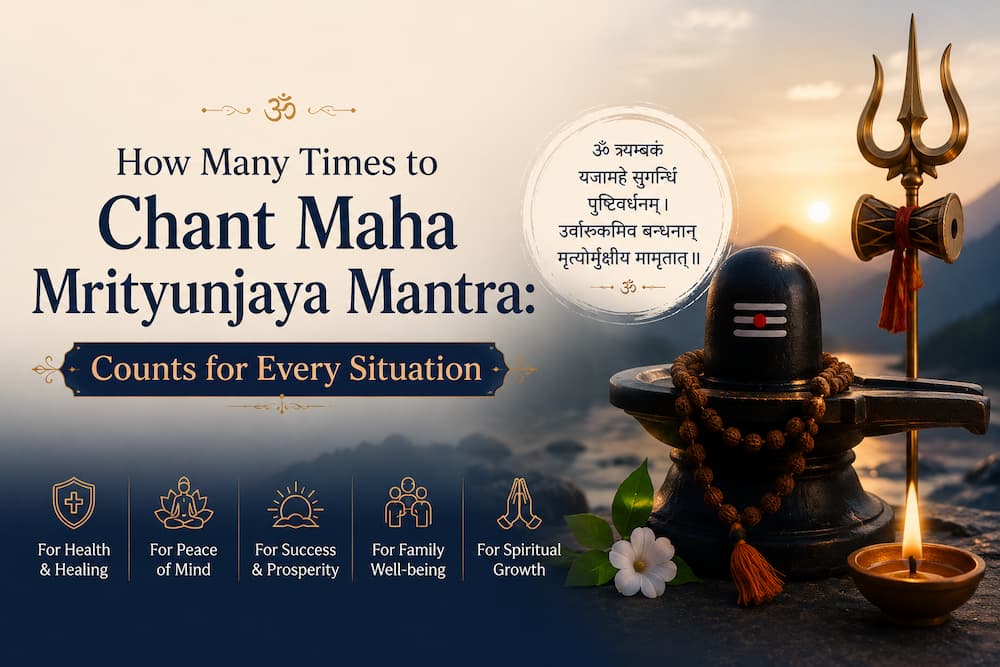

The Maha Mrityunjaya Mantra has five principal chanting counts in the classical tradition: 11, 21, 108, 1,008 and 125,000. Each count corresponds to a specific situation, a specific depth of practice and a specific expected result. The answer to how many times to chant the Maha Mrityunjaya Mantra is not a single number, it depends entirely on what you are chanting it for.
This guide covers all five counts, the situations each is appropriate for, how long each takes, and the practical guidance for each. It also addresses the most common follow-up questions: can you chant at night, does count matter more than sincerity, and how many times for a sick person.
For the complete Maha Mrityunjaya Mantra with Sanskrit, transliteration, full meaning and benefits, see the Mahamrityunjaya Mantra article on abmantra.com.
The Five Counts: Complete Reference Table
| Count | When to Use | Duration | Best Time | Why This Count |
| 11 times | Minimum daily practice, beginners | 10-12 minutes | Any morning — sunrise ideal | 11 is a sacred number in Shaiva tradition. Eleven repetitions is the shortest complete practice — enough to create the daily protective field without requiring a major time commitment. |
| 21 times | Daily practice with intention | 20-25 minutes | Morning, before noon | A middle count that deepens the practice beyond minimum while remaining accessible for most schedules. The traditional count when performing the mantra for general wellbeing. |
| 108 times | Standard sadhana — one full mala | 45-60 minutes | Brahma Muhurta or sunrise | 108 is the primary sadhana count. At 108 repetitions the mantra practice reaches the depth where the body’s nervous system begins to register a consistent change. This is the count that classical texts describe as generating genuine healing effect. |
| 1,008 times | Crisis or intensive healing practice | 7-8 hours (split across day) | Spread across morning and evening | Traditional for serious illness, surgery recovery or acute crisis. Often performed by a group rather than a single individual. One thousand and eight is the complete cycle — nine malas of 108 each is one way to reach this count. |
| 125,000 times (Purascharana) | Complete mantra initiation or serious vow | 40-90 days of sustained practice | Daily, same time, same place | The Purascharana is the complete consecration of a mantra — chanting it enough times to fully embed it in consciousness. 125,000 repetitions of the Maha Mrityunjaya Mantra is a traditional Purascharana count referenced in classical Tantra texts. |
Sources: Classical Tantra texts on Purascharana practice. The Rigveda 7.59.12 source of the mantra. The 108-count tradition as referenced across Shaiva ritual texts.
108 Times: Why This Is the Primary Count
108 is the most important count for Maha Mrityunjaya Mantra practice — and understanding why helps you chant it with greater awareness.
The Astronomical Significance
108 appears across Vedic astronomy in a way that is not accidental. The distance between the Earth and Sun is approximately 108 times the Sun’s diameter. The distance between the Earth and Moon is approximately 108 times the Moon’s diameter. The Sun’s diameter is approximately 108 times the Earth’s diameter. The Vedic tradition encodes these ratios into the chanting count: 108 repetitions align the practice with the cosmic proportions of the solar system.
Source: Sri Sri Ravi Shankar on the significance of 108 — nine planets times twelve constellations equals 108, representing the complete cycle of planetary influence on consciousness.
The Physiological Effect at 108
Research on mantra repetition and the nervous system shows that sustained rhythmic sound repetition — which is what 108 repetitions of a mantra produces — activates the parasympathetic nervous system and reduces cortisol levels. This effect requires a minimum duration of approximately 30-45 minutes of continuous practice to become measurable. A standard pace of 108 Maha Mrityunjaya Mantra repetitions takes 45-60 minutes — which is precisely the duration required. The count is calibrated to the physiological response threshold.
Source: Multiple clinical studies on mantra and mindfulness practice duration effects on parasympathetic nervous system activation. Referenced in Brewer JA et al., PNAS 2011 on meditation and Default Mode Network.
Practical Guidance for 108 Repetitions
• Use a Rudraksha or Sphatik (crystal) mala — Rudraksha is specifically associated with Shiva and is the most appropriate mala for Maha Mrityunjaya Mantra practice.
• Sit facing north or east. Brahma Muhurta (4:35 to 5:23 AM) is ideal. Any morning time before noon is acceptable.
• Chant clearly and steadily — not rushed, not laboured. Each complete repetition of the mantra should take approximately 25-30 seconds.
• If you are chanting for a specific person who is ill, state their name and situation silently before beginning the count and hold it throughout.
How Many Times to Chant Maha Mrityunjaya Mantra for Illness
For a family member who is seriously ill, the Maha Mrityunjaya Mantra practice is one of the most powerful spiritual tools available in the Hindu tradition. Here is the specific guidance:
• Daily chanting on the patient’s behalf: 108 times, with the patient’s name stated silently as intention before beginning. Continue for a minimum of 40 consecutive days.
• Group akhand path (continuous chanting without break): A group of practitioners taking turns to chant the Maha Mrityunjaya Mantra continuously for a full day and night — completing approximately 10,000 to 25,000 repetitions — is a traditional practice for acute crisis or post-surgery recovery.
• Chanting near the patient: Live chanting in the patient’s presence is considered more effective than recorded audio. The vibration of a sincere practitioner chanting at close range has a different quality than audio playback.
• The Rigveda 7.59.12 source of the mantra is specifically a liberation prayer — liberation from the fear of death, not necessarily from death itself. The mantra’s promise is: as a ripe cucumber falls naturally from the vine, may liberation come naturally. This does not always mean physical recovery — it means the removal of fear and the presence of grace.
Source: Valmiki Ramayana — reference to Maha Mrityunjaya Mantra’s healing context. Rigveda 7.59.12 — the original verse. Classical Shaiva ritual texts on group healing practices.
From our practice: We chanted the Maha Mrityunjaya Mantra 108 times daily for 21 consecutive days when a close family member underwent cardiac surgery in 2019. We chanted it in the hospital corridor during the surgery and in the room afterward. We cannot say with certainty what the mantra contributed. We can say that the quality of presence it brought to what was otherwise an experience of helpless waiting changed that experience significantly — for us and, we believe, for the patient.
Conclusion: Start with 11, Build to 108
The Maha Mrityunjaya Mantra does not require a large count to begin producing its effect. Start with 11 repetitions tomorrow morning. Do it for 7 days. Then extend to 21. Extend to 108 when you are ready. The mantra will meet you wherever your practice currently is — but it rewards consistency and depth more than any other approach.
Om Tryambakam Yajamahe — begin today.
Frequently Asked Questions
How many times should I chant Maha Mrityunjaya Mantra daily?
For a standard daily practice: 108 times — one full mala — is the traditional and most effective count. If 108 times is too long for your current schedule, begin with 11 or 21 times and build up. The most important thing is consistency: 11 times every day produces more benefit than 108 times once a week.
Can I chant Maha Mrityunjaya Mantra 108 times at night?
The traditional preference is morning — Brahma Muhurta (4:35 to 5:23 AM) or sunrise. This is because the Maha Mrityunjaya Mantra is a Shiva mantra associated with the force of liberation, which is strongest in the sattvic hours before sunrise. That said, if morning practice is genuinely impossible, evening practice is better than no practice. Night chanting (after 9 PM) is generally not recommended for this mantra specifically, though different teachers take different positions.
How many times to chant Maha Mrityunjaya Mantra for a sick person?
For someone who is seriously ill: 108 times daily chanted by a family member on the patient’s behalf, with the patient’s name held in intention throughout, is the standard classical prescription. For acute situations, a group of practitioners chanting 1,008 times collectively in one sitting (an akhand path) is a traditional practice across North India. The mantra should be chanted near the patient if possible — the vibration of live chanting near the body is considered more effective than recorded audio.
What is the jaap sankhya (chanting count) for Maha Mrityunjaya Mantra?
The principal jaap sankhya referenced in classical texts are: 11 (minimum daily), 21 (standard daily with intention), 108 (full sadhana count — one mala), 1,008 (intensive practice for crisis or serious illness), and 125,000 (Purascharana — complete consecration of the mantra). For a specific 40-day sadhana, 108 repetitions daily for 40 consecutive days is the most complete and well-documented practice in the tradition.
Does the count matter or is sincerity more important?
Both matter, but differently. Sincerity is the necessary condition — a distracted 108 repetitions produces less than a focused 11 repetitions. The count matters because the tradition has identified specific counts that correspond to measurable shifts in the practitioner’s experience: 11 times creates a basic energetic shift, 108 times creates a sustained physiological change (reduced heart rate, nervous system calming), and extended practice over 40 days creates lasting neurological patterns. Sincerity without count produces an incomplete practice; count without sincerity produces mechanical repetition. Both are required.
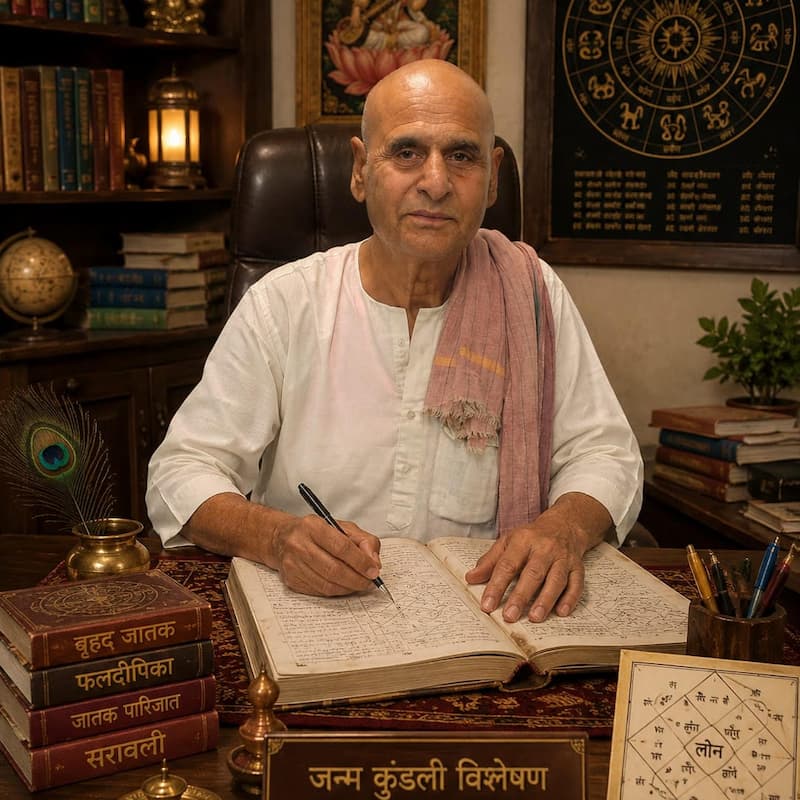
Narendra Kumar Chaubey is a Jyotisha Acharya with over 30 years of experience, based in Bihar and serving clients across India in Vedic astrology, mantra shastra, Vastu and ritual practice.
He completed his formal training at Kameshwar Singh Darbhanga Sanskrit University (KSDSU), one of India’s oldest and most respected institutions for Vedic and Sanskrit scholarship, where he studied Jyotisha shastra, mantra vidya and related classical sciences. KSDSU’s tradition of rigorous Sanskrit education tracing directly to the Mithila region’s centuries-old pandit lineage forms the foundation of his practice.
Over three decades, Narendra Kumar Chaubey has worked with thousands of individuals and families across Bihar and across India, offering guidance in:
- Kundli (birth chart) analysis: Identifying karmic patterns, planetary periods and life path guidance through classical Jyotisha
- Palmistry (Hasta Samudrika): Reading the hand according to the classical Samudrika Shastra tradition
- Vastu Shastra: Assessment and correction of living and working spaces according to directional and elemental principles
- Mantra and Pooja vidhi: Performing and guiding all categories of puja, havan, and mantra sadhana for personal, family and business situations
- Predictive Jyotisha: Transit analysis, muhurta (auspicious timing) selection and remedial guidance
He works across four languages Sanskrit, Hindi, English and Bhojpuri making classical knowledge accessible to practitioners across educational backgrounds and regions.
His writing for ABMantra brings the precision of classical Vedic training to practical mantra guidance: not general advice but specific prescriptions grounded in shastra, lineage and 30 years of direct practice with real situations.
For more info follow on: