
Every morning, before human beings invented prayer, built temples or composed mantras, they watched the sun rise. The warmth on the skin, the gradual appearance of colour in a dark world, the resumption of birdsong and activity: all of this preceded any theology. The instinct to bow toward the rising sun is older than any tradition that has tried to explain it.
In the Vedic tradition, that instinct was given form, language and an entire science. The entity toward which ancient human beings turned their faces at dawn was named Surya, described in detail, addressed in hundreds of hymns, and woven into every major aspect of Vedic life from daily rituals to great epics. Understanding who Lord Surya is in the Vedic tradition means understanding not just a deity but the oldest continuous relationship between human consciousness and the cosmos.
This article covers Lord Surya’s Vedic origins, his complete iconography and what every element of his form means, the stories in which he plays a central role, his 12 principal names and their meanings, the major temples dedicated to him, and the festivals through which millions of Indians continue to worship him every year.
For the complete guide to all Surya Mantras including pronunciation, meaning and chanting practice, see our main article: Surya Mantra: Meaning, Benefits and Correct Chanting Method.
Lord Surya in the Vedic Tradition: Origins and Significance
The Rigveda, the oldest of the four Vedas and one of the oldest existing texts in any human language, contains more hymns addressed to Surya than to almost any other deity. The Surya Sukta (Rigveda Book 1, Hymn 115) opens with one of the most celebrated verses in all of Vedic literature:
| Chitra devanamuditah aniikaadvisho divo mahinaa vardhate shucih“The brilliant face of the gods has risen, the eye of Mitra, Varuna and Agni. He has filled heaven and earth and the mid-region; the Sun is the soul of all that moves and stands still.”Rigveda 1.115.1 |
Source: Rigveda, Mandala 1, Sukta 115 (Surya Sukta). Sanskrit text available via the IITK Rigveda digital archive.
This verse contains the foundation of everything the Vedic tradition says about Surya. He is described as the eye of multiple deities (Mitra, Varuna, Agni) simultaneously, meaning he is not one god among many but the perceptual centre of the entire divine order. He is called the soul (atman) of all that moves and stands still, meaning every living and non-living thing in the universe has its existence sustained by his energy.
In the Navagraha system of Vedic astrology, Surya holds the position of greatest importance. He is the centre around which all other planets are interpreted. A person’s Sun sign in Jyotish is called the Lagna-related Surya, and the Sun’s strength in the natal chart determines the quality of a person’s core identity, leadership capacity and the degree to which their life force expresses itself fully.
The term Pratyakshadaivam (the directly perceptible God) is unique to Surya in the Hindu pantheon. Every other deity requires faith for their reality to be accessed. Surya alone can be seen, felt and confirmed with the physical senses. This directness gave the Vedic rishis confidence that the solar mantras they composed were reaching their intended recipient.
Lord Surya’s Family: Divine Relationships and Children
The Puranas provide detailed accounts of Surya’s family, and each relationship in that family carries specific cosmological meaning.
Parents: Kashyapa and Aditi
Surya is the son of the sage Kashyapa and his wife Aditi, the goddess of infinity, boundlessness and the cosmic mother. Aditi is described in the Rigveda as the mother of all the Adityas (solar deities), and Surya is the foremost of her sons. The name Aditya (son of Aditi) reflects this lineage and carries the quality of boundlessness: Surya, as Aditi’s son, is the finite expression of his mother’s infinite nature. He is the concentrated, visible point of a boundless maternal source.
Wives: Sanjna and Chhaya
Surya’s first wife is Sanjna (also called Sanjana), the daughter of Vishwakarma, the divine architect. According to the Markandeya Purana and the Vishnu Purana, Sanjna could not bear Surya’s radiance and eventually retreated to the forest in the form of a mare to seek refuge. Before leaving, she created a shadow-form of herself named Chhaya (Shadow) to take her place.
Surya, not knowing about the substitution, lived with Chhaya and had children with her. It was only when Chhaya showed favouritism to her own children over Sanjna’s children that Surya discovered the truth. He then went to Vishwakarma, who reduced his radiance to a manageable level. With his light diminished, Sanjna returned to him. The excess solar material that Vishwakarma filed away became the Sudarshana Chakra of Vishnu and the trident of Shiva, the weapons of the two greatest gods made from the surplus of the Sun’s power.
Notable Children
| Child | Mother | Significance |
| Yama | Sanjna | The god of death and dharma. Governs the departure of the soul from the body and the judgement of karma after death. That the Sun is the father of death reflects the Vedic understanding that life and death are both solar processes. |
| Yamuna | Sanjna | The sacred river goddess. The Yamuna river is considered Surya’s daughter, which is why bathing in the Yamuna is considered an act of solar purification. |
| Karna | Kunti (Mahabharata) | The great warrior of the Mahabharata, born to Kunti through the grace of a solar mantra she inadvertently activated. Karna inherits his father’s quality of boundless generosity: he is known as the most giving character in the entire epic. |
| Shani | Chhaya | The planet Saturn. Shani’s relationship with his father Surya is characterised by tension in the mythology, reflecting the astrological enmity between the Sun and Saturn. Shani embodies karma, delay and the removal of ego, qualities that stand in necessary opposition to Surya’s illuminating brightness. |
| Ashwini Kumaras | Sanjna (in mare form) | The twin divine physicians of the Vedas. Born when Surya took the form of a horse and found his wife Sanjna in her mare form in the forest. The Ashwini Kumaras govern health, healing and the medical sciences in the Vedic tradition. |
Sources: Markandeya Purana; Vishnu Purana Book 3; Mahabharata, Adi Parva (Karna’s birth); Bhagavad Gita Chapter 4, verse 1 (Vivasvan / Karna lineage).
Iconography of Lord Surya: What Every Element Means
The visual form of Lord Surya is one of the most precisely encoded in the entire Hindu iconographic tradition. Every element, from the number of arms to the footwear, carries a specific meaning rooted in Vedic cosmology. Understanding the iconography transforms a glance at any Surya image from a passive visual experience into an active reading of solar theology.
| Iconographic Element | Meaning and Vedic Significance |
| Four arms | The four arms represent the four directions, the four Vedas and the Sun’s governance over the entire cosmos. Two arms hold lotuses symbolising purity and spiritual awakening. One arm bestows blessings (Varada Mudra) and one offers protection (Abhaya Mudra). |
| Two lotuses | The lotus grows from mud and rises to bloom above the water, untouched by the impurity of its origin. Surya holding lotuses signifies that his light reaches everywhere including places of impurity, yet remains uncorrupted. The lotus is also the symbol of Lakshmi and of spiritual awakening. |
| Seven horses | The seven horses pulling Surya’s chariot represent the seven colours of visible light (VIBGYOR), the seven days of the week and the seven chakras of the human energy system. The single-wheeled chariot represents the single solar year. The charioteer is Aruna (the dawn), who is described as having no legs, symbolising that the dawn itself has no fixed form. |
| Golden complexion | Surya is consistently described as having a golden or copper-red complexion, corresponding to the colour of the sun at sunrise and sunset. Gold in the Vedic tradition is the metal of solar consciousness: pure, untarnishable and the most refined form of material reality. |
| Crown and armour | The crown signifies sovereignty over the celestial realm. The armour (Kavach) represents the protective quality of sunlight. The Surya Kavach stotra, a hymn dedicated to this armour, is recited for protection from illness and adversity. |
| Facing fully forward | Unlike most Hindu deities who are shown in a three-quarter or profile posture, Surya faces directly forward. This represents his quality as Pratyakshadaivam (the directly visible God): he hides nothing and can be faced directly, the only deity in the Hindu pantheon that can be looked at (carefully, at sunrise or sunset) with the physical eye. |
One distinctive feature of many north Indian Surya images is the pair of high boots (Upanat) that the deity wears. This is considered unusual in Hindu iconography, where deities are typically depicted barefoot. Scholars interpret the boots as evidence of the Central Asian and Persian influence on the north Indian solar cult, where the sun god Mithra was similarly depicted. It is a visible reminder that the solar worship tradition crossed cultural boundaries long before the modern era.
The 12 Principal Names of Lord Surya
Surya is addressed by a remarkable number of names across the Vedic texts, the Puranas, the epics and the mantra tradition. Each name is not merely a label but an invocation of a specific quality or function. Below are the 12 most important names with their meaning and the text in which they primarily appear.
| Name | Meaning | Primary Source |
| Surya | The one who induces activity; that which sets all things in motion | Rigveda, Nirukta of Yaska |
| Aditya | Son of Aditi, the goddess of infinity; the boundless one | Rigveda Book 1; Brihadaranyaka Upanishad |
| Ravi | The radiant one; one who shines brilliantly | Most common name in everyday Sanskrit and vernacular Indian languages |
| Bhaskara | The one who leads to enlightenment; the maker of light | Aditya Hridayam, Surya Namaskar Mantra (11th name) |
| Mitra | The universal friend; the one who shines on all without discrimination | One of the oldest solar names; appears in both Vedic and Avestan traditions |
| Vivasvan | The brilliant shining one; the Sun as pure luminosity | Bhagavad Gita (Ch. 4, verse 1); Mahabharata |
| Martanda | The cosmic egg; the Sun as the primal source of all life | Rigveda; Shatapatha Brahmana |
| Pushan | The nourisher; the one who causes all things to grow | Rigveda; governs safe travel and the nourishment of all living beings |
| Savitri | The stimulator; the force that sets creation in motion | Gayatri Mantra (Tat Savitur Varenyam); Rigveda Book 3, Hymn 62 |
| Hiranya Garbha | The golden womb; the cosmic source from which creation emerged | Rigveda Book 10, Hymn 121; Mundaka Upanishad |
| Arka | The one worthy of praise; a flash of light | Surya Namaskar Mantra (11th name); Vedic hymns |
| Khaga | One who moves through the sky without pause or deviation | Surya Namaskar Mantra (5th name) |
For the complete 12-name Surya Namaskar Mantra with corresponding yoga poses and chanting method, see our article: Surya Namaskar Mantra: 12 Names of the Sun God with Meaning and Steps.
Lord Surya in the Major Epics and Puranas
Surya and Karna: The Gift of Divine Armour
One of the most poignant solar stories in the Mahabharata is the birth of Karna. The princess Kunti, before her marriage, was given a mantra by the sage Durvasa that would summon any deity and grant her a child. Curious and impulsive, she tested the mantra by calling upon Surya. The Sun God appeared and, bound by the power of the mantra, gave her a son: Karna, born with his father’s golden armour (Kavach) and earrings (Kundal) fused to his body, making him virtually indestructible.
Throughout the Mahabharata, Karna embodies his father Surya’s most celebrated quality: unqualified generosity. Surya is the giver of light to all, without asking who deserves it. Karna, in the tradition of his father, gives without calculation, including eventually giving up his divine armour to Indra in an act of generosity that directly leads to his death. The solar lineage of giving is the moral thread that runs through the entire Karna narrative.
Surya and Hanuman: The Guru-Shishya Bond
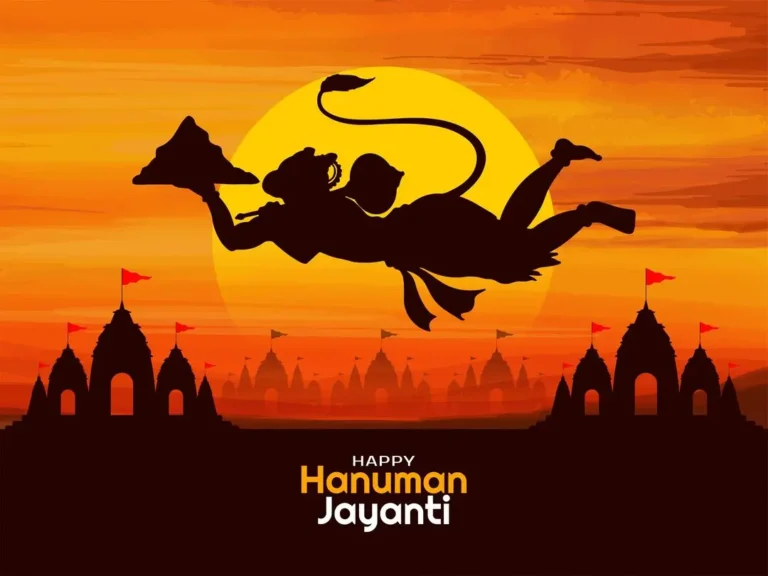
According to the Puranas, Hanuman received much of his learning directly from Lord Surya. When Hanuman sought a teacher in his youth, no sage on earth could keep up with his leaping, boundless energy. Surya, moving across the sky, agreed to teach Hanuman on the condition that the young student keep pace with him while learning. Hanuman agreed and learned the entirety of the Vedas and the Vedangas while running alongside the moving Sun.
This story carries a specific teaching about the nature of Surya. He is not a deity who sits in a fixed place and receives visitors. He is always in motion, always giving, always accessible to those who are genuinely willing to keep pace with him. The relationship between Surya and Hanuman is one of the most cherished in the devotional tradition and is the reason why many Hanuman devotees also maintain a Surya practice.
Surya and the Aditya Hridayam: The Gift to Lord Rama
The most dramatic appearance of Surya in the Ramayana is in the Yuddha Kanda (Book of War), when the sage Agastya descends to the battlefield and teaches Lord Rama the Aditya Hridayam, the Heart of the Sun. The hymn was taught at the moment when Rama was physically and mentally exhausted before his final confrontation with Ravana.
The story communicates something essential about Surya’s nature as a patron: he does not come to those who are comfortable and in no need of help. He comes through the intermediary of a sage to someone standing exhausted on a battlefield, and what he offers is not magic but a practice: a way of re-connecting with solar energy through dedicated sound and intention.
For the complete Aditya Hridayam with all 31 verses, their meaning and chanting method, see our article: Aditya Hridayam: Complete Lyrics, Meaning, Benefits and How to Chant.
Major Surya Temples in India
Unlike most Hindu deities, Surya temples are relatively rare because Surya worship is traditionally conducted in the open air, facing the sun directly. The major Surya temples that do exist are among the most architecturally significant religious sites in India, because they were built not merely as houses for a deity but as precise instruments for capturing and directing solar light.
| Temple | Location | Period Built | Distinctive Feature |
| Konark Sun Temple | Odisha, India | 13th century CE, King Narasimhadeva I | Designated UNESCO World Heritage Site. Entire structure designed as a giant chariot with 24 wheels. The presiding deity is Surya. The temple’s alignment ensures that the first rays of sunrise strike the main idol directly. |
| Modhera Sun Temple | Gujarat, India | 1026 CE, King Bhimdev I | Designed so that during the two equinoxes, the rising sun illuminates the main sanctum without casting a shadow. The tank (Surya Kund) in front is considered one of the finest examples of stepwell architecture in India. |
| Suryanaar Kovil | Tamil Nadu, India | Medieval period, rebuilt multiple times | One of the Navagraha (nine planets) temples of Tamil Nadu. The presiding deity is Surya as one of the nine planetary deities. Widely visited for solar-related remedies including recovery from eye diseases and career obstacles. |
| Dakshinaarka Temple | Gaya, Bihar, India | Ancient; current structure medieval | One of the rare temples where Surya is worshipped facing south (Dakshin). Associated with ancestor worship (Pitru Paksha). Visiting during Pitru Paksha and offering water to Surya here is considered especially meritorious. |
| Surya Pahar | Assam, India | Archaeological site, 9th-10th century | A remarkable hilltop complex with hundreds of rock-cut Surya images. Evidence of the ancient solar worship tradition across eastern India predating even the great Sun temples of Odisha. |
Source: Archaeological Survey of India (ASI) heritage listings for Konark and Modhera. UNESCO World Heritage List entry for Konark Sun Temple (1984).
From our visits: Standing inside the Konark Sun Temple early in the morning, before the tourist crowds arrive, is one of the most profound experiences of solar worship in India. The 24 carved wheels around the base of the temple each represent one of the 24 hours of the day, and the temple’s east-facing entrance means that on equinox mornings the sun enters the sanctum at exactly the right angle. When you stand in that shaft of light, the architectural precision of a 13th-century builder who understood how to bring the Sun indoors becomes immediately felt.
Festivals Dedicated to Lord Surya
Surya is the only major Hindu deity with a festival cycle tied to the actual solar calendar rather than the lunar calendar. The key solar festivals mark the Sun’s movement through the year and the changes in the quality of solar energy at different points of the annual cycle.
| Festival | Timing | Significance | Key Mantra |
| Ratha Saptami | 7th day of Shukla Paksha in Magha month (Jan/Feb) | The Sun’s birthday in the Vedic calendar. The day the Sun turns its chariot northward (Uttarayana). Special bathing rituals, water offerings and recitation of the Aditya Hridayam are observed. | Aditya Hridayam + Om Suryaya Namah 108 times |
| Makara Sankranti | January 14 (fixed solar date) | The Sun’s entry into Capricorn (Makara). The most important solar transition of the year, marking the end of Dakshinayana (Sun’s southern journey) and the beginning of Uttarayana (northern journey). Observed with kite flying, sesame offerings and ritual bathing. | Surya Beej Mantra + Gayatri at sunrise |
| Chhath Puja | 6th day after Diwali (Oct/Nov), 4-day festival | The only Hindu festival that worships the Sun directly in both its setting and rising forms. Observed through complete fasting (including no water), standing in rivers at sunset and sunrise, and offering Arghya. Primarily observed in Bihar, eastern UP and the Nepali Terai. | Surya Arghya Mantra + Surya Gayatri |
| Surya Shashti | 6th day of Shukla Paksha in Kartik month | Direct precursor to Chhath Puja. Dedicated to both Surya and Chhathi Maiya. | Om Suryaya Namah + Surya Beej Mantra |
| Sunday Worship | Every Sunday (Ravivar) | Sunday is Ravivar, the day of Ravi (the Sun). Weekly special worship including water offerings (Arghya), fasting on Sundays and chanting of Surya Mantras is one of the most accessible ongoing solar practices in the tradition. | Any Surya Mantra, especially Beej Mantra 108 times |
Conclusion
Lord Surya is not a minor figure in the Hindu tradition. He is among the oldest continuously worshipped deities in human history, appearing in the Rigveda over 3,500 years ago and still receiving daily offerings at thousands of temples, rivers and household shrines across India every morning.
What makes Surya uniquely accessible is precisely what the Vedic rishis identified: he is Pratyakshadaivam, the directly perceptible God. You do not need a temple, a priest or special initiation to be in his presence. You need only to rise at dawn, face east, and open your eyes. The rest of the tradition, the mantras, the iconography, the stories and the festivals, is an elaboration of that one simple act of recognition.
Understanding who Lord Surya is makes every Surya Mantra you chant more alive. When you know that Om Bhaskaraya Namah is addressed to the god who is simultaneously Rama’s helper on the battlefield, Hanuman’s teacher and Karna’s father, the name carries a weight that a transliteration alone cannot convey.
Frequently Asked Questions
Who is Lord Surya in Hinduism?
Lord Surya is the Sun God in the Vedic and Hindu tradition, one of the Ashtadikpalas (guardians of the directions) and the most important of the Navagrahas (nine celestial bodies that influence human life). He is considered Pratyakshadaivam, the only deity visible to the naked eye. He is the father of Karna (Mahabharata), Yama (the god of death) and Shani (Saturn), and the guru of Lord Hanuman. In the Vedic tradition, Surya is not merely a physical star but a conscious, benevolent cosmic force that sustains all life on earth.
What are the seven horses of Lord Surya’s chariot?
The seven horses pulling Surya’s golden chariot represent the seven colours of visible light (violet, indigo, blue, green, yellow, orange and red), the seven days of the week, and the seven chakras of the human energy system. Their names are Gayatri, Brihati, Ushnik, Jagati, Trishtup, Anushtup and Pankti, each corresponding to a Vedic metre. The charioteer is Aruna (dawn), described in the Puranas as the son of the sage Kashyapa and Vinata.
What is the significance of Pratyakshadaivam?
Pratyakshadaivam means ‘the directly perceptible God’. Surya holds this unique distinction in the Hindu pantheon: he is the only deity whose existence can be directly verified with the physical senses. You do not need faith to know the Sun exists; you feel it every morning. This directness gave the Vedic rishis great confidence in solar worship: they were addressing a force whose reality was beyond doubt, and encoding their deepest wisdom into the mantras and rituals directed at this most visible of all divine presences.
What is the relationship between Surya and Shani (Saturn)?
In the Puranas, Shani (Saturn) is the son of Surya and his second wife Chhaya (Shadow). Their relationship is described as strained: Shani, from birth, embodied a quality that stood in opposition to his father’s solar brightness. Surya represents the ego, directness and illumination; Shani represents karma, delay and the removal of ego. The tension between father and son in the mythology maps precisely onto the astrological relationship between the Sun and Saturn, which are considered enemies in Jyotish.
Which temples are most important for Surya worship in India?
The three most significant Surya temples in India are the Konark Sun Temple in Odisha (a UNESCO World Heritage Site, built in the 13th century as a giant stone chariot), the Modhera Sun Temple in Gujarat (1026 CE, designed so the equinox sunrise illuminates the sanctum directly) and the Suryanaar Kovil in Tamil Nadu (one of the Navagraha temples). For pilgrims seeking Surya’s blessings for career, health or the resolution of Saturn-related challenges, these three temples are the traditional destinations.
Is Lord Surya the same as the Rigvedic Savitri?
Savitri and Surya are closely related but carry distinct emphases in the Vedic tradition. Savitri is the stimulating, propelling aspect of the Sun as the force that sets creation in motion and inspires the intellect. Surya is the broader solar deity encompassing all solar qualities. The Gayatri Mantra invokes Savitri specifically (Tat Savitur Varenyam), which is why it is particularly powerful for intellectual clarity and the awakening of inner wisdom. Most classical commentators consider Savitri and Surya to be two faces of the same cosmic reality rather than separate beings.

Bhawna Anand is a talented content writer and editor with over 5 years of experience crafting engaging stories for Abmantra. She specializes in Fashion, Lifestyle, and Spiritual content, along with expert guides on Festivals, Gifting, and Ecommerce. Bhawna’s informative writing style has been instrumental in building Abmantra’s loyal readership and vibrant online community.
When not at work, Bhawna enjoys traveling the world, which often inspires her to write captivating travel pieces that transport readers to new destinations. She also loves to sing, cook, and read good novels.