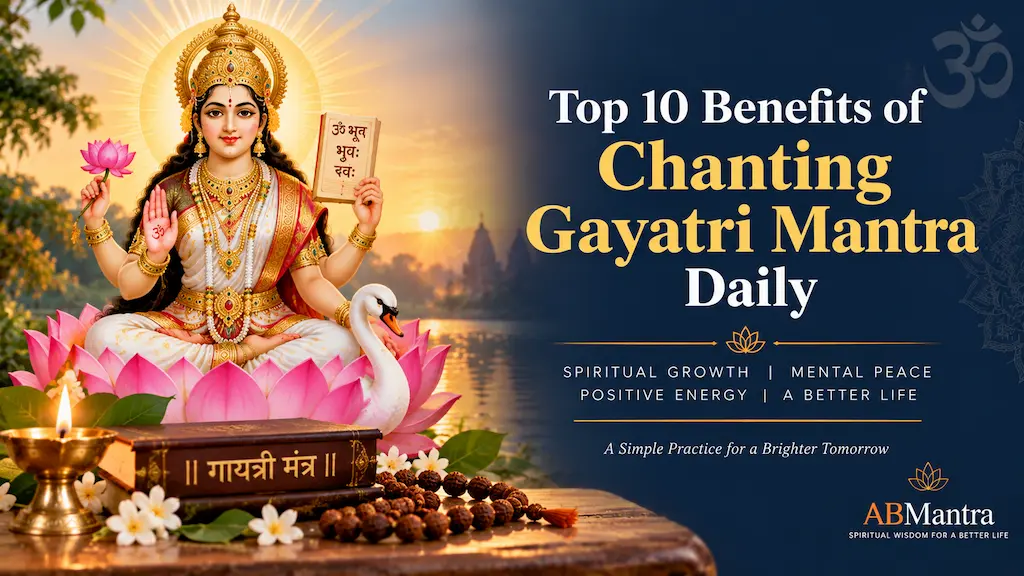

The benefits of chanting the Gayatri Mantra daily do not arrive all at once. They arrive in a sequence – and knowing that sequence is what keeps most practitioners going through the first two weeks, which is when the practice feels the most ordinary and the least rewarding. This guide covers what actually changes when you chant the Gayatri Mantra consistently, week by week, along with the ten specific benefits of chanting Gayatri Mantra daily that the tradition identifies and that consistent practitioners report. It also covers the part of the mantra that almost no benefits article explains: what Bhur Bhuvah Svah means, and why those three words – chanted before the main mantra – determine what the Gayatri is actually asking for.
The Gayatri Mantra: Complete Text and Structure
भर्गो देवस्य धीमहि। धियो यो नः प्रचोदयात्।।
Bhargo Devasya Dhimahi | Dhiyo Yo Nah Prachodayat
Source: Rigveda 3.62.10 – received by Rishi Vishwamitra
Meter: Gayatri – 24 syllables in 3 lines of 8 each
Addressed to: Savitur – not the physical sun (Surya) but the divine illuminating principle
Specific request: Dhi illumination – the clarification of the higher intellect
Daily count: Minimum 3 times at sunrise. Traditional: 108 times. Brahmin Sandhya Vandana: 108 times at each of three Sandhyas (sunrise, midday, sunset).
What Changes in 40 Days: The Week-by-Week Experience
Most benefits articles present the Gayatri’s benefits as static facts. The reality is sequential. The following timeline reflects what consistent daily practitioners – chanting 108 times at sunrise – typically report.
Days 1 to 7 – Novelty and resistance: The practice is new. The mind has not yet formed the habit, so each session requires conscious decision and effort. Attention wanders frequently. Some practitioners experience an unusual emotional release in the first week – old thoughts surfacing, a quality of restlessness, sometimes resistance to sitting. This is not a sign the practice is working incorrectly. It is the first encounter between the mantra’s settling quality and the accumulated mental activity that has not had a settling practice to work against before.
Days 8 to 14 – The plateau: The novelty has worn off. The practice feels ordinary. Nothing dramatic appears to be happening. This is the week most people either abandon the practice or discover something important about it: that the benefit of a mantra practice is not in the feeling of any particular session but in what accumulates across sessions. The session at day 10 may feel flat and distracted. It is still depositing something.
Days 15 to 21 – First consistent shift: Something in the morning quality has changed. Practitioners typically notice this not during the practice itself but after it – in the quality of the first hour of the day. A slight increase in clarity. A sense of being more settled before the day’s activity begins. The shift is subtle enough that some practitioners miss it. The question to ask is not “do I feel the mantra working during chanting?” but “has my relationship with the morning changed?”
Days 22 to 30 – Concentration deepens: The mantra has become familiar. The mind wanders less during the 108 repetitions. The practice begins to feel genuinely nourishing rather than simply disciplined. Sleep quality often improves around this point – a downstream effect of the morning nervous system regulation.
Days 31 to 40 – The mantra arises on its own: Practitioners begin to notice the Gayatri mantra appearing in the mind spontaneously – at traffic signals, before meetings, in moments of stress. This is the sign of what the tradition calls Japa Siddhi establishing itself: the mantra has moved from a conscious practice to an internal resource available without deliberate invocation.
Day 41 and beyond: The practice is established. The most consistent report from long-term Gayatri practitioners: missing a day produces a noticeable gap in the morning quality that missing a day would not have produced at week one. The practice has become something the system expects and misses when absent.
Bhur Bhuvah Svah: What These Three Words Actually Mean
Almost every Gayatri benefits article skips these three words or describes them vaguely as “representing the three worlds.” They are the key to understanding what the Gayatri is asking for and why it is addressed to all three planes simultaneously.
Bhur (भूर्) – the physical world: The earth, the material plane, the body and all its functions. Bhur encompasses everything tangible – what can be seen, touched, measured and experienced through the physical senses. When the Gayatri opens with Bhur, it addresses the divine not only in some abstract spiritual realm but in the very physical world the practitioner inhabits. The benefits of the Gayatri at the Bhur level are physical: health, clarity of the senses, the body’s basic functioning.
Bhuvah (भुवः) – the subtle world: The intermediate space between the physical and the spiritual – the realm of breath, prana, emotion, the subtle body. Bhuvah is where anxiety lives, where creative inspiration arises, where the inner weather of daily life is generated. The Gayatri addresses the divine at this level too, which is why its benefits include emotional stability, stress reduction and creative opening alongside physical health.
Svah (स्वः) – the causal world: The mental and spiritual plane – where thought arises, where karma accumulates, where the individual soul meets the universal consciousness. This is the level at which the Gayatri’s primary request – Dhi illumination – operates. The clarity of the higher intellect is a Svah-level benefit. You cannot think your way to it; you can only align with the source of it.
The Gayatri is the only primary Vedic mantra that opens by addressing all three worlds simultaneously. Its benefits are not confined to one plane. They work on the body (Bhur), the emotions and breath (Bhuvah) and the intellect (Svah) at the same time. This is why it is called the Mother of All Mantras – not because it is the most powerful in a single dimension but because it is the most complete across all dimensions.
Savitur: Why the Gayatri Is Not Addressed to the Sun
This is the distinction most articles miss entirely. The Gayatri Mantra is addressed to Savitur – not to Surya. These are not the same.
Surya is the sun as a physical object. Savitur is the solar generating principle – the divine intelligence that produces the sun’s illuminating, life-sustaining quality. Savitur is from the root Sav (to generate, to create, to bring forth). Savitur is the creator aspect of solar energy – not the sun as we observe it in the sky but the generating force that makes the sun possible and that works through the sun to sustain all life.
This distinction explains why the Gayatri can be chanted at night (despite some misconceptions), why it is said to have been received in the pre-dawn darkness of deep meditation, and why its specific request is for the illumination of the Dhi (intellect) rather than for physical health or material prosperity. You are not asking the sun to make you smarter. You are asking the divine generating principle of illumination to direct its quality toward your higher intelligence. These are different requests.
The Gayatri Mantra is the first mantra I prescribe to almost every client who asks where to begin. Not because it is the most powerful in any specific dimension – there are mantras more specifically targeted for health, for wealth, for protection, for each planetary affliction. The Gayatri is the first prescription because it is the most complete. Its three-level structure (Bhur Bhuvah Svah) means it works on whatever level the practitioner needs most, without requiring the practitioner to diagnose their own need in advance.
The benefit I observe most consistently, across 30 years of prescribing this mantra, is what I would call the quality of morning perception. Clients who maintain 108 repetitions at sunrise for 40 consecutive days report a change in how the morning feels – not dramatically, not suddenly, but gradually and unmistakably. The day starts from a different baseline. There is more clarity before the day’s demands begin. Decisions made in the morning feel cleaner. This is the Dhi illumination at work – not as a mystical event but as a quiet, consistent improvement in the quality of morning awareness.
For Jyotisha clients with a Sun-afflicted chart (Sun debilitated, combust planets, or in difficult houses): the Gayatri has a specific astrological benefit alongside its general spiritual one. The Gayatri addresses Savitur – the solar generating principle – which directly corresponds to the Surya energy in the chart. Consistent Gayatri practice effectively functions as a Surya remedy for Sun-related chart difficulties: issues of confidence, authority, father relationship, career authority and the quality of vitality. For these clients I prescribe the Gayatri alongside any more specific planetary remedy as a foundational practice.
Top 10 Benefits of Chanting Gayatri Mantra Daily
| # | Benefit | Mechanism | Timeline |
|---|---|---|---|
| 1 | Illumination of the intellect (Dhi) | The Prachodayat line specifically asks Savitur to direct its illuminating quality toward the Dhi – the higher discriminating intelligence. This is the Gayatri’s primary and specific benefit, not a side effect. | 21 to 40 days of consistent daily practice |
| 2 | Improved concentration and memory | The rhythmic 24-syllable structure, chanted consistently, trains the mind’s capacity for sustained attention. Memory improvement is a downstream effect of concentration improvement. | 14 to 30 days |
| 3 | Emotional stability and stress reduction | The Bhuvah-level (subtle body) effect of the mantra. Regular chanting regulates the breath through the discipline of consistent rhythmic vocalisation, which directly affects the vagus nerve and the nervous system’s stress response. | 7 to 21 days |
| 4 | Improved sleep quality | A downstream effect of the morning nervous system regulation. Practitioners who maintain the Brahma Muhurta practice consistently report improved sleep onset and quality within 2 to 3 weeks. | 14 to 30 days |
| 5 | Chitta shuddhi – purification of stored impressions | Repeated mantra practice gradually dissolves accumulated negative mental impressions (Samskaras) stored in the Chitta. This manifests as a reduction in repetitive negative thought patterns and emotional reactivity over time. | 30 to 90 days |
| 6 | Creative clarity and inspired thinking | The Bhuvah-level effect: as emotional static reduces, the subtler creative channel becomes accessible. Many writers, artists and problem-solvers report their most productive thinking in the hour following the morning Gayatri practice. | 21 to 40 days |
| 7 | Protection from negative influences | The Gayatri is specifically said to carry a Kavach (protective shield) quality – the divine illumination it invokes creates an energetic clarity around the practitioner that negative influences (Tamasic people, harmful situations, one’s own negative impulses) find less purchase in. | 40 days minimum |
| 8 | Improvement in speech and vocal clarity | The 24-syllable structure, practiced daily with attention to correct pronunciation, strengthens the muscles of the vocal apparatus and the precision of the nervous system’s control of speech. The tradition also holds that the Vak Siddhi (power of the spoken word to manifest) develops through Gayatri practice. | 21 to 40 days |
| 9 | Physical health through breath regulation | Each repetition of the Gayatri Mantra, chanted at a natural pace, produces a specific breathing pattern – a slow, full exhale during chanting followed by a natural inhale. This pranayamic effect directly benefits lung capacity, oxygenation and the autonomic nervous system’s balance. | 7 to 21 days |
| 10 | Spiritual awakening and Dhi-based wisdom | The cumulative effect of daily Dhi illumination across months and years: the practitioner’s relationship with understanding changes. Decisions become clearer. The quality of discernment in daily life – distinguishing what is true from what is merely compelling – improves measurably. | 90 days and beyond |
How to Chant the Gayatri Mantra Daily: Practical Guide
Time: Brahma Muhurta – the 90-minute window before sunrise. The tradition prescribes the Gayatri at three Sandhyas (junctions): sunrise, midday and sunset. For most modern practitioners, sunrise alone is the sustainable starting point.
Direction: Face east at sunrise. The sunrise direction is specific to the Gayatri – you are facing the rising Savitur, the solar principle you are addressing. This is not ceremonial. It is the physical enactment of the mantra’s direction of address.
Count: Minimum 3 times. Accessible daily practice: 108 times (one mala round – approximately 10 to 15 minutes at a natural pace). Traditional full practice: 108 times at sunrise, 32 times at midday, 108 times at sunset.
Mala: Crystal (Sphatik) mala is the traditional choice for Gayatri practice. Rudraksha is also used. Hold the mala in the right hand, moving one bead per repetition with the thumb and middle finger. Do not cross the Meru bead – turn the mala around when you reach it.
Pronunciation: The key sounds to get right: Varenyam (not Varenyum), Dhimahi (the dh is aspirated – dhi as in the start of “dhee”), Prachodayat (Pra-chod-a-yat – four syllables, equal stress). Spend one session listening to a classical recording before establishing your own pace.
- Wikipedia – Gayatri Mantra: Rigveda 3.62.10 as the source, Rishi Vishwamitra as the receiver, the 24-syllable Gayatri meter, Savitur as the addressee, the three Sandhyas as the traditional practice times, Brahma Muhurta
- Wikipedia – Savitur: the Vedic solar deity as the generating/illuminating principle distinct from Surya as the physical sun; Savitur’s specific role as the creator and sustainer of light and life
- Wikipedia – Vyahrti: Bhur, Bhuvah and Svah as the three sacred utterances representing the three planes of existence in the Vedic cosmological system; their role in the Sandhya Vandana ritual
- Japa Yoga by Swami Sivananda – the cumulative effects of consistent daily practice vs occasional intensive practice; the 40-day practice cycle; Chitta shuddhi (purification of stored impressions) as the long-term mechanism of mantra benefits
Gayatri Mantra lyrics and meaning: complete word-by-word guide
When to chant Gayatri Mantra: the three Sandhyas and Brahma Muhurta explained
Can we chant Gayatri Mantra at night: the complete answer
Gayatri Mantra 108 times benefits: why 108 and what one mala round does
Ultimate Guide to Hindu Mantras for Beginners: where to start
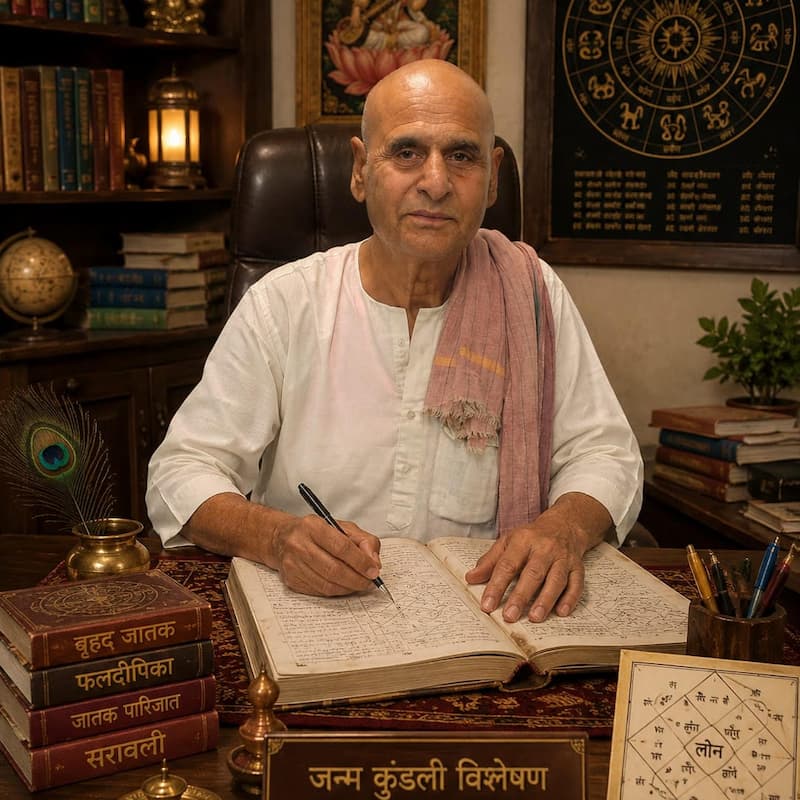
Narendra Kumar Chaubey is a Jyotisha Acharya with over 30 years of experience, based in Bihar and serving clients across India in Vedic astrology, mantra shastra, Vastu and ritual practice.
He completed his formal training at Kameshwar Singh Darbhanga Sanskrit University (KSDSU), one of India’s oldest and most respected institutions for Vedic and Sanskrit scholarship, where he studied Jyotisha shastra, mantra vidya and related classical sciences. KSDSU’s tradition of rigorous Sanskrit education tracing directly to the Mithila region’s centuries-old pandit lineage forms the foundation of his practice.
Over three decades, Narendra Kumar Chaubey has worked with thousands of individuals and families across Bihar and across India, offering guidance in:
- Kundli (birth chart) analysis: Identifying karmic patterns, planetary periods and life path guidance through classical Jyotisha
- Palmistry (Hasta Samudrika): Reading the hand according to the classical Samudrika Shastra tradition
- Vastu Shastra: Assessment and correction of living and working spaces according to directional and elemental principles
- Mantra and Pooja vidhi: Performing and guiding all categories of puja, havan, and mantra sadhana for personal, family and business situations
- Predictive Jyotisha: Transit analysis, muhurta (auspicious timing) selection and remedial guidance
He works across four languages Sanskrit, Hindi, English and Bhojpuri making classical knowledge accessible to practitioners across educational backgrounds and regions.
His writing for ABMantra brings the precision of classical Vedic training to practical mantra guidance: not general advice but specific prescriptions grounded in shastra, lineage and 30 years of direct practice with real situations.
For more info follow on: