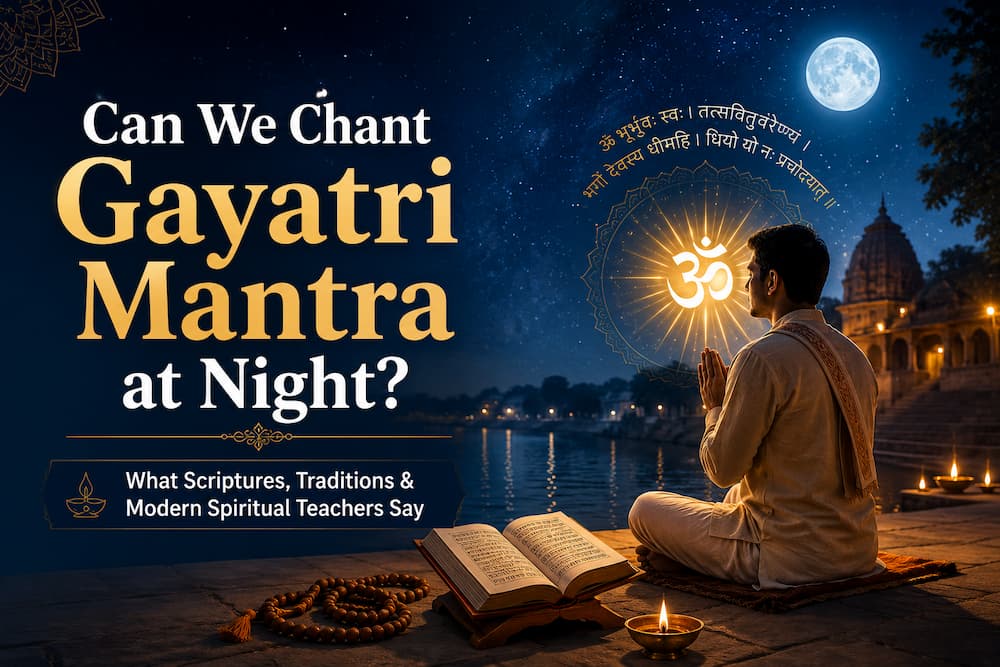

Quick Answer
There is no strict prohibition in Vedic scriptures against chanting the Gayatri Mantra at night. However, the tradition makes a clear distinction between what is prohibited and what is prescribed.
Evening (until sunset): Fully prescribed. The Sayam Sandhya is the third formal chanting window. Chant 64 times facing west at dusk.
After sunset but before 10 PM: Acceptable for personal japa. Not the formal Sandhyavandanam ritual but personal chanting is valid.
After 10 PM: Not prescribed. Outside the mantra’s natural domain but not forbidden.
At midnight: Not recommended. Midnight belongs to Shiva’s Ardha Ratri energy. The Gayatri is a solar mantra and functions optimally in solar hours.
Who This Article Is For
This article is for you if: you work late and can only chant at night and want to know if that is valid | you have been told night chanting of Gayatri is forbidden and want to verify that | you missed your morning practice and want to know if you can chant before bed.
Already published: When to chant Gayatri Mantra: the 3 Sandhyas and best time guide covers the three prescribed windows in detail.
If you have been told you cannot chant the Gayatri Mantra at night, you were given a partial answer. The complete answer requires understanding a distinction the tradition makes precisely: the difference between what is prohibited and what is simply not prescribed. These are not the same thing, and confusing them has led to a great deal of unnecessary anxiety about one of the simplest mantra practices in the Vedic tradition.
The Key Distinction: Prohibited vs Not Prescribed
Most articles on this topic give a yes or no answer. The actual answer from the tradition is more precise than either.
The Gayatri Mantra has three formally prescribed chanting windows called the Sandhyas: Brahma Muhurta at dawn, Madhyahnika at noon, and Sayam Sandhya at dusk. The classical texts specify these windows clearly. What they do not do is explicitly prohibit chanting at other times for personal japa.
| Time | Status | Traditional basis |
|---|---|---|
| Brahma Muhurta (4:00 to 5:30 AM) | Prescribed: highest priority | Chandogya Upanishad 2.24.1, Dharmasindhu: pratha Sandhya, the most powerful window |
| Noon (11:45 AM to 12:15 PM) | Prescribed: second Sandhya | Madhyahnika, the midday Sandhya. 32 repetitions in the formal ritual |
| Dusk (exact sunset) | Prescribed: third Sandhya | Sayam Sandhya. 64 repetitions, facing west. Fully valid evening practice |
| Evening before 10 PM | Acceptable for personal japa | No scriptural prohibition. Outside the formal Sandhya windows but valid personal practice |
| After 10 PM | Not prescribed | The classical texts do not assign this window to the Gayatri. Not forbidden, but not the mantra’s optimal domain |
| Midnight | Not recommended | Midnight is Ardha Ratri, associated with Shiva and Kali. The Gayatri is a solar mantra addressed to Savitr |
Why the Gayatri Mantra Is Called a Solar Mantra: and What That Means at Night
Here is what most articles on this topic miss entirely — and it is the key to understanding the night chanting question.
The Gayatri Mantra is addressed to Savitr, not Surya. Both are solar deities, but they are distinct. Before the sunrise, the sun is called Savitr. After sunset it is called Surya.
Savitr vs Surya: The Distinction That Answers the Night Question
Savitr is the pre-sunrise form of the sun deity: the divine light that exists in potential before the sun appears on the horizon. It represents intelligence, wisdom and the power that illuminates the mind. The Gayatri Mantra is addressed to Savitr specifically.
Surya is the sun as it appears after sunrise: visible, active, fully manifest.
This is why the Gayatri Mantra is most powerfully chanted before and at sunrise: it is addressed to Savitr, whose primary domain is the dawn transition. The Sayam Sandhya (dusk) is valid because it is a solar transition moment. Deep night is outside both Savitr’s primary domain and the Sandhya transitions.
This does not prohibit night chanting. It explains why night is outside the mantra’s optimal energetic alignment.
The Sayam Sandhya: Why Evening Is Fully Valid
The Sayam Sandhya (the evening Sandhya) is performed at dusk, at the exact moment of sunset. It is a fully prescribed chanting window, not a compromise. The Dharmasindhu specifies 64 repetitions facing west, performed at the transition between day and night.
The Sayam Sandhya Practice
Time: At exact sunset (check local sunrise/sunset times)
Direction: Face west
Count: 64 repetitions (traditional) or 108 repetitions (modern practice)
Preparation: Wash hands and face if possible. Sit quietly for one minute before beginning.
Validity: Fully prescribed in the Dharmasindhu and classical Sandhyavandanam texts. This is not a compromise. It is the third formal Sandhya.
The Formal Ritual vs Personal Japa: An Important Distinction
The night chanting question also depends on what kind of practice you are asking about.
The formal Sandhyavandanam ritual has strict time windows and cannot be performed at night. The Sayam Sandhya has a sunset cutoff after which the formal ritual is considered incomplete.
Personal japa, meaning simply sitting and chanting the Gayatri Mantra with a mala, is a different category of practice. Satyananda Yoga, citing classical sources, states: “Ritualistic chanting has stricter rules. The transition times of the day are recommended.” The word recommended for personal japa confirms that the two categories are treated differently.
| Type of practice | Night chanting valid? | Classical basis |
|---|---|---|
| Formal Sandhyavandanam ritual | No: the ritual has a sunset cutoff | Dharmasindhu: the formal ritual must be performed at the Sandhya moment |
| Personal japa with mala | Evening yes, late night not prescribed but not prohibited | Satyananda Yoga citing classical sources: personal practice has fewer restrictions |
| Mental chanting (mansik japa) | Yes at any time | Vaishnava Chintamani: mental practice has no time restriction |
| Listening to recorded Gayatri | Yes at any time | Listening is not formal recitation and carries no formal restrictions |
What to Do If You Can Only Chant at Night
Life does not always allow Brahma Muhurta practice. Night shifts, infant care, illness, travel: these are real situations. The Kanchi Paramacharya stated that even chanting 10 times at the nearest available Sandhya window is the minimum the tradition asks.
| Your situation | What to do | Why it works |
|---|---|---|
| Night shift worker, sleep at 7 AM | Chant at your personal dawn: the quiet period before you sleep | Your biological rhythm is inverted. The tradition responds to sincere intention and rhythm, not only clock time |
| Cannot chant before 10 PM due to work or family | Chant between sunset and 10 PM. Even 11 repetitions is the valid minimum | This falls within the acceptable personal japa window. Consistent practice at a fixed time is more valuable than irregular practice at the ideal time |
| Missed all three Sandhyas and it is now midnight | Chant 11 times with sincere intention and go to sleep | The tradition’s crisis minimum applies. Do not skip the day entirely because you missed the ideal window |
| 40-day sadhana, missed the morning, it is now 11 PM | Chant the full count tonight at whatever time is available | Missing a day of a 40-day sadhana requires restarting. Chanting late to preserve the count is preferable to breaking continuity |
The Principle Behind the Flexibility
Daivya Chakra (September 2024): “There is no strict prohibition in the Vedic scriptures against chanting the Gayatri Mantra at night. The mantra’s power and effect transcend the time of day, as it is fundamentally a prayer for enlightenment and wisdom, which are needed at all times.”
This reflects a genuine thread in classical Vedic thinking: the prescription of optimal times does not create a prohibition of other times. It creates a hierarchy of effectiveness, not a binary of permitted and forbidden.
From Our Practice
From Our Practice
During a period of sustained travel for client consultations across different states, my morning practice became genuinely irregular. Reaching new cities at odd hours, adjusting to different households — the quiet before-dawn window I had maintained for years was frequently unavailable.
I moved my Gayatri practice to 9:30 PM on those nights, after the day’s work was done.
I noticed the quality of the practice was different at that hour: quieter, more inward, less expansive than the dawn practice I was used to. The Gayatri at dawn feels like opening a window. At night it feels more like lighting a lamp in a closed room.
Both are real. Both are valid. The dawn practice is more powerful. The night practice is what was available. And a practice maintained imperfectly is worth more than a perfect practice that has been abandoned.
Frequently Asked Questions
❓ I work until 11 PM and cannot chant in the morning. Is my Gayatri practice pointless?
No. Chant at 11 PM with full sincerity. The tradition’s hierarchy places dawn above evening and evening above night for optimal effectiveness. But it does not place night practice below no practice. An 11 PM Gayatri chant maintained every day for 40 days will produce genuine results. The consistency matters more than the clock time for personal japa.
❓ My grandmother says chanting Gayatri after dark invites negative energy. Is that true?
This belief exists in some regional traditions but it is not found in the core Vedic texts. The Gayatri Mantra is a protective solar mantra. The concern about night and negative energy in the broader tradition relates to certain Tantric and Shaiva practices performed at midnight, not to the Gayatri specifically. Chanting the Gayatri at 9 or 10 PM does not invite negative energy.
❓ Can I listen to Gayatri Mantra recordings at night while falling asleep?
Yes. Listening to a Gayatri Mantra recording is not the same as formal recitation and does not carry the same time restrictions. The vibration of the mantra in the room has a beneficial effect on the sleeping environment. This is distinct from the question of personal recitation, which has the guidelines described in this article.
❓ I was doing a 40-day Gayatri sadhana and missed today’s morning practice. It is now midnight. Should I chant or skip today?
Chant. A gap in a 40-day sadhana requires restarting from Day 1. If you can preserve the continuity by chanting at midnight, do so. The spirit of a 40-day commitment is daily consistency. A midnight recitation to maintain that continuity is within the tradition’s understanding of sincere effort. Resume the morning practice from tomorrow.
❓ Is the evening Gayatri chant as effective as the morning one?
No, but significantly more effective than no practice. The dawn Brahma Muhurta window is the most powerful because the atmospheric sattvic quality, the neural freshness and the alignment with Savitr’s primary domain all converge at that hour. The Sayam Sandhya (dusk) is the second most auspicious window. Evening after dark is valid personal practice but outside the peak windows.
❓ Can women chant the Gayatri Mantra at night?
Yes. The night chanting guidelines apply equally to all practitioners. For personal japa the same time guidance applies regardless of gender. See our dedicated article: Can women chant Gayatri Mantra?
Begin Tonight If That Is What You Have
If tonight is the only time available to you, sit down, close your eyes and chant.
The Gayatri Mantra
Om Bhur Bhuvah Swah
Tat Savitur Varenyam
Bhargo Devasya Dheemahi
Dhiyo Yo Nah Prachodayat
ॐ भूर्भुवः स्वः तत्सवितुर्वरेण्यम्
भर्गो देवस्य धीमहि धियो यो नः प्रचोदयात्
Meaning: We meditate on the divine light of Savitr who has created the universe. May that divine light illuminate our intellect.
Chant 11 times tonight. Set an alarm for one hour before sunrise tomorrow. That is your next step: not abandoning the night practice, but adding the morning practice alongside it.
The mantra is a prayer for light. It does not stop being that prayer when the sun is below the horizon. The sun does not disappear at night. It changes its relationship to your horizon. The mantra follows the same logic.
Sources and Citations
- Can Gayatri Mantra Be Chanted at Night? Daivya Chakra, September 2024
- Gayatri Mantra: Meaning, Benefits and Chanting Rules. Satyananda Yoga, November 2025
- Gayatri Mantra significance and Savitr. Nepal Yoga Home
- Gayatri Mantra chanting rules. Vedic Sources, May 2022
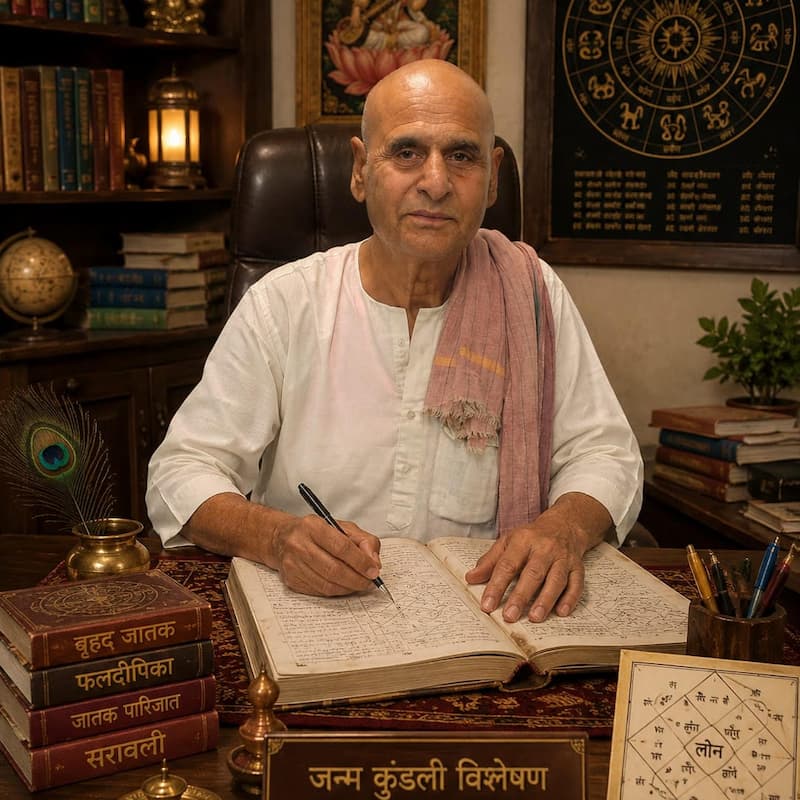
Narendra Kumar Chaubey is a Jyotisha Acharya with over 30 years of experience, based in Bihar and serving clients across India in Vedic astrology, mantra shastra, Vastu and ritual practice.
He completed his formal training at Kameshwar Singh Darbhanga Sanskrit University (KSDSU), one of India’s oldest and most respected institutions for Vedic and Sanskrit scholarship, where he studied Jyotisha shastra, mantra vidya and related classical sciences. KSDSU’s tradition of rigorous Sanskrit education tracing directly to the Mithila region’s centuries-old pandit lineage forms the foundation of his practice.
Over three decades, Narendra Kumar Chaubey has worked with thousands of individuals and families across Bihar and across India, offering guidance in:
- Kundli (birth chart) analysis: Identifying karmic patterns, planetary periods and life path guidance through classical Jyotisha
- Palmistry (Hasta Samudrika): Reading the hand according to the classical Samudrika Shastra tradition
- Vastu Shastra: Assessment and correction of living and working spaces according to directional and elemental principles
- Mantra and Pooja vidhi: Performing and guiding all categories of puja, havan, and mantra sadhana for personal, family and business situations
- Predictive Jyotisha: Transit analysis, muhurta (auspicious timing) selection and remedial guidance
He works across four languages Sanskrit, Hindi, English and Bhojpuri making classical knowledge accessible to practitioners across educational backgrounds and regions.
His writing for ABMantra brings the precision of classical Vedic training to practical mantra guidance: not general advice but specific prescriptions grounded in shastra, lineage and 30 years of direct practice with real situations.
For more info follow on: