
|
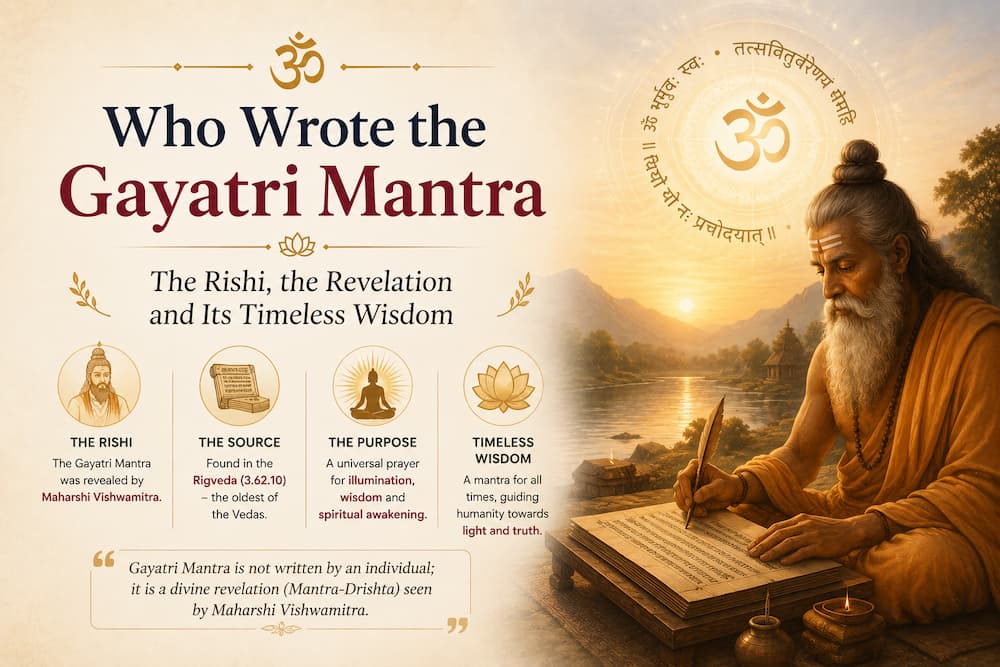
Quick Answer The Gayatri Mantra was composed by sage Vishwamitra. It appears in the Rigveda, Mandala 3, Hymn 62, Verse 10 : written as RV 3.62.10 in academic notation. Vishwamitra composed most of the 62 hymns in Mandala 3 of the Rigveda, composed between 1500 and 1000 BCE. He is one of the Saptarishis, the seven great sages of ancient India. However, there is an important distinction that most articles miss: in the Vedic tradition, Vishwamitra is technically called the Mantra Drashta (seer of the mantra) rather than its author. The tradition holds that the mantra existed as a cosmic truth before Vishwamitra perceived it. |
|
Who This Article Is For This article is for you if: you want the factual answer with the actual Rigveda reference, not just a name | you have heard both that Vishwamitra wrote it and that no one wrote it and want to understand the difference | you want to know the story behind how the mantra came to be. Also see: Gayatri Mantra complete guide: lyrics, meaning and how to chant |
If you have been searching who wrote the Gayatri Mantra and found different answers on different sites, that confusion has a real cause. The answer depends on whether you are asking a historical question or a philosophical one. This article gives you both answers, clearly separated, with the actual Rigveda reference so you can verify it yourself.
Who Wrote the Gayatri Mantra: The Historical Answer |
The Gayatri Mantra is attributed to the brahmarshi (royal sage turned great sage) Vishwamitra. This attribution is consistent across Wikipedia, academic Vedic scholarship, and all mainstream Hindu traditions.
The mantra appears in the Rigveda, Mandala 3, Hymn 62, Verse 10 : written in academic notation as RV 3.62.10. Mandala 3 is one of the eight family books of the Rigveda, the oldest core of the text, composed between approximately 1500 and 1000 BCE. Vishwamitra is considered the chief author of the entire third Mandala, not just the Gayatri verse.
Who Was Vishwamitra? Why He Matters |
Vishwamitra’s life is one of the most dramatic transformation stories in all of Sanskrit literature. He was born a Kshatriya king : Rajarshi Vishwamitra : ruling a prosperous kingdom. After a conflict with the sage Vasishtha (the principal author of Rigveda Mandala 7), he renounced his kingdom and undertook intense tapasya (austerity) to become a Brahmarshi.
The journey from king to Brahmarshi is the context for the Gayatri Mantra. It was during Vishwamitra’s period of extreme penance that he perceived the Gayatri verse. The mantra is not the work of a comfortable scholar : it is the perception of someone who had given up everything to attain the highest level of spiritual realisation.
|
What Most Articles Miss About Vishwamitra The Puranas record that only 24 rishis in all of history have understood the complete power of the Gayatri Mantra. Vishwamitra is described as the first of those 24. Yajnavalkya, the great sage of the Brihadaranyaka Upanishad, is described as the last. This is why Vishwamitra’s name means what it means: Vishwa (universe) + Mitra (friend). He is called the friend of the entire universe because the mantra he perceived is available to all of humanity, not to any single lineage or tradition. |
Mantra Drashta vs Author: The Important Distinction |
Here is what creates the confusion you may have encountered: in the Vedic tradition, the rishis are not called the authors of the mantras. They are called Mantra Drashtas : seers of the mantra.
The distinction matters philosophically. The Vedic tradition holds that the mantras are apaurusheya : not of human origin. They are eternal vibrations that exist as cosmic truths independent of any person. The rishis did not create them. They perceived them during states of deep meditation and gave them form in human language.
So the complete answer is: Vishwamitra is the Mantra Drashta of the Gayatri Mantra : the sage who first perceived and transmitted it. He is also the attributed author of Mandala 3 of the Rigveda, where the verse is recorded. Both statements are accurate. The first is the traditional answer. The second is the historical-textual answer.
The Gayatri Meter: Why the Mantra Has This Name |
The mantra is called the Gayatri Mantra not only because of its spiritual significance but because of its poetic structure. It is composed in the Gayatri Chandas (Gayatri meter) : a Sanskrit poetic form with 24 syllables arranged in three lines of 8 syllables each.
The word Gayatri itself comes from two Sanskrit roots: gai (to sing) and trai (to protect). The name means: that which protects the one who sings it.
|
An Important Detail Almost No Article Mentions There are thousands of mantras composed in the Gayatri meter. Each deity in the Hindu tradition has its own Gayatri mantra : the Ganesha Gayatri, the Shiva Gayatri, the Lakshmi Gayatri, the Saraswati Gayatri, and so on. When we say the Gayatri Mantra without qualification, we mean specifically RV 3.62.10 : Vishwamitra’s verse dedicated to Savitr. All other Gayatri mantras take the same meter but address different deities. This distinction matters when you are searching for a specific Gayatri mantra. The one attributed to Vishwamitra and dedicated to Savitr is the original and most sacred form. |
Where the Gayatri Mantra Appears: All Three Texts |
The Gayatri Mantra is not exclusive to the Rigveda. It appears in all three major Vedas, each version slightly different in its framing:
The version most people chant today : Om bhur bhuvah svah, tat savitur varenyam, bhargo devasya dhimahi, dhiyo yo nah prachodayat : combines elements from all three texts. The core verse (tat savitur varenyam onwards) is Vishwamitra’s original. The Om and the Mahavyahritis were added later as part of the Sandhyavandanam ritual structure.
From Our Practice |
|
From Our Practice The first time I read that Vishwamitra was a king before he was a sage, something in how I understood the mantra shifted. A king who gave up a kingdom to sit in austerity for years until he could perceive this verse : that is not the biography of a scholar writing a prayer. It is the biography of someone who paid the highest possible price for what the mantra contains. I now always share this context with people who are beginning a Gayatri practice. The mantra is not a formula that was written down one afternoon. It is a perception that cost its seer everything he had. Chanting it with that understanding changes the quality of the chanting. |
Frequently Asked Questions |
Begin Your Gayatri Practice With This Understanding |
The next time you chant the Gayatri Mantra, you are chanting a verse that a king renounced his kingdom to perceive. Vishwamitra sat in austerity for years : facing obstacles, setbacks, and failures : until he attained the state in which he could receive this particular vibration and give it form in human language.
That context is not mythology to set aside before the real practice begins. It is part of the practice. The mantra carries the weight of what it cost to be seen.
Chant it with that knowledge and see whether the quality of the silence after the 108th repetition feels different.
|
Sources and Citations
|
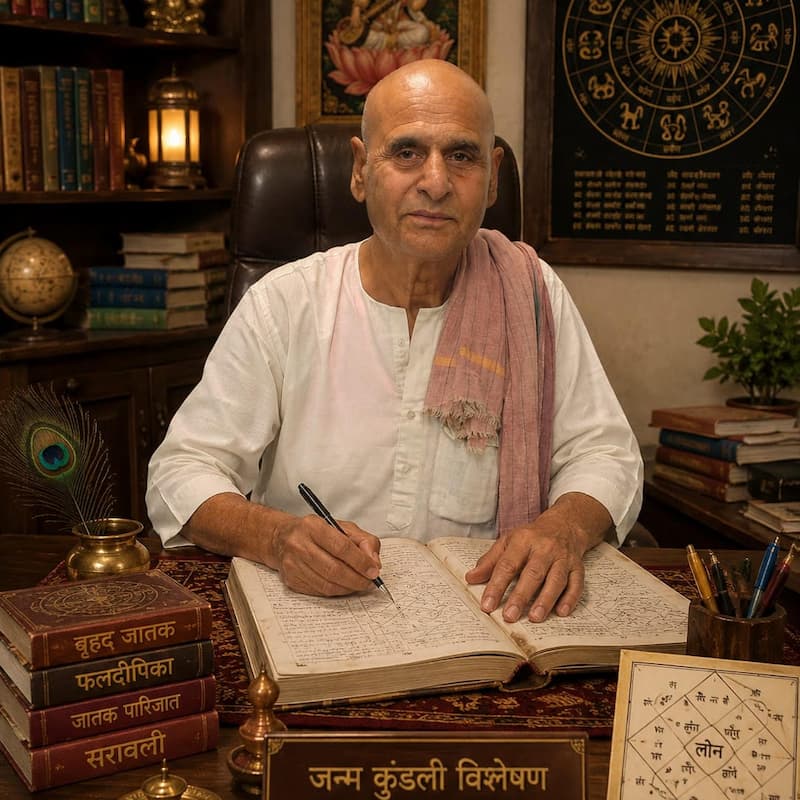
Narendra Kumar Chaubey is a Jyotisha Acharya with over 30 years of experience, based in Bihar and serving clients across India in Vedic astrology, mantra shastra, Vastu and ritual practice.
He completed his formal training at Kameshwar Singh Darbhanga Sanskrit University (KSDSU), one of India’s oldest and most respected institutions for Vedic and Sanskrit scholarship, where he studied Jyotisha shastra, mantra vidya and related classical sciences. KSDSU’s tradition of rigorous Sanskrit education tracing directly to the Mithila region’s centuries-old pandit lineage forms the foundation of his practice.
Over three decades, Narendra Kumar Chaubey has worked with thousands of individuals and families across Bihar and across India, offering guidance in:
- Kundli (birth chart) analysis: Identifying karmic patterns, planetary periods and life path guidance through classical Jyotisha
- Palmistry (Hasta Samudrika): Reading the hand according to the classical Samudrika Shastra tradition
- Vastu Shastra: Assessment and correction of living and working spaces according to directional and elemental principles
- Mantra and Pooja vidhi: Performing and guiding all categories of puja, havan, and mantra sadhana for personal, family and business situations
- Predictive Jyotisha: Transit analysis, muhurta (auspicious timing) selection and remedial guidance
He works across four languages Sanskrit, Hindi, English and Bhojpuri making classical knowledge accessible to practitioners across educational backgrounds and regions.
His writing for ABMantra brings the precision of classical Vedic training to practical mantra guidance: not general advice but specific prescriptions grounded in shastra, lineage and 30 years of direct practice with real situations.
For more info follow on: