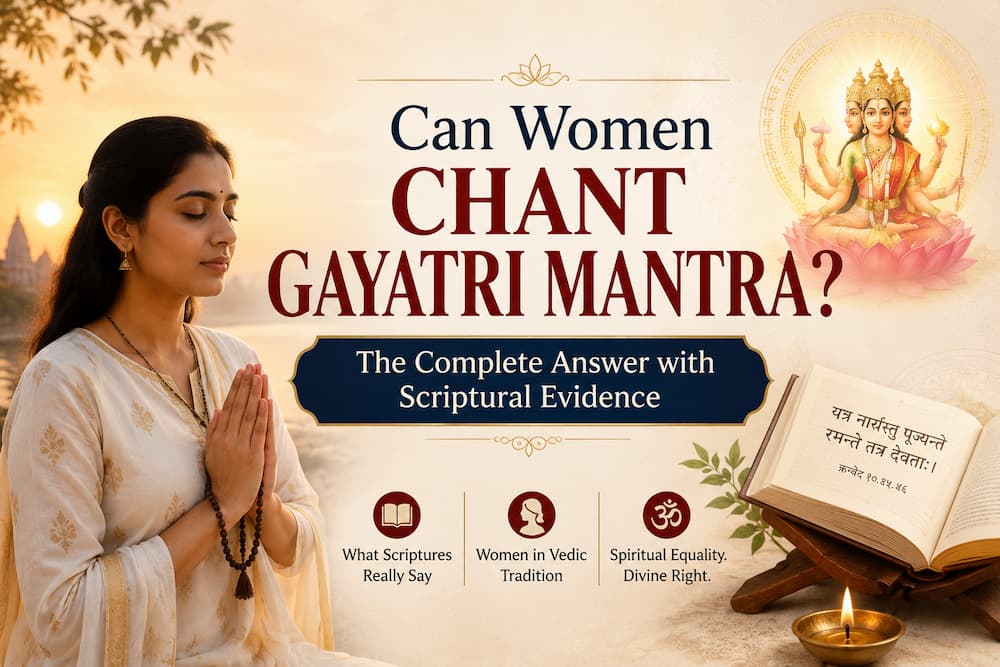

| Yes, women can chant Gayatri Mantra. Vedic scriptures including the Āśvalāyana Gṛhya Sūtra, Kāṭhaka Gṛhya Sūtra and Śatapatha Brāhmaṇa all contain specific instructions for women chanting Vedic mantras. The restriction on women is a medieval-era social development, not a Vedic injunction. Multiple classical authorities, including Sri Sri Ravi Shankar, the Gayatri Pariwar and the Brahma Kumaris, have confirmed this and reinstated women’s right to Gayatri practice. |
This is one of the most searched questions about the Gayatri Mantra and one with the most misleading answers online. If you search for it right now, you will find articles claiming women must never chant the Gayatri Mantra, citing fears of facial hair, hormonal changes and infertility. You will also find authoritative teachers flatly contradicting these claims with scriptural evidence. This article presents both positions honestly and gives you the evidence to decide for yourself.
What the Vedic Scriptures Actually Say About Women and Gayatri Mantra
The argument that women cannot chant the Gayatri Mantra is based primarily on the link between Gayatri practice and the sacred thread ceremony (Yajñopavīta/Janeu) which was, in later periods, restricted to men of the three upper varnas. The reasoning was: no sacred thread, no right to Vedic mantras.
This reasoning collapses when you look at the earlier texts.
Scriptural Evidence FOR Women Chanting
• Āśvalāyana Gṛhya Sūtra 1/1/9: In the absence of the yajman (the one performing the yajna), his wife, son or unmarried daughter could perform the Yajna. If women could perform a fire ritual, they could certainly chant the mantra that accompanies it.
• Śatapatha Brāhmaṇa 1/9/2/21-23: Specific directions are given to women about pronouncing Yajurveda mantras 23, 25, 27 and 29. A text that gives women specific mantra pronunciation instructions is not a text that bans women from mantras.
• Kāṭhaka Gṛhya Sūtra 3/1/30: Women are directed to study and chant Vedic mantras and perform Vedic rituals.
• Laugākṣī Gṛhya Sūtra 25: Same propounds study and chanting of Vedic mantras by women.
• Śaṅkara Digvijaya 3/16: Records that Bharati Devi was well-versed in all the Vedas and other scriptures. She debated with Shankaracharya as an equal. The text asks: how can a ban be imposed on women’s scriptural study if such women existed?
Sources: Āśvalāyana Gṛhya Sūtra 1/1/9; Kāṭhaka Gṛhya Sūtra 3/1/30 and 26/3; Laugākṣī Gṛhya Sūtra 25; Śatapatha Brāhmaṇa 1/9/2/21-23; Śaṅkara Digvijaya 3/16. References compiled from Bilaspur Swamiji’s classical commentary on Gayatri practice.
Where Did the Restriction Come From?
The restriction on women chanting the Gayatri Mantra developed gradually during the medieval period roughly from the 8th to 16th centuries CE as caste and gender hierarchies became more rigid across Indian society. The sacred thread ceremony, which had originally included women in some traditions, became increasingly male-only. Since Gayatri practice was tied to the thread ceremony, women’s access to it was progressively restricted.
Sri Sri Ravi Shankar has spoken about this in his teachings the restriction emerged from a social desire to keep spiritual power, including healing and sankalpa shakti, within a male-controlled domain. There is no Vedic verse that mandates it.
Source: Sri Sri Ravi Shankar, Wisdom.srisriravishankar.org on women and the Gayatri Mantra.
What About the Claim That Gayatri Mantra Causes Physical Changes in Women?
Some sources claim that women who chant the Gayatri Mantra will develop facial hair, experience menstrual irregularities or become infertile because the mantra activates the Muladhara, Swadhisthana and Manipura chakras in ways that affect female physiology.
This claim should be evaluated carefully. Here is what the evidence actually shows:
• No clinical study has ever documented facial hair growth or hormonal changes caused by mantra chanting in women.
• The Gayatri Mantra is a prayer for illuminated intellect Om Bhur Bhuvah Swaha, Tat Savitur Varenyam, Bhargo Devasya Dhimahi, Dhiyo Yo Nah Prachodayat. Its stated effect is clarity of mind and good thoughts. It does not target any gland or reproductive system.
• Millions of women have chanted the Gayatri Mantra for decades in the Brahma Kumaris tradition, in the Gayatri Pariwar founded by Pandit Shriram Sharma Acharya in 1953, and in homes across India without any reported physiological side effects.
• The same mantra is chanted by men who are also claimed to have these same chakras. If the mantra affected these chakras, the effects would apply to men too which no one claims.
The physiological claim appears to be a post-hoc rationalisation for a social restriction rather than a genuine observation or scriptural teaching.
From our practice: We have been chanting the Gayatri Mantra daily since 2014 108 times at sunrise every morning. We began this practice after studying the scriptural evidence described above and deciding that the medieval restriction was not binding on us. In 12 years of daily practice, we have not experienced any negative physiological effects. We have experienced exactly what the mantra promises: greater clarity of thought and better quality of decisions in situations where clarity mattered.
The Practical Rules for Women’s Gayatri Mantra Practice
The classical tradition does offer practical guidance for women’s Gayatri practice that most teachers including those who fully support women’s right to chant accept as reasonable.
| Rule | What It Means and Why |
| Daily practice | Women can chant the Gayatri Mantra every day, at the same times as men Brahma Muhurta, sunrise, noon or sunset. 108 repetitions at sunrise is the standard daily practice. No restriction applies to regular daily chanting. |
| During menstruation | The traditional guidance from classical commentators: pause formal sadhana (anushthan, 40-day vow) during menstruation and resume after bathing when the period ends. For regular daily practice, different teachers take different positions. Many modern teachers say there is no bar at any time. |
| Pregnancy | Gentle chanting is considered beneficial during pregnancy by most teachers. The Gayatri Mantra is a prayer for illuminated intellect asking for clarity, good thoughts and divine light. These are qualities that benefit both mother and child. No classical text prohibits chanting during pregnancy. |
| No sacred thread required | Women do not need to have undergone any ceremony or wear any sacred thread to chant the Gayatri Mantra. The mantra’s power is available to any sincere practitioner, regardless of gender or ritual status. |
| Time of day | The Gayatri Mantra is associated with the Sun and is most powerful at sunrise. Any morning time before noon is appropriate. Noon and sunset are secondary times. Night chanting is traditionally not recommended for this mantra specifically but is accepted if morning practice is genuinely impossible. |
For the complete Gayatri Mantra with Sanskrit, transliteration, word-by-word meaning and benefits, see the Gayatri Mantra article on abmantra.com.
Modern Teachers Who Confirm Women Can Chant Gayatri Mantra
The question is not academically unsettled. Multiple major modern teachers and organisations have confirmed with scriptural backing that women can and should chant the Gayatri Mantra:
• Sri Sri Ravi Shankar (Art of Living): Nowhere it is said that women cannot chant. It is unfortunate that somewhere in the middle ages these rights of women were taken away. We have reinstated this in the Ashram.
• Pandit Shriram Sharma Acharya (Gayatri Pariwar, founded 1953): Built the entire Gayatri Pariwar movement on the principle that the Gayatri Mantra belongs to all humanity, with women’s practice specifically restored. The movement today has millions of women practitioners across India.
• Brahma Kumaris: Teach Gayatri Mantra to women as standard spiritual education.
• Bilaspur Swamiji’s classical commentary: Unmarried women or widows can conveniently perform Gayatri Sadhana like men.
The counterpoint teachers who maintain the restriction generally base it on adherence to post-Vedic social tradition rather than on any specific Vedic injunction. When pressed for the actual Vedic verse that prohibits women from chanting, it cannot be produced because it does not exist.
Frequently Asked Questions
Can women chant Gayatri Mantra during periods?
The traditional guidance is to pause formal Gayatri Mantra sadhana during menstruation and resume after bathing on the day it ends. This applies specifically to structured sadhana (a committed 40-day or anushthan vow practice). For daily personal chanting, many modern teachers including Sri Sri Ravi Shankar and the Gayatri Pariwar say there is no bar at any time. The traditional reasoning is not about “impurity” in any moral or social sense a framing that causes understandable discomfort and resistance today. The Vedic understanding is physiological and energetic: menstruation is a period of intense pranic activity and inward-directed energy in the body. The Vedic tradition advises against directing that energy outward into formal ritual or mantra vow structures not because the woman is somehow lesser or impure, but because the body’s energy is already fully engaged. Maintaining a committed outward sadhana during this time is considered to create an energetic conflict, not a moral failing. This is the same principle that advises against intensive fasting or vigorous physical practice during menstruation. Rest and restoration are the prescription not exclusion. The Bilaspur Swamiji’s text states: chanting may be suspended during this period and resumed after bathing on expiry. This is a timing guidance, not a permanent restriction.
Can unmarried girls chant Gayatri Mantra?
Yes. The Bilaspur Swamiji’s classical commentary states explicitly: unmarried women can conveniently perform Gayatri Sadhana like men. There is no scriptural bar on unmarried women chanting this mantra. Many girls begin learning and chanting the Gayatri Mantra from childhood, and the Brahma Kumaris and Gayatri Pariwar actively teach it to young girls as a foundation of spiritual education.
Does chanting Gayatri Mantra cause facial hair or hormonal changes in women?
No. This claim appears in some medieval-era texts and has been repeated without examination for centuries. There is no clinical evidence, no mechanism and no logic by which chanting a Sanskrit mantra would cause hormonal changes. The claim was likely generated to justify a social restriction not the other way around. Sri Sri Ravi Shankar addresses this directly: men thought that if women chant Gayatri Mantra, it would bring them healing power and sankalpa shakti which men preferred to keep for themselves. The restriction was social, not scriptural or physiological.
What time should women chant Gayatri Mantra?
The same times as anyone else: Brahma Muhurta (approximately 4:35 to 5:23 AM), sunrise, noon and sunset are the four traditional times. Among these, sunrise is the most widely practised for daily sadhana. The Gayatri Mantra is specifically a prayer to the solar light facing east at sunrise while chanting aligns the practice with its natural source of power. 108 repetitions at sunrise is the standard daily practice.
Can women do Gayatri Mantra jaap at night?
Traditional guidance does not recommend Gayatri Mantra jaap at night because the mantra is specifically associated with the Sun and solar energy which is absent at night. Sunrise is the primary time, sunset the secondary. If a woman can only practise at night due to her schedule, many teachers say sincerity matters more than timing and the practice is still valid. But for maximum effectiveness, any morning time before noon is better than night.
Which Gayatri Mantra is specifically recommended for women?
There is no separate Gayatri Mantra for women the Vedic Gayatri Mantra (Om Bhur Bhuvah Swaha, Tat Savitur Varenyam, Bhargo Devasya Dhimahi, Dhiyo Yo Nah Prachodayat) is the same for all practitioners. Women chant the same mantra in the same way as men. The Goddess Gayatri herself is feminine she is the presiding deity of the mantra. There is a long tradition of women being deeply devoted to Gayatri as both a mantra and a goddess.
Do women need initiation to chant Gayatri Mantra?
No formal initiation from a Guru is required for women or men to chant the Gayatri Mantra. It is freely available to all. That said, learning it from a knowledgeable teacher even informally ensures correct pronunciation, which matters for this mantra because its three vyahritis (Bhur, Bhuvah, Swaha) and the main verse each carry specific meaning and vibration. The Gayatri Pariwar has taught the mantra to millions of women across India since 1953 without requiring any formal initiation beyond learning the correct pronunciation.
Conclusion
The answer is yes. Women can chant the Gayatri Mantra. The Vedic scriptures support it. The classical Grahya Sutras support it. The strongest modern teachers support it. The millions of women who have practised it without adverse effects confirm it.
The restriction is medieval, not Vedic. Following a medieval social convention over the Vedic evidence itself is a choice but it should be a fully informed choice, not one made because the internet told you that facial hair is a risk.
If you are a woman who has been wanting to begin Gayatri Mantra practice and this question was what stopped you it need not stop you. Sit facing east tomorrow at sunrise. Chant 11 times to start. The rest will follow.
For the mantra meaning pillar covering all types and how mantras work, see the Mantra Meaning, Types and Benefits article.
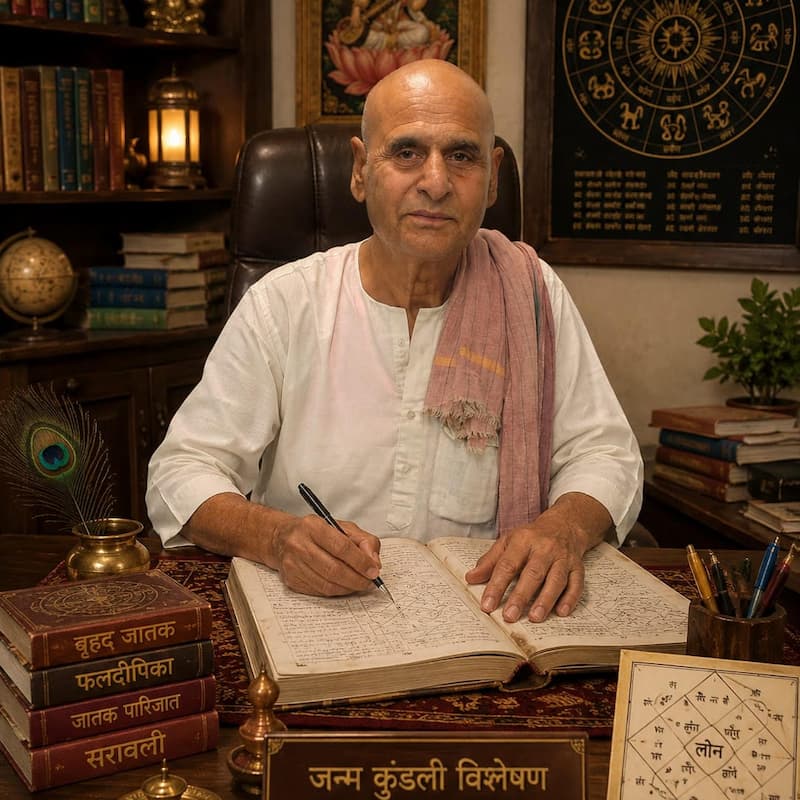
Narendra Kumar Chaubey is a Jyotisha Acharya with over 30 years of experience, based in Bihar and serving clients across India in Vedic astrology, mantra shastra, Vastu and ritual practice.
He completed his formal training at Kameshwar Singh Darbhanga Sanskrit University (KSDSU), one of India’s oldest and most respected institutions for Vedic and Sanskrit scholarship, where he studied Jyotisha shastra, mantra vidya and related classical sciences. KSDSU’s tradition of rigorous Sanskrit education tracing directly to the Mithila region’s centuries-old pandit lineage forms the foundation of his practice.
Over three decades, Narendra Kumar Chaubey has worked with thousands of individuals and families across Bihar and across India, offering guidance in:
- Kundli (birth chart) analysis: Identifying karmic patterns, planetary periods and life path guidance through classical Jyotisha
- Palmistry (Hasta Samudrika): Reading the hand according to the classical Samudrika Shastra tradition
- Vastu Shastra: Assessment and correction of living and working spaces according to directional and elemental principles
- Mantra and Pooja vidhi: Performing and guiding all categories of puja, havan, and mantra sadhana for personal, family and business situations
- Predictive Jyotisha: Transit analysis, muhurta (auspicious timing) selection and remedial guidance
He works across four languages Sanskrit, Hindi, English and Bhojpuri making classical knowledge accessible to practitioners across educational backgrounds and regions.
His writing for ABMantra brings the precision of classical Vedic training to practical mantra guidance: not general advice but specific prescriptions grounded in shastra, lineage and 30 years of direct practice with real situations.
For more info follow on: