
Lord Hayagriva taught knowledge to Goddess Saraswati herself. This single fact, recorded in the Hayagriva Purana and referenced across Vaishnava texts, establishes why the Hayagriva Mantra is the most complete knowledge mantra in the tradition: it invokes the source that Saraswati herself draws from.
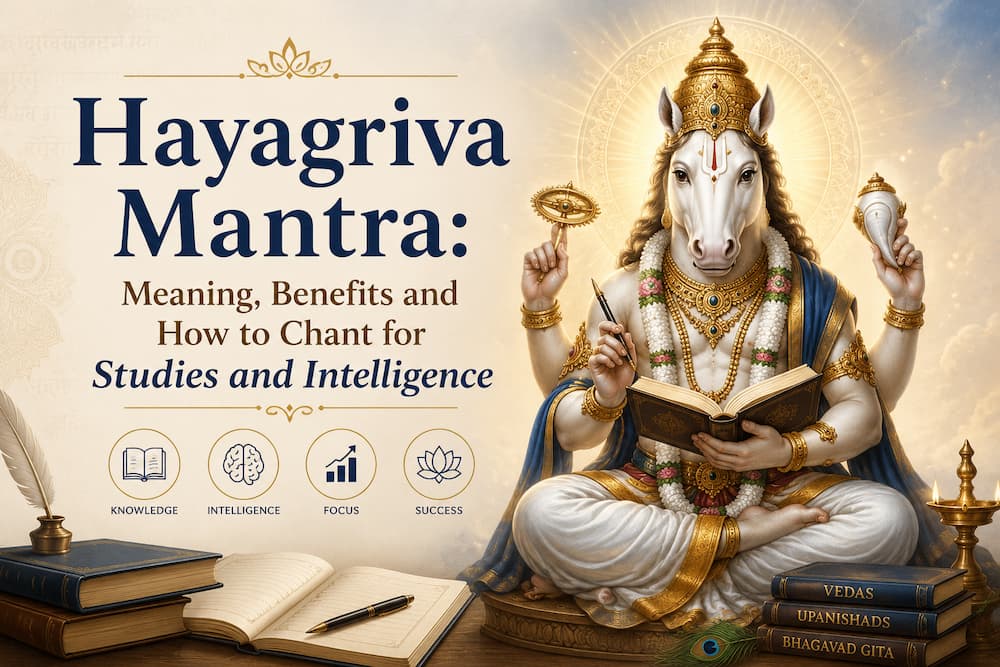
Hayagriva is the horse-headed avatar of Lord Vishnu. In Sanskrit, Haya means horse and Griva means neck. He is depicted as brilliant white in colour, seated on a white lotus, holding the Vedas, which he rescued from the demons Madhu and Kaitabha and restored to Lord Brahma. His worship tradition dates back to approximately 2,000 BCE, when Indo-Aryan people venerated the horse as the symbol of speed, strength and intelligence.
This complete Hayagriva Mantra guide covers the principal mantras with their Sanskrit, transliteration and meaning, the benefits specifically for students and knowledge seekers, the correct method for chanting before exams, and the difference between the Hayagriva Mantra and the Saraswati Mantra.
Source: Hayagriva Purana on the deity’s origin. Pancharatra Agama texts on Hayagriva worship tradition dated to 2,000 BCE. Temple tradition at Guruvayur (Kerala), Melukote (Karnataka) and Tamil Nadu Desika temples.
Hayagriva Mantra: Sanskrit Text, Transliteration and Meaning
Three principal mantras are used in the Hayagriva tradition. Each serves a different purpose and depth of practice.
1. Hayagriva Moola Mantra (Daily Practice)
| Hayagriva Moola Mantra ॐ हयग्रीवाय नमः Om Hayagrivaya Namah Meaning: Salutation to Lord Hayagriva. The simplest and most accessible form, suitable for daily practice, chanting before study sessions and as an opening invocation. |
2. Hayagriva Principal Mantra (Complete Invocation)
| Hayagriva Principal Mantra ज्ञानानन्दमयं देवं निर्मल स्फटिकाकृतिम्। आधारं सर्व विद्यानां हयग्रीवं उपास्महे॥ Jnananandamayam Devam Nirmala Sphatikakrutim. Aadharam Sarvavidyanam Hayagrivam Upasmahe. Meaning: We worship Lord Hayagriva, who is the embodiment of knowledge and bliss, whose form is pure like a crystal, and who is the foundational support of all forms of knowledge. |
This verse is the most complete devotional expression of Hayagriva’s nature. Every word carries specific meaning:
• Jnananandamayam: made of (maya) knowledge (jnana) and bliss (ananda). He is not merely knowledgeable, knowledge and bliss are his substance.
• Devam: the divine, the shining one.
• Nirmala Sphatikakrutim: of form (krutim) pure (nirmala) as crystal (sphatika). Crystal reflects light without adding colour, Hayagriva’s mind reflects knowledge without distortion.
• Aadharam Sarvavidyanam: the foundational support (aadharam) of all (sarva) forms of knowledge (vidyanam). Every branch of knowledge, Vedic, scientific, artistic, technical, has Hayagriva as its ultimate source.
• Hayagrivam Upasmahe: we worship (upasmahe) Hayagriva with devotion and absorption.
Source: Hayagriva Principal Mantra from the Hayagriva Upanishad and Pancharatra texts. Meaning analysis from Vaishnava commentarial tradition.
3. Hayagriva Gayatri Mantra (For Intellectual Development)
| Hayagriva Gayatri Mantra ॐ वागीश्वराय विद्महे हयग्रीवाय धीमहि। तन्नो हंसः प्रचोदयात्॥ Om Vagiswaraya Vidmahe Hayagrivaya Dhimahi. Tanno Hamsah Prachodayat. Meaning: Om, we know the lord of speech. We meditate on Lord Hayagriva. May that swan (divine intelligence) inspire and illuminate our intellect. |
The Hayagriva Gayatri follows the Gayatri metre, three lines with a specific meditative progression. Vagishwara (lord of speech) addresses his power over language and expression. Hamsah (swan) in the final line refers to the divine intelligence that discriminates between truth and untruth, like a swan that separates milk from water. This Gayatri is specifically used for 40-day sadhana focused on intellectual development and improvement of speech.
Hayagriva Mantra Benefits: What This Practice Does
For Students, The Primary Application
The Hayagriva Mantra is the most direct knowledge mantra in the Vaishnava tradition, and its benefits for students are specific rather than vague:
• Memory retention and recall: The verse Aadharam Sarvavidyanam specifically invokes Hayagriva as the support of all knowledge, which practitioners interpret as strengthening the mind’s capacity to hold and retrieve what has been learned.
• Clarity of thinking under pressure: Examination situations produce anxiety that disrupts clear thinking. The mantra’s effect of calming the mind, through the parasympathetic activation of sustained rhythmic chanting, directly addresses this.
• Fluency of speech and expression: Hayagriva is Vagishwara, lord of speech. Practitioners who chant before oral examinations, interviews or public presentations consistently report greater ease and fluency. This is the most specific and consistently documented benefit of the practice.
• Concentration during study: Chanting 11 repetitions of the Moola Mantra before a study session creates a focused, settled quality of attention. It is the equivalent of a warm-up, clearing the mental space before engaging with difficult material.
Beyond Academics, Knowledge Across All Domains
Hayagriva’s mantra is not limited to school and university examinations. Aadharam Sarvavidyanam means the support of all forms of knowledge, not just academic knowledge. Practitioners use the Hayagriva Mantra for:
• Learning a new language or musical instrument
• Developing expertise in a professional domain
• Overcoming speech difficulties including stammering and lack of confidence in speaking
• Improving clarity and precision in writing
• Deepening understanding of spiritual texts, specifically the Vedas, of which Hayagriva is the rescuer and the guardian
In the Vaishnava temple tradition, particularly at Guruvayur in Kerala, the Desika temples in Tamil Nadu and Melukote in Karnataka, priests chant the Hayagriva Mantra during Saraswati Puja, Navaratri and daily homas. The September full moon (Sravana Purnima), which is also Hayagriva Jayanti, is considered the most auspicious day for beginning a Hayagriva Mantra sadhana.
Source: Temple tradition at Guruvayur Kerala, Melukote Karnataka, Tamil Desika temples. Hayagriva Jayanti on Sravana Purnima referenced in Vaishnava almanac traditions.
How to Chant Hayagriva Mantra: Method for Students
Daily Practice
• Time: Morning, before beginning any study for the day. Sunrise is ideal.
• Count: 108 repetitions of the Moola Mantra (Om Hayagrivaya Namah) on a white or crystal mala.
• Visualise: Lord Hayagriva as brilliant white, seated on a lotus, holding the Vedas. Crystal-pure clarity is his nature, visualise that quality entering your mind.
• Close: Chant the Jnananandamayam verse once as the closing prayer.
Before a Study Session
• Chant Om Hayagrivaya Namah 11 times before sitting to study.
• State your intention: ‘I am studying [subject]. May Lord Hayagriva support my understanding and retention.’
• Begin studying. The 11 repetitions takes approximately 2 minutes and creates a noticeably different quality of focus for the session that follows.
Before an Examination
• The night before: 11 repetitions of the Moola Mantra. Ask Hayagriva to consolidate what you have learned and bring it forward clearly when needed.
• Morning of exam: 11 repetitions facing east before leaving home. The Jnananandamayam verse once.
• Entering the hall: 3 silent repetitions of Om Hayagrivaya Namah.
From our practice: Our daughter began a 40-day Hayagriva Moola Mantra sadhana before her Class 12 Board examinations in 2023, 108 repetitions every morning at 6 AM. She has a Sanskrit background and understood the meaning of each word from the beginning, which we believe amplified the practice significantly. She scored 94% overall and 98% in Mathematics, a subject she had previously found difficult. We cannot attribute this entirely to the mantra practice, because she also studied extremely hard. But she said consistently through the 40 days that the morning practice created a quality of calm clarity in her study sessions that was different from anything she had experienced before. She intends to do the sadhana again before her engineering entrance examinations.
Hayagriva Mantra vs Saraswati Mantra: Which to Choose
| Element | Hayagriva Mantra | Saraswati Mantra |
| Deity | Lord Hayagriva, horse-headed avatar of Vishnu | Goddess Saraswati, goddess of learning and arts |
| Gender | Male principle, structured, foundational | Female principle, creative, flowing |
| Emphasis | Retention, recall, systematic knowledge, Vedas | Creative intelligence, expression, arts, flow |
| Best for | Competitive exams, technical subjects, memory, speech | Creative writing, music, arts, language fluency |
| Special day | Sravana Purnima (August full moon), Hayagriva Jayanti | Basant Panchami, Saraswati Puja (Navratri Day 9) |
| Tradition | Vaishnava, Guruvayur, Melukote, Tamil Desika temples | Pan-Hindu, all traditions, no restriction |
| Use together? | Yes, complementary, not competing |
The most effective approach for students is to use both. Hayagriva Moola Mantra for structured daily sadhana and retention. Saraswati Mantra for creative subjects, language learning and artistic pursuits. Neither one replaces the other.
Frequently Asked Questions
What is the Hayagriva Mantra?
The Hayagriva Mantra is a devotional prayer to Lord Hayagriva, the horse-headed avatar of Lord Vishnu who is the deity of wisdom, knowledge and the Vedas. The principal mantra is Jnananandamayam Devam Nirmala Sphatikakrutim, Aadharam Sarvavidyanam Hayagrivam Upasmahe, meaning: we worship Lord Hayagriva, who is the embodiment of knowledge and bliss, pure as crystal, and who is the support of all forms of knowledge. It is chanted specifically for academic success, memory improvement, clarity of thinking, fluency in speech and success in competitive examinations.
Is the Hayagriva Mantra different from the Saraswati Mantra for studies?
Yes, different deity, different energy, complementary purposes. The Saraswati Mantra invokes the goddess of learning, arts and wisdom, emphasising creative intelligence and the flow of knowledge. The Hayagriva Mantra invokes the god of knowledge, emphasising retention, recall, systematic understanding and the foundational structure of knowledge. Hayagriva is described as the deity who taught Saraswati. For students, many practitioners recommend both: Saraswati Mantra in the morning for creative flow and Hayagriva Mantra before specific study sessions or examinations.
Which Hayagriva Mantra is best for studies?
Three mantras are used specifically for studies. The Moola Mantra (Om Hayagrivaya Namah) is the most accessible, simple, short and effective for daily practice. The Jnananandamayam Devam mantra (the principal mantra in this article) is the most complete devotional invocation. The Hayagriva Gayatri Mantra is the most specific for intellectual development, used for sharpening the intellect and improving concentration over a sustained 40-day practice. For students appearing for a specific examination, the recommended approach is: the Moola Mantra 108 times daily for 40 days before the exam, with the Jnananandamayam verse chanted once on the morning of the exam.
How many times should I chant the Hayagriva Mantra?
The Moola Mantra (Om Hayagrivaya Namah): 108 times daily for a sustained daily practice. Before a specific exam or study session: 11 times immediately before sitting down to study or entering the examination hall. The Jnananandamayam verse: once in the morning as an opening devotional prayer, or 11 times for a more concentrated practice. The Hayagriva Gayatri Mantra: 108 times daily for a 40-day sadhana focused on intellectual development.
When should I chant the Hayagriva Mantra for exams?
Three times: the night before the examination (11 times to settle anxiety and consolidate what has been studied), on the morning of the examination before leaving home (11 times with a clear mind), and immediately before entering the examination hall (silently, 3 times, to establish focus and invoke Hayagriva’s presence). The 40-day sadhana practice should ideally be completed before examination season begins, not started the night before an exam.
Can non-Vaishnavas chant the Hayagriva Mantra?
Yes, fully. Lord Hayagriva is described as the source of all knowledge, a universal principle rather than a sectarian deity. The mantra Aadharam Sarvavidyanam (the support of all forms of knowledge) implies that all knowledge originates from him, regardless of the tradition of the student. Students from any Hindu tradition, Shaiva, Shakta, Smarta or Vaishnava, can chant the Hayagriva Mantra for academic and intellectual purposes. No sectarian initiation is required.
Conclusion
The Hayagriva Mantra is the least known and the most powerful knowledge mantra in the Hindu tradition. It remains relatively obscure in North India compared to Saraswati, and that obscurity is an opportunity. Students who discover it before an examination season and build even a 21-day practice will find something genuinely different from the generic mantra advice available online.
Begin with the Moola Mantra: Om Hayagrivaya Namah, 11 times before your next study session. Notice the quality of attention that follows. Then decide whether the 40-day practice is worth your commitment before your next major examination.
Jnananandamayam Devam, Lord Hayagriva, the embodiment of knowledge and bliss.
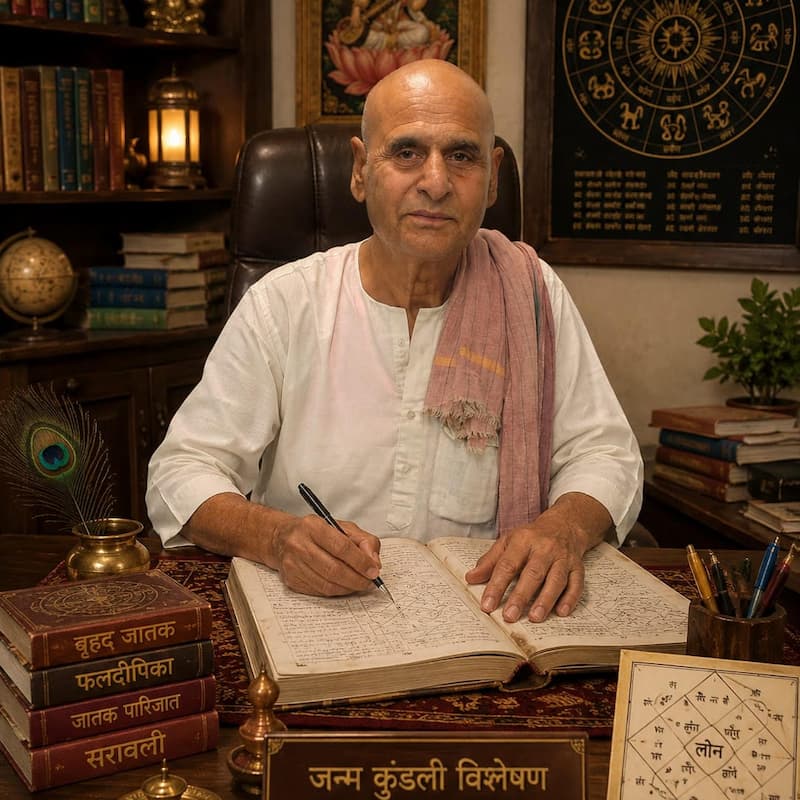
Narendra Kumar Chaubey is a Jyotisha Acharya with over 30 years of experience, based in Bihar and serving clients across India in Vedic astrology, mantra shastra, Vastu and ritual practice.
He completed his formal training at Kameshwar Singh Darbhanga Sanskrit University (KSDSU), one of India’s oldest and most respected institutions for Vedic and Sanskrit scholarship, where he studied Jyotisha shastra, mantra vidya and related classical sciences. KSDSU’s tradition of rigorous Sanskrit education tracing directly to the Mithila region’s centuries-old pandit lineage forms the foundation of his practice.
Over three decades, Narendra Kumar Chaubey has worked with thousands of individuals and families across Bihar and across India, offering guidance in:
- Kundli (birth chart) analysis: Identifying karmic patterns, planetary periods and life path guidance through classical Jyotisha
- Palmistry (Hasta Samudrika): Reading the hand according to the classical Samudrika Shastra tradition
- Vastu Shastra: Assessment and correction of living and working spaces according to directional and elemental principles
- Mantra and Pooja vidhi: Performing and guiding all categories of puja, havan, and mantra sadhana for personal, family and business situations
- Predictive Jyotisha: Transit analysis, muhurta (auspicious timing) selection and remedial guidance
He works across four languages Sanskrit, Hindi, English and Bhojpuri making classical knowledge accessible to practitioners across educational backgrounds and regions.
His writing for ABMantra brings the precision of classical Vedic training to practical mantra guidance: not general advice but specific prescriptions grounded in shastra, lineage and 30 years of direct practice with real situations.
For more info follow on: