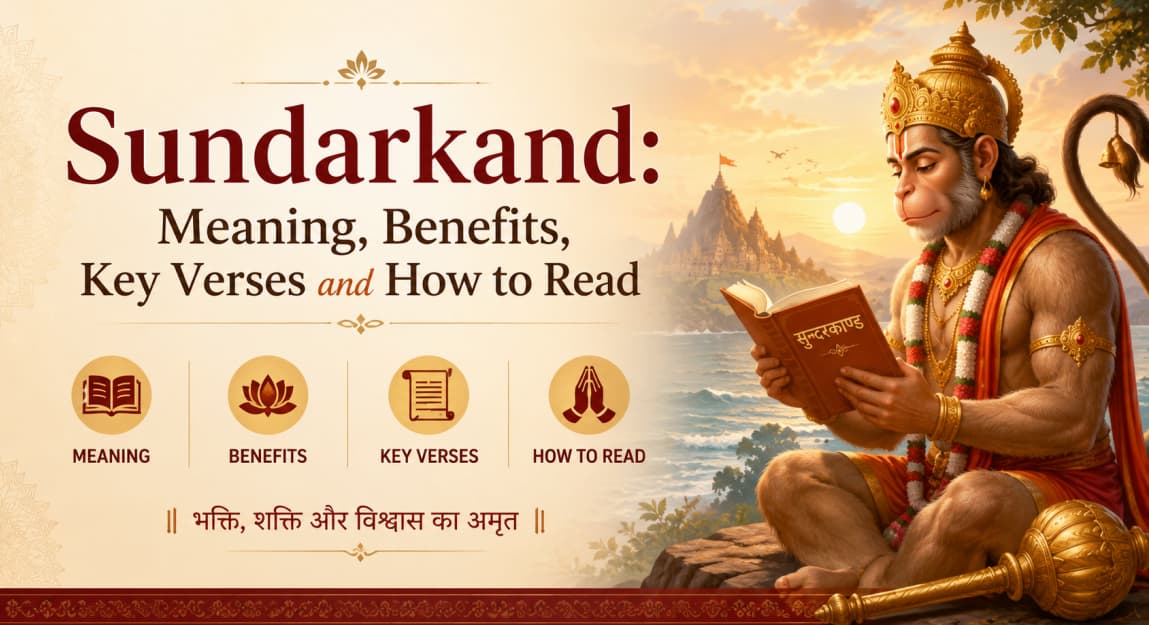

Sundarkand is the only book of the Valmiki Ramayana in which Lord Rama barely appears. The entire fifth Kanda 68 sargas in Valmiki’s Sanskrit, 526 chaupais in Tulsidas’s Ramcharitmanas belongs to Hanuman. Every other part of the Ramayana is Rama’s story. The Sundarkand is Hanuman’s.
This is not an accident. Valmiki, one of the most precise writers in all of Sanskrit literature, called this chapter Sundara beautiful specifically because it is the most complete portrait of what a devotee can achieve when his qualities, his devotion and his purpose align without obstacle. Hanuman crossed 800 yojanas of ocean alone. He found the hidden captive in the enemy’s city. He spoke truth to power in Ravana’s own court. He set fire to Lanka and extinguished the fire before it touched Sita. He returned and reported without pride, without embellishment, without claim.
This guide covers the meaning of the name, all 7 chapters of the story with their key lessons, 3 verses that every Sundarkand reader should understand deeply, the benefits of regular Sundarkand path, the difference between Valmiki’s Sanskrit original and Tulsidas’s Awadhi version, and the correct method for Sundarkand recitation at home.
For the complete story of Lord Hanuman including his birth, iconography and all 6 Ramayana missions, see: Lord Hanuman Story, Significance, Iconography and His Role in the Ramayana.
What Is Sundarkand: Meaning of the Name and Its Place in the Ramayana
The Ramayana is divided into 7 Kandas (books): Bala Kanda (childhood), Ayodhya Kanda (exile), Aranya Kanda (forest), Kishkindha Kanda (the monkey kingdom), Sundara Kanda (Lanka mission), Yuddha Kanda (war), and Uttara Kanda (aftermath). It is the fifth.
Sundar means beautiful in Sanskrit. Understanding the Sundarkand meaning of the name itself opens the text. Three explanations are given for why Valmiki chose it. First, Hanuman’s mother Anjana called him Sundar a term of affection for her son. Second, the Kanda describes Lanka, which Valmiki calls Sundar Lanka a city of extraordinary beauty that Hanuman is about to burn. Third, and most importantly, the Kanda itself is considered the most beautifully composed section of the Ramayana the literary peak of Valmiki’s art.
None of these explanations fully captures what practitioners mean when they say Sundarkand is beautiful. What they mean is that it is the most emotionally complete and spiritually dense section of the entire epic. Every major quality of the devotee courage, intelligence, humility, determination, precision, restraint is demonstrated not described. It shows rather than tells. That is what makes it beautiful.
Source: Valmiki Ramayana, Sundara Kanda, Sarga 1. The name and its triple meaning Hanuman’s childhood name, Lanka’s name, and the chapter’s literary quality is discussed in classical Sanskrit commentaries on the Ramayana.
Valmiki Sundara Kanda vs Tulsidas Sundarkand: Key Differences
Most practitioners do not know there are two distinct texts. Choosing the right one for your practice depends on your language background and your purpose.
| Element | Valmiki’s Sundara Kanda | Tulsidas’s Sundarkand |
| Language | Sanskrit | Awadhi (a dialect of Hindi, 16th century) |
| Length | 68 sargas approximately 2,900 verses | 526 chaupais, 60 dohas, 6 chhands, 3 shlokas |
| Period | 5th century BCE to 3rd century CE | Composed by Tulsidas around 1574-1600 CE |
| Reading time | 5 to 6 hours (full recitation) | 3 to 4 hours (full recitation) |
| Accessible to | Sanskrit scholars and those trained in Vedic recitation | All Hindi speakers, most North Indians |
| Tone | Narrative, precise, detailed every detail of the mission recorded | Devotional, emotional, rhythmically beautiful for singing |
| Best for | Scholarly study, temple recitation by trained pujaris, South Indian tradition | Home practice, group path, weekly recitation in North India |
For home practice, Tulsidas’s Ramcharitmanas version is the right text for most people in North India. Its Awadhi is accessible to anyone who understands Hindi, its metre makes it suitable for singing and for memorisation, and its 450-year history of devotional use means there is rich traditional guidance available for every verse. All key verses here are from Tulsidas’s version.
Source: Goswami Tulsidas, Ramcharitmanas, Sundarkand. The verse count of 526 chaupais, 60 dohas, 6 chhands and 3 shlokas is from the standard Gita Press Gorakhpur edition of Ramcharitmanas.
Sundarkand Story: All 7 Chapters Summarised with Their Key Lessons
This text is not a sequence of events it is a sequence of demonstrations. Each chapter shows Hanuman applying a different quality to a different obstacle. Reading it with this understanding transforms the text from a story into a manual for navigating impossible situations.
| # | Chapter | Sargas | Story | Key lesson |
| 1 | Hanuman’s Leap Across the Ocean | Sargas 1-4 | Hanuman assumes cosmic size and leaps from Mahendra Mountain across 800 yojanas of ocean. The gods test him along the way: Mainaka mountain offers rest, Surasa opens her jaws and must be outwitted, and Simhika the shadow-catching demon must be destroyed. Each obstacle is resolved differently rest declined, wit used, force applied demonstrating Hanuman’s calibration of response to situation. | Calibrate response to situation rest, wit or force as the obstacle demands. |
| 2 | Entering Lanka and Searching for Sita | Sargas 5-16 | Hanuman shrinks to the size of a cat and enters Lanka at night. He searches Ravana’s palace, the inner chambers, the gardens, the streets everywhere he can imagine Sita might be. He sees Ravana sleeping. He sees the decorated wives. He begins to doubt. This section is the most psychologically rich in the entire Ramayana Hanuman’s near-despair and his rational process of recovery. | Intelligence before action. Search thoroughly. Doubt is not weakness it is the practitioner testing their own logic. |
| 3 | Finding Sita in the Ashoka Grove | Sargas 17-22 | Hanuman finds Sita seated under an Ashoka tree, surrounded by demonesses, threatened by Ravana, close to despair. He watches Ravana’s approach and threats. He watches Sita’s dignified refusal. He watches Trijata’s dream. He understands the full situation before revealing himself intelligence before action. | Observation before intervention. Understand the full situation before revealing yourself. |
| 4 | The Meeting with Sita | Sargas 33-40 | Hanuman descends and presents himself. Sita tests him is he truly Rama’s messenger or a demon in disguise? Hanuman describes Rama’s appearance in exact detail, presents the ring. The conversation between Sita and Hanuman is the emotional heart of the Sundarkand. Sita’s dignity and love, Hanuman’s assurance and devotion two beings of complete integrity in the worst possible circumstances. | Integrity recognises integrity. Two beings of complete character meet and trust each other instantly. |
| 5 | The Destruction of the Ashoka Garden | Sargas 43-51 | Hanuman destroys the Ashoka grove not out of rage but deliberately, to force a confrontation that will allow him to assess Lanka’s strength. This is intelligence disguised as destruction. He kills the guards, kills Aksha Kumar, and allows himself to be captured by Indrajit’s Brahmastra. | Destruction can be purposeful intelligence, not rage. |
| 6 | Hanuman in Ravana’s Court | Sargas 52-54 | Brought before Ravana with his tail set on fire, Hanuman delivers Rama’s message with complete dignity. He calls Ravana by name, not by title. He does not bow. He states the situation plainly: return Sita or face destruction. This scene is Hanuman’s greatest moment as a diplomat warrior-strength held in complete equanimity before the most powerful king on earth. | Truth spoken without fear is the warrior’s highest act. No bow. No title. Plain statement. |
| 7 | Burning Lanka and Return | Sargas 55-68 | Hanuman uses the burning tail to set Lanka alight. He returns to Sita to take leave, extinguishes his tail in the ocean, and leaps back across the sea. He finds the waiting monkey army and Jambavan, delivers the news that changes everything, and with Angada and the army returns to Rama. The arc is complete: mission assigned, executed against all odds, reported. | Complete the mission. Return without pride. Report with accuracy. |
Sundarkand Key Verses: 3 Verses Every Reader Should Understand
This text contains hundreds of verses. Three of them are quoted across the entire devotional tradition as the verses that carry the Sundarkand’s deepest teaching. Understanding these three changes how you read everything around them.
| Jambavan’s verse Hanuman’s forgotten power कवन सो काज कठिन जग माहीं। जो नहिं होइ तात तुम्ह पाहीं॥ Kavan So Kaaj Kathin Jag Maahin. Jo Nahin Hoi Taat Tumh Paahin. Meaning: What task is there in this world so difficult that it cannot be accomplished by you, O son?Significance: This is the verse that woke Hanuman up. When all the vanaras were despairing at the edge of the ocean and no one believed the crossing was possible, Jambavan reminded Hanuman of his own divine nature. The Sundarkand does not begin with Hanuman’s strength it begins with his forgetting and his remembering. The most important teaching: our greatest capacities are often the ones we have forgotten we possess. |
| Hanuman’s response the moment of awakening राम काज लगि तव अवतारा। सुनतहिं भयउ पर्बताकारा॥ Ram Kaaj Lagi Tav Avataara. Sunatahi Bhayau Parbataakara. Meaning: For the work of Rama you have taken birth hearing this, he became as large as a mountain. Significance: The moment Hanuman heard his purpose clearly stated not reminded of his powers but reminded of his purpose he expanded to cosmic size instantly. This is its central psychological teaching: when you are clear about why you are doing what you are doing, the capacity for the task arrives with the clarity. Hanuman did not expand his body through effort. He expanded it through remembering his purpose. |
| Sita’s response to Hanuman the meeting तुम मम प्रिय भरतहि सम भाई। सो क्यों न मोहि होहिं अधिकाई॥ Tum Mam Priya Bharatahi Sam Bhai. So Kyun Na Mohi Hohin Adhikaayi. Meaning: You are as dear to me as Bharata is to my Lord how then could you not be even dearer to me? Significance: Sita’s words to Hanuman after he brings Rama’s ring and proves his identity. She equates him with Bharata Rama’s most beloved brother. This is the highest compliment Sita could give. The Sundarkand’s meeting scene is not merely a plot point it is a meditation on what happens when two beings of complete integrity meet in the worst possible circumstances. Neither one collapses. Both hold. |
Source: All three verses from Tulsidas’s Ramcharitmanas, Sundarkand and Kishkindha Kanda. The Jambavan verse (Kavan So Kaaj) is technically in the Kishkindha Kanda but is recited as the opening invocation of Sundarkand path in most traditions.
Sundarkand Benefits: What Regular Path Does
The benefits described in the classical tradition are specific and consistent across 450 years of documented practice. They are not vague promises of general wellbeing they correspond directly to what happens in the text.
Removal of Persistent Obstacles
Hanuman succeeded at the mission no one else dared attempt. This quality the breakthrough where all else has failed is what this text invokes. Practitioners who read Sundarkand for 7 consecutive Tuesdays for a specific obstacle consistently report a shift in the situation between weeks 3 and 5. Not because the Sundarkand magically rearranges external events, but because the practitioner who has spent 7 weeks absorbing Hanuman’s approach to impossible situations begins to see their own situation differently.
Protection from Enemies and Negative Forces
Its final chapters show Hanuman operating in enemy territory inside Lanka’s walls, in Ravana’s own court without being touched. The Ashoka grove demonesses could not harm Sita while this text was being recited in her vicinity (Trijata’s dream explicitly says this). The tradition treats this as a living principle: the home where this path is regularly conducted is protected. This is why families read it after a death in the family, before a court case, when there is a sense of negative energy in the home.
Healing and Recovery from Illness
The Sanjeevani episode the moment Hanuman restores Lakshmana’s life at the last possible moment is the basis for the Sundarkand’s specific association with illness recovery. It is read beside hospital beds in India with a consistency that cuts across all social and economic levels. The principle: Hanuman did not ask whether Lakshmana deserved to be saved, or whether the cure was available, or whether it was too late. He simply went and got the entire mountain.
Saturn and Rahu Remedy
For the same Jyotish reasons that make Tuesday and Saturday Hanuman worship effective for Saturn, the this text read on Saturdays is one of the most potent Saturn remedies in classical Jyotish. Seven Saturdays of Sundarkand path is the prescription given by many experienced Jyotishis for Sade Sati. This text is also prescribed for Rahu Mahadasha because Hanuman’s capacity to cut through illusion (which Rahu generates) is nowhere more clearly demonstrated than in his ability to see past Maya in Lanka.
The Psychological Benefit: Fear Dissolves
This is the benefit competitors never mention, and it is the most important one. Reading it regularly especially with understanding of each episode’s meaning gradually dismantles the practitioner’s relationship to fear. Not through positive affirmation or reassurance, but through repeated immersion in the detailed account of a being for whom no obstacle was final. Hanuman did not become fearless by suppressing fear. He became fearless by acting despite fear, every single time, until the fear had nothing left to grasp. The practitioner who reads about this enough times, deeply enough, eventually begins to do the same.
How to Read Sundarkand at Home: Complete Method
Home recitation requires no priest, no elaborate ritual, no expensive materials. What it requires is time, a clean space and a sincere attitude. One complete recitation takes 3 to 4 hours.
What You Need
• A printed copy of the Ramcharitmanas Sundarkand (Gita Press Gorakhpur edition is the most widely used)
• A Rama or Hanuman image on a clean red cloth
• A ghee diya and agarbatti (gugal or sandalwood)
• Laddoo, fruit or jaggery as prasad for offering after completion
• Uninterrupted time minimum 3.5 hours for the full path
Step-by-Step Method
1. Bathe and wear clean clothes white, saffron or red. Sit facing east or north.
2. Light the diya and agarbatti. Offer red flowers to the image if available.
3. Open with the invocation: Om Shri Ram Jai Ram Jai Jai Ram 11 times. Then the Jambavan verse: Kavan So Kaaj Kathin Jag Maahin… 3 times.
4. Read the Sundarkand from the beginning. Read clearly, at a steady pace not too fast, not too slow. Each chaupai should be complete and distinct.
5. When you reach the end the army’s return to Rama and the reunion take a pause. Sit in silence for 3 to 5 minutes before the closing sequence.
6. Close with the Hanuman Chalisa once. Then the Hanuman Aarti.
7. Offer the prasad. Distribute to all present. Do not eat the prasad alone the tradition treats Sundarkand prasad as a family blessing.
From our practice: The Sundarkand changes quality around the third week of regular reading. The first two readings you are following the story. By the third, you begin to feel the weight of specific moments differently Sita’s refusal of Ravana carries more force, Jambavan’s verse lands differently, Hanuman’s silence before Ravana feels larger. By the fifth or sixth reading, you begin to recognise which episode you are in during your own life. The Sundarkand becomes a diagnostic tool: am I in the ocean-crossing chapter (enormous task, unknown outcome)? Am I in the search chapter (looking for something I cannot find, beginning to doubt)? Am I in the Lanka-burning chapter (controlled destruction as a form of intelligence)? When you can name which chapter of the Sundarkand your life is currently in, the text has become something more than a recitation. It has become a map.
Conclusion: The Sundarkand as a Map for Impossible Situations
Every family in India has a story about the Sundarkand. A relative’s illness that turned around after the family read it for seven Saturdays. A legal case that resolved after a group path. A marriage saved. A business rescued. These stories are not proof of anything scientifically verifiable. But they are consistent consistent across regions, communities, languages and centuries in a way that demands some explanation beyond coincidence.
The explanation this tradition offers is precise: the Sundarkand works because Hanuman works, and Hanuman is present. Not as a historical figure whose deeds are remembered, but as a Chiranjeevi an immortal being who is currently alive and currently responsive. This text is not merely a record of what he did. It is a direct line of contact with him as he is now.
Whether or not you accept that theological claim, the practical instruction is the same: read it. Read it for 7 consecutive Tuesdays for the specific thing that is not working in your life. Read each chapter with enough attention to identify the quality Hanuman is demonstrating. Let the quality enter your thinking about your own situation. And report back to yourself, or to anyone who asks what has changed.
Jai Bajrang Bali. Jai Sankat Mochan. Jai Pavan Putra.
FAQs About Sundarkand
What is Sundarkand?
Sundarkand is the fifth book (Kanda) of the Valmiki Ramayana. It is entirely dedicated to Lord Hanuman’s mission to Lanka his crossing of the ocean, his search for Sita, the meeting with Sita, the burning of Lanka and his return to Rama with the news that changes the course of the war. The name Sundar means beautiful given to Hanuman by his mother Anjana, and chosen by Valmiki because this Kanda is both the most beautiful literary section of the Ramayana and the section that most beautifully illustrates the qualities of the ideal devotee. In Tulsidas’s Ramcharitmanas, the Sundarkand contains 526 chaupais (four-line verses), 60 dohas (couplets), 6 chhands and 3 shlokas.
What are the benefits of reading Sundarkand?
The classical tradition attributes specific benefits to path (recitation): removal of obstacles, particularly those that have persisted despite other remedies; protection from enemies and negative forces; recovery from illness the Sanjeevani episode makes Sundarkand the specific text for those facing health crises; relief from Saturn’s effects (Sade Sati, Shani Mahadasha) when chanted on Tuesdays and Saturdays; and the gradual dissolution of fear as a baseline quality of the practitioner. The psychological benefit is equally significant: the Sundarkand teaches that no situation is as permanently hopeless as it appears. Hanuman found Sita when no one else could. He burned Lanka when no one else dared. The practitioner who has internalized these stories carries a different quality of confidence than one who has not.
How long does it take to read Sundarkand?
A single complete recitation of Tulsidas’s Ramcharitmanas Sundarkand takes approximately 3 to 4 hours at a steady pace. Many practitioners split it across two sessions: the first half in the morning and the second half in the evening of the same day. For the Valmiki Ramayana Sundara Kanda, which is longer (68 sargas in Sanskrit), a full reading takes 5 to 6 hours. For those beginning the practice, reading the Sundarkand with the Hindi meaning for each verse is recommended before building to full recitation from memory.
Which day is best to read Sundarkand?
Tuesday and Saturday are the two primary days for Sundarkand recitation, for the same Jyotish reasons that make these days important for all Hanuman practice. Tuesday is Hanuman’s birthday day and Mars’s day. Saturday is the day of Saturn’s promise through Shani’s relationship with Hanuman. For specific obstacle removal, reading the Sundarkand on 7 consecutive Tuesdays is a traditional prescription. For general practice, once a week on Tuesday or Saturday is the standard. The Sundarkand is also read on special occasions family crises, before surgery, after a death in the family, before a major examination regardless of the day.
What is the difference between Valmiki Sundara Kanda and Tulsidas Sundarkand?
Valmiki’s Sundara Kanda is the original Sanskrit text 68 sargas (chapters), composed between the 5th century BCE and 3rd century CE by Maharshi Valmiki. It is the primary scriptural source and the most detailed account of the Lanka mission. Tulsidas’s Sundarkand is the corresponding section of his Ramcharitmanas, composed in Awadhi in the 16th century CE. It is shorter, more devotionally accessible, and uses the chaupai-doha metre that makes it rhythmically beautiful for recitation. Most households in North India recite Tulsidas’s version because of its accessibility in Awadhi. South Indian traditions often recite Valmiki’s Sanskrit original. Both are spiritually equivalent the difference is linguistic and cultural, not in authority or effect.
Can Sundarkand be read at home without a pandit?
Yes, fully and without restriction. Home Sundarkand path without a pandit is the most common form of this practice in India. The only requirements are: a clean space, a lit ghee diya and agarbatti, and a Rama or Hanuman image before you. Begin with Om or Shri Ram Jai Ram Jai Jai Ram repeated 3 times as the opening invocation. Then read the Sundarkand at a clear, steady pace. Close with the Hanuman Aarti. Offer prasad typically laddoo or fruit and distribute to family members. A pandit is traditional for group path (akhand or samuhik) but is not required for home practice.
How many times should Sundarkand be read for maximum benefit?
Single recitation: for general devotional practice, once per week is a complete practice. 7 consecutive Tuesdays: the classical prescription for specific obstacle removal. Akhand path (continuous reading without break, completed in one sitting by multiple readers): performed for major life events, serious illness or as a vow. 21-day consecutive reading: for deep crisis situations where daily Sundarkand recitation for 21 days is prescribed alongside the Sankat Mochan Mantra practice. The tradition consistently says: one sincere recitation with full attention and understanding of each episode’s meaning produces more benefit than multiple mechanical readings.
What is the significance of the Sundarkand in the Ramayana?
This Kanda is the pivot of the entire Ramayana. Before it, Rama has lost Sita and does not know where she is. After it, he knows, and the war can begin. But more than its narrative importance, the Sundarkand is the only book of the Ramayana in which the primary hero is not Rama but Hanuman. Every other Kanda is about Rama’s story. The Sundarkand is entirely Hanuman’s story. This is why Valmiki called it Sundar it is the book that most beautifully illustrates what the ideal devotee is capable of when his qualities, his devotion and his purpose align completely. The Sundarkand’s sustained message is: devotion is not passive. It leaps oceans. It burns cities. It finds what no one else could find. And then it returns and reports, without pride.
Narendra Kumar Chaubey is a Jyotisha Acharya with over 30 years of experience, based in Bihar and serving clients across India in Vedic astrology, mantra shastra, Vastu and ritual practice.
He completed his formal training at Kameshwar Singh Darbhanga Sanskrit University (KSDSU), one of India’s oldest and most respected institutions for Vedic and Sanskrit scholarship, where he studied Jyotisha shastra, mantra vidya and related classical sciences. KSDSU’s tradition of rigorous Sanskrit education — tracing directly to the Mithila region’s centuries-old pandit lineage — forms the foundation of his practice.
Over three decades, Narendra Kumar Chaubey has worked with thousands of individuals and families across Bihar and across India, offering guidance in:
- Kundli (birth chart) analysis — identifying karmic patterns, planetary periods and life path guidance through classical Jyotisha
- Palmistry (Hasta Samudrika) — reading the hand according to the classical Samudrika Shastra tradition
- Vastu Shastra — assessment and correction of living and working spaces according to directional and elemental principles
- Mantra and Pooja vidhi — performing and guiding all categories of puja, havan, and mantra sadhana for personal, family and business situations
- Predictive Jyotisha — transit analysis, muhurta (auspicious timing) selection and remedial guidance
He works across four languages — Sanskrit, Hindi, English and Bhojpuri — making classical knowledge accessible to practitioners across educational backgrounds and regions.
His writing for ABMantra brings the precision of classical Vedic training to practical mantra guidance: not general advice but specific prescriptions grounded in shastra, lineage and 30 years of direct practice with real situations.