
In the vast tradition of Vedic mantras, some hymns are long and elaborate. Others are short and concentrated to the point of being almost invisible. The Surya Beej Mantra belongs to the second category. Eight syllables. Two seconds to speak. Centuries of recorded transformative effect.
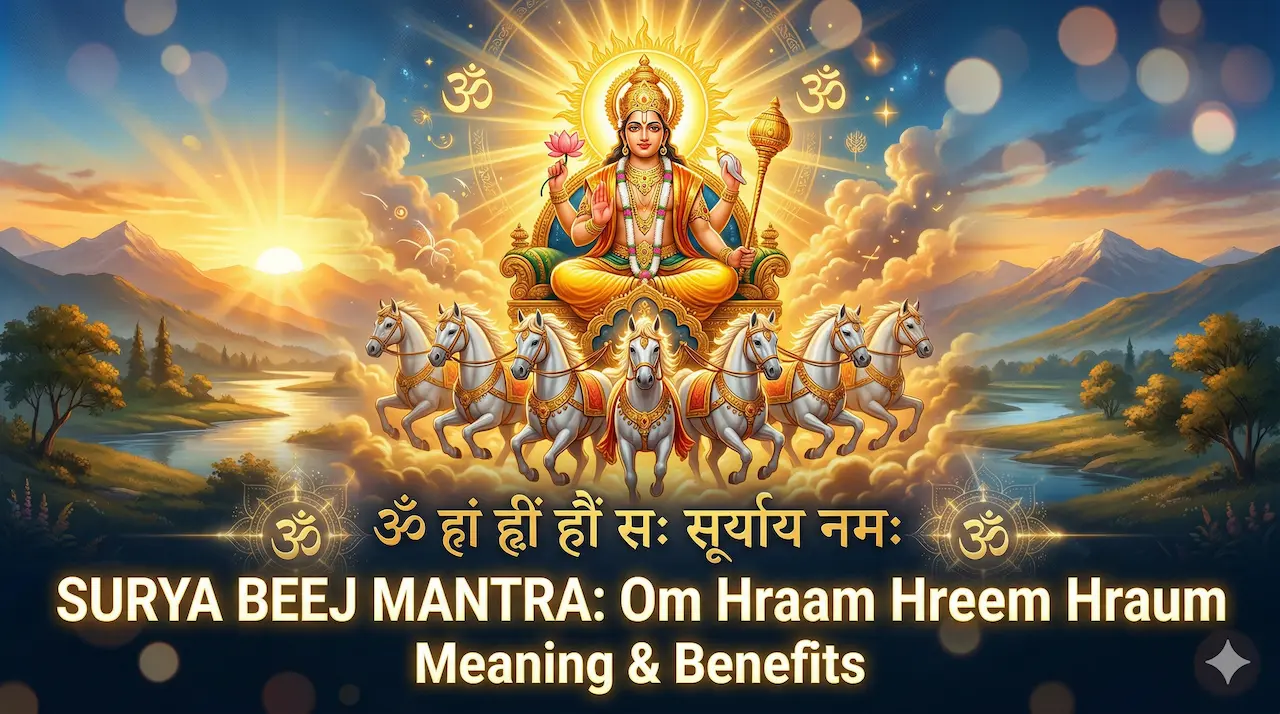
A beej mantra (also written as bija mantra) is a seed syllable. Just as an entire tree is compressed inside a small seed, a beej mantra contains the complete essence of a deity or cosmic force in the shortest possible sound form. The Surya Beej Mantra, Om Hraam Hreem Hraum Sah Suryaya Namah, is the seed form of Lord Surya, the Sun God.
This article explains the meaning of every syllable in the mantra, why those specific sounds were chosen by the Vedic rishis, what benefits arise from regular chanting, and how to practise correctly from the first day.
For a broader introduction to all Surya Mantras including the Aditya Hridayam and the 12 names of Surya Namaskar, see our complete guide: Surya Mantra: Meaning, Benefits and Correct Chanting Method.
The Surya Beej Mantra in Full
| Sanskritॐ ह्रां ह्रीं ह्रौं सः सूर्याय नमःTransliterationOm Hraam Hreem Hraum Sah Suryaya NamahMeaningI invoke the seed energy of Lord Surya through his three solar aspects. I offer this life force to the Sun God with complete reverence. |
Meaning of Every Syllable
Each element of this mantra was placed precisely by the Vedic rishis. None of the eight syllables is decorative. Below is a complete breakdown of what each part means and why it is there.
| Syllable | Element | Full Meaning and Significance |
| Om | Cosmic consciousness | The primordial sound of the universe; the universal vibration that precedes all creation |
| Hraam | Morning solar energy | The seed syllable of Surya in his morning form (Arka). Associated with the rising sun and the energy of new beginnings |
| Hreem | Peak solar force | The seed syllable of Surya in his noon form (Mitra). The peak force of the sun at midday; willpower and vital heat |
| Hraum | Evening solar energy | The seed syllable of Surya in his evening form (Bhaskar). The reflective, illuminating quality of light as it deepens |
| Sah | Prana (life force) | The life-force syllable. Sah is the sound of prana, the vital breath that animates all living beings |
| Suryaya | The Sun God | Dative case of Surya, meaning ‘to Surya’ or ‘for Surya’. The mantra is directed to him as an offering |
| Namah | Devotional surrender | I bow. A complete act of surrender and reverence. Not merely a polite greeting but an acknowledgement of Surya’s supremacy |
The three seed syllables Hraam, Hreem and Hraum represent the Sun as a living, three-phased force across a single day: the rising sun that awakens, the noon sun that drives action, and the evening sun that illuminates through reflection. Together they invoke the full solar cycle in a single breath.
Why Beej Mantras Work: The Science of Sound
Vedic mantras operate through sound vibration. When you speak or think a mantra, you produce a specific pattern of vibration in the body, in the breath and in the surrounding air. Beej mantras are particularly concentrated because they carry the maximum vibrational content in the minimum number of syllables.
The Vedic rishis were precise observers of the relationship between sound and effect. They documented that certain syllable combinations, when chanted with correct pronunciation and sustained attention, produced predictable and repeatable results in the practitioner. The Surya Beej Mantra was specifically constructed to activate the solar plexus energy centre (Manipura chakra), increase prana and align the practitioner’s energy with the cosmic energy of the Sun.
Peer-reviewed research has begun to document the physiological mechanisms behind these effects. A landmark 2011 study in the International Journal of Yoga found that OM chanting produced measurable changes in brain hemodynamics and deactivated limbic regions associated with fear and anxiety. A 2018 study in the same journal found that sustained mantra repetition lowered heart rate and improved heart rate variability in participants, consistent with the Vedic claim that mantra restores prana.
Source 1: Kalyani, B.G. et al. (2011). Neurohemodynamic correlates of OM chanting: a pilot functional neuroimaging study. International Journal of Yoga, 4(1), 3-6.
Source 2: Sharma, K. et al. (2018). Effect of mantra meditation on cardiac autonomic modulation. International Journal of Yoga, 11(2).
The Surya Upanishad, a minor Upanishad of the Atharva Veda tradition, establishes Surya as the ultimate Brahman and states that all life emerges from solar energy. The Beej Mantra is the sonic distillation of this teaching. (Surya Upanishad, verses 1-7)
Benefits of Chanting the Surya Beej Mantra
The following benefits are drawn from the Vedic textual tradition, Jyotish (Vedic astrology), and the consistent experience of long-term practitioners. They are grouped by the dimension of life they affect most directly.
| Area | Benefit | Traditional Source |
| Physical Vitality | The three seed syllables Hraam, Hreem and Hraum correspond to the three phases of the sun and the three stages of metabolic activity in the body. Regular chanting is traditionally associated with improved digestion, stronger immunity and sustained physical energy. | Referenced in Surya Upanishad and classical Navagraha texts |
| Mental Strength | The mantra stimulates the solar plexus chakra (Manipura), the energy centre associated with willpower, confidence and the capacity for decisive action. Practitioners who chant consistently often report a marked reduction in procrastination and self-doubt. | Manipura activation through Surya sadhana |
| Eye Health | Surya has been worshipped specifically for eye health since Vedic times. The early morning practice of offering water to the sun while chanting this mantra is one of the oldest traditional remedies for weak eyesight. | Aditya Hridayam, verse on Sarva Roga Nashana |
| Success and Recognition | In Vedic astrology, a weak Sun in the horoscope is associated with lack of confidence and difficulty receiving recognition. Chanting the Beej Mantra is the primary Vedic remedy for strengthening the Sun in the natal chart. | Navagraha remedial astrology (Jyotish) |
| Spiritual Clarity | The mantra works directly on Ajna chakra (the third eye) and Sahasrara (the crown chakra). Long-term practice dissolves unconscious patterns and brings increasing clarity about one’s life direction. | Tantric Surya sadhana tradition |
From our practice: Among the five benefits listed above, the most consistently reported by readers who write to us is the shift in mental strength: specifically, a reduction in the hesitation that precedes difficult decisions. Many practitioners describe the change not as a sudden surge of confidence but as a quieting of the internal noise that usually delays action. That qualitative shift typically appears around weeks three to four of a daily 108-round practice.
How to Chant the Surya Beej Mantra: Complete Method
Prerequisites
1. Wake before sunrise. Bathing is ideal; if not possible, wash your hands, face and feet.
2. Sit on a mat or wooden seat facing east. Sitting on the ground directly is not recommended in Vedic practice.
3. Hold a mala of 108 beads if available. A mala is not essential but makes counting effortless and keeps the hands engaged, which supports concentration.
4. Take three slow breaths to settle the mind before beginning.
Pronunciation Guide
Correct pronunciation is important but should not become a source of anxiety. The following table addresses the most common mistakes:
| Syllable | Correct Sound | Sounds Like | Common Error |
| Hraam | Long ‘aa’ as in ‘calm’ | Hr + arm | Pronouncing it as ‘hrum’ or ‘hram’ with a short vowel |
| Hreem | Long ‘ee’ as in ‘dream’ | Hr + dream | Cutting the vowel short; it should be held briefly |
| Hraum | Rounded ‘au’ as in ‘om’ | Hr + ohm | Flattening it to ‘hrom’ or rushing past it |
| Sah | Soft ‘ah’ exhalation | Soft sigh | Pronouncing it as ‘sa’ without the final aspirate |
| Namah | Final ‘ah’ is aspirated | Na-mah | Dropping the final ‘h’; always exhale softly on the last syllable |
The 108-Count Practice
One mala of 108 repetitions is the standard daily practice. Begin at the first bead (not the Meru bead, which is kept as the anchor), chant the full mantra once per bead, and complete one full round. The practice takes approximately 12 to 20 minutes depending on your pace.
If 108 repetitions feels like too much initially, the tradition allows for 11, 27 or 54 repetitions as partial counts, each of which carries proportional benefit. Build up to 108 over the first two to three weeks.
Graduated Learning Schedule
| Period | Focus | What to Do |
| Day 1 to 7 | Listening only | Play a traditional recording each morning at sunrise. Sit quietly and listen from start to finish without chanting. Let the syllables settle into your ear and memory. |
| Day 8 to 14 | Slow reading | Chant from the transliteration text at half the pace of any recording you have heard. Prioritise clear pronunciation over rhythm at this stage. |
| Day 15 to 21 | 108-count practice | Chant the full mantra once per bead on a mala of 108 beads. This takes approximately 15 to 20 minutes. The repetition builds both memorisation and energetic familiarity. |
| Day 22 onwards | Independent practice | Chant from memory. Any mispronunciation at this stage will self-correct over weeks. Sincerity matters far more than phonetic perfection. |
Best Time, Days and Occasions for Practice
• Sunrise (Brahma Muhurta): The 48-minute window before sunrise is considered the most powerful time for all mantra practice. Chanting the Beej Mantra during this period activates solar energy before the sun has even risen, aligning internal and external cycles.
• Sunday: Ravivar is the day of Ravi (the Sun). A more intensive practice on Sundays, such as three rounds of 108 rather than one, builds accumulated solar energy over weeks and months.
• Ratha Saptami: The seventh day of the Magha lunar month is the Sun’s birthday in the Vedic calendar. Starting a 40-day Beej Mantra sadhana on Ratha Saptami is a traditional practice.
• Makara Sankranti: The solar new year, when the Sun enters Capricorn. A natural starting point for a new cycle of practice.
• During illness or weakness: The mantra’s association with vitality and immune strength makes it particularly valuable during periods of physical or mental depletion. Chanting quietly while resting is entirely appropriate.
Surya Beej Mantra vs Other Surya Mantras
Many practitioners ask which Surya Mantra to focus on. The answer depends on the time available and the specific quality of practice you are building.
| Mantra | Sanskrit | Time | Best Used For |
| Surya Beej Mantra | Om Hraam Hreem Hraum Sah Suryaya Namah | 5 to 15 min | Daily practice, vitality, Jyotish remedies, beginners |
| Surya Gayatri | Om Bhaskaraya Vidmahe Maha Dyuthi Karaya Dhimahi Tanno Surya Prachodayat | 10 to 20 min | Intellectual clarity, meditation, those familiar with Gayatri tradition |
| Aditya Hridayam | 31 verses from Valmiki Ramayana | 15 to 25 min | Major challenges, illness, sustained 40-day sadhana, comprehensive practice |
| Surya Namaskar Mantra | 12 names: Om Mitraya Namah to Om Bhaskaraya Namah | 10 to 30 min | Combined physical and mantra practice, morning yoga sadhana |
For the complete guide to the Aditya Hridayam with all 31 verses and their meaning, see our article on Aditya Hridayam: Lyrics, Meaning and Benefits. For combining mantra with yoga, see our guide on the Surya Namaskar Mantra and 12 Names.
Common Mistakes and How to Avoid Them
• Chanting too quickly. Speed degrades the syllable quality and reduces vibrational effect. A slow, deliberate pace of roughly one mantra every eight to ten seconds is ideal.
• Practising at irregular times. Mantra builds its effect through rhythmic repetition at consistent times. Chanting at sunrise daily for 30 days is far more effective than chanting 300 times in a single session once a week.
• Skipping the Om. Some practitioners abbreviate the mantra and start with Hraam. The Om carries the universal resonance that prepares the nervous system and the mind to receive the specific solar syllables that follow. It should never be omitted.
• Chanting while distracted by screens or conversation. Keep the eyes softly closed or fixed gently on the rising sun during dedicated practice.
• Expecting results too quickly. Forty days of daily practice is the traditional minimum for perceptible shifts in energy and mood. Results accumulate and deepen over months and years, not days.
Conclusion
The Surya Beej Mantra is the most efficient entry point into the entire Surya Mantra tradition. It is short enough to practise every day without disrupting a busy routine, yet potent enough that long-term practitioners return to it as a lifelong foundation even after learning more elaborate hymns.
Begin with 11 repetitions tomorrow morning. Face east. Keep your eyes softly closed and your attention on the sound of each syllable. Increase the count by a few each day until you reach 108. By the time you complete your first 40 days, you will understand from direct experience why this eight-syllable mantra has been passed down in an unbroken tradition for thousands of years.
To explore the complete family of Surya Mantras, visit our main guide: Surya Mantra: Meaning, Benefits and Correct Chanting Method. For advanced practice, learn the Aditya Hridayam — the 31-verse solar hymn that the sage Agastya taught to Lord Rama before battle.
Frequently Asked Questions
What is the Surya Beej Mantra?
The Surya Beej Mantra is Om Hraam Hreem Hraum Sah Suryaya Namah. It is the most concise and potent of all Surya Mantras, composed of seed syllables that directly activate solar energy in the body and mind. It is chanted 108 times daily at sunrise for maximum effect.
How many times should I chant the Surya Beej Mantra?
The traditional count is 108 repetitions per session, which corresponds to one full round of a mala. For beginners, starting with 11 or 27 repetitions and building up to 108 over several weeks is a sustainable approach. On auspicious occasions such as Sundays or Ratha Saptami, three rounds of 108 is considered especially powerful.
What is the correct pronunciation of Om Hraam Hreem Hraum?
Hraam is pronounced with a long ‘aa’ as in ‘calm’, not the short ‘a’ in ‘cat’. Hreem rhymes with ‘dream’. Hraum rhymes with ‘om’ but with an ‘Hr’ at the start. The ‘H’ in all three is softly aspirated, not a hard English ‘H’. Listening to a traditional recording for the first week of practice is the fastest way to internalise the correct sounds.
Can I chant the Surya Beej Mantra at night?
Sunrise is strongly preferred for any Surya practice because the mantra invokes solar energy, which is aligned with daylight and morning hours. If sunrise practice is genuinely impossible, the next best option is any time before noon. Evening chanting is considered less effective but not harmful. Night chanting is generally discouraged for Surya mantras specifically.
How long before I see results from chanting the Surya Beej Mantra?
Traditional texts mention 40 days of consistent daily practice as the minimum period for noticeable inner change. Most practitioners report shifts in energy and mental clarity within the first two to three weeks. The Vedic principle is that mantra works cumulatively. The results are proportional to the consistency and sincerity of practice over time.
Is the Surya Beej Mantra suitable for everyone?
Yes. The Surya Beej Mantra is one of the most universally accessible Vedic mantras. There are no caste, gender or sectarian restrictions. The only guidance is to maintain cleanliness, face east at sunrise, and approach the practice with genuine intention. Women traditionally pause the practice during menstruation, though quiet listening during that period is considered fine.

Bhawna Anand is a talented content writer and editor with over 5 years of experience crafting engaging stories for Abmantra. She specializes in Fashion, Lifestyle, and Spiritual content, along with expert guides on Festivals, Gifting, and Ecommerce. Bhawna’s informative writing style has been instrumental in building Abmantra’s loyal readership and vibrant online community.
When not at work, Bhawna enjoys traveling the world, which often inspires her to write captivating travel pieces that transport readers to new destinations. She also loves to sing, cook, and read good novels.