

The Bajrang Baan is the most powerful protective prayer in the Hanuman tradition. Where the Hanuman Chalisa is a peaceful hymn of praise and daily devotion, the Bajrang Baan is a warrior prayer an urgent, direct invocation of Hanuman’s most fierce and protective energy. The name Bajrang Baan itself tells you this: Bajrang is one of Hanuman’s names (meaning body of thunderbolt), and Baan means arrow. This is Hanuman’s arrow, aimed directly at whatever threatens the devotee.
The Bajrang Baan is attributed to Goswami Tulsidas, the same poet-saint who composed the Hanuman Chalisa and the Ramcharitmanas. According to the tradition, a tantric performed a Maran Mantra (a black-magic death curse) on Tulsidas. He developed painful boils all over his body. In response, Tulsidas composed this prayer in Hindi, chanting it with complete focus on Lord Hanuman’s protection. Overnight, the boils disappeared. The Bajrang Baan has been used for crisis situations ever since.
This complete guide covers the opening doha with its Bajrang Baan meaning, the key verses with their Sanskrit text and English translation, the closing promises, the full rules for chanting correctly, the benefits, and the important differences between this prayer and the Hanuman Chalisa including when to use each one.
Source: Goswami Tulsidas, Vinaya Patrika tradition, 16th century CE. The Bajrang Baan is preserved in Awadhi language across multiple manuscript traditions.
What Is Bajrang Baan and Why Is It Different from Hanuman Chalisa
The Bajrang Baan is a devotional hymn to Lord Hanuman composed in the Awadhi dialect of Hindi. It is written in the chaupai metre, the same form as the Hanuman Chalisa. But that is where the similarity ends. The two are fundamentally different types of prayer.
The Hanuman Chalisa is a stotra, a hymn of praise. It narrates Hanuman’s qualities and deeds in a peaceful, celebratory way. The Bajrang Baan is an ahvahana and an urgent summons. It calls Hanuman into immediate action. Where the Chalisa says ‘Victory to you, O Hanuman’ this prayer says ‘Rise up. Come now. Do not delay. In the name of Rama, act immediately.’
The Bajrang Baan also contains tantric beej mantras embedded within its verses Om Hanu Hanu, Om Hrim Hrim, Om Hum Hum. These are not decorative. They are concentrated sound-energy invocations that make this prayer qualitatively more intense than any other Hanuman stotra. This is why the tradition treats it with special reverence and caution. It is reserved for genuine emergencies, not casual daily chanting.
| Element | Hanuman Chalisa | Bajrang Baan |
| Purpose | Daily devotion, praise, remembrance | Emergency protection, crisis removal, serious spiritual threat |
| Tone | Peaceful, narrative, celebratory | Urgent, commanding, warrior-prayer |
| Structure | 40 chaupais gradual progression | Short intense chaupais + beej mantras direct invocation |
| Mantras within it | None it is a stotra (hymn) | Contains Om Hanu Hanu, Om Hrim Hrim, Om Hum Hum tantric beej sounds |
| Best time | Any time especially sunrise | Serious need only Tuesday or Saturday morning |
| How many times | 1 to 108 times daily | Once with full sincerity not for casual repetition |
| Who can chant it | Everyone no restriction | Anyone in genuine need but respect the tradition’s guidance on non-casual use |
| Result | Gradual strengthening of devotion and protection | Immediate invocation of Hanuman’s fierce protective energy |
Bajrang Baan: Opening Doha with Meaning
The Bajrang Baan begins with a doha, a couplet that sets the single most important condition for the prayer to work. Read this opening verse before chanting and keep it in mind throughout.
| निश्चय प्रेम प्रतीति ते, बिनय करैं सनमान। तेहि के कारज सकल शुभ, सिद्ध करैं हनुमान॥ Nishchay Prem Prateeti Te, Binay Karain Sanmaan. Tehi Ke Karaj Sakal Shubh, Siddha Karain Hanuman. Meaning: With firm faith and sincere love, and with humility and respect, Lord Hanuman fulfils all auspicious works for such a devotee. Significance: This opening doha sets the most critical condition for the Bajrang Baan: Nishchay Prem Prateeti firm faith combined with sincere love. This prayer does not respond to ritual or routine. It responds to genuine need, genuine faith and genuine devotion. This is the first and most important rule for anyone who chants it. |
Nishchay means absolute certainty. Prem means sincere love not casual interest but devoted love. Prateeti means faith based on experience or trust. All three together are required for this prayer to activate fully. It is not mechanical; it responds to the quality of the devotee’s sincerity.
Bajrang Baan Key Verses: Lyrics with Meaning and Significance
This hymn contains approximately 46 verses (the exact count varies slightly across manuscript traditions). Below are the most important verses across the four sections of the Bajrang Baan, with the Hindi text, transliteration, plain English meaning and an explanation of why each verse matters.
For the complete Bajrang Baan lyrics in Hindi and the full Bajrang Baan path, the entire text can be found in the Vinaya Patrika collection and is widely available in both print and digital forms. The Bajrang Baan in Hindi is the original and most powerful form to chant even if you do not understand Awadhi, the sound of the original carries its own energy. This guide presents the most important verses with the Bajrang Baan meaning of each, so you can chant with understanding rather than by rote.
Section 1: The Urgent Summons (Verses 1-10)
The opening section of the Bajrang Baan calls on Hanuman with urgent directness, naming his deeds in the Ramayana as evidence of the power being invoked.
| Verse 1-2 जय हनुमंत संत हितकारी। सुनि लीजै प्रभु अरज हमारी॥ जन के काज विलंब न कीजै। आतुर दौरि महा सुख दीजै॥ Jai Hanumant Sant Hitkari, Suni Lijai Prabhu Araj Hamari. Jan Ke Kaaj Vilamb Na Kijai, Aatur Dauri Maha Sukh Dijai. Meaning: Victory to Hanuman, the benefactor of saints. Lord, hear my humble prayer. Do not delay in completing your devotee’s task rush forward and grant great happiness. Why it matters: This prayer opens with urgency. Unlike the Hanuman Chalisa’s peaceful invocation, the Bajrang Baan’s very first verse is a direct, urgent appeal: do not delay. This tone of holy urgency characterises the entire hymn. |
| Verse 3-4 जैसे कूदि सिंधु महि पारा। सुरसा बधि पैठि बिस्तारा॥ आगे जाय लंकिनी रोका। मारेहु लात गई सुरलोका॥ Jaise Kudi Sindhu Mahi Para, Surasa Badh Paithi Bistara. Aage Jaay Lankini Roka, Marehu Laat Gaee Surloka. Meaning: Just as you leapt across the ocean, and expanded yourself to enter Surasa’s mouth Lankini blocked your path, but you kicked her and she flew to the heavens. Why it matters: The Bajrang Baan recounts Hanuman’s deeds not for historical interest but as an invocation. By naming each impossible act, it calls on the same power that accomplished those acts to now act for the devotee. This is the core spiritual mechanism of the prayer. |
Section 2: The Tantric Invocation (Verses 11-20)
The middle section of the Bajrang Baan is where the beej mantras appear Om Hanu Hanu, Om Hrim Hrim, Om Hum Hum. This is the most intense section and the reason the Bajrang Baan path is treated differently from the Chalisa. These verses call on Hanuman in his Rudra avatar form the most fierce manifestation of his divine energy.
| Verse 11-12 जय गिरिधर जय जय सुखसागर। सुरसमूह समरथ भटनागर॥ ॐ हनु हनु हनु हनुमंत हठीले। बैरिहि मारु बज्र की कीले॥ Jai Giridhar Jai Jai Sukhsagar, Sursamooh Samarth Bhatnagar. Om Hanu Hanu Hanu Hanu Hanumant Hathile, Bairihi Maaru Bajra Ki Kile. Meaning: Victory to the one who lifted the mountain, victory to the ocean of happiness, the capable one worshipped by all gods. Om Hanu Hanu Hanu Hanu the relentless Hanuman pierce my enemies with the force of a thunderbolt. Why it matters: This is where the prayer shifts from narrative to direct mantra invocation. The Om Hanu Hanu Hanu repetition is the beej sound of Hanuman delivered in rapid succession. This is why the Bajrang Baan is classified as a tantric-devotional stotra rather than a simple hymn of praise. |
| Verse 13-14 गदा बज्र लै बैरिहि मारो। महाराज प्रभु दास उबारो॥ ओंकार हुंकार महाप्रभु धावो। बज्र गदा हनु विलंब न लावो॥ Gada Bajra Lai Bairihi Maaro, Maharaj Prabhu Daas Ubaaro. Omkar Hunkar Mahaprabhu Dhaavo, Bajra Gada Hanu Vilamb Na Laavo. Meaning: Take up the mace and thunderbolt and strike my enemies O great King, O Lord, save your servant. With the sound of Om and Hum, O Great Lord, rush forward bring the thunderbolt and mace without delay. Why it matters: The Hunkar (Hum) is Shiva’s war cry. By invoking both Om and Hum together, the Bajrang Baan calls on Hanuman in his Rudra aspect the most fierce and powerful form he embodies as the Ekadasha Rudra (one of the eleven Rudras). |
| Verse 15-16 ॐ ह्रीं ह्रीं ह्रीं हनुमंत कपीशा। ॐ हुं हुं हुं हनु अरि उर शीशा॥ सत्य होहु हरि शपथ पाय के। रामदूत धरु मारु धाय के॥ Om Hrim Hrim Hrim Hanumant Kapeesa, Om Hum Hum Hum Hanu Ari Ur Sheesa. Satya Hohu Hari Shapath Pay Ke, Ramdoot Dharu Maaru Dhaay Ke. Meaning: Om Hrim Hrim Hrim Hanuman the lord of monkeys Om Hum Hum Hum strike the enemy’s chest and head. Make this true by the oath of Lord Hari O messenger of Rama, seize and destroy, rushing forward. Why it matters: The Hrim and Hum beej mantras are among the most powerful in the tantric tradition. Hrim invokes the divine feminine energy that cuts through illusion; Hum invokes Shiva’s fire. Their presence in this stotra is what makes it qualitatively different from the Hanuman Chalisa and places it firmly in the category of urgent, crisis-level prayer. |
Closing Verses: The Three Promises
The Bajrang Baan closes with three promises that are among the most direct guarantees in all of Hanuman devotional literature.
| पाठ करै बजरंग बान की, हनुमत रक्षा करैं प्राण की। यह बजरंग बाण जो जापै, तेहि ते भूत प्रेत सब काँपै। धूप देय अरु जपै हमेशा, ताके तन नहिं रहे कलेशा। Paath Karai Bajrang Baan Ki, Hanumat Raksha Karain Praan Ki. Yeh Bajrang Baan Jo Jaapai, Tehi Te Bhoot Pret Sab Kanpai. Dhoop Dey Aru Japai Hameshaa, Taake Tan Nahin Rahe Kaleshaa. Meaning: Whoever recites the Bajrang Baan, Hanuman protects their very life. Whoever chants this stotra all ghosts and evil spirits tremble before them. Whoever offers incense and chants always that person’s body remains free from all afflictions. Three promises: The three promises of these closing verses: life protection, freedom from all supernatural threats and freedom from bodily suffering. These are not conditional they apply to anyone who chants with the firm faith described in the Bajrang Baan’s opening doha. |
Source: Closing verses, Tulsidas, Vinaya Patrika tradition. These three closing promises are the most widely quoted section of the Bajrang Baan across classical commentaries.
Bajrang Baan Benefits: What This Prayer Does
The benefits described in the classical tradition are specific and serious. The Bajrang Baan is not a prayer for general wellbeing it is for specific protective intervention. Understanding these benefits helps you know when this prayer is the right choice.
• Protection from black magic (kala jadoo), evil eye (nazar) and spiritual attack this is the primary prayer prescribed in classical texts for these situations. The Bajrang Baan’s closing verse directly promises that all ghosts and spirits tremble before those who chant it.
• Removal of persistent, unexplained suffering when a person faces obstacles that have no apparent cause and have not responded to other prayers, the Bajrang Baan path for 41 days is the traditional prescription.
• Freedom from bodily afflictions the closing verse promises: Taake Tan Nahin Rahe Kaleshaa (that person’s body remains free from all afflictions). Serious illness that has not responded to treatment is one of the situations where this prayer is traditionally chanted on the patient’s behalf.
• Immediate crisis protection when someone is in sudden danger, fear or acute distress, even one sincere recitation invokes Hanuman’s urgent protective response. The opening verses of the Bajrang Baan specifically ask him to rush forward without delay.
• Saturn and Rahu remedy this prayer’s invocation of Hanuman in his Rudra aspect makes it effective for serious Saturn and Rahu afflictions in Jyotish. For Sade Sati that has not eased through regular Hanuman Chalisa practice, the Bajrang Baan path is a more intensive intervention.
• Removal of obstacles from important life endeavours the opening doha promises: Tehi Ke Karaj Sakal Shubh Siddha Karain Hanuman. When a project or endeavour has been blocked by circumstances beyond the devotee’s control, the Bajrang Baan with a clear intention is the appropriate prayer.
From our practice: The Bajrang Baan is the prayer we turn to when everything else has been tried. There was a period in our family where a close relative experienced unexplained and sudden deterioration in health alongside a string of inexplicable misfortunes. All standard remedies had been attempted. We undertook a 41-day Bajrang Baan sadhana on their behalf same time each morning, same space, same intention held throughout. By day 21 the situation had shifted. We cannot say with certainty what caused the change. We can say that the Bajrang Baan was the prayer that accompanied the turning point, and that our family’s relationship with this prayer has never been casual since.
How to Chant Bajrang Baan: Rules and Method
The Bajrang Baan has specific rules that do not apply to regular daily mantras. These rules are not superstition they reflect the recognition that this is a more powerful and intense prayer than ordinary devotional chanting, and powerful things deserve respect.
| Rule | What It Means and Why |
| Chant only in genuine need | This prayer is for crisis situations serious illness, black magic, persistent spiritual disturbance, sudden danger. It is not a mantra for daily casual chanting or for minor requests. The Bajrang Baan’s opening doha establishes this clearly: Nishchay Prem Prateeti the firm, serious faith of someone who truly needs help. |
| Never use for trivial purposes | Chanting the Bajrang Baan for small inconveniences, ordinary wishes or to test its power is considered disrespectful to the tradition. This is not a superstition it is the basic principle that powerful tools deserve serious respect. The Bajrang Baan is the equivalent of calling for emergency help. Use it when there is a genuine emergency. |
| Bathe before chanting | Take a full bath before sitting for the Bajrang Baan. Wear clean clothes, preferably red or saffron. This is not ceremonial it is about approaching a powerful prayer with the respect and purity it requires. |
| Face east or north | Sit facing east (direction of the rising sun, Hanuman’s guru) or north (direction of divine energy in Vedic tradition). Place a Hanuman image or photo before you. |
| Light a diya and offer incense | The closing verse of the Bajrang Baan specifically prescribes: Dhoop Dey (offer incense). A ghee diya should also be lit. These offerings are not decorative they are part of the Bajrang Baan’s ritual technology. |
| Chant once with complete focus | One sincere, fully attentive recitation of the Bajrang Baan is more powerful than multiple distracted repetitions. Concentrate completely throughout. If the mind wanders, gently bring it back. |
| Observe dietary purity | Avoid non-vegetarian food, alcohol, onion and garlic on the day you chant the Bajrang Baan. If you are doing a 41-day Bajrang Baan sadhana for a specific need, observe this throughout the entire period. |
| Complete a 41-day sadhana for serious needs | For persistent problems long-term illness, ongoing spiritual disturbance, deeply rooted obstacles the traditional prescription is a 41-day Bajrang Baan sadhana: chant once daily for 41 consecutive days with the same intention held throughout. Do not break the continuity. |
Step-by-Step Chanting Method
1. Take a full bath. Wear clean red or saffron clothes.
2. Set up a clean space with a Hanuman image or photo on a red cloth. Light a ghee diya and a stick of gugal or tagar incense (or any natural incense).
3. Sit facing east or north. Take three slow, deep breaths to settle the mind.
4. State your intention clearly in your mind before beginning. What are you asking Hanuman for? Be specific. The Bajrang Baan responds to specific genuine need.
5. Read the opening doha once slowly: Nishchay Prem Prateeti Te… Let the meaning settle.
6. Read the full path at a steady, clear pace. Pronounce each syllable especially the beej mantras (Om Hanu Hanu, Om Hrim Hrim, Om Hum Hum) with care and attention.
7. Read the closing verses and the final promise: Paath Karai Bajrang Baan Ki, Hanumat Raksha Karain Praan Ki. Let the weight of this promise settle.
8. Sit in silence for three to five minutes after completing the Bajrang Baan path. Let the prayer settle before returning to daily activity.
9. Offer a banana, laddoo or jaggery as prasad. Distribute to others if possible.
For the complete Hanuman protection mantra practice with guidance on which mantra to use for which type of threat, see our article: Hanuman Mantra for Protection Which to Chant, When and Why.
When to Chant Bajrang Baan: A Practical Guide
Knowing when this prayer is the right choice matters as much as knowing how to chant it. Here is a practical guide based on the Bajrang Baan tradition.
The Bajrang Baan is the right choice when you are facing:
• Unexplained illness that has not responded to medical treatment and you sense a spiritual dimension.
• Something that feels like evil eye (nazar), black magic or a spiritual attack unusual events, persistent bad luck, disturbed sleep, a sense of negative presence.
• A serious, urgent crisis danger, sudden loss, extreme fear where immediate protective intervention is needed.
• A 41-day sadhana is being undertaken to remove a deeply rooted persistent obstacle.
• Saturn or Rahu afflictions where the regular Hanuman Chalisa practice has not been sufficient.
Use Hanuman Chalisa instead when:
• A daily devotional practice for general wellbeing, protection and spiritual growth is what you need.
• Strength, courage and wisdom for everyday challenges is what you are seeking.
• Building a consistent relationship with Hanuman over time is the goal.
• You are a beginner starting a Hanuman mantra practice for the first time.
Both prayers together chanting the Chalisa first and then the Bajrang Baan once for a specific need is considered by many experienced practitioners to be the most complete Hanuman puja for serious situations. The Chalisa builds the devotional relationship; this prayer delivers the specific urgent request.
For the complete Hanuman Chalisa with all 40 verses and their meanings, see our article: Hanuman Chalisa Complete Lyrics, Meaning and How to Read.
Conclusion: The Bajrang Baan as Hanuman’s Urgent Arrow
The Bajrang Baan is not a prayer for every day. It is for the days when every day’s prayers have not been enough the moments when you need Hanuman not in his gentle, accessible aspect but in his full warrior manifestation, the Rudravatar, the destroyer of all that threatens the devotee.
Approach this prayer with respect. Learn the Hanuman Chalisa first and establish a daily practice before turning to the Bajrang Baan. When genuine need arises and in every life, genuine need does arise this prayer will be there. Chant it once with firm faith, sincere love and specific intention. That is all it asks.
Jai Bajrang Bali. The Bajrang Baan’s arrow never misses its mark.
Frequently Asked Questions About Bajrang Baan
What is the Bajrang Baan and what does the name mean?
Bajrang Baan literally means the arrow of Bajrang a direct invocation of Lord Hanuman’s most fierce and protective energy as an arrow aimed at whatever threatens the devotee. It is a devotional hymn attributed to Goswami Tulsidas, composed in Awadhi language, and one of the most powerful protective prayers in the Hindu tradition. Unlike the Hanuman Chalisa which is a peaceful devotional stotra, this prayer is a warrior invocation a direct urgent call for divine intervention during crisis, danger or serious spiritual disturbance.
How is this prayer different from the Hanuman Chalisa?
The Hanuman Chalisa is a 40-verse devotional hymn for daily practice. It praises Hanuman’s qualities and deeds in a peaceful, narrative way. The Bajrang Baan is an urgent, warrior-style invocation for crisis situations. It contains tantric beej mantras (Om Hanu Hanu, Om Hrim Hrim, Om Hum Hum) that make it qualitatively more intense. The Chalisa is chanted daily by millions; this prayer is reserved for genuine emergencies. Many experienced practitioners recommend learning the Chalisa first before approaching the Bajrang Baan.
Can I chant the Bajrang Baan every day?
Traditional guidance cautions against casual daily chanting of this prayer without a specific genuine need. For daily devotional practice, the Hanuman Chalisa, the Hanuman Mool Mantra and the Hanuman Beej Mantra are the appropriate choices. The Bajrang Baan is reserved for genuine crisis or for a specific 41-day sadhana with a clear intention. That said, if someone has maintained this practice daily for many years with good results, that is a personal matter between the devotee and the tradition.
What specific situations is the Bajrang Baan used for?
This prayer is specifically used for protection from negative energies, evil eye (nazar), black magic, spiritual disturbances, ghosts and spirits, sudden danger and serious ongoing problems that have not responded to other prayers. It is also used for serious illness when chanted by a devoted family member on behalf of the patient. The 41-day Bajrang Baan sadhana is prescribed in classical tradition for removing deeply rooted obstacles and persistent life difficulties.
Who wrote the Bajrang Baan?
The Bajrang Baan is traditionally attributed to Goswami Tulsidas (1532 to 1623 CE), the great poet-saint who also composed the Hanuman Chalisa and the Ramcharitmanas. It is written in Awadhi, the same dialect that Tulsidas used for all his principal works. Some scholars note that its tantric elements (the beej mantras within the chaupais) suggest it may have been composed when Tulsidas was facing a severe spiritual attack the tradition says a tantric performed a Maran Mantra on him and this prayer was composed as his response.
Can women chant this prayer?
Yes. There is no gender restriction on the Bajrang Baan. Women can chant it for protection and in times of need with the same efficacy as men. The same guidelines apply: sincerity, genuine need, physical purity and the correct attitude of urgent devotion described in the opening doha.
What should I do after chanting this prayer?
After completing the chant, sit in silence for two to three minutes. Do not immediately return to daily activities. Offer prasad traditionally a banana, laddoo or jaggery to the Hanuman image. Touch the prasad to your forehead before eating it. If you are doing a 41-day sadhana, note the day in a simple diary and maintain the same time, same space and same intention every day. When the sadhana is complete, offer a special puja with sindoor, red flowers and distribute prasad to five or more people.
Is it safe to chant the Bajrang Baan at home?
Yes. The Bajrang Baan is perfectly safe to chant at home with sincerity and respect. The cautions in the tradition are about attitude do not chant casually or for trivial purposes rather than about location. A clean home space with a Hanuman image, a lit ghee diya, incense and a sincere heart is a completely appropriate setting.
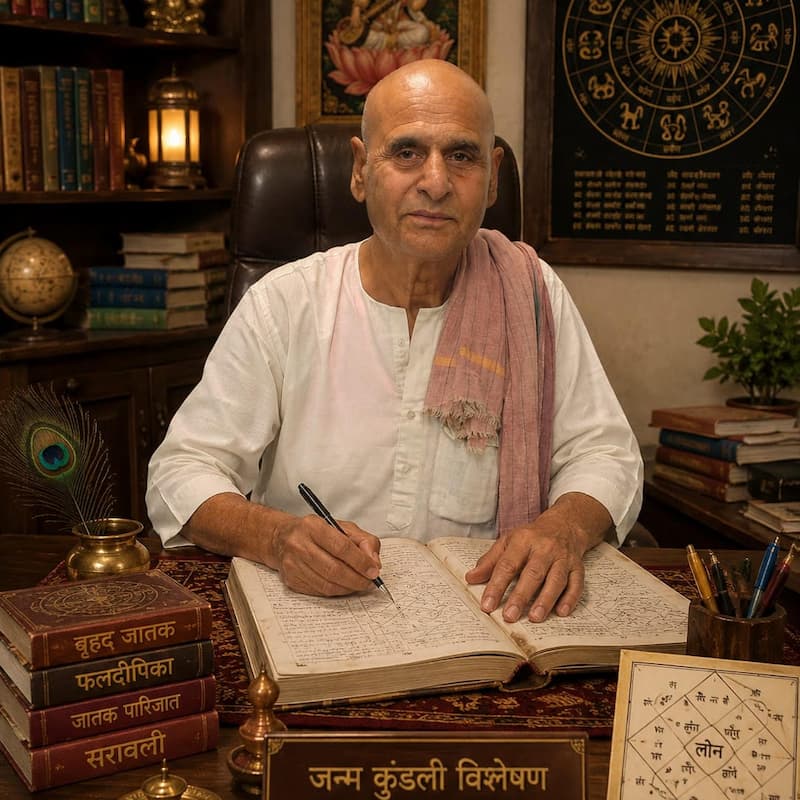
Narendra Kumar Chaubey is a Jyotisha Acharya with over 30 years of experience, based in Bihar and serving clients across India in Vedic astrology, mantra shastra, Vastu and ritual practice.
He completed his formal training at Kameshwar Singh Darbhanga Sanskrit University (KSDSU), one of India’s oldest and most respected institutions for Vedic and Sanskrit scholarship, where he studied Jyotisha shastra, mantra vidya and related classical sciences. KSDSU’s tradition of rigorous Sanskrit education tracing directly to the Mithila region’s centuries-old pandit lineage forms the foundation of his practice.
Over three decades, Narendra Kumar Chaubey has worked with thousands of individuals and families across Bihar and across India, offering guidance in:
- Kundli (birth chart) analysis: Identifying karmic patterns, planetary periods and life path guidance through classical Jyotisha
- Palmistry (Hasta Samudrika): Reading the hand according to the classical Samudrika Shastra tradition
- Vastu Shastra: Assessment and correction of living and working spaces according to directional and elemental principles
- Mantra and Pooja vidhi: Performing and guiding all categories of puja, havan, and mantra sadhana for personal, family and business situations
- Predictive Jyotisha: Transit analysis, muhurta (auspicious timing) selection and remedial guidance
He works across four languages Sanskrit, Hindi, English and Bhojpuri making classical knowledge accessible to practitioners across educational backgrounds and regions.
His writing for ABMantra brings the precision of classical Vedic training to practical mantra guidance: not general advice but specific prescriptions grounded in shastra, lineage and 30 years of direct practice with real situations.
For more info follow on: