


The Hanuman Beej Mantra “Om Aim Hrim Hanumate Ramadutaya Namah” is the most concentrated and energetically intense form of Hanuman mantra available to an ordinary practitioner without formal initiation. Where the Hanuman Mool Mantra (Om Hanumate Namah) is the daily devotional form accessible to everyone, the Hanuman Beej Mantra is the intensive sadhana form: designed for 40-day committed practice, for serious obstacle removal and for situations where the gentler mantra has not been sufficient.
The word Beej means seed in Sanskrit. A beej mantra is not merely a shorter version of a longer prayer it is a concentrated seed sound that contains the entire force of the deity’s energy in its most compact form. The Hanuman Beej Mantra encodes this concentrated energy through two tantric beej syllables (Aim and Hrim) alongside Hanuman’s principal name and his most important title (Ramaduta Rama’s messenger). Together they make the Hanuman Beej Mantra one of the most complete and powerful formulations available in the Hanuman mantra tradition.
This complete guide to the Hanuman Beej Mantra covers the full Sanskrit text and its transliteration, the meaning of every syllable in the mantra, the benefits of the Hanuman Beej Mantra practice, how it differs from the Mool Mantra and the Gayatri Mantra, the correct chanting method, a complete 40-day sadhana guide and answers to the most common questions about this mantra.
For all Hanuman Mantras including the Mool Mantra, Gayatri Mantra and Bajrang Baan, see the main article: Hanuman Mantra Meaning, Types, Benefits and How to Chant.
Hanuman Beej Mantra: Sanskrit Text, Transliteration and Full Meaning
The Hanuman Beej Mantra is presented here in its complete form. Read this before studying the syllable breakdown the whole mantra should be in your mind before you understand each of its parts.
| Hanuman Beej Mantra ॐ ऐं ह्रीं हनुमते रामदूताय नमः Om Aim Hrim Hanumate Ramadutaya Namah Meaning: Salutation to Hanuman, the ocean of wisdom and divine energy, the perfect messenger and servant of Lord Rama I bow to you completely. |
This Hanuman Beej Mantra is chanted 108 times daily as the standard count for dedicated sadhana practice. It is most commonly begun on a Tuesday. The complete 40-day Hanuman Beej Mantra sadhana is described in detail later in this guide.
Source: Hanuman Beej Mantra as preserved in the Hanuman Upasana tradition and referenced across multiple mantra collections including the Mantra Mahodadhi. The presence of Aim and Hrim beej sounds connects it to the broader Shakta-Vaishnava tantric tradition that developed around Hanuman worship.
Hanuman Beej Mantra Meaning: Every Syllable Explained
Understanding the Hanuman Beej Mantra meaning requires going deeper than a simple translation. Each sound in this mantra carries a specific energetic function. This is the distinguishing quality of beej mantras: they are not merely words, they are carefully constructed sound formulations where every syllable serves a purpose.
| Sound | Meaning | Function in the Mantra | Source |
| Om | The primordial sound of the universe. Opens and closes every mantra. Connects the individual self to universal consciousness. | Opens the mantra. Connects the individual practitioner to the cosmic ground from which Hanuman’s energy operates. | Mandukya Upanishad |
| Aim (ऐं) | The beej of Saraswati, the goddess of wisdom and sound. Brings the quality of intelligence, clarity and the power of sacred speech into the mantra. | Brings divine intelligence and the quality of clear discernment into the mantra. Aim is the quality that makes Hanuman Buddhimatam Varishtham the foremost among the wise. | Tantric tradition |
| Hrim (ह्रीं) | The beej of Maya the divine power that animates creation. Also associated with the heart chakra. Brings vitality, magnetic energy and transformative power. | Activates transformative energy and vital force. Hrim is the quality that makes Hanuman capable of changing circumstances not merely witnessing them. | Shakti Tantras |
| Hanumate | The dative form of Hanuman meaning ‘to Hanuman’ or ‘for Hanuman.’ This is the address: the mantra is directed toward him specifically. | The grammatical address. The mantra is directed to Hanuman specifically, not to a general divine principle. | Sanskrit grammar dative case |
| Ramadutaya | Rama’s messenger one of Hanuman’s most important titles. Ramaduta means the one entrusted by Rama to carry out impossible missions. Invoking this title calls on Hanuman’s quality of flawless execution under divine mandate. | Activates Hanuman’s mission-executing quality. This title calls on the Hanuman who crossed an ocean, found the impossible to find and returned to report with perfect accuracy. | Valmiki Ramayana, Sundarakanda |
| Namah | Salutation, bow, surrender. From na (not) + mama (mine) meaning ‘not mine’, a complete offering of the self. The closing surrender that completes the mantra. | Closes the loop. The practitioner’s ego is offered. What remains is pure intention meeting pure energy. | Vedic Sanskrit |
The structural logic of the Hanuman Beej Mantra is worth appreciating. It opens with Om (the universal ground), adds Aim (divine intelligence), adds Hrim (transformative vital energy), addresses Hanuman by name (Hanumate), invokes his primary title (Ramadutaya) and closes with surrender (Namah). This sequence moves from cosmic to specific to personal from the universal to the particular divine presence to the individual practitioner’s act of offering.
Source: Mandukya Upanishad on Om as universal consciousness. Shakta Tantra texts on Aim and Hrim beej functions. Valmiki Ramayana, Sundarakanda, on Hanuman as Ramaduta.
Hanuman Beej Mantra vs Mool Mantra vs Gayatri: Which to Chant and When
The three principal Hanuman mantras the Mool Mantra, the Beej Mantra and the Gayatri Mantra are not interchangeable. Each serves a different purpose and is appropriate for different practitioners and different situations. Understanding the distinction helps you choose the right Hanuman mantra practice for where you are right now.
| Element | Mool Mantra | Beej Mantra | Gayatri Mantra |
| Form | Mool Mantra (seed form) | Beej Mantra (concentrated seed form) | Gayatri (meditative hymn form) |
| Sanskrit | ॐ हनुमते नमः | ॐ ऐं ह्रीं हनुमते रामदूताय नमः | ॐ आञ्जनेयाय विद्महे… |
| Length | 3 syllables + Om | 8 syllables + Om | 24 syllables (Gayatri metre) |
| Intensity | Gentle, accessible | Concentrated, intense | Meditative, illuminating |
| Best for | Daily devotion, beginners, children | 40-day sadhana, obstacle removal, deep practice | Courage, intellect, meditation |
| Count | 11 or 108 times daily | 108 times daily, same time each day | 11 or 108 times |
| Day to begin | Any day | Tuesday most auspicious to start | Any day, especially sunrise |
| Initiation needed | No | No but sincere commitment required | No |
The practical guidance from experienced practitioners is consistent: establish the Mool Mantra as a daily practice first. Once you can maintain 108 repetitions daily for at least one month without breaking, the Hanuman Beej Mantra sadhana becomes the natural next step. Attempting the Beej Mantra sadhana without the foundation of consistent Mool Mantra practice is possible but significantly harder to sustain.
Hanuman Beej Mantra Benefits: What This Practice Does
The Hanuman Beej Mantra benefits described here are drawn from the classical mantra tradition and from the consistent experience of practitioners across many generations. They are specific rather than general the Hanuman Beej Mantra is a targeted practice, not a general-purpose devotional chant.
Removal of Deep-Rooted Obstacles
The most documented benefit of the Hanuman Beej Mantra is its effectiveness in removing obstacles that have resisted other approaches. The Ramadutaya title is the key: Hanuman in his role as Rama’s messenger succeeded at literally every mission he was assigned, including the most impossible ones crossing an ocean alone, finding a hidden captive in an enemy city, reviving the dying with a single herb. This mantra invokes that mission-executing quality directly. When chanted for 40 days with a specific clear intention, practitioners consistently report that circumstances blocking their path begin to rearrange.
Saturn (Shani) Dasha and Sade Sati Remedy
This practice is one of the most prescribed Jyotish remedies for Saturn-related difficulties. Classical Jyotish texts including the Brihat Parashara Hora Shastra recommend Hanuman practice for Saturn periods because of the specific relationship between the two: Hanuman saved Shani from Ravana’s captivity in Lanka, and Shani in gratitude promised to moderate his effects on Hanuman’s sincere devotees. The Beej Mantra, as the most intensive of the regular Hanuman mantras, is prescribed for serious Saturn afflictions where the lighter Mool Mantra practice has not been sufficient.
Source: Brihat Parashara Hora Shastra, Saturn remedies chapter. Also referenced in multiple Navagraha Stotra collections.
Courage and the Dissolution of Fear
Hrim, the second beej sound in the Hanuman Beej Mantra, is specifically associated with the dissolution of limiting energy patterns including the energetic roots of persistent fear and self-doubt. Combined with Hanuman’s own quality as Mahavira (the great hero) and Abhaya (the one who is fearless), this mantra has a specific effect on practitioners who are facing situations that require courage they do not yet feel they have. This is a documented pattern: the 40-day sadhana reliably produces a felt shift in the practitioner’s relationship to fear.
Support for Serious Undertakings
The Hanuman Beej Mantra is particularly used when beginning a major life undertaking a business launch, a career change, a legal matter, a competitive examination, a medical treatment. The tradition of chanting it 108 times daily for 40 days before a specific date (an exam date, a launch date, a court hearing) is a practical application of this mantra’s obstacle-clearing and mission-executing energy. Aim (divine intelligence) and Hrim (transformative vital force) together with Ramadutaya (the quality of flawless execution) make it the most relevant Hanuman mantra for performance-related intentions.
Spiritual Deepening and Proximity to Hanuman’s Presence
Beyond the specific practical benefits, the 40-day Hanuman Beej Mantra sadhana reliably produces something subtler and more lasting: a direct felt sense of Hanuman’s protective presence. Practitioners who complete the full 40 days consistently describe the same experience by the second or third week, the mantra begins to recite itself. They find themselves chanting it silently during commutes, before difficult conversations, while waiting. This internalization is itself the deepest benefit: the mantra becomes a living part of the practitioner’s inner landscape rather than a formal practice performed at a fixed time.
How to Chant the Hanuman Beej Mantra: Pronunciation and Method
Correct pronunciation matters more with the Hanuman Beej Mantra than with simpler mantras, specifically because of the two beej sounds Aim and Hrim. These are precise Sanskrit phonemes with specific resonance qualities. Mispronouncing them does not nullify the mantra sincere intention remains the primary factor but correct pronunciation amplifies the mantra’s effect significantly.
Pronunciation Guide
| Syllable | Pronunciation | Common Mistake to Avoid |
| Om | The ‘O’ is a long open vowel (as in ‘home’). The ‘M’ is a nasal resonance held for 2 to 3 seconds felt in the chest and skull. | Cutting the ‘M’ short. The nasal resonance of Om is where much of its effect lies. Hold it. |
| Aim (ऐं) | Pronounced ‘I-yim’ a diphthong. The ‘ai’ sounds like the English ‘I’ said slowly. The final nasal ‘m’ should resonate. | Saying ‘aim’ as in the English word. The Sanskrit Aim has an ‘I’ sound, not an ‘A’ sound. |
| Hrim (ह्रीं) | Pronounced ‘Hreem’ the ‘Hr’ is a combined consonant cluster. The ‘ee’ is a long vowel held briefly. The final ‘m’ is nasal. | Dropping the ‘Hr’ cluster. In spoken practice, ‘Hreem’ should feel like it begins in the throat. |
| Hanumate | Ha-nu-ma-te four clear syllables. The ‘te’ at the end signals the dative case (to Hanuman). | Rushing through this word. It contains Hanuman’s name and deserves the same deliberateness as the beej sounds. |
| Ramadutaya | Ra-ma-du-ta-ya five syllables. The ‘du’ is short. The ‘ya’ ending is light. | Dropping the ‘ya’ ending. The full word Ramadutaya is the title that activates the mission-executing aspect. |
| Namah | Na-mah two syllables. The ‘ah’ at the end is an aspirated open vowel, not silent. | Saying ‘Namah’ as if it ends with a hard ‘a’ like ‘name.’ The ‘ah’ ending is an open exhalation. |
The best way to learn the correct pronunciation of the Hanuman Beej Mantra is to listen to a clean audio recording of an experienced chanter and repeat phrase by phrase until the sound feels natural. Once you have the pronunciation established, maintain it consistently. The consistency of the sound pattern is itself part of what makes the mantra work.
Hanuman Beej Mantra 40-Day Sadhana: Complete Guide
The 40-day Hanuman Beej Mantra sadhana is the traditional and most powerful method for receiving the full benefits. The number 40 comes from the Hanuman Chalisa’s own reference to 40 days as the period after which results become visible to a sincere practitioner. This 40-day structure is used across traditions because it is the minimum period for creating a genuine new neural and energetic pattern one that begins to operate on its own rather than requiring constant conscious effort.
1. Choose Tuesday as your start day. This is the most auspicious day to begin a Hanuman Beej Mantra sadhana and sets the right energetic foundation for the full 40 days.
2. Set a fixed time before starting. The same time every day for all 40 days. Brahma Muhurta (4:35 to 5:23 AM) is the classical recommendation. If this is not possible, any fixed daily time works consistency matters more than the hour.
3. Set up a clean space. A small altar with a Hanuman image, a lit ghee diya and an agarbatti is the traditional setup. Red or saffron cloth on the altar is appropriate for Hanuman.
4. State your intention silently before the first chant of each session. Know specifically what you are asking the Hanuman Beej Mantra to work on in your life. Hold this intention without forcing it state it and then let it go as you chant.
5. Begin with Om Hanumate Namah recited 3 times as an opening invocation. Then move into the Hanuman Beej Mantra for the full 108 count.
6. Chant 108 times using a rudraksha or tulsi mala. Hold the mala in the right hand. Use thumb and middle finger to move one bead per repetition. Do not cross the Meru (the central bead) when you reach it, turn the mala and go back.
7. Chant at a pace where every syllable is clear: Om… Aim… Hrim… Hanumate… Ramadutaya… Namah. Not rushed. Not laboured. Steady and clear.
8. Observe these vows for all 40 days: avoid non-vegetarian food, alcohol, onion and garlic on the day of practice. If you observe daily practice, maintain these throughout the full 40 days.
9. If you miss a day, restart the 40-day count from day one. This rule is strict because the energetic continuity of the sadhana depends on it.
10. On day 40, offer a special puja: red flowers, laddoo prasad, a new red cloth for the altar. Distribute the prasad to at least five people. Express gratitude whether or not you have seen the results yet.
From our practice: The most commonly reported turning point in the 40-day Hanuman Beej Mantra sadhana is around day 21. The first two weeks feel effortful you are consciously constructing the practice every morning. By the third week something shifts. The mantra begins to feel like it is chanting itself. You wake with it already present in the mind. This shift from practice as effort to practice as natural state is itself one of the most significant results of the sadhana. It is the point at which the Hanuman Beej Mantra has moved from memory to samskara a genuine impression on consciousness.
Source: The 40-day sadhana tradition as referenced in the Hanuman Chalisa (verse 37), multiple Shakta Tantra texts on the role of sustained practice in mantra sadhana, and the broader 40-day vow tradition in Indian spiritual practice.
Hanuman Beej Mantra: Rules and What to Avoid
Observe These During the 40-Day Sadhana
• Begin on Tuesday. This is the single most important timing decision for the Hanuman Beej Mantra sadhana.
• Maintain the same time every day. Even 10 minutes early or late is acceptable. Missing the practice entirely is not.
• Wear red or saffron during the formal morning practice. These are Hanuman’s colours in the tradition.
• Hold a specific, clear intention. Know what you are asking the Hanuman Beej Mantra to work on. Vague sadhana produces vague results.
• Offer a small prasad at the end of each session. Even just a piece of jaggery placed before the Hanuman image and eaten after the session is sufficient.
Avoid These During the 40-Day Sadhana
• Non-vegetarian food, alcohol, onion and garlic on the day of practice. For daily sadhana, observe this every day.
• Chanting with a distracted or impatient mind. Return to the mantra when the mind wanders but do not rush through the count just to complete it.
• Switching to a different mantra mid-sadhana. If you begin with the Hanuman Beej Mantra, complete the full 40 days with this mantra.
• Missing a day and continuing as if it did not happen. If you miss a day, restart the count. This is the traditional rule and it is what makes the sadhana effective.
• Chanting this mantra casually without the sadhana structure. It is designed for committed practice. For casual daily devotion, Om Hanumate Namah is the correct choice.
Conclusion: Begin the Hanuman Beej Mantra Practice
This mantra Om Aim Hrim Hanumate Ramadutaya Namah is not the right starting point for everyone. If you are new to Hanuman mantra practice, begin with Om Hanumate Namah chanted 108 times daily and establish that as a consistent habit first. This practice will be waiting for you when you are ready.
If you have been chanting the Mool Mantra consistently and are ready to go deeper if there is a specific obstacle that needs serious attention, a difficult period in life that requires more than devotion, or a genuine readiness to commit to 40 days of concentrated sadhana the Hanuman Beej Mantra is the most powerful tool available in this tradition without a Guru’s initiation.
Begin on the next Tuesday. Chant 108 times. Return the next morning. Continue for 40 days. That is all the Hanuman Beej Mantra asks of you and everything it asks of you. Jai Bajrang Bali.
Frequently Asked Questions About Hanuman Beej Mantra
What is the Hanuman Beej Mantra?
The Hanuman Beej Mantra is Om Aim Hrim Hanumate Ramadutaya Namah a concentrated seed-sound invocation of Lord Hanuman that contains two tantric beej sounds (Aim and Hrim) alongside the primary name and title of Hanuman. The word Beej means seed in Sanskrit. A beej mantra encodes a large amount of spiritual energy into a short form like a seed that contains the entire tree within it. The Hanuman Beej Mantra is more concentrated and more intense than the simple Mool Mantra (Om Hanumate Namah) and is used for deep sadhana, serious obstacle removal and the 40-day practice tradition.
What does Om Aim Hrim Hanumate Ramadutaya Namah mean?
Each syllable carries a specific meaning. Om is the primordial universal sound. Aim is the beej of Saraswati wisdom and sacred speech. Hrim is the beej of Maya or divine vital energy, associated with the heart and transformation. Hanumate is the dative form of Hanuman’s name (meaning ‘to Hanuman’ the mantra is addressed directly to him). Ramadutaya means ‘Rama’s messenger’ invoking Hanuman in his role as the one entrusted with executing impossible missions. Namah means salutation and surrender. Together: I salute and surrender to Hanuman, the ocean of wisdom and transformative energy, the perfect messenger and agent of Lord Rama.
How many times should I chant the Hanuman Beej Mantra?
108 times daily is the standard count for the Hanuman Beej Mantra one complete mala. This is the count used for the 40-day sadhana. For beginners who find 108 repetitions difficult initially, starting with 27 (one quarter mala) for the first week and building to 108 is acceptable. The key principle is that once you commit to a sadhana count, maintain it consistently for the full 40 days without reducing it mid-practice.
Which day is best to chant the Hanuman Beej Mantra?
Tuesday (Mangalvar) is the most auspicious day to begin a Hanuman Beej Mantra sadhana and the best day for the weekly extended practice. Saturday (Shanivar) is the second important day. For daily practice, the Hanuman Beej Mantra can be chanted every day of the week once the sadhana has begun. The tradition is to start on a Tuesday and maintain daily practice for 40 consecutive days.
Does the Hanuman Beej Mantra require initiation from a Guru?
No. The Hanuman Beej Mantra is one of the Hanuman mantras that does not require formal initiation (Diksha). Hanuman is specifically described in the tradition as the most accessible of all deities requiring only sincere devotion and genuine need, not formal initiation. The beej sounds Aim and Hrim are from the broader tantric tradition where they are sometimes given with initiation, but in the context of the Hanuman Beej Mantra they are available to all practitioners. Begin with a sincere heart, a clear intention and the correct pronunciation.
What is the difference between Hanuman Beej Mantra and Hanuman Mool Mantra?
The Hanuman Mool Mantra (Om Hanumate Namah) is the simplest, most accessible form of Hanuman invocation suitable for daily practice, beginners and children. The Hanuman Beej Mantra (Om Aim Hrim Hanumate Ramadutaya Namah) is a more concentrated and intense form that includes the tantric beej sounds Aim and Hrim. The Mool Mantra is like drinking plain water from a spring. The Beej Mantra is like drinking the same water in a concentrated extract form. Both are Hanuman the Beej Mantra simply delivers more energy per repetition and is used for more targeted, intensive sadhana work.
Can I chant the Hanuman Beej Mantra during Sade Sati?
Yes the Hanuman Beej Mantra is one of the most effective practices during Sade Sati (Saturn’s 7.5-year transit) and Shani Mahadasha. Hanuman saved Shani (Saturn) from Ravana’s captivity in Lanka, and Shani in gratitude promised to lighten his effects on Hanuman’s devoted practitioners. The Hanuman Beej Mantra chanted 108 times daily for 40 days, with particular emphasis on Saturdays, is a more intensive version of the standard Saturday Hanuman practice that Jyotish texts prescribe for Saturn remediation.
What results should I expect from a 40-day Hanuman Beej Mantra sadhana?
Most practitioners report a noticeable shift in energy and clarity within the first 2 to 3 weeks. The specific changes depend on what intention you hold during the sadhana. Common reports include: obstacles that had been blocking a project or relationship beginning to shift, a greater sense of courage and willingness to act in areas where fear had been the dominant experience, reduction in unexplained anxiety, and a felt sense of Hanuman’s presence and protection. Results are not always dramatic or immediate sometimes they appear as circumstances quietly rearranging in the background. The consistent experience across generations of practitioners is: finish the 40 days fully and sincerely, and something will have changed.
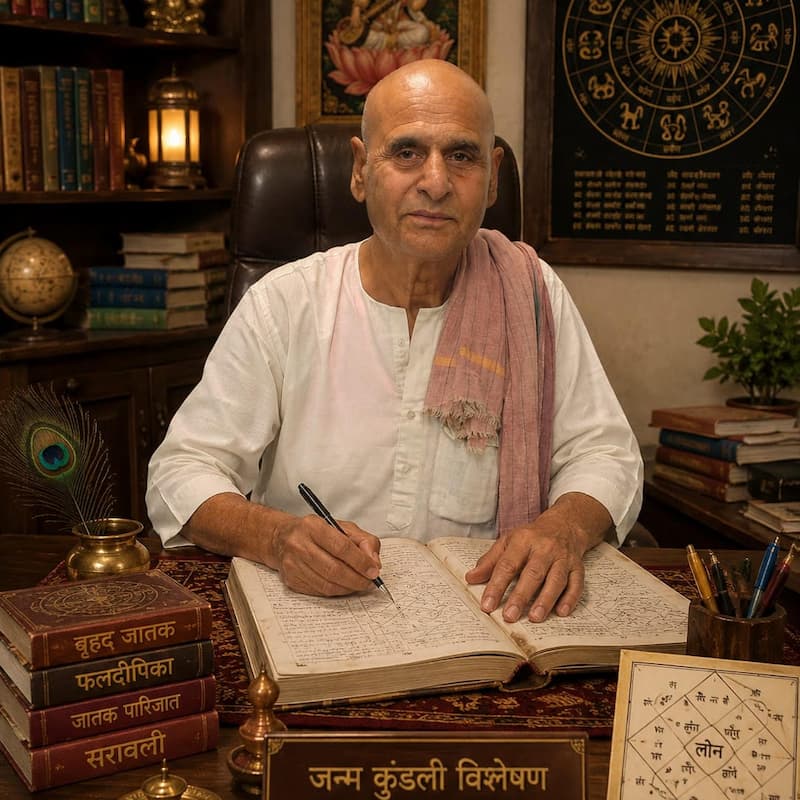
Narendra Kumar Chaubey is a Jyotisha Acharya with over 30 years of experience, based in Bihar and serving clients across India in Vedic astrology, mantra shastra, Vastu and ritual practice.
He completed his formal training at Kameshwar Singh Darbhanga Sanskrit University (KSDSU), one of India’s oldest and most respected institutions for Vedic and Sanskrit scholarship, where he studied Jyotisha shastra, mantra vidya and related classical sciences. KSDSU’s tradition of rigorous Sanskrit education tracing directly to the Mithila region’s centuries-old pandit lineage forms the foundation of his practice.
Over three decades, Narendra Kumar Chaubey has worked with thousands of individuals and families across Bihar and across India, offering guidance in:
- Kundli (birth chart) analysis: Identifying karmic patterns, planetary periods and life path guidance through classical Jyotisha
- Palmistry (Hasta Samudrika): Reading the hand according to the classical Samudrika Shastra tradition
- Vastu Shastra: Assessment and correction of living and working spaces according to directional and elemental principles
- Mantra and Pooja vidhi: Performing and guiding all categories of puja, havan, and mantra sadhana for personal, family and business situations
- Predictive Jyotisha: Transit analysis, muhurta (auspicious timing) selection and remedial guidance
He works across four languages Sanskrit, Hindi, English and Bhojpuri making classical knowledge accessible to practitioners across educational backgrounds and regions.
His writing for ABMantra brings the precision of classical Vedic training to practical mantra guidance: not general advice but specific prescriptions grounded in shastra, lineage and 30 years of direct practice with real situations.
For more info follow on: