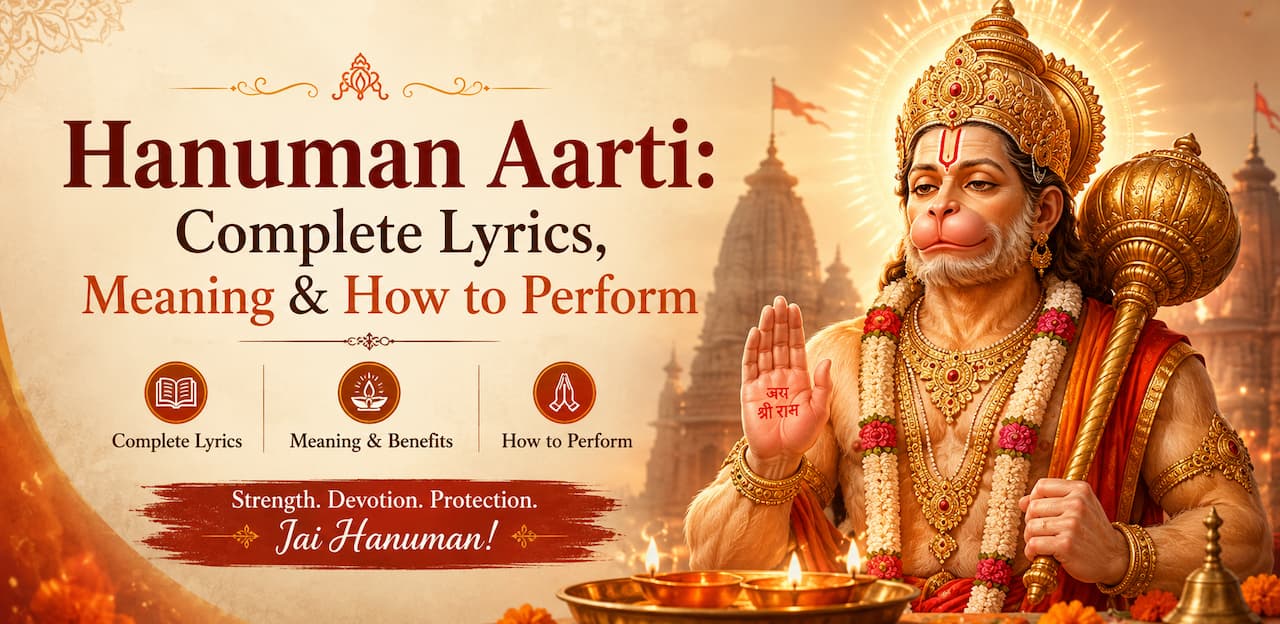

The Hanuman Aarti — Aarti Kije Hanuman Lala Ki — is the devotional closing hymn that seals every Hanuman puja. After the Chalisa is chanted and the mantra practice is complete, this aarti closes the circle of worship. The waving of a camphor flame before Hanuman’s image, the ringing of the bell, the singing of these 13 verses — this is the moment when the puja transitions from personal prayer into a complete offering of light, sound and devotion.
The Hanuman Aarti lyrics and meaning are attributed to Goswami Tulsidas — the same poet-saint who composed the Hanuman Chalisa and the Ramcharitmanas. Written in Awadhi with the same warmth and directness that characterises all of Tulsidas’s Hanuman compositions, this prayer moves through Hanuman’s principal qualities and great deeds before closing with its most important promise: whoever sings it attains the highest state and dwells in Vaikuntha.
This complete Hanuman Aarti guide covers the full lyrics in Hindi and English, the Hanuman Aarti meaning of every verse, the step-by-step performance method, what items are needed, the benefits and the difference between this aarti and the Hanuman Chalisa.
For the complete Hanuman Chalisa with all 40 verses and their meanings — the prayer that precedes the Hanuman Aarti in daily practice — see: Hanuman Chalisa — Complete Lyrics, All 40 Verses with Meaning and How to Read.
What Is Hanuman Aarti and Why Is It Performed
The word Aarti comes from the Sanskrit Aratrika, meaning the removal of darkness. An aarti is a ritual in which a lit lamp — traditionally a camphor flame or a ghee diya on a metal plate — is waved before a deity in a clockwise circular motion while a devotional hymn is sung. The Hanuman Aarti is the specific hymn and ritual performed in honour of Lord Hanuman.
In Hindu puja practice, the aarti is always the concluding act. It is the formal offering of light that closes the worship session. The five traditional offerings in puja (Pancha Upachara) are: fragrance (incense), flowers, light (diya), food (prasad) and water. The Hanuman Aarti is the offering of light — the most visible and most joyful of the five offerings — and it is the offering that formally completes the puja.
Source: Hindu ritual tradition — Aarti as the concluding Pancha Upachara offering. Referenced in the Agni Purana and multiple Vaishnava ritual texts.
The camphor flame used in the Hanuman Aarti carries specific symbolism. Camphor burns completely without residue — this is the symbolic message: the ego should burn completely in the flame of devotion. The devotee who performs this aarti with that understanding transforms a simple ritual into a profound act of surrender.
This aarti is performed after the Hanuman Chalisa in daily home puja, at the conclusion of any temple visit, at the end of special Tuesday and Saturday puja sessions, on Hanuman Jayanti as part of the day’s complete worship, and as a standalone brief devotional act when time does not permit the full Chalisa. It can be completed in 3 to 4 minutes and is among the most time-efficient complete devotional acts in the Hanuman tradition.
Hanuman Aarti Full Lyrics: Aarti Kije Hanuman Lala Ki — Hindi and English
Here are the complete Hanuman Aarti lyrics in Hindi, Roman transliteration and meaning of every verse. The aarti contains 13 verses — a refrain, 11 main verses and a closing couplet attributed to Tulsidas. The refrain (Aarti Kije Hanuman Lala Ki) is repeated at the beginning and end of the aarti, and many traditions repeat it between verses as well.
| Verse 1 (Refrain) आरती कीजै हनुमान लला की। दुष्ट दलन रघुनाथ कला की॥ Aarti Kije Hanuman Lala Ki. Dusht Dalan Raghunath Kala Ki. Meaning: Perform the aarti of beloved Hanuman — the destroyer of the wicked, the divine power of Lord Rama. Significance: The refrain that opens and closes this aarti. Lala means beloved child — Hanuman is addressed with the warmth and tenderness of a parent’s love. Dusht Dalan (destroyer of the wicked) names his protective function. This single couplet establishes both the emotional register and the practical purpose of the aarti. |
| Verse 2 जाके बल से गिरिवर कांपे। रोग दोष जाके निकट न झांके॥ Jake Bal Se Girivar Kaanpe. Rog Dosh Jake Nikat Na Jhaanke. Meaning: With his power even the great mountains tremble. Disease and defects do not come near him. Significance: Two powers in two lines: the external (mountains tremble before his strength) and the internal (disease and defect cannot approach him). This verse is the scriptural basis for chanting this aarti during illness — Rog Dosh Nikat Na Jhaanke makes a direct promise that ailments cannot approach Hanuman’s devoted practitioners. |
| Verse 3 अंजनि पुत्र महाबलदायी। संतन के प्रभु सदा सहाई॥ Anjani Putra Maha Baldaayi. Santan Ke Prabhu Sada Sahai. Meaning: Son of Anjani, the giver of great strength — he is always the helper and Lord of the saints. Significance: Maha Baldaayi means the one who gives enormous strength — not a passive deity but an active giver. Santan Ke Prabhu Sada Sahai is the promise most saints and sadhus live by: Hanuman is always the helper of those who walk the path of devotion. This is why this aarti is chanted in monasteries, ashrams and saints’ residences across India every morning. |
| Verse 4 दे बीरा रघुनाथ पठाए। लंका जारी सिया सुध लाए॥ De Beera Raghunath Pathaaye. Lanka Jaari Siya Sudhi Laaye. Meaning: Given a ring by Raghunath (Rama) and sent on his mission — he burned Lanka and brought back news of Sita. Significance: Beera is the Hindi word for betel leaf — but here it is the ring of recognition that Rama gave Hanuman as Sita’s identification token. The verse compresses the entire Lanka mission into one line: the departure with Rama’s trust, the burning of Lanka, the return with Sita’s message. All of Hanuman’s greatness in a single couplet. |
| Verse 5 लंका सो कोट समुद्र सी खाई। जात पवनसुत बार न लाई॥ Lanka So Kot Samudra Si Khaayi. Jaat Pavansut Baar Na Laayi. Meaning: Lanka’s fortress was surrounded by an ocean like a moat — yet the son of the wind crossed it without a moment’s hesitation. Significance: Baar Na Laayi means without taking even a moment — without hesitation. What the verse is saying is what this aarti asks the devotee to cultivate: the willingness to move toward the impossible without letting fear create delay. |
| Verse 6 लंका जारी असुर संहारे। सियारामजी के काज संवारे॥ Lanka Jaari Asur Sanhaare. Siyaramji Ke Kaaj Sanvaare. Meaning: He burned Lanka and destroyed the demons — accomplishing everything for Sita and Rama. Significance: Kaaj Sanvaare means to arrange, complete and perfect. Not just accomplishing the task but arranging it beautifully. This is the standard that Hanuman set for every devotee who wants to serve: not half-measures but completeness in service. |
| Verse 7 लक्ष्मण मूर्च्छित पड़े सकारे। आनि संजीवन प्राण उबारे॥ Lakshman Moorchhit Pade Sakaare. Aani Sanjeevan Praan Ubaare. Meaning: Lakshmana lay unconscious at dawn — Hanuman brought the Sanjeevani herb and restored his life. Significance: Sakaare means at dawn — the most critical timing detail. Lakshmana was near death and the remedy had to arrive before sunrise. Hanuman crossed the Himalayas and returned in time. This aarti includes this verse because it is the clearest demonstration of Hanuman acting as the remover of that which seems impossible to remove. |
| Verse 8 पैठि पाताल तोरि जम-कारे। अहिरावण की भुजा उखारे॥ Paithi Pataal Tori Jam-kaare. Ahiravan Ki Bhuja Ukhaare. Meaning: He entered the underworld and broke open the realm of Yama (death) — tearing apart Ahiravana’s arms. Significance: Ahiravana was the most powerful demon in the Patala (underworld). Even there, in the realm of death itself, Hanuman entered and defeated him. This verse signals that Hanuman’s protection extends beyond the visible world — he can act in dimensions of existence that no other deity readily enters on a devotee’s behalf. |
| Verse 9 बाएं भुजा असुर दल मारे। दाहिने भुजा संतजन तारे॥ Baayen Bhuja Asur Dal Maare. Daahine Bhuja Santjan Taare. Meaning: With his left arm he destroys armies of demons — with his right arm he protects and uplifts the saints. Significance: This is the most visually precise verse in the aarti. Left arm destroys. Right arm protects. The same being, in the same moment, holding both functions simultaneously. This is the quality of the divine protector: not choosing between destruction and compassion but holding both perfectly calibrated to what each situation requires. |
| Verse 10 सुर नर मुनि आरती उतारे। जय जय जय हनुमान उचारे॥ Sur Nar Muni Aarti Utaare. Jai Jai Jai Hanuman Uchaare. Meaning: Gods, humans and sages all perform his aarti — singing Victory, Victory, Victory to Hanuman. Significance: Sur (gods), Nar (humans), Muni (sages) — all three categories of conscious beings in the Hindu cosmological framework perform this aarti. The triple Jai (victory) at the close of this verse is the most jubilant moment in the aarti and is traditionally sung loudest, with the bell and clapping at their most energetic. |
| Verse 11 कंचन थार कपूर लौ छाई। आरती करत अंजना माई॥ Kanchan Thaar Kapoor Lau Chhaayi. Aarti Karat Anjana Maai. Meaning: With a golden plate and the light of camphor shining — Mother Anjana herself performs the aarti. Significance: The most tender image in this aarti: Hanuman’s own mother Anjana performing his aarti with a golden plate and camphor. The camphor flame is the traditional light of this aarti — it burns completely without residue, symbolising the ego’s complete surrender in devotion. |
| Verse 12 जो हनुमानजी की आरती गावे। बसि बैकुंठ परम पद पावे॥ Jo Hanumanji Ki Aarti Gaave. Basi Baikunth Param Pad Paave. Meaning: Whoever sings the Hanuman Aarti — dwells in Vaikuntha and attains the highest state. Significance: The closing promise of the Hanuman Aarti: singing it leads to Vaikuntha (the abode of Vishnu/Rama) and Param Pad (the supreme state). This is not a conditional promise — Jo (whoever), Gaave (sings). Any sincere practitioner who sings the aarti reaches this result. This is why it is chanted at the end of every puja — it is a direct path to the highest. |
| Verse 13 (Final Couplet) लंक विध्वंस किये रघुराई। तुलसीदास प्रभु कीरति गाई॥ Lank Vidhvans Kiye Raghurai. Tulsidas Prabhu Keerti Gaayi. Meaning: Raghurai (Rama) destroyed Lanka — and Tulsidas sang the glory of this Lord. Significance: Tulsidas signed this aarti in the final couplet — confirming its attribution. Having praised Hanuman through all the verses, Tulsidas closes by reminding us that all of Hanuman’s greatness points back to Rama. Hanuman’s story is Rama’s story. The devotee who sings this aarti participates in both. |
| CLOSING REFRAIN आरती कीजै हनुमान लला की। दुष्ट दलन रघुनाथ कला की॥ Aarti Kije Hanuman Lala Ki. Dusht Dalan Raghunath Kala Ki. |
Source: Aarti Kije Hanuman Lala Ki attributed to Goswami Tulsidas, Vinaya Patrika tradition. Composed in Awadhi, 16th century CE. The aarti is sung daily in Hanuman temples across India and in the Sankat Mochan Hanuman Temple in Varanasi, founded by Tulsidas himself.
How to Perform Hanuman Aarti: Step-by-Step Method
The Hanuman Aarti can be performed in two ways: as part of the full Tuesday or Saturday puja, or as a daily brief closing to the Hanuman Chalisa practice. Both methods are described below.
Items Needed for Hanuman Aarti
| Item | Purpose and Notes |
| Aarti thali (plate) | A metal plate — brass, silver or copper — to hold the diya and offerings. A plain plate is sufficient. Some households keep a dedicated thali for Hanuman Aarti. |
| Camphor (kapoor) or ghee diya | Camphor is the traditional flame for the Hanuman Aarti — it burns completely without residue. A ghee diya (lamp with cotton wick and cow ghee) is equally valid. Light the camphor or diya on the thali before beginning. |
| Bell (ghanta) | The bell is rung continuously during the Hanuman Aarti to mark the transition into sacred time. It can be held in the left hand while the right hand holds the thali, or rung by a second person. |
| Incense (agarbatti) | Light before beginning the Hanuman Aarti. The smoke carries the prayer upward. Gugal (guggul) is the traditional incense for Hanuman; any natural incense is appropriate. |
| Red flowers | Hanuman’s colour is red. Offering red flowers — rose, hibiscus or red marigold — on the thali alongside the diya is the traditional embellishment. |
| Laddoo or jaggery (prasad) | Offered after the Hanuman Aarti is complete. The prasad is touched to the flame briefly, placed before the Hanuman image and then distributed to all present. |
| Hanuman image or photo | The Hanuman Aarti is performed facing the Hanuman image. A framed photo is sufficient. The image should be placed on a red cloth on the altar. |
Daily Practice: Hanuman Aarti After the Hanuman Chalisa
1. Complete the Hanuman Chalisa recitation (or the Hanuman mantra practice for the day).
2. Light the camphor or ghee diya on the thali. Light the agarbatti.
3. Pick up the thali in both hands (or the right hand with the bell in the left).
4. Begin singing the Hanuman Aarti: Aarti Kije Hanuman Lala Ki…
5. As you sing, wave the diya in a slow clockwise circle before the Hanuman image — starting from the feet, moving up to the face, over the head and back down. Complete 3 to 5 circles.
6. Ring the bell continuously throughout the aarti.
7. At verse 10 (Sur Nar Muni Aarti Utaare, Jai Jai Jai Hanuman Uchaare) — this is the moment of highest energy. Increase the bell ringing and sing the Jai Jai Jai with full voice.
8. Complete the aarti with the closing refrain: Aarti Kije Hanuman Lala Ki.
9. Place the thali before the Hanuman image. Offer the laddoo or jaggery as prasad.
10. Pass the diya flame to all present — each person passes both hands over the flame and touches their face (receiving the light as prasad).
Full Tuesday/Saturday Puja Sequence
On Tuesday and Saturday, the complete Hanuman puja sequence is: Hanuman Dhyana Shloka (3 times), Hanuman Mool Mantra (108 times), Hanuman Chalisa (1, 3, 7 or 11 times), Hanuman Aarti (once), distribution of prasad. The aarti is always the final act of this sequence — it closes and seals the puja energy that has been built through the mantras and the Chalisa.
From our practice: The verse that changes everything in the Hanuman Aarti is verse 9 — Baayen Bhuja Asur Dal Maare, Daahine Bhuja Santjan Taare (left arm destroys demons, right arm uplifts the saints). When you are waving the diya and reach this verse and it lands in you — really lands, not just passes through — the whole aarti changes quality. You understand in that moment that you are standing before a being who is simultaneously destroying what threatens you and supporting what nourishes you. The aarti thali is heavier with that understanding. The bell sounds different. This is what the Hanuman Aarti is for: not the ritual mechanics but the moments of understanding that the ritual creates.
Hanuman Aarti Benefits: What This Practice Does
The Hanuman Aarti benefits are described both in the aarti itself and in the broader Hanuman devotional tradition. Verse 12 makes the most direct statement: whoever sings the Hanuman Aarti attains Vaikuntha and the highest state. Below are the practical benefits as described across the classical tradition.
• Completion of puja: This aarti formally seals the puja. A puja completed without the Hanuman Aarti is considered incomplete in the tradition — like a conversation that ends mid-sentence. The Hanuman Aarti closes the circle of devotion that the Chalisa and mantra practice opened.
• Disease and defect removal: Verse 2 of the Hanuman Aarti states explicitly: Rog Dosh Jake Nikat Na Jhaanke (disease and defect do not come near him). Performing this aarti consistently is a traditional protection against illness — particularly when a family member is unwell, the aarti is performed on their behalf.
• Protection from negative forces: The opening refrain names Hanuman as Dusht Dalan. This aarti establishes that protective force around the home and the practitioner each time it is performed.
• Accumulation of punya (merit): The act of offering light to Hanuman through the aarti is one of the most meritorious devotional acts in the tradition. Verse 12 states the result: Basi Baikunth Param Pad Paave — the highest state is attained.
• Purification of the space: The camphor flame, the incense, the bell and the collective singing all create a purified devotional atmosphere. Negative energy finds it difficult to persist in a space where Hanuman Aarti is performed regularly.
• Deepening of devotional feeling: The act of physically waving the light, ringing the bell and singing aloud engages the body, voice and mind simultaneously. This multi-sensory engagement produces a depth of devotional feeling that silent mantra practice alone does not always reach.
These Hanuman Aarti benefits are most fully experienced when the practice is maintained regularly — daily if possible, or at minimum every Tuesday and Saturday. Singing each Hanuman Aarti verse with understanding produces a different quality of experience than rote singing. Both have value. The understanding deepens the experience significantly.
Hanuman Aarti vs Hanuman Chalisa: How They Work Together
The Hanuman Aarti and the Hanuman Chalisa are designed to work together as the two principal Hanuman devotional texts. Understanding the role of each makes the daily practice more intentional and more complete.
| Element | Hanuman Chalisa | Hanuman Aarti |
| Type | Stotra — devotional hymn for chanting as main practice | Closing hymn — performed with diya as conclusion of puja |
| Length | 40 verses — 10 to 15 minutes per recitation | 13 verses — 3 to 4 minutes |
| When | Main body of the daily or weekly practice | Always after the Chalisa — never before |
| How chanted | Seated, eyes closed or open, with full attention | Standing, waving a lit diya, ringing a bell |
| Function | Prayer, meditation, mantra energy, protection | Offering of light, completion of puja, sealing of devotional energy |
| Promise | Verse 38: Shiva witnesses that all who read it succeed | Verse 12: all who sing it attain Vaikuntha |
| Can it stand alone? | Yes — Hanuman Chalisa alone is a complete practice | Yes — the Hanuman Aarti can be sung as a brief standalone act |
Conclusion: Perform the Hanuman Aarti Daily
This aarti takes 3 to 4 minutes. A ghee diya. A bell. Thirteen verses of Tulsidas sung before Hanuman’s image. That is all it takes to perform one of the most complete devotional acts in the Hanuman tradition — an act that gods, humans and sages all perform, according to verse 10, and that leads directly to the highest state, according to verse 12.
If you have been chanting the Chalisa but not closing with the Hanuman Aarti, tonight is the right time to begin. The Chalisa opens the door. The Hanuman Aarti completes the conversation.
Aarti Kije Hanuman Lala Ki. Jai Bajrang Bali.
Frequently Asked Questions About Hanuman Aarti
What is the Hanuman Aarti?
The Hanuman Aarti (Aarti Kije Hanuman Lala Ki) is a devotional hymn attributed to Goswami Tulsidas, chanted at the conclusion of Hanuman puja. It consists of 13 verses describing Hanuman’s qualities, his great deeds in the Ramayana and the blessings he bestows on his devotees. The word Aarti refers to the ritual of waving a lit lamp (diya) before a deity in a circular motion while singing the hymn. The Hanuman Aarti is sung at the end of the puja as the formal conclusion and offering of light camphor or ghee to Hanuman.
What is the difference between Hanuman Aarti and Hanuman Chalisa?
The Hanuman Chalisa is a longer 40-verse devotional hymn chanted as a standalone meditation — it can take 10 to 15 minutes per recitation. This aarti is a shorter 13-verse closing hymn sung at the end of puja while waving a diya before the Hanuman image. In daily practice, the Hanuman Aarti follows the Chalisa: you chant the Chalisa first as the main prayer, then close with the Hanuman Aarti as the formal conclusion of the puja. They work together — the Chalisa is the body of the practice and the Aarti is the closing offering.
When should Hanuman Aarti be performed?
The Hanuman Aarti is performed at the conclusion of any Hanuman puja. In daily home practice, it is chanted after the Hanuman Chalisa during the morning and evening puja. On Tuesdays and Saturdays the Hanuman Aarti is performed with greater elaboration: incense, a ghee diya, red flowers and laddoo offered as prasad. On Hanuman Jayanti, the aarti is performed with full ceremony. This aarti can also be chanted as a standalone prayer at any time when a brief but complete devotional act is needed.
Can women perform Hanuman Aarti?
Yes, fully and without restriction. Women can perform the Hanuman Aarti at all times and in all conditions. There are no gender restrictions on the Hanuman Aarti. The verse 11 of the Hanuman Aarti itself depicts Hanuman’s mother Anjana performing his aarti — making it clear that women’s participation in the Hanuman Aarti is not only permitted but celebrated within the tradition itself.
What items are needed for Hanuman Aarti?
The minimum required items are: a ghee diya (a small lamp with a cotton wick and pure cow ghee), and a metal or clay plate (thali) to hold the diya. A camphor lamp is the traditional choice for the Hanuman Aarti because camphor burns completely without residue, symbolising complete surrender of the ego. Additional items for the full Tuesday or Saturday puja include: red flowers, sindoor (vermilion), laddoo or jaggery as prasad, agarbatti (incense), and a bell to ring during the aarti. Hanuman’s image or idol should be placed on a red cloth on the altar.
What is the benefit of singing Hanuman Aarti?
The Hanuman Aarti itself states the primary benefit in verse 12: Jo Hanumanji Ki Aarti Gaave, Basi Baikunth Param Pad Paave — whoever sings the Hanuman Aarti attains the highest state and dwells in Vaikuntha (the abode of Rama). Practically, the Hanuman Aarti benefits include: completion and sealing of the puja energy (the aarti closes the devotional circuit opened by the Chalisa), removal of disease and defect (verse 2), protection from negative forces (verse 1 and 2), and the accumulation of merit from a complete and sincere act of devotion. The combination of sound (the hymn), light (the diya), movement (the circular waving) and intention creates one of the most complete devotional acts in the Hanuman tradition.
How do you wave the diya during Hanuman Aarti?
Hold the aarti plate (thali) with both hands or the right hand alone. Begin at the feet of the Hanuman image and slowly move the diya upward in a large clockwise circle — feet, waist, chest, face, over the head and back down. Complete this circuit three, five or seven times while singing the aarti. The movement should be steady and devotional, not mechanical. The bell is rung continuously during the aarti — either by a second person or held in the left hand if using the right hand for the thali. After the aarti, offer the diya for the devotees to pass their hands over the flame (receiving the warmth as prasad).
Can Hanuman Aarti be performed without a Hanuman idol?
Yes. A framed photograph of Hanuman is sufficient. If neither an idol nor a photo is available, a red tilak (mark) made with sindoor on the wall facing east can serve as the focal point for the aarti. The presence of the image helps concentration and deepens the experience — but the Hanuman Aarti’s effectiveness depends on the sincerity of the devotee’s intention, not on the material elaborateness of the setup.
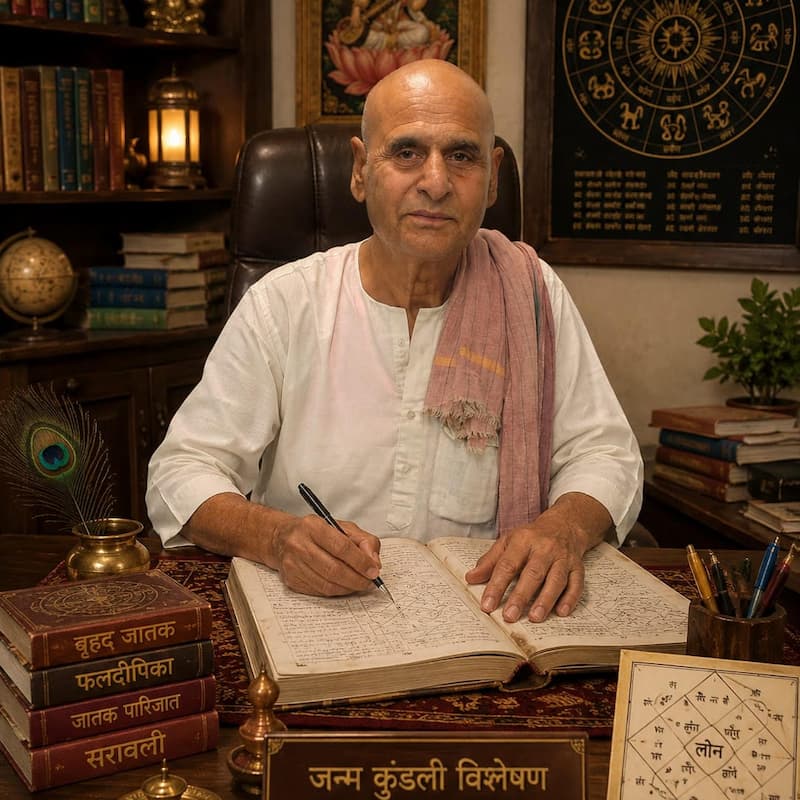
Narendra Kumar Chaubey is a Jyotisha Acharya with over 30 years of experience, based in Bihar and serving clients across India in Vedic astrology, mantra shastra, Vastu and ritual practice.
He completed his formal training at Kameshwar Singh Darbhanga Sanskrit University (KSDSU), one of India’s oldest and most respected institutions for Vedic and Sanskrit scholarship, where he studied Jyotisha shastra, mantra vidya and related classical sciences. KSDSU’s tradition of rigorous Sanskrit education tracing directly to the Mithila region’s centuries-old pandit lineage forms the foundation of his practice.
Over three decades, Narendra Kumar Chaubey has worked with thousands of individuals and families across Bihar and across India, offering guidance in:
- Kundli (birth chart) analysis: Identifying karmic patterns, planetary periods and life path guidance through classical Jyotisha
- Palmistry (Hasta Samudrika): Reading the hand according to the classical Samudrika Shastra tradition
- Vastu Shastra: Assessment and correction of living and working spaces according to directional and elemental principles
- Mantra and Pooja vidhi: Performing and guiding all categories of puja, havan, and mantra sadhana for personal, family and business situations
- Predictive Jyotisha: Transit analysis, muhurta (auspicious timing) selection and remedial guidance
He works across four languages Sanskrit, Hindi, English and Bhojpuri making classical knowledge accessible to practitioners across educational backgrounds and regions.
His writing for ABMantra brings the precision of classical Vedic training to practical mantra guidance: not general advice but specific prescriptions grounded in shastra, lineage and 30 years of direct practice with real situations.
For more info follow on: