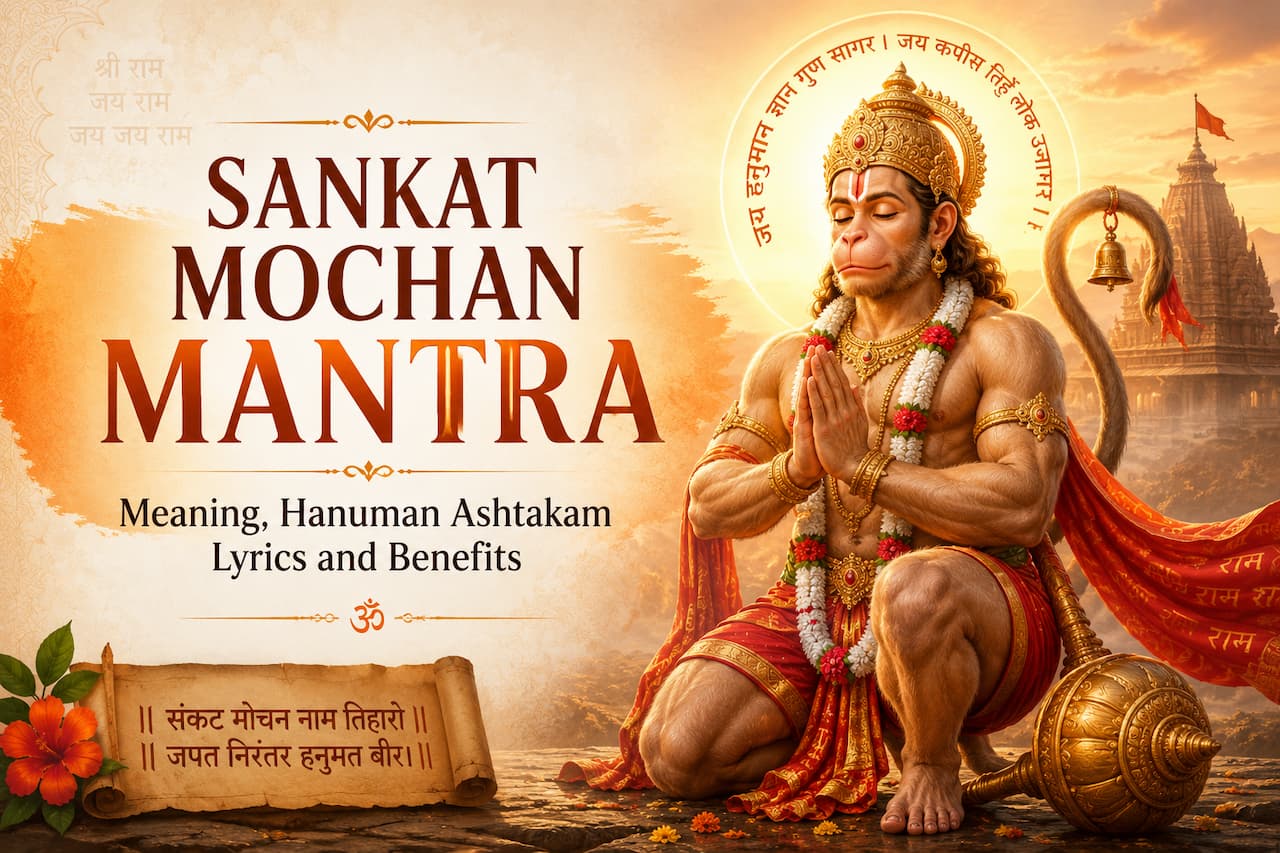

The Sankat Mochan Mantra is the mantra of the remover of all troubles. Sankat means trouble, crisis or difficulty. Mochan means the one who liberates or removes. Together they name one of Hanuman’s most beloved and most relied-upon qualities across all of India: his absolute dependability in crisis. When all other paths are exhausted, when the situation feels impossible, when the ordinary remedies have not worked the Sankat Mochan Mantra is the mantra practitioners turn to.
There are two forms of the Sankat Mochan practice. The first is the Sankat Mochan Mantra Om Ham Hanumate Namah a short seed mantra for daily japa practice that can be chanted 108 times on a mala or silently in any moment of sudden distress. The second is the Sankat Mochan Hanuman Ashtakam, an 8-verse devotional hymn by Goswami Tulsidas where each verse recalls one of Hanuman’s impossible rescues and closes with the famous refrain: Ko Nahin Jaanat Hai Jag Mein Kapi, Sankat Mochan Naam Tihaaro who in this world does not know, O Monkey, that your name is Sankat Mochan?
This complete Sankat Mochan Mantra guide covers the Sanskrit text and full meaning of the seed mantra, the Sankat Mochan Hanuman Ashtakam with all 8 verses and their significance, the Sankat Mochan Mantra benefits, the correct chanting method and practical guidance on when to use the mantra versus the Bajrang Baan.
For all Hanuman Mantras including the Mool Mantra, Beej Mantra, Bajrang Baan and protection mantras, see: Hanuman Mantra Meaning, Types, Benefits and How to Chant.
Sankat Mochan Mantra: Sanskrit Text and Complete Meaning
The primary Sankat Mochan Mantra used in japa practice is Om Ham Hanumate Namah. Understanding the Sankat Mochan Mantra meaning syllable by syllable is the key to chanting it with genuine awareness. This is the seed-form invocation of Hanuman’s Sankat Mochan quality, the most concentrated and accessible version of this practice.
| Sankat Mochan Mantra ॐ हं हनुमते नमः Om Ham Hanumate Namah Meaning: Salutation to Hanuman with his seed sound Ham the remover of all troubles and obstacles. |
Syllable-by-Syllable Meaning
| Sound | Meaning | Function in the Mantra |
| Om | The primordial sound of the universe the ground from which all mantras arise. | Opens the mantra and connects the practitioner to the universal field of Hanuman’s energy. |
| Ham (हं) | The beej (seed sound) of Hanuman himself. Ham is the sound most directly associated with Hanuman’s energy in the tantric tradition. | This single syllable is what makes the Sankat Mochan Mantra different from the Mool Mantra (Om Hanumate Namah). Ham is Hanuman’s direct vibrational signature invoking him by his own sound rather than just his name. |
| Hanumate | The dative form of Hanuman’s name meaning ‘to Hanuman’ or ‘for Hanuman’. The mantra is addressed directly to him. | The grammatical address of the mantra. Every repetition is a direct invocation not a general prayer but a specific call to one specific being. |
| Namah | Salutation, surrender, offering. From Na (not) + Mama (mine) ‘not mine’. A complete offering of the ego. | The closing that completes the circuit: the practitioner offers themselves entirely and Hanuman’s Sankat Mochan quality responds. |
The Ham beej is what distinguishes the Sankat Mochan Mantra from other Hanuman mantras. It places Hanuman’s own sound energy his resonance, not just his name at the centre of the practice. Practitioners consistently report that the Sankat Mochan Mantra produces a more immediate calming response than the Mool Mantra, precisely because the Ham beej creates a direct vibrational connection rather than a conceptual one.
Source: Ham as Hanuman’s beej sound is referenced in the Hanuman Upasana tradition and multiple mantra collections including the Mantra Mahodadhi. The use of the dative case (Hanumate rather than Hanuman) follows the grammatical pattern of all devotional mantras that address a deity directly.
Sankat Mochan Hanuman Ashtakam: All 8 Verses with Meaning
The Sankat Mochan Hanuman Ashtakam (also known as Sankat Mochan Naam Tihaaro) was composed by Goswami Tulsidas in Awadhi. Ashtakam means eight the prayer contains exactly 8 verses, each describing one of Hanuman’s impossible rescues, and each closing with the same refrain.
The refrain Ko Nahin Jaanat Hai Jag Mein Kapi, Sankat Mochan Naam Tihaaro is the theological and emotional core of the Ashtakam. Ko Nahin Jaanat (who does not know?) is a rhetorical question that functions as a declaration: everyone knows. Every single verse of the Ashtakam is building the same case: here is what Hanuman did in an impossible situation. And here is the conclusion: who does not know your name is Sankat Mochan?
The Sankat Mochan Hanuman Ashtakam is chanted after the Hanuman Chalisa in most Hanuman temple traditions and in the daily puja sequence before the Hanuman Aarti. It is specifically recited for situations of ongoing difficulty where the Chalisa provides general devotional grounding and the Ashtakam focuses specifically on the removal of a particular crisis.
Source: Sankat Mochan Hanuman Ashtakam composed by Goswami Tulsidas, preserved in the Vinaya Patrika collection. The Ashtakam is chanted daily in the Sankat Mochan Temple in Varanasi the temple Tulsidas himself founded.
| Verse 1 बाल समय रवि भक्षि लियो तब, तीनहुँ लोक भयो अँधियारो। ताहि सो त्रास भयो जग को, यह संकट काहू सों जात न टारो॥ देवन आनि करी बिनती तब, छाँड़ि दियो रवि कष्ट निवारो। को नहिं जानत है जग में कपि, संकटमोचन नाम तिहारो॥ Baal Samay Ravi Bhakshi Liyo Tab, Teenahun Lok Bhayo Andhiyaaro. Taahi So Traas Bhayo Jag Ko, Yah Sankat Kaahu Son Jaat Na Taaro. Devan Aani Kari Binati Tab, Chhaadi Diyo Ravi Kasht Nivaaro. Ko Nahin Jaanat Hai Jag Mein Kapi, Sankat Mochan Naam Tihaaro. Meaning: In your childhood you swallowed the Sun, and all three worlds fell into darkness. The whole world was terrified by this catastrophe no one could remove it. Then the gods came and pleaded with you, and you released the Sun and removed the distress. Who in this world does not know, O Monkey, that your name is Sankat Mochan? Significance: The refrain Ko Nahin Jaanat Hai Jag Mein Kapi, Sankat Mochan Naam Tihaaro (Who does not know your name is Sankat Mochan?) is the heart of the Ashtakam and is repeated after every verse. It is simultaneously a statement and a question: everyone knows, and yet the asking deepens the knowing. This refrain is one of the most powerful affirmations in the Hanuman devotional tradition. |
| Verse 2 बालि की त्रास कपीस बसे गिरि, जात महाप्रभु पंथ निहारो। चौंकि महामुनि सापि दियो तब, चाहिए कौन विचार बिचारो॥ कैद्विज रूप लिवाय महाप्रभु, सो तुम दास के सोक निवारो। को नहिं जानत…॥ Baali Ki Traas Kapees Base Giri, Jaat Mahaprabhu Panth Nihaaro. Chaunki Mahaa Muni Saap Diyo Tab, Chahiye Kaun Bichaar Bichaaro. Kai Dwij Roop Liwaay Mahaprabhu, So Tum Daas Ke Sok Niwaaro. Meaning: Sugriva, the king of monkeys, was living in the mountain out of fear of Bali. You looked out for the Lord on his path. When the sage cursed (Bali at the mountain boundary), there was no need for further deliberation. You brought Lord Rama disguised as a Brahmin and thus removed your devotee’s (Sugriva’s) sorrow. Significance: This verse establishes Hanuman’s role as the divine connector bringing those who need help together with the one who can provide it. When Sugriva was trapped by fear, Hanuman did not simply provide comfort: he changed the entire situation by creating the meeting between Rama and Sugriva. The Sankat Mochan tradition values this quality of holistic problem-solving over mere sympathy. |
| Verse 3 अंगद के संग लेन गए सिय, खोज कपीस यह बैन उचारो। जीवत नाँ बचिहौ हम सो जु, बिना सुधि लाए इहाँ पग धारो॥ हेरि थके तट सिंधु सबाई तब, लाय सिया-सुधि प्राण उबारो। को नहिं जानत…॥ Angad Ke Sang Lain Gaye Siya, Khoj Kapees Yah Bain Uchaaro. Jeevat Naa Bachihau Ham So Ju, Bina Sudhi Laay Ihaan Pag Dhaaro. Heri Thake Tat Sindhu Sabaai Tab, Laay Siya-Sudhi Praan Ubaaro. Meaning: You went with Angad and others to search for Sita. The king of monkeys declared: we shall not remain alive if we return without news of Sita. All became exhausted searching the ocean shore. Then you brought news of Sita and saved everyone’s life. Significance: The verse captures the moment of collective despair before Hanuman’s breakthrough. Ko Nahin Jaanat everyone knows that when all paths have been exhausted, Hanuman finds one more. This is the experiential core of the Sankat Mochan mantra tradition: it is called upon precisely when all other options have failed. |
| Verse 4 रावन त्रास दई सिय को सब, राक्षसी सों कही सोक निवारो। ताहि समय हनुमान महाप्रभु, जाय महा रजनीचर मारो॥ चाहत सीय असोक सों आगि सु, दै प्रभुमुद्रिका सोक निवारो। को नहिं जानत…॥ Raavan Traas Dayee Siya Ko Sab, Raakshashi Son Kahi Sok Nivaaro. Taahi Samay Hanumaan Mahaprabhu, Jaay Mahaa Rajneechar Maaro. Chaahat Seeya Asok Son Aagi Su, Dai Prabh Mudrika Sok Nivaaro. Meaning: Ravana was tormenting Sita, and the demonesses were troubling her further. At that very moment you, the great Lord Hanuman, went and killed many of the terrible night-wandering demons. When Sita was about to take fire from the Ashoka tree, you gave her Rama’s ring and removed her sorrow. Significance: Hanuman arrived at exactly the right moment not before Sita’s despair had deepened, not after it was too late. The Sankat Mochan tradition teaches that the removal of trouble happens at precisely the right time, not necessarily the time the devotee demands. The ring given at the moment of maximum despair is the signature of Sankat Mochan’s grace. |
| Verse 5 बान लग्यो उर लछिमन के तब, प्राण तजे सुत रावन मारो। लै गृह बैद्य सुषेन समेत, तबै गिरि द्रोण सु बीर उपारो॥ आनि सजीवन हाथ दिए तब, लछिमन के तुम प्राण उबारो। को नहिं जानत…॥ Baan Lagyo Ur Lakshman Ke Tab, Praan Taje Sut Raavan Maaro. Lai Grih Baidya Sushen Samet, Tabai Giri Dron Su Beer Upaaro. Aani Saajeevani Hath Dayee Tab, Lakshman Ke Tum Praan Ubaaro. Meaning: When an arrow of Meghnath (Ravana’s son) struck Lakshmana’s chest and he was nearly lifeless you brought Vaidya Sushen along with his home, and then lifted the entire Dron mountain. Bringing the Sanjeevani herb in your hands, you restored Lakshmana’s life. Significance: The Sankat Mochan mantra is most powerfully associated with this verse the restoration of life at the point of no return. Sanjeevani literally means life-giving. This verse is why the Sankat Mochan mantra is chanted beside the beds of critically ill patients. Hanuman went beyond what was asked: he did not just find the herb, he brought the physician, the entire mountain and the herb leaving nothing to chance. |
| Verse 6 रावण युद्ध अजान कियो तब, नाग की फाँस सभी सिर डारो। श्रीरघुनाथ समेत सबाई दल, मोह भयो यह संकट भारो॥ आनि खगेश तबहिं हनुमान जु, बंधन काटि सुत्रास निवारो। को नहिं जानत…॥ Raavan Yudh Ajaan Kiyo Tab, Naag Ki Phaas Sabhi Sir Daaro. Shri Raghunath Samet Sabaai Dal, Moh Bhayo Yah Sankat Bhaaro. Aani Khagesh Tabahee Hanumaan Ju, Bandhan Kaati Su Traas Nivaaro. Meaning: Ravana used the secret weapon of serpent-nooses, binding everyone’s heads. The entire army including Lord Rama fell into a stupor this was a grave crisis. Then Hanuman immediately brought Garuda (king of eagles) and cutting all the bonds, removed the terror. Significance: The serpent-noose weapon represents invisible, systemic bondage when the threat is not external and obvious but wraps around the mind and will of everyone simultaneously. Hanuman’s response: bring the natural enemy of the serpent. The Sankat Mochan mantra is relevant here for situations that feel like invisible chains depression, addictions, circumstances that trap without a visible mechanism. |
| Verse 7 बंधु समेत जबै अहिरावन, लै रघुनाथ पाताल सिधारो। देबिन्ही पूजि भलि विधि सों बलि, देउ सबै मिलि मंत्र विचारो॥ जाय सहाय भयो तब ही, अहिरावन सैन्य समेत संहारो। को नहिं जानत…॥ Bandhu Samet Jabai Ahiraavan, Lai Raghunath Paataal Sidhaaro. Devhinhi Puji Bhalee Vidhi Son Bali, Deu Sabai Mili Mantra Vichaaro. Jaay Sahaay Bhayo Tab Hi, Ahiraavan Sainya Samet Sanhaaro. Meaning: When Ahiravana along with his brother abducted Lord Rama and Lakshmana to the underworld (Patala) and when all the demons were consulting together about the ritual sacrifice you immediately went there and destroyed Ahiravana along with his entire army. Significance: Hanuman entered Patala the realm of death without hesitation to retrieve the captives. This is the Sankat Mochan quality at its most extreme: the willingness to enter the underworld itself on a devotee’s behalf. For those in the deepest crises, verse 7 is the most personally relevant verse of the Ashtakam. |
| Verse 8 काज किए बड़ देवन के तुम, बीर महाप्रभु देखि बिचारो। कौन सो संकट मोर गरीब को, जो तुमसे नहिं जात है टारो॥ बेगि हरो हनुमान महाप्रभु, जो संकट मोहि दास उबारो। को नहिं जानत…॥ Kaaj Kiye Bad Devan Ke Tum, Beer Mahaprabhu Dekhi Bichaaro. Kaun So Sankat Mor Gareeb Ko, Jo Tum Se Nahin Jaat Hai Taaro. Begi Haro Hanumaan Mahaprabhu, Jo Sankat Mohi Das Ubaaro. Meaning: You have done great deeds even for the gods O great warrior Lord, consider this carefully. What trouble of this poor devotee is there that cannot be removed by you? Quickly remove it, O great Lord Hanuman rescue this your servant from whatever distress afflicts me. Significance: The final verse is the devotee’s direct personal plea. After seven verses establishing what Hanuman has done for gods, armies and Ram himself, the eighth verse asks: if you did all that for them, what obstacle of mine a poor and ordinary devotee could possibly be too difficult for you? This humility combined with absolute confidence in Hanuman’s power is the devotional posture that the entire Ashtakam has been building toward. |
Sankat Mochan Mantra Benefits: What This Practice Does
The Sankat Mochan Mantra benefits are grounded in what the name itself means: the removal of all troubles. The classical tradition describes these benefits specifically rather than vaguely each benefit corresponds to a demonstrated quality of Hanuman that appears in the Ashtakam or in the broader Ramayana tradition.
• Removal of obstacles that have resisted other approaches: The Sankat Mochan Mantra is specifically called upon when other mantras and prayers have not produced results. The Ashtakam’s verses all describe situations that appeared impossible Lakshmana near death, Rama bound in serpent-nooses, Sita about to take her own life. The mantra is calibrated for precisely these moments.
• Immediate relief in acute fear or anxiety: The Ham beej in the Sankat Mochan Mantra produces a direct calming response when chanted particularly when chanted silently in the moment of anxiety. This is one of the mantra’s most practically important benefits and is widely reported by practitioners across traditions.
• Saturn and Rahu remedy in Jyotish: The Sankat Mochan Mantra is prescribed in classical Jyotish texts as a remedy for Saturn-related suffering Sade Sati, Shani Mahadasha, Shani Antardasha. The Hanuman-Saturn connection (Hanuman freed Shani from Ravana’s captivity) makes this mantra specifically relevant for Saturn periods of difficulty.
• Recovery from serious illness: Verse 5 of the Ashtakam the Sanjeevani episode is the most directly health-related verse in the entire Hanuman tradition. The Sankat Mochan Mantra and the Ashtakam are chanted beside the bedsides of critically ill patients across India. The tradition does not claim the mantra replaces medical treatment; it claims it creates the conditions under which recovery becomes possible.
• Freedom from oppressive external circumstances: Verse 7 of the Ashtakam Hanuman entering Patala to rescue Rama and Lakshmana from Ahiravana is the verse for situations where the difficulty feels like captivity. Legal entanglements, toxic workplace situations, trapped relationships the Sankat Mochan tradition specifically addresses these through this verse’s energy.
• Mental peace and clarity under pressure: The act of chanting the Sankat Mochan Mantra 108 times particularly with the Ashtakam’s 8 verses of impossible rescues systematically builds the conviction that no situation is beyond Hanuman’s reach. This conviction itself produces a quality of calm under pressure that practitioners describe as one of the most lasting benefits of sustained Sankat Mochan Mantra practice.
Source: Brihat Parashara Hora Shastra (Saturn remedies); Valmiki Ramayana Sundarakanda and Yuddhakanda (Hanuman’s rescues as referenced in Ashtakam verses); classical Hanuman Upasana texts on Sankat Mochan Mantra benefits.
How to Chant the Sankat Mochan Mantra: Method and Practice
Daily Japa Practice Om Ham Hanumate Namah
1. Sit in a clean, quiet space facing east or north. A Hanuman image with a lit ghee diya is the traditional setup.
2. Take three slow, deep breaths. State your intention internally what specific sankat (trouble) are you asking to be removed.
3. Hold a Rudraksha or Tulsi mala in the right hand. Begin from the bead next to the Meru.
4. Chant Om Ham Hanumate Namah at a steady, clear pace one bead per repetition. 108 repetitions = one full mala.
5. After completing the count, sit in silence for 2 to 3 minutes before returning to daily activity.
6. For acute ongoing difficulty, the classical prescription is 7 malas daily (756 repetitions) for 21 consecutive days.
Sankat Mochan Hanuman Ashtakam How to Recite
7. The Ashtakam is recited after the Hanuman Chalisa and before the Hanuman Aarti in the full puja sequence.
8. It can also be recited as a standalone prayer particularly effective when facing a specific crisis.
9. Read all 8 verses with the refrain after each verse: Ko Nahin Jaanat Hai Jag Mein Kapi, Sankat Mochan Naam Tihaaro.
10. For specific difficult situations, the tradition prescribes chanting the Ashtakam 7 times daily for 21 days.
11. Close the Ashtakam recitation with the Hanuman Aarti if performing as part of a full puja sequence.
Emergency Use Silent Chanting
The Sankat Mochan Mantra (Om Ham Hanumate Namah) can be chanted silently in any situation without any formal setup. In traffic, in a hospital corridor, before an examination, during a difficult meeting, in a moment of sudden fear the mantra can be repeated silently any number of times. The tradition explicitly recognises this accessibility as one of the Sankat Mochan Mantra’s defining characteristics: it is available precisely when no formal practice is possible.
From our practice: There is a quality of the Sankat Mochan Mantra that becomes clear only after sustained practice it is different from other Hanuman mantras in that it seems to work on the practitioner’s perception of the problem rather than only on the problem itself. After 21 days of daily practice, situations that felt impossible often begin to look different not because the circumstances have changed but because the conviction that they can change has deepened. The Ashtakam makes this explicit in verse 8: the final plea is not just ‘remove my trouble’ but ‘you have done this for gods and kings what could my small trouble possibly be beyond you?’ That shift in perspective from ‘my problem is too big’ to ‘no problem is too big for Hanuman’ is the first and most significant result of the Sankat Mochan Mantra practice.
Sankat Mochan Mantra: When to Use It vs Other Hanuman Mantras
The Sankat Mochan Mantra sits between the Mool Mantra (lightest, most accessible) and the Bajrang Baan (most intense, reserved for emergencies) in the Hanuman mantra tradition. Understanding where it fits helps you use it correctly.
| Situation | Use This | Why |
| Daily devotion and general wellbeing | Mool Mantra (Om Hanumate Namah) | Accessible, gentle, builds a protective devotional baseline. No specific crisis needed. |
| Persistent obstacle or ongoing difficulty | Sankat Mochan Mantra (Om Ham Hanumate Namah) | Ham beej gives more concentrated energy than the Mool Mantra. Appropriate for sustained use in difficulty. |
| Deep sadhana and 40-day committed practice | Hanuman Beej Mantra (Om Aim Hrim Hanumate…) | More intensive tantric form. Used when the Sankat Mochan Mantra alone has not been sufficient. |
| Sudden fear, anxiety or acute distress | Sankat Mochan Mantra silently in the moment | Short enough to hold in memory under stress. Ham beej produces immediate calming response. |
| Serious spiritual attack or black magic | Bajrang Baan (once, with complete sincerity) | The most intense Hanuman protection prayer. Reserved for genuine emergencies. |
| After major puja, before Aarti | Sankat Mochan Hanuman Ashtakam | 8-verse hymn that focuses the puja energy specifically on the removal of troubles. |
For the Bajrang Baan the most intense Hanuman protection prayer see: Bajrang Baan Complete Lyrics, Meaning, Benefits and How to Chant. For the Hanuman Beej Mantra and 40-day sadhana, see: Hanuman Beej Mantra Meaning, Benefits and 40-Day Sadhana.
Conclusion: Begin the Sankat Mochan Mantra Practice
The Sankat Mochan Mantra is the mantra for ordinary humans in ordinary crises. It does not require elaborate initiation, expensive ritual materials or years of preparation. It requires a mala, a quiet space, 108 repetitions and the sincerity to ask: Hanuman, whose name everyone knows is Sankat Mochan please remove this trouble too.
If you are in a period of difficulty right now one that has not responded to what you have already tried begin the Sankat Mochan Mantra today. Chant Om Ham Hanumate Namah 108 times in the morning. Read the Ashtakam once after the Chalisa on Tuesday. Continue for 21 days with the same intention held steadily throughout. The eighth verse will become meaningful in a way you could not have predicted when you began.
Ko Nahin Jaanat Hai Jag Mein Kapi, Sankat Mochan Naam Tihaaro. Jai Bajrang Bali.
Frequently Asked Questions About Sankat Mochan Mantra
What is the Sankat Mochan Mantra?
The Sankat Mochan Mantra is Om Ham Hanumate Namah a short but highly concentrated invocation of Lord Hanuman in his role as Sankat Mochan, the remover of all troubles and obstacles. The Ham syllable is Hanuman’s specific beej (seed sound), making this mantra a direct resonance with his energy. Sankat means trouble, crisis or difficulty; Mochan means the one who liberates or removes. The Sankat Mochan Mantra is chanted 108 times daily for sustained obstacle removal, or silently in any moment of sudden fear or crisis. Unlike the Bajrang Baan (which is reserved for serious emergencies) and the Beej Mantra (which requires committed 40-day sadhana), the Sankat Mochan Mantra is the most accessible of the intensive Hanuman protection mantras appropriate for daily use in any situation of difficulty.
What is the difference between the Sankat Mochan Mantra and the Sankat Mochan Hanuman Ashtakam?
The Sankat Mochan Mantra (Om Ham Hanumate Namah) is a single-line seed mantra for japa (repetitive counting). It is chanted 108 times on a mala. The Sankat Mochan Hanuman Ashtakam is an 8-verse devotional hymn composed by Tulsidas, where each verse recalls one of Hanuman’s great rescues and closes with the refrain Ko Nahin Jaanat Hai Jag Mein Kapi, Sankat Mochan Naam Tihaaro (who does not know that your name is Sankat Mochan?). The mantra is used for daily japa and immediate crisis situations. The Ashtakam is recited as a complete prayer typically after the Hanuman Chalisa and before the Hanuman Aarti for deeper crisis situations and dedicated weekly practice.
How many times should the Sankat Mochan Mantra be chanted?
For daily practice: 108 times (one mala). For situations of acute difficulty or crisis: 7 malas (756 times) per day for 21 consecutive days is a traditional prescription from classical sources. For immediate situations of sudden fear or distress: the mantra can be chanted silently any number of times in the moment without a formal count. The Sankat Mochan Mantra is one of the few Hanuman mantras that the tradition explicitly permits to be chanted in transit, at work and in any environment its accessibility is one of its defining qualities.
Which day is best for the Sankat Mochan Mantra?
Tuesday (Mangalvar) and Saturday (Shanivar) are the two primary days. Tuesday is most auspicious for beginning a Sankat Mochan Mantra sadhana. Saturday is particularly important for the Saturn-related application of the mantra chanting the Sankat Mochan Mantra specifically on Saturdays is a classical Jyotish remedy for Sade Sati and Shani Mahadasha. For acute ongoing difficulty, the mantra should be chanted every day the twice-weekly emphasis is for dedicated structured practice, not a limit on when it can be used.
Can the Sankat Mochan Mantra be chanted silently?
Yes and this is one of its most practically important qualities. The Sankat Mochan Mantra (Om Ham Hanumate Namah) is short enough to be held in memory under stress and can be chanted silently in any situation: in a hospital waiting room, before a difficult conversation, during travel, in traffic, at moments of sudden anxiety. The tradition explicitly recognises this accessibility. Silent chanting (Manasika japa) is considered equally valid to audible chanting for this mantra. For the formal daily practice, audible or whispered chanting is preferred. For immediate use in crisis moments, silent repetition is both appropriate and effective.
What is the Sankat Mochan Hanuman Ashtakam?
The Sankat Mochan Hanuman Ashtakam (Sankat Mochan Naam Tihaaro) is an 8-verse devotional hymn composed by Goswami Tulsidas in Awadhi language. Each verse describes one of Hanuman’s greatest rescues swallowing the Sun in childhood, helping Sugriva, finding Sita, reviving Lakshmana, entering the underworld to rescue Rama and closes with the same refrain: Ko Nahin Jaanat Hai Jag Mein Kapi, Sankat Mochan Naam Tihaaro (who in this world does not know your name is Sankat Mochan?). The eighth verse is the devotee’s direct personal plea: you have done all this for gods and kings what obstacle of mine, a poor devotee, could possibly be beyond you? The Ashtakam is recited after the Hanuman Chalisa and before the Hanuman Aarti.
When should I use the Sankat Mochan Mantra versus the Bajrang Baan?
The Sankat Mochan Mantra (Om Ham Hanumate Namah) is for regular daily use for ongoing difficulties, sustained obstacle removal and immediate moments of fear or anxiety. It can be chanted every day. The Bajrang Baan is reserved for acute emergencies black magic, serious spiritual attack, life-threatening situations where immediate fierce divine intervention is needed. The Bajrang Baan is chanted once with complete sincerity in a crisis. Think of the Sankat Mochan Mantra as a daily supplement and the Bajrang Baan as emergency medicine both are Hanuman, but one is for sustained daily use and one is for genuine crises that demand the most intense invocation.
Can I chant the Sankat Mochan Mantra for someone else?
Yes. The Sankat Mochan Mantra and the Sankat Mochan Hanuman Ashtakam can both be chanted on behalf of another person a sick family member, a child facing difficulties, a relative going through a crisis. When chanting on someone else’s behalf, hold their name and their specific situation in your intention at the start of the practice. State internally: I am chanting this Sankat Mochan Mantra for (name), for (specific situation). Then proceed with the normal method. The tradition consistently describes this as effective Hanuman’s response is not limited by the physical location of the one in need.
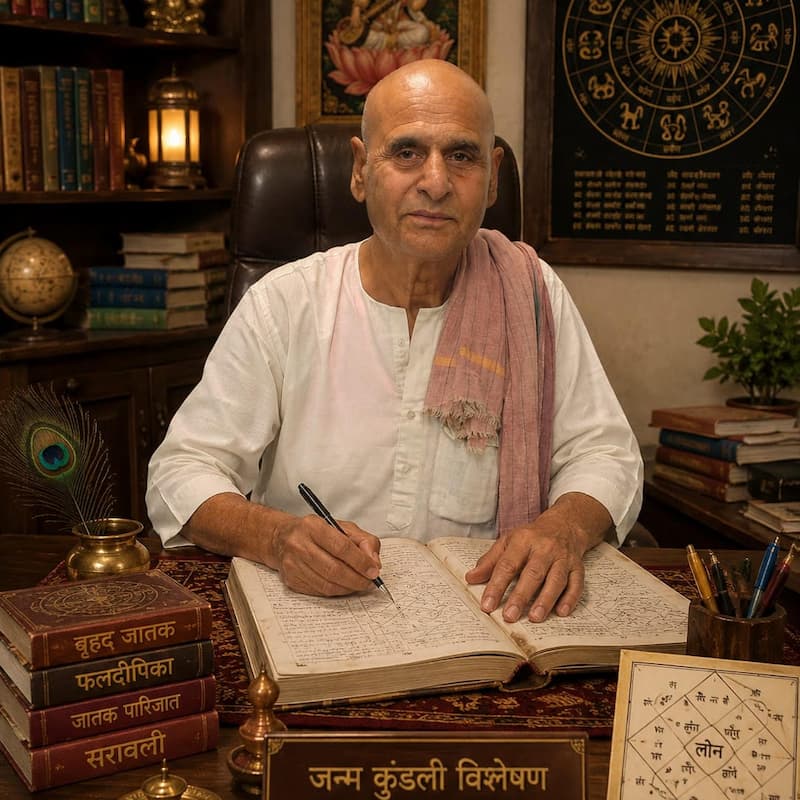
Narendra Kumar Chaubey is a Jyotisha Acharya with over 30 years of experience, based in Bihar and serving clients across India in Vedic astrology, mantra shastra, Vastu and ritual practice.
He completed his formal training at Kameshwar Singh Darbhanga Sanskrit University (KSDSU), one of India’s oldest and most respected institutions for Vedic and Sanskrit scholarship, where he studied Jyotisha shastra, mantra vidya and related classical sciences. KSDSU’s tradition of rigorous Sanskrit education tracing directly to the Mithila region’s centuries-old pandit lineage forms the foundation of his practice.
Over three decades, Narendra Kumar Chaubey has worked with thousands of individuals and families across Bihar and across India, offering guidance in:
- Kundli (birth chart) analysis: Identifying karmic patterns, planetary periods and life path guidance through classical Jyotisha
- Palmistry (Hasta Samudrika): Reading the hand according to the classical Samudrika Shastra tradition
- Vastu Shastra: Assessment and correction of living and working spaces according to directional and elemental principles
- Mantra and Pooja vidhi: Performing and guiding all categories of puja, havan, and mantra sadhana for personal, family and business situations
- Predictive Jyotisha: Transit analysis, muhurta (auspicious timing) selection and remedial guidance
He works across four languages Sanskrit, Hindi, English and Bhojpuri making classical knowledge accessible to practitioners across educational backgrounds and regions.
His writing for ABMantra brings the precision of classical Vedic training to practical mantra guidance: not general advice but specific prescriptions grounded in shastra, lineage and 30 years of direct practice with real situations.
For more info follow on: