
|
Quick Answer Guru Mantra has two distinct meanings that are often confused: Meaning 1 (Diksha Mantra): A personal mantra given to a disciple by their spiritual teacher (guru) during initiation (diksha). It is specific to that person, chosen by the guru based on the disciple’s spiritual constitution, and traditionally kept secret. Meaning 2 (Jupiter Planetary Mantra): The Navagraha mantra for the planet Jupiter (Guru Grah / Brihaspati). Chanted on Thursdays to invoke Jupiter’s blessings for wisdom, wealth, education and dharma. Which one you need depends on your situation. If you have a spiritual teacher: the diksha mantra. If you are dealing with Jupiter-related difficulties in your birth chart: the Brihaspati mantra. |
|
Who This Article Is For This article is for you if: you want to understand what a guru mantra actually is before approaching a teacher | you have been given a mantra during initiation and want to understand its significance | you are looking for the Jupiter planetary mantra and want the correct text and chanting method | you are unsure whether these two concepts are the same thing. Also see: Guru Purnima 2026: mantra, puja vidhi and complete guide |
If you have been searching for the guru mantra and found different answers describing completely different things, that is not a mistake. The term genuinely covers two separate traditions. This article explains both clearly, gives you the correct mantra text for the Jupiter planetary mantra, and tells you everything you need to know about the diksha mantra before you seek one.
Here is what most articles on this topic miss entirely: the term guru mantra does not have one meaning. It has three. The diksha mantra from a teacher. The Jupiter planetary mantra from Jyotish. And the Gurur Brahma shloka chanted before any practice. Searching for one and finding the others is not a mistake in the search results. It is a reflection of genuine complexity in the tradition itself.
Meaning 1: Guru Mantra as the Personal Diksha Mantra |
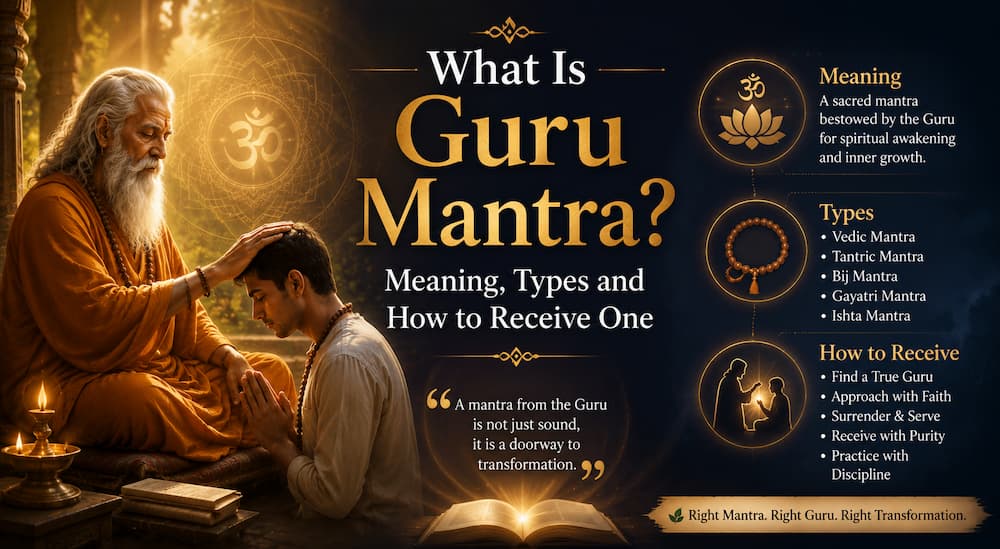
In the Vedic and Tantric traditions, a guru mantra is the personal mantra a spiritual teacher (guru) gives to a disciple during initiation. This initiation is called diksha, a Sanskrit word meaning consecration, dedication, or self-devotion.
The word diksha comes from two roots: da (to give) and ksha (to destroy). Diksha is a simultaneous giving and destroying: the guru gives the mantra and destroys the disciple’s ignorance and negative karma at the moment of transmission. The Yogapedia definition (December 2023) describes it precisely: “A mantra diksha is a mantra that a guru gives to a disciple as part of an initiation. The guru gives instructions about how to recite the mantra. The mantra is carefully chosen for its significance.”
|
What Makes a Guru Mantra Different from Any Other Mantra Most mantras are public knowledge. The Gayatri Mantra, the Maha Mrityunjaya Mantra, the Hare Krishna Mahamantra: these are freely available and can be chanted by anyone. A guru mantra is different in three specific ways: 1. It is chosen specifically for you. A true guru selects the mantra based on your ishta devata (chosen deity), your spiritual constitution, your current karma and your specific spiritual needs. Two disciples of the same guru may receive completely different mantras. 2. It is transmitted with shakti. The tradition holds that a mantra received from a guru carries the energetic transmission of the entire lineage behind that guru, going back to the adi guru (first teacher). This shakti is what differentiates a received mantra from the same mantra read in a book. 3. It is traditionally kept secret. A guru mantra is not shared with others. This is not arbitrary. Secrecy preserves the energetic integrity of the transmission and prevents the dissipation of the accumulated practice energy. |
Types of Guru Diksha: How a Guru Mantra Is Transmitted |
The tradition recognises multiple ways a guru can transmit a mantra. The Sanatan Sanstha and Hindu Jagruti Samiti texts document four primary types:
How to Receive a Guru Mantra: The Traditional Path |
The tradition is clear: a mantra must ideally be received from a qualified guru, not self-selected. Tulasi Vanam (May 2024), citing classical Vedic sources, states: “A mantra must be taken from a guru only. Like for worldly knowledge, we need experts to guide us on various subjects, for knowledge of the Supreme Truth, we certainly need the right guru.”
The traditional path to receiving a guru mantra:
|
What If You Do Not Have a Living Guru? This is the most common practical question. The classical tradition’s answer has two parts. First: Many lineages allow initiation through a lineage rather than a living guru. If you are drawn to a specific tradition (Vaishnava, Shaiva, Shakta, Smarta), a qualified teacher within that lineage can give diksha even if the original guru is no longer living. The power comes through the parampara (lineage), not solely through the individual guru. Second: If no guru is accessible, the Vaishnava Chintamani states that the Name of the deity itself functions as the guru mantra. Chanting Om Namah Shivaya, Om Namo Narayanaya, or the Hare Krishna Mahamantra with full sincerity is recognised in multiple traditions as a valid path in the absence of formal initiation. The inner qualification matters more than the outer ceremony. |
Meaning 2: Guru Mantra as the Jupiter Planetary Mantra |
The second meaning of guru mantra comes from Vedic astrology (Jyotish). In this context, Guru refers not to a teacher but to the planet Jupiter, known in Sanskrit as Guru Grah or Brihaspati. Jupiter is the largest planet in the solar system and the planet associated with wisdom, dharma, wealth, education, children, and spiritual inclination.
When astrologers or Jyotish practitioners refer to the guru mantra, they mean the mantra chanted to invoke Jupiter’s blessings or to mitigate the effects of a weak, debilitated, or afflicted Jupiter in the birth chart.
The Two Guru Mantras Side by Side |
The Gurur Brahma Shloka: The Most Universal Guru Mantra |
There is a third usage of guru mantra that sits between the two above: the Gurur Brahma shloka, traditionally recited before any spiritual practice as an offering to the guru principle itself.
This shloka is the most commonly referred to as the guru mantra in popular usage. It is chanted on Guru Purnima, before spiritual classes, at the start of any new learning. It does not require a guru to give it : it is offered universally to the guru principle in all its forms.
From Our Practice |
|
From Our Practice When I received my diksha mantra from my teacher at Chinmaya Mission Delhi, I expected something dramatic. A long ceremony. A sense of power descending. What actually happened was quieter than I expected. He whispered seven syllables into my right ear and said: chant this 108 times every morning before anything else. That is all. Seven syllables. Nothing else. It took me about three weeks of daily chanting before I understood that the mantra itself was not the point. The mantra was a reminder. Every morning for those 108 repetitions, I was returning to the one conversation that had actually changed my understanding. The mantra held the memory of the moment of transmission. That is what makes a received mantra different from a self-selected one. It contains a relationship, not just a sound. |
Frequently Asked Questions |
Begin With What You Have |
If you have a guru and a received mantra: return to it tomorrow morning. 108 repetitions. Before anything else. The gap in practice does not define the relationship.
If you are looking for the Jupiter planetary mantra: begin chanting Om Gram Greem Graum Sah Gurave Namah on the next Thursday. 108 times, facing north, wearing yellow if possible. Do this for 11 consecutive Thursdays and observe what changes.
If you have neither a guru nor a specific mantra and are wondering where to start: chant the Gurur Brahma shloka once at the beginning of your day. It asks for nothing except the willingness to acknowledge that you do not already know everything you need to know. That acknowledgement is the beginning of every spiritual practice that has ever worked.
|
Sources and Citations
|
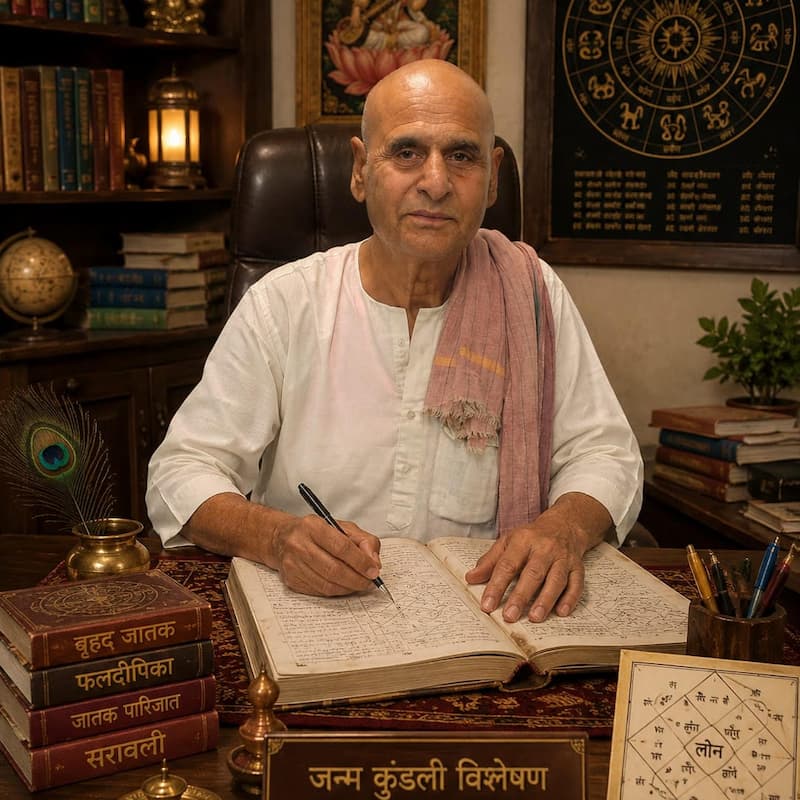
Narendra Kumar Chaubey is a Jyotisha Acharya with over 30 years of experience, based in Bihar and serving clients across India in Vedic astrology, mantra shastra, Vastu and ritual practice.
He completed his formal training at Kameshwar Singh Darbhanga Sanskrit University (KSDSU), one of India’s oldest and most respected institutions for Vedic and Sanskrit scholarship, where he studied Jyotisha shastra, mantra vidya and related classical sciences. KSDSU’s tradition of rigorous Sanskrit education tracing directly to the Mithila region’s centuries-old pandit lineage forms the foundation of his practice.
Over three decades, Narendra Kumar Chaubey has worked with thousands of individuals and families across Bihar and across India, offering guidance in:
- Kundli (birth chart) analysis: Identifying karmic patterns, planetary periods and life path guidance through classical Jyotisha
- Palmistry (Hasta Samudrika): Reading the hand according to the classical Samudrika Shastra tradition
- Vastu Shastra: Assessment and correction of living and working spaces according to directional and elemental principles
- Mantra and Pooja vidhi: Performing and guiding all categories of puja, havan, and mantra sadhana for personal, family and business situations
- Predictive Jyotisha: Transit analysis, muhurta (auspicious timing) selection and remedial guidance
He works across four languages Sanskrit, Hindi, English and Bhojpuri making classical knowledge accessible to practitioners across educational backgrounds and regions.
His writing for ABMantra brings the precision of classical Vedic training to practical mantra guidance: not general advice but specific prescriptions grounded in shastra, lineage and 30 years of direct practice with real situations.
For more info follow on: