
Quick Answer
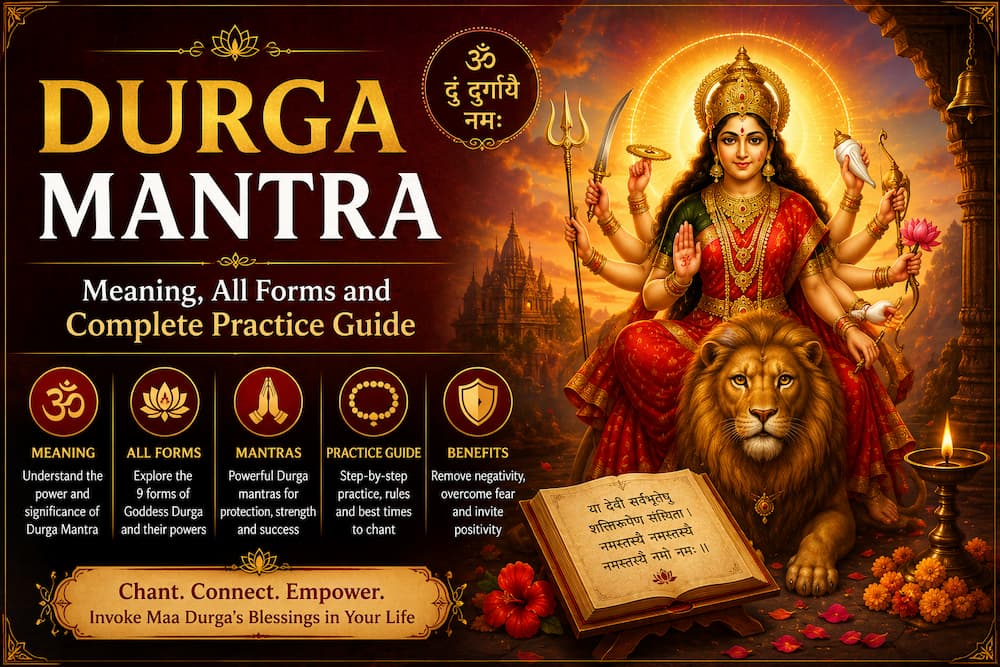
The primary Durga Mantra is the Navarna Mantra:
Om Aim Hreem Kleem Chamundaye Vichche
ॐ ऐं ह्रीं क्लीं चामुण्डायै विच्चे
Meaning: Om. I invoke Saraswati (Aim), Mahalakshmi (Hreem) and Mahakali (Kleem) through Chamunda, the fierce destroyer of ego and ignorance (Vichche).
Chant 108 times daily using a Rudraksha or red coral mala. Tuesday and Friday are most auspicious. This single mantra simultaneously invokes all three forms of the Divine Mother and is the root mantra of the entire Devi Mahatmya tradition, dated to the 4th to 5th century CE within the Markandeya Purana.
Who This Article Is For
This article is for you if: you are facing repeated obstacles that seem to have no rational explanation | someone has created problems for you deliberately and you want protection | you feel under a persistent threat, negative energy or external opposition | you want the correct Sanskrit Durga mantra with full word-by-word meaning, not a generic list.
This article is NOT for you if: you are looking for a quick chant without practice or commitment.
If something is actively working against you, the Durga mantra is the right place to start. Not because it is the most powerful mantra in Hinduism. But because Goddess Durga, in her Chamunda form specifically, was born for one purpose: to destroy what is harming her devotees. This guide gives you the correct Durga mantra with word-by-word meaning, the right practice method, and the honest answer to how long it takes to work.
What the Durga Mantra Actually Means: Navarna Mantra Word by Word
Here is what most articles miss entirely: the Navarna Mantra contains three goddesses, not one. That misunderstanding changes the quality of the chant entirely.
The mantra: Om Aim Hreem Kleem Chamundaye Vichche. Nine syllables. Nine is not arbitrary. Nava means nine in Sanskrit and arna means syllable. The Navarna Mantra is literally the nine-syllable mantra. It appears in the Devi Mahatmya (Durga Saptashati), the central scripture of the Shakta tradition, composed approximately in the 4th to 5th century CE within the Markandeya Purana.
| Syllable | Deity | What It Invokes |
|---|---|---|
| Om (ॐ) | Universal | The primordial sound. Opens the channel to all divine energy. The foundation on which every mantra is built. |
| Aim (ऐं) | Maha Saraswati | Beej mantra of Saraswati. Invokes knowledge, wisdom and clarity. The power to understand and discern. |
| Hreem (ह्रीं) | Maha Lakshmi | Beej mantra of Lakshmi and Bhuvaneshwari. Invokes the divine feminine, abundance and transformation. Removes illusion. |
| Kleem (क्लीं) | Maha Kali | Beej mantra of Kali and Kamadeva. Invokes attraction, creative force and the power of desire aligned with dharma. |
| Chamundaye (चामुण्डाये) | Chamunda | To Chamunda: the form of Durga who killed the demons Chanda and Munda. The slayer of ego, anger and opposition. |
| Vichche (विच्चे) | Liberation | Cut away. Remove. Liberate. The command to the goddess to sever the practitioner from the forces opposing them. |
Here is what this means in plain terms: you are not calling one goddess. You are calling the combined power of Saraswati, Lakshmi and Kali through their unified fierce form, Chamunda, and commanding her to cut whatever is harming you. The word Vichche is not a request. It is a directive. That is why the Navarna Mantra has a reputation as the most protective of all Durga mantras.
Durga Mantra for Protection: The Devi Kavach and Argala Stotram
The Navarna Mantra removes. The Devi Kavach protects. Both are needed for complete protection practice.
The Devi Kavach (literally, the Divine Shield) is a prayer from the Devi Mahatmya in which each part of the body is placed under Durga’s protection. It is recited before the main Saptashati reading but can be used as a standalone protective practice.
Devi Kavach: Opening Verse
Pranamy-aham Mahakaliim Mahishasura-Mardhinim
Shuladharinim Chakradharinim Chandikam Dharanipratim
प्रणम्यामि महाकालीं महिषासुर-मर्दिनीम्।
शूलधारिणीं चक्रधारिणीं चण्डिकां धरणीप्रतिम्॥
Meaning: I bow to Mahakali, the destroyer of Mahishasura, who holds the trident, the discus, and who is Chandika, the support of the earth.
The Argala Stotram is recited immediately after the Kavach. Its repeated refrain is: Jayanti Mangala Kali Bhadrakali Kapalini, Durga Shiva Kshama Dhatra Swaha Svadha Namostute. This refrain names twelve forms of the goddess in sequence, creating a complete circle of protection around the practitioner.
Here is what most Durga practice guides do not tell you: the Kavach and Argala are not optional additions for serious practitioners. In traditional Shakta sadhana, reciting the Navarna Mantra without first establishing the Kavach is like building a fire without creating an enclosure. The power generates without direction.
Which Durga Mantra for Which Problem: A Practical Guide
Durga has 108 names and nine primary forms, the Navadurga. Each form addresses a different category of difficulty. Chanting the Navarna Mantra reaches all forms simultaneously. But if you know which Navadurga form applies to your specific problem, your intention becomes precise.
| Your specific problem | Form of Durga | Additional mantra to add |
|---|---|---|
| Fear, anxiety, persistent threat | Shailaputri (first form) | Om Devi Shailaputryai Namah (108 times) |
| Obstacles blocking all progress | Brahmacharini (second form) | Om Devi Brahmacharinyai Namah |
| Enemy opposition, court cases, legal problems | Chandraghanta (third form) | Om Devi Chandraghantayai Namah |
| Deep grief, bereavement, emotional wounds | Kushmanda (fourth form) | Om Devi Kushmandayai Namah |
| Problems with children or family protection | Skandamata (fifth form) | Om Devi Skandamatayai Namah |
| Negative energy in home or workplace | Katyayani (sixth form) | Om Devi Katyayanyai Namah |
| Black magic, evil eye, deliberate harm by others | Kalaratri (seventh form) | Om Devi Kalaratryai Namah |
| Long-standing bad luck and misfortune | Mahagauri (eighth form) | Om Devi Mahagauryai Namah |
| Complete life transformation, starting fresh | Siddhidatri (ninth form) | Om Devi Siddhidatryai Namah |
Use the Navarna Mantra as your foundation. Add the specific Navadurga mantra for your situation. Chant both in sequence: Navarna first (108 times), then the specific form mantra (21 times). Do not reverse the order.
How to Chant the Durga Mantra: Complete 40-Day Method
Most online sources say there are no special formalities for chanting the Navarna Mantra. That is partially true. You can chant it anywhere, any time, in an emergency. But for a structured 40-day practice aimed at removing persistent obstacles, the method matters.
What You Need
- Rudraksha mala (first choice): directly associated with Shiva and Shakti, amplifies protective mantras
- Red coral mala (second choice): red is Durga’s colour and coral amplifies Mars energy, which aligns with her warrior aspect
- Image or idol of Goddess Durga: the Mahishasuramardini form is most appropriate for protection practice
- Red flowers: red hibiscus is traditional for Durga puja
- Ghee lamp and incense
Daily Practice Sequence
- Bathe before sitting. Face north or east.
- Light the ghee lamp. Offer red flowers.
- Invoke Ganesha first: Om Gam Ganapataye Namah (once).
- Recite the Devi Kavach opening verse three times. This establishes the protective enclosure before the main mantra.
- Chant Om Aim Hreem Kleem Chamundaye Vichche 108 times. Keep the specific problem clearly in mind during the first 11 repetitions. After that, release the thought and let the mantra do its work.
- Add the specific Navadurga mantra for your situation (21 times).
- Close with Om Durgayai Namah (3 times). This seals the practice.
- Sit in silence for 5 minutes. Do not move immediately.
The 40-Day Commitment
Start on a Tuesday. Tuesday is ruled by Mars (Mangal), whose energy aligns with Durga’s warrior and protective aspect. Do not skip a single day. Missing one day requires restarting from Day 1 on the next Tuesday.
For very serious situations involving active harm from others, the traditional practice is 40 days followed by a 10-day rest, then a second 40-day cycle. Three complete cycles address most persistent karmic obstructions in the Shakta tradition.
What Not to Do During a Durga Mantra Practice
- Do not share that you are doing this practice. Disclosing an active protective sadhana weakens its field.
- Do not chant the Navarna Mantra with the intention of harming another person. The mantra is protective, not aggressive. Misused intention reverses the effect onto the practitioner.
- Do not eat meat or consume alcohol during the 40-day period. Tamasic food weakens the sattvic field the mantra builds.
- Do not skip the Kavach recitation if you are doing a full sadhana. Chanting the Navarna without the Kavach generates force without a container.
- Do not expect external drama. Durga’s intervention is often quiet. The threat moves away. The person causing problems finds a reason to leave. Nothing announces itself.
From Our Practice
A student in our group had been facing a workplace situation where a senior colleague was actively sabotaging her work. Formal complaints had produced nothing. She began the Navarna Mantra on a Tuesday in October, adding the Chandraghanta mantra specifically because the situation involved deliberate opposition from a person in authority.
By Day 21 the colleague was transferred to a different department. By Day 40 my student had been promoted into the vacancy.
I am careful about sharing this story because it can sound like magic. It was not. What the mantra did was shift how she carried herself in that workplace. She stopped flinching. She stopped anticipating the next attack. That change in her presence is what changed the dynamics around her. Durga does not always remove the obstacle. Sometimes she gives you the quality of the warrior that makes the obstacle irrelevant.
Frequently Asked Questions
❓ Someone is deliberately trying to harm me and I am scared. Which Durga mantra do I start with right now?
Start with the Navarna Mantra immediately: Om Aim Hreem Kleem Chamundaye Vichche. You do not need a mala or a puja setup for an emergency chant. Sit quietly, close your eyes, and chant it 21 times with sincere intent. For sustained protection, begin the full 40-day sadhana on the next Tuesday with the Kalaratri mantra added for situations involving deliberate harm.
❓ I have negative energy in my home and my family keeps falling sick. Which Durga mantra helps with this?
The Katyayani form of Durga specifically addresses negative energy in living spaces. Add Om Devi Katyayanyai Namah (21 times) after the Navarna Mantra daily. Also recite the Devi Kavach at the entrance of your home on Tuesdays and Fridays. Most practitioners notice a shift in the home atmosphere within 11 to 21 days of consistent practice.
❓ I have a court case going on for 3 years. Will the Durga mantra help?
The Chandraghanta form of Durga governs legal battles and opposition from authority figures. Add Om Devi Chandraghantayai Namah to your daily practice. Also combine it with the Vijaya Lakshmi prayer from the Ashta Lakshmi tradition. The mantra does not guarantee a verdict. It creates the conditions in which justice is more likely to prevail and your own mind stays clear under pressure.
❓ Can I chant the Durga mantra during periods?
Yes. The Shakta tradition, from which the Navarna Mantra comes, has no menstruation restriction for Devi mantras. Durga is a feminine deity and the Shakta texts do not prohibit women from invoking her during menstruation. The restriction that exists in some other traditions applies to male-deity rituals, not to Devi worship.
❓ I have been chanting for 2 weeks and the situation seems worse. Should I stop?
Do not stop. In Shakta sadhana, a temporary worsening between Days 10 and 21 is recognised as a sign that the mantra is active and the obstruction is being disturbed. A problem that was stable often becomes visible or more acute before it shifts. Continue the practice without interruption. If you stop at this point, you lose the accumulated effect entirely.
❓ Can men chant the Durga mantra or is it only for women?
Men chant the Navarna Mantra widely. The Devi Mahatmya itself was composed and transmitted by male rishis. The mantra has no gender restriction. Durga is the universal mother. Her protection is offered equally. The only requirement is sincere devotion and consistent practice.
Begin the Practice on the Next Tuesday
The next Tuesday is your starting date. Before that day, write down in one specific sentence what you are asking Durga to address. Not “protect me from bad energy” but “I am asking Durga to remove the opposition from [specific situation] that has been active since [date].” Precision of intention is itself a form of devotion.
On Tuesday morning: light the lamp, offer red flowers, invoke Ganesha once, recite the Kavach verse three times, chant Om Aim Hreem Kleem Chamundaye Vichche 108 times, add your Navadurga mantra 21 times, close with Om Durgayai Namah three times, sit for 5 minutes.
Return the next morning. Return the morning after that.
By Day 21, notice not whether the situation has changed but whether your relationship to it has changed. That shift is what Durga produces first. What follows it is different for everyone. But it always follows.
Sources and Citations
- Devi Mahatmya (Durga Saptashati). Markandeya Purana, Chapters 81 to 93, 4th to 5th century CE. Translation and commentary: templepurohit.com
- Navarna Mantra meaning and syllable analysis. Medium: Pritam Kumar Sinha, Transcendental Vibrations: The Spiritual Science of the Navarna Mantra, June 2024
- Navadurga (nine forms of Durga). Wikipedia, citing Melton, J.G., Religious Celebrations, 2010
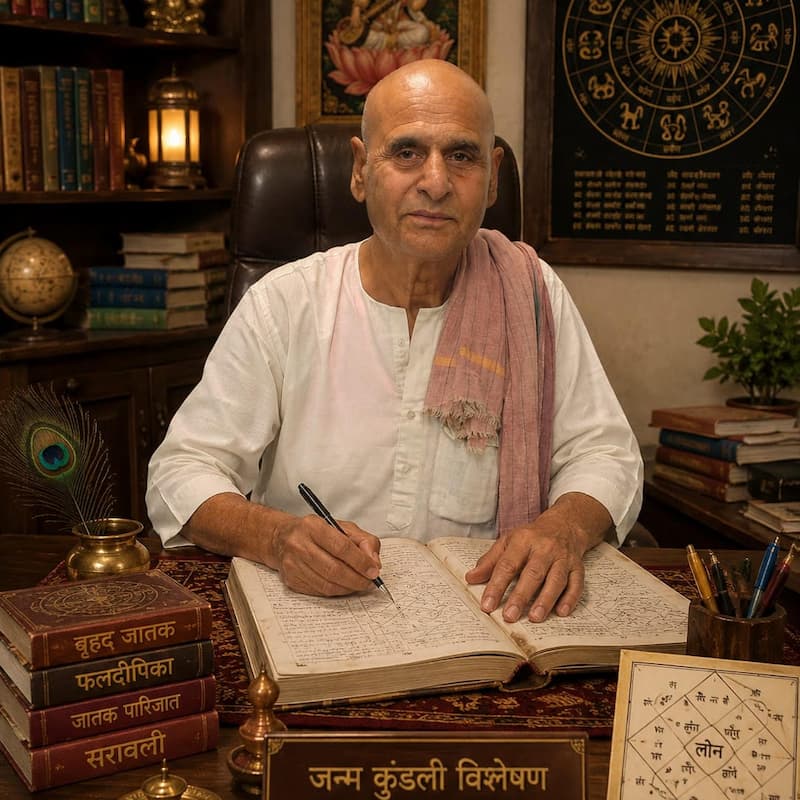
Narendra Kumar Chaubey is a Jyotisha Acharya with over 30 years of experience, based in Bihar and serving clients across India in Vedic astrology, mantra shastra, Vastu and ritual practice.
He completed his formal training at Kameshwar Singh Darbhanga Sanskrit University (KSDSU), one of India’s oldest and most respected institutions for Vedic and Sanskrit scholarship, where he studied Jyotisha shastra, mantra vidya and related classical sciences. KSDSU’s tradition of rigorous Sanskrit education tracing directly to the Mithila region’s centuries-old pandit lineage forms the foundation of his practice.
Over three decades, Narendra Kumar Chaubey has worked with thousands of individuals and families across Bihar and across India, offering guidance in:
- Kundli (birth chart) analysis: Identifying karmic patterns, planetary periods and life path guidance through classical Jyotisha
- Palmistry (Hasta Samudrika): Reading the hand according to the classical Samudrika Shastra tradition
- Vastu Shastra: Assessment and correction of living and working spaces according to directional and elemental principles
- Mantra and Pooja vidhi: Performing and guiding all categories of puja, havan, and mantra sadhana for personal, family and business situations
- Predictive Jyotisha: Transit analysis, muhurta (auspicious timing) selection and remedial guidance
He works across four languages Sanskrit, Hindi, English and Bhojpuri making classical knowledge accessible to practitioners across educational backgrounds and regions.
His writing for ABMantra brings the precision of classical Vedic training to practical mantra guidance: not general advice but specific prescriptions grounded in shastra, lineage and 30 years of direct practice with real situations.
For more info follow on: