
Quick Answer
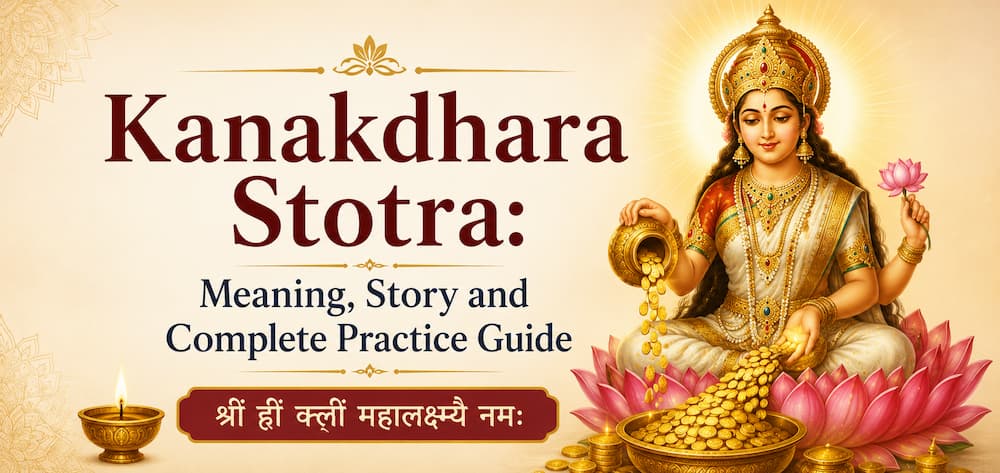
Kanakdhara Stotra (also spelled Kanakadhara Stotram) means the hymn that causes a stream of gold to flow. Kanaka = gold. Dhara = flow or stream.
It is a 21-verse hymn composed by Adi Shankaracharya in the 8th century CE, dedicated to Goddess Mahalakshmi. It is the only major Lakshmi hymn in the tradition that was composed spontaneously : not as a planned prayer but as an immediate response to witnessing genuine poverty.
It is chanted primarily to remove poverty, clear debt, attract prosperity and invite the compassionate grace (Kataaksha) of Goddess Lakshmi.
Chant: All 21 verses daily. Friday morning facing east. Ghee lamp and lotus or marigold flowers. For debt and acute financial difficulty: chant for 21 consecutive days. For complete sadhana: 40 days.
Who This Article Is For
This article is for you if: you are dealing with debt, poverty or persistent financial difficulty | you want to know the story behind the Kanakdhara Stotra and why it is considered especially powerful for poverty removal | you want the complete practice method including which verse to focus on for the deepest effect.
Also see: Sri Suktam: the Rigvedic foundation of all Lakshmi practice and Lakshmi Mantra: complete practice guide
The Kanakdhara Stotra has a specific power that most Lakshmi hymns do not: it was composed for someone who had nothing. Not for a king or a merchant or even an ordinary householder. It was composed for a woman so poor that her only possession to offer a visiting saint was a single dried gooseberry. The tradition holds that what Shankaracharya composed for her in that moment reaches all people in that same condition : the genuinely destitute who have nothing to offer but sincere devotion.
Here is what most articles about this stotra miss: the story is not merely a legend that increases the hymn’s reputation. The story is the theological key to understanding why the stotra works. The woman’s poverty was understood by Shankaracharya as a result of past-life karma : she had not given in previous lives and therefore had nothing in this one. His argument to Lakshmi was not “she is poor, please help her.” His argument was “she gave everything she had.” That shift from poverty as condition to devotion as offering is the theological basis of the stotra’s power.
The Story: How the Kanakdhara Stotra Was Composed
Adi Shankaracharya (8th century CE, approximately 788 to 820 CE) was traveling as a young Brahmachari, seeking bhiksha (alms) for his daily meal. He arrived at the door of a poor Brahmin woman’s home in a village believed to be Punnorkode in Kerala.
The woman had nothing in her home to give. No grain, no food, nothing of any material value. But unwilling to turn a guest away empty-handed : the tradition of hospitality (Atithi Devo Bhava, the guest is God) being absolute in her understanding : she searched her home and found a single dried gooseberry (amla). She placed it in Shankaracharya’s begging bowl with complete sincerity and humility.
Shankaracharya was deeply moved. He recognised in her action the essence of true giving: she gave her last possession. He prayed to Goddess Mahalakshmi on her behalf. The tradition records that Mahalakshmi initially hesitated : the woman’s poverty was the result of past-life karma, she had not given in previous births. Shankaracharya argued that the woman had just given everything she had. Past karma or not, this moment of complete giving deserved a complete response.
Goddess Lakshmi was pleased with the argument. She showered the woman’s home with golden gooseberries. The house of that poor woman still stands in Kaladi, Kerala : the birthplace of Shankaracharya himself : and is known to devotees as a site of pilgrimage associated with the Stotra’s origin. The woman’s hut in Punnorkode became known as Swarnathu Mana (Golden House). A Mahalakshmi temple stands at that spot today, consecrated in 2018.
The hymn Shankaracharya composed in that moment of prayer is the Kanakdhara Stotra.
The Opening Verse: Meaning and Significance
Kanakdhara Stotra : Opening Verse
Sanskrit:
Anga Lakshanam Samruddhi Janma Janm Antaraagam
Vaksha Sthalilasita Kamala Yaavalambya
Bhavantim Visham Vikhyata Bharathaayya Nandham
Kamala Nilayam Pranathosmi Dhevim
Devanagari:
अंग लक्षणं समृद्धि जन्म जन्मान्तरागम्।
वक्ष स्थलीलसित कमला यावलम्ब्य।
भवन्तिं विषं विख्यात भारतायय नंदम्।
कमला निलयं प्रणतोस्मि देवीम्॥
Meaning: I bow to the goddess who dwells in the lotus : Goddess Lakshmi : who grants prosperity across births (Jana Janmantara), who is situated on the chest of Vishnu, who is the joy of the world, who is established in the lotus. I prostrate before her.
The Structure: 21 Verses and What Each Group Does
| Verses | Focus | What this group does |
|---|---|---|
| 1 to 5 | Establishing Lakshmi’s divine qualities | Describes her beauty, compassion, association with Vishnu and lotus. Builds the devotional relationship before making any request. Shankaracharya does not ask first : he praises first. |
| 6 to 10 | The theological argument | The verses where Shankaracharya argues with Lakshmi on behalf of the poor woman. He invokes her compassion (Kataaksha), her role as universal mother, and her power to override even past-life karma. These verses are the emotional core of the stotra. |
| 11 to 15 | Descriptions of her grace | Further descriptions of Lakshmi’s beauty and benevolence. The devotee surrenders deeper into the relationship established in the earlier verses. |
| 16 to 20 | Direct requests for prosperity | Explicit requests for wealth, abundance, removal of poverty, family wellbeing and the permanent presence of Lakshmi in the devotee’s life. |
| 21 (Phala Shruti) | The result of chanting | Describes what happens to those who chant with devotion: poverty is removed, Lakshmi’s grace is established, and the devotee is liberated from material lack. |
The Theological Key: Verse 7 and Shankaracharya’s Argument
Verse 7 of the Kanakdhara Stotra is the one where Shankaracharya makes his central argument to Lakshmi. It is the most important verse in the stotra for understanding why it works.
Verse 7: The Argument
Tripurantha Karim Vratha Bhashma Lepanam
Bhujaga Bhushana Bhooshita Bhoosurothama
Radha Natha Samaksha Tava Stuthi Varnana
Kamala Nilayam Pranathosmi Dhevim
Approximate meaning: O Goddess of the lotus : even the greatest devotees of Shiva (who destroyed the three cities), even those covered in ash and wearing serpents, praised you before the eyes of your consort Vishnu. I, too, prostrate before you.
The argument: If even Shiva’s greatest devotees came to praise Lakshmi, then surely a poor woman who gave her only possession is worthy of your grace. The argument moves from the great to the humble: if you accepted the praise of the mighty, how can you reject the offering of the absolutely poor?
Kanakdhara Stotra vs Sri Suktam: When to Use Each
| Feature | Kanakdhara Stotra | Sri Suktam |
|---|---|---|
| Origin | Composed by Adi Shankaracharya, 8th century CE. Sanskrit stotra in devotional tradition. | Rigveda Khila (appendix), the oldest Vedic layer : significantly older. |
| For whom | Specifically composed for the genuinely poor. Most effective when financial difficulty is acute and real. | For all Lakshmi practitioners. More of a formal Vedic invocation than a crisis prayer. |
| Primary purpose | Removing poverty and debt. The compassion-based argument to Lakshmi to override past karma. | Inviting Lakshmi into the home and life, removing Alakshmi, establishing long-term prosperity. |
| Emotional register | Intense devotion, surrender, compassion. The stotra has an emotional quality of pleading from a place of real need. | Formal, confident Vedic invocation. More structured, less emotionally intense. |
| Combined practice | Sri Suktam in the morning (Vedic foundation), Kanakdhara Stotra in the evening (devotional appeal). This combination is specifically recommended in the Vedic tradition for acute financial difficulty. | |
The Complete Practice Method
What You Need
- Ghee lamp : mandatory. The stotra invokes Lakshmi’s Kataaksha (compassionate glance). A ghee lamp creates the physical light that aligns with this invocation.
- Lotus flowers or yellow/white marigold
- Image of Goddess Mahalakshmi (Kamala Nilayam form: seated on lotus)
- Yellow cloth for the altar
- Any gooseberry (amla) fruit as a symbolic offering : honouring the story that brought this stotra into existence
Daily Practice
- Bathe before practice. Friday morning is ideal. Any morning is valid.
- Face east. Light the ghee lamp. Offer flowers and one amla fruit as a symbolic acknowledgement of the stotra’s origin.
- Sit quietly for one minute. Recall the story: a woman with nothing offered her last possession. You are in her tradition now.
- Chant all 21 verses of the Kanakdhara Stotra. If you do not know them by memory, use a printed text or audio reference.
- When you reach Verses 6 to 10 (the theological argument section), slow down slightly. These are the verses where Shankaracharya argued for the poor woman. Chant them with the awareness that you are making the same argument for yourself.
- Sit in silence for 5 minutes after the final verse.
- For debt specifically: chant for 21 consecutive days without interruption. For general prosperity: continue for 40 days.
The Most Powerful Timing
Akshaya Tritiya (the third day of the bright fortnight of Vaishakha month) is the most auspicious day of the year to begin the Kanakdhara Stotra practice. Akshaya means inexhaustible : any dharmic action begun on this day multiplies. A Kanakdhara sadhana begun on Akshaya Tritiya carries particular potency for permanent prosperity rather than temporary relief.
Dhanteras (two days before Diwali) and all Fridays are the next most auspicious options. The full moon Friday (Purnima Shukravar) is the strongest regular weekly timing.
From Our Practice
From Our Practice
I first encountered the Kanakdhara Stotra during a period of genuine financial difficulty: a period when the distance between what was needed and what was available felt impossible to bridge. I was not looking for a devotional practice at that point. I was looking for something real.
What made the stotra real for me was the story. The woman had nothing. She gave the nothing she had. And the argument Shankaracharya made to Lakshmi on her behalf is the same argument that runs through the entire stotra: not “she deserves wealth” but “she gave everything.” That is a different argument. It does not claim worthiness. It claims completeness of offering.
I began the 21-day practice on a Friday in November. I placed an amla on the altar every day. By Day 14, an unexpected payment arrived from a client who had owed money for eight months and simply sent it without prompting. By Day 21, two new work engagements had confirmed.
I cannot prove causation. What I can say is that the quality of the practice during those 21 days was different from any other mantra practice I had done : because the story gave it a specific emotional grounding that pure mantra repetition does not have. You are not repeating sounds. You are repeating an argument that a great saint made to a goddess on behalf of a woman with nothing. When you understand that, the stotra becomes something else entirely.
Frequently Asked Questions
❓ I have serious debt and no money. Is the Kanakdhara Stotra the right practice for me?
Yes. The Kanakdhara Stotra was specifically composed for this situation. Begin the 21-day practice on the next Friday. If you cannot obtain an amla, make the offering symbolically : a leaf, a flower, or simply your sincere intention. The theological basis of the stotra is that complete sincerity of offering, regardless of its material value, is what reaches Lakshmi. Alongside the practice, also do one act of giving each Friday : even a very small amount to someone in genuine need. This mirrors the woman’s action that triggered the stotra.
❓ Can I chant the Kanakdhara Stotra without knowing Sanskrit?
Yes. Chant with an audio reference from a qualified reciter and follow the transliterated text. The tradition values sincere intention alongside pronunciation. Shankaracharya composed this stotra in a moment of pure compassion : that emotional quality of sincere appeal is what the stotra transmits. Do not let imperfect pronunciation stop you from beginning.
❓ Is the Kanakdhara Stotra better than the Lakshmi Mantra for removing debt?
For acute debt and poverty, the Kanakdhara Stotra is more specifically targeted. It was composed for exactly this situation. The Lakshmi Mantra (Om Shreem Mahalakshmiyei Namaha) is excellent as a daily practice for general prosperity. For a specific crisis of debt or poverty, chant the Kanakdhara Stotra for 21 days as the primary practice and add the Lakshmi Mantra 108 times after as a secondary practice. Together they address both the structural issue (Kanakdhara’s theological argument) and the energetic channel (Lakshmi Mantra’s daily resonance).
❓ How many verses does the Kanakdhara Stotra have and which version should I chant?
The original Shankaracharya composition has 21 verses. Some versions list 22 verses with an additional closing verse. Both are authentic. Extended versions reach 37 verses with additional stotras. For daily home practice, the 21-verse version is complete and correct. If you find 22 verses in your source text, chant those : the additional verse is a valid conclusion to the practice.
❓ Does the Kanakdhara Stotra need to be performed by a priest, or can I chant it myself?
Shankaracharya himself composed it as a personal prayer, not as a priestly ritual. Personal daily chanting is the intended and complete form of the practice. A priest-led Kanakdhara Yagya amplifies the practice through fire ceremony and collective energy : if this is available to you on Akshaya Tritiya or Dhanteras, it is an excellent addition. But the daily personal chanting at home, consistently maintained for 21 or 40 days, is what the tradition documents as effective.
❓ Can men chant the Kanakdhara Stotra or is it only for women?
Men chant the Kanakdhara Stotra widely and it is equally effective for them. The story involves a woman, but Shankaracharya composed the stotra as a universal invocation to Lakshmi. The deity is universal, the hymn is universal. Men facing poverty, debt or financial crisis chant this stotra with the same intention and with the same documented results as women.
Begin This Friday
Obtain an amla fruit. If you cannot find one, a simple fruit will do : the spirit of the offering matters more than the specific fruit.
This Friday morning: light your ghee lamp, place the fruit before Lakshmi’s image, and begin chanting. All 21 verses. When you reach the theological argument verses : 6 through 10 : remember what Shankaracharya was arguing: not that the woman deserved wealth, but that she gave everything she had.
You are making the same argument. Make it with that same specificity of intent.
Return next Friday. And every day in between. Twenty-one days for debt relief. Forty days for the complete establishment of abundance.
The golden rain the stotra promises is not a metaphor for a feeling of prosperity. In the tradition, it is understood as the actual flow of right resources arriving at the right time : which is what abundance actually is. Not a hoard of gold but a reliable stream. Kanaka Dhara: not the vault of gold but the stream of it.
Sources
- Kanakadhara Stotram: Lyrics, Meaning, Story and Benefits. Amit Ray, December 2025. Shankaracharya’s story, poor Brahmin woman, golden gooseberry rain
- Kanakadhara Stotram: Complete Guide. Hindutone, February 2026. 21 verses, chanting procedure, Kataaksha invocation
- Meaning and Benefits of Chanting Kanakadhara Stotram. Pillai Center, April 2022. Akshaya Tritiya as most auspicious day; Kanaka Lakshmi fire lab tradition
- Shri Kanakdhara Stotra Significance. Yagyas Devam, October 2025. Swarnathu Mana temple at Punnorkode, consecrated 2018; Siddha Mantra classification
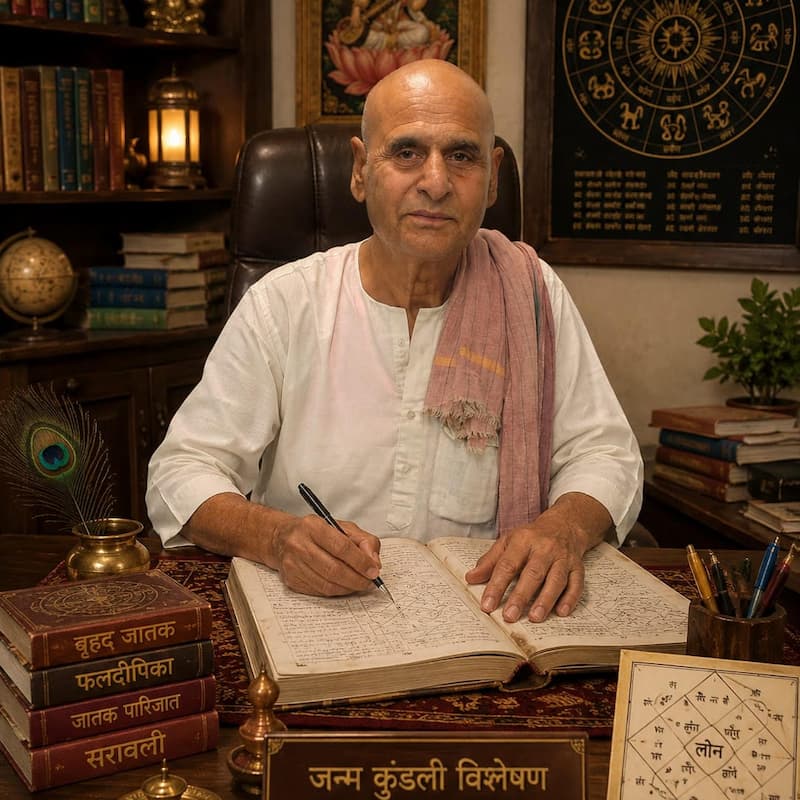
Narendra Kumar Chaubey is a Jyotisha Acharya with over 30 years of experience, based in Bihar and serving clients across India in Vedic astrology, mantra shastra, Vastu and ritual practice.
He completed his formal training at Kameshwar Singh Darbhanga Sanskrit University (KSDSU), one of India’s oldest and most respected institutions for Vedic and Sanskrit scholarship, where he studied Jyotisha shastra, mantra vidya and related classical sciences. KSDSU’s tradition of rigorous Sanskrit education tracing directly to the Mithila region’s centuries-old pandit lineage forms the foundation of his practice.
Over three decades, Narendra Kumar Chaubey has worked with thousands of individuals and families across Bihar and across India, offering guidance in:
- Kundli (birth chart) analysis: Identifying karmic patterns, planetary periods and life path guidance through classical Jyotisha
- Palmistry (Hasta Samudrika): Reading the hand according to the classical Samudrika Shastra tradition
- Vastu Shastra: Assessment and correction of living and working spaces according to directional and elemental principles
- Mantra and Pooja vidhi: Performing and guiding all categories of puja, havan, and mantra sadhana for personal, family and business situations
- Predictive Jyotisha: Transit analysis, muhurta (auspicious timing) selection and remedial guidance
He works across four languages Sanskrit, Hindi, English and Bhojpuri making classical knowledge accessible to practitioners across educational backgrounds and regions.
His writing for ABMantra brings the precision of classical Vedic training to practical mantra guidance: not general advice but specific prescriptions grounded in shastra, lineage and 30 years of direct practice with real situations.
For more info follow on: