
Quick Answer
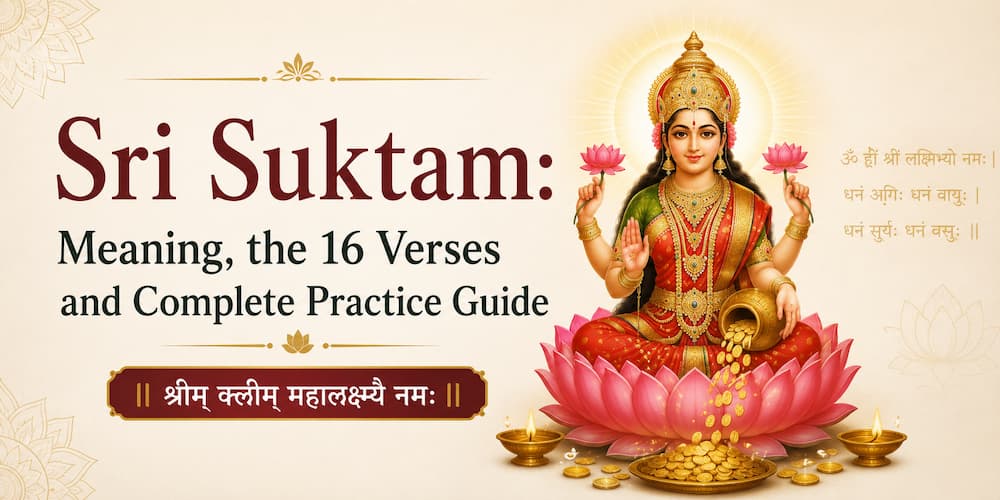
Sri Suktam is a 16-verse Vedic hymn from the Khila section of the Rigveda, dedicated to Goddess Sri (Lakshmi). It is the most ancient and authoritative invocation of the goddess of wealth in the entire Vedic literature.
Sri means radiance, prosperity and auspiciousness. Suktam means well-spoken hymn. Sri Suktam is literally the well-spoken hymn to radiance and prosperity.
The opening verse invokes Agni (fire) as the intermediary who carries the offering to Sri. The 16 verses progressively invite the goddess in, establish her in the home, request the removal of Alakshmi (misfortune), and ask for complete abundance of wealth, grain, cattle, children and spiritual liberation.
Chant: All 16 verses daily, facing east, in front of a ghee lamp. Friday is the most auspicious day. Full benefit requires consistent daily practice for 40 days minimum.
Who This Article Is For
This article is for you if: you want to understand what Sri Suktam actually says and means, not just what it is | you want the word-by-word meaning of the opening verse | you want to know the difference between Sri Suktam and the Lakshmi mantra and which is more powerful | you are building a Lakshmi practice and want the complete Vedic foundation.
Also see: Lakshmi Mantra: meaning in Hindi and complete practice guide and Kuber Mantra: wealth preservation and business success
If you have been told to chant Sri Suktam for wealth without being told what it means, you have been given the practice without the understanding that makes it work at its deepest level. This article gives you both: the complete meaning of the Sri Suktam and the practice method that the Vedic tradition prescribes for it.
Here is what most articles on Sri Suktam miss: the hymn is not primarily asking for money. It is asking for the removal of Alakshmi, the goddess of misfortune who is Lakshmi’s elder sister. The Vedic tradition understands that Lakshmi cannot enter a space that Alakshmi occupies. You do not invite Lakshmi in first. You ask her to remove Alakshmi first. This reversal of order is the theological core of the Sri Suktam and it changes how you understand every verse.
The Source: Where Sri Suktam Comes From
Sri Suktam is found in the Khila section of the Rigveda, the appendix to the fifth Mandala. Khila means supplement : texts that are attached to but not part of the main Rigveda corpus. This makes Sri Suktam one of the most ancient hymns to Lakshmi in the written tradition, predating most of the Puranic literature that later expanded the Lakshmi worship tradition significantly.
| Feature | Detail |
|---|---|
| Source text | Rigveda Khilani (Appendix), fifth Mandala, Bashkala Shakha tradition |
| Number of verses | 16 core verses (Suktas/Richas). Extended versions include up to 37 verses with the Phala Shruti and Lakshmi Gayatri |
| Deity | Goddess Sri (Lakshmi) invoked through Agni (fire deity) as intermediary |
| Rishi (seer) | Ananda : the rishi who perceived this hymn in meditation |
| Chandas (meter) | Anushtup (8-syllable lines, the most common Rigvedic meter) |
| Purpose | Invoking Sri, removing Alakshmi, requesting complete abundance including material wealth, grain, children and liberation |
| Agni connection | The first 15 verses invoke Lakshmi through Agni : the sacred fire carries the invocation to the goddess. This is why Sri Suktam is traditionally chanted during Havan (fire ceremony) |
The Opening Verse: Word by Word Meaning
The first verse of Sri Suktam is its most chanted and most significant. It establishes the complete framework of the hymn in four lines.
Sri Suktam : Verse 1
Sanskrit (Devanagari):
हिरण्यवर्णां हरिणीं सुवर्णरजतस्रजाम्।
चन्द्रां हिरण्मयीं लक्ष्मीं जातवेदो म आवह॥
Transliteration:
Hiranyavarnam Harinim Suvarna Rajata Srajam
Chandram Hiranmayim Lakshmim Jatavedo Ma Avaha
Literal meaning: O Jataveda (Agni), bring to me Lakshmi : she who is golden in complexion (Hiranyavarnam), she who is green like nature (Harinim), she who is garlanded with gold and silver flowers (Suvarna Rajata Srajam), she who is radiant like the moon (Chandram), she who is made of gold (Hiranmayim).
| Word | Meaning | What it reveals about Lakshmi |
|---|---|---|
| Hiranyavarnam हिरण्यवर्णाम् |
Golden-complexioned (Hiranya = gold, Varna = complexion) | Gold is the colour of solar energy, of divine consciousness made manifest. Lakshmi’s golden complexion is not a physical description : it is a statement that she is made of the same substance as divine light. |
| Harinim हरिणीम् |
She who is green, she who moves like a deer (Harini = deer or green) | Green is the colour of nature, of growth and of living abundance. Lakshmi is not the goddess of accumulated gold. She is the goddess of living, growing, regenerating prosperity. This word places abundance in nature, not in vaults. |
| Suvarna Rajata Srajam सुवर्णरजतस्रजाम् |
Garlanded with gold and silver flowers (Suvarna = gold, Rajata = silver, Sraja = garland) | Gold (solar) and silver (lunar) together represent the complete spectrum of abundance: daytime and nighttime prosperity, visible and hidden wealth, active earning and quiet accumulation. |
| Chandram चन्द्राम् |
Shining like the moon (Chandra = moon) | The moon is cool, soothing, beloved by all. Lakshmi’s lunar quality means her abundance is not harsh or competitive but naturally attractive : people and resources come toward her light as naturally as the eye turns to the moon. |
| Hiranmayim हिरण्मयीम् |
Consisting of gold, made of gold | Not just wearing gold but being gold : the substance of abundance itself, not a recipient of it. |
| Jatavedo जातवेदः |
O Jataveda (Agni, the fire deity who knows all creation) | The invocation is addressed to Agni, not to Lakshmi directly. Agni is the intermediary : the sacred fire who carries the offering to the divine. This is why the verse is chanted in front of a ghee lamp. |
| Ma Avaha म आवह |
Bring to me, invoke for me | A direct request. Not a prayer of uncertain hoping but a confident request to Agni to bring Sri to the practitioner. The Vedic tradition is direct in its requests. |
The Alakshmi Nashana: The Hidden Core of Sri Suktam
Verse 10 of Sri Suktam is the most theologically significant verse, and it is the one most articles do not focus on. It is the verse that requests the removal of Alakshmi.
Verse 10: The Alakshmi Nashana Verse
Sanskrit:
Kshut Pipasam Malam Jyeshtham Alakshmim Nashaymi Aham
Abhutim Asamriddhim Cha Sarvan Nirnuda Me Grihaat
Meaning: I destroy hunger, thirst and impurity. I destroy Jyeshtha (the elder form, Alakshmi). I expel from my home all poverty, all absence of prosperity, and all non-abundance.
Why this verse matters: This is not a request to Lakshmi : it is a declaration by the practitioner. “I destroy Alakshmi. I expel poverty from my home.” The practitioner is not asking a deity to act. The practitioner is stating what they are doing. This shift from petition to declaration is a profound theological statement about the practitioner’s own agency in the process of inviting abundance.
Alakshmi: Why the Removal Comes Before the Invitation
In the Vedic tradition, Alakshmi (also called Jyeshtha, the elder one) is Lakshmi’s elder sister who emerged from the cosmic ocean before Lakshmi during the Samudra Manthan. Where Lakshmi represents beauty, prosperity and auspiciousness, Alakshmi represents misfortune, poverty, quarrels and disease. The tradition holds that the two sisters cannot occupy the same space simultaneously.
This is why the Sri Suktam does not simply ask for wealth. It systematically removes Alakshmi from the space first, then invites Lakshmi in. Most personal wealth practices fail because they only do the second step. The Sri Suktam is structured to do both, in the correct sequence.
The 16 Verses: What Each One Does
| Verse | Primary invocation | What it requests |
|---|---|---|
| 1 | Jatavedo (Agni), bring Sri to me | The opening invitation through fire. Establishes the channel. |
| 2 | She who is radiant with fire, golden, lotus-seated | Describes Lakshmi’s form; deepens the visualisation |
| 3 | She who smells of lotus, who is sister to the moon | Invokes Lakshmi’s gentle, lunar quality of abundance |
| 4 | She who is of golden complexion, nourishes with rain | Requests nourishment : food, water, fertility |
| 5 | She who is eternal, who grants wishes | Asks for permanence of abundance, not temporary windfall |
| 6 | She who is daughter of the ocean, sister of Soma | Genealogy of Lakshmi : her divine lineage establishes her authority |
| 7 | She who is born of the lotus, who gives all wishes | Requests all forms of abundance simultaneously |
| 8 | She who is the consort of Vishnu, who is earth itself | Establishes Lakshmi as the very ground of material existence |
| 9 | She who is ever-active, who nourishes children | Asks for family prosperity and health of children |
| 10 | I destroy Alakshmi, I expel poverty from my home | The Alakshmi Nashana declaration : the practitioner expels misfortune |
| 11 | She who dwells in the lotus, who is lotus herself | Deepens the Padma (lotus) identification of Lakshmi with purity |
| 12 | Grant me fame, prosperity and beauty | Requests recognition and reputation alongside material wealth |
| 13 | She who bestows upon all beings their nourishment | Recognises Lakshmi as the source of all material sustenance |
| 14 | Drive away sin and poverty as the sun drives darkness | Uses the sun metaphor: abundance naturally drives away poverty |
| 15 | Invite prosperity through daily Havan with ghee | The ritual instruction: this verse prescribes the Havan practice |
| 16 (Phala Shruti) | The fruits of chanting Sri Suktam | Describes what happens to sincere daily practitioners: Lakshmi remains permanently |
Sri Suktam vs Lakshmi Mantra: Which Is More Powerful
This is the most common question about Sri Suktam, and the answer requires understanding what each practice is.
| Feature | Sri Suktam | Lakshmi Mantra (Om Shreem Mahalakshmiyei Namaha) |
|---|---|---|
| Source | Rigveda Khila : oldest Vedic source | Tantric tradition : post-Vedic but widely used |
| Length | 16 verses : complete hymn (7 to 15 minutes) | One mantra : chanted 108 times (10 to 20 minutes) |
| Structure | Comprehensive : invites Sri, removes Alakshmi, requests complete abundance | Focused : primarily on attracting Lakshmi’s energy toward the practitioner |
| Best for | Long-term wealth establishment, business owners, households, complete Lakshmi practice | Daily practice, immediate need, personal financial situation |
| Combined practice | Sri Suktam once daily (complete) + Lakshmi Mantra 108 times after | The two together form the most complete Lakshmi practice available |
| Verdict | Neither is more powerful : they operate at different levels. Sri Suktam is the Vedic invocation of the goddess into the space. The Lakshmi Mantra is the personal request for abundance. Both are needed for a complete practice. | |
The Complete Sri Suktam Practice
Daily Practice
- Wake during Brahma Muhurta or early morning. Bathe before the practice.
- Set up your puja space: ghee lamp, lotus flowers or marigold if available, image of Lakshmi.
- Light the ghee lamp. The ghee lamp is not optional for Sri Suktam : the first 15 verses are addressed to Agni (fire) as the intermediary. The lamp is your Agni.
- Sit facing east. Begin chanting all 16 verses of Sri Suktam in sequence.
- On reaching Verse 10 (the Alakshmi Nashana verse), pause briefly before chanting. Hold the clear intention: you are declaring the removal of misfortune from your home and life. This is a declaration, not a request.
- After completing all 16 verses, sit in silence for 5 minutes.
- Optionally: follow with Om Shreem Mahalakshmiyei Namaha 108 times as the personal mantra extension of the Sri Suktam practice.
The Most Auspicious Days and Times
Friday: Venus’s day : the most auspicious day for any Lakshmi practice including Sri Suktam.
Full moon days (Purnima): The moon is Lakshmi’s lunar form. Full moon Fridays are the most powerful combination.
Dhanteras: The day of Dhanvantari and Lakshmi : most auspicious of the year for beginning a Sri Suktam practice.
Navratri: The 9 nights dedicated to the divine feminine : Sri Suktam during Navratri carries particular potency.
Morning: The sunrise hour. Sri Suktam chanted as the sun rises aligns the golden-light invocation of the first verse with the actual appearance of golden light.
From Our Practice
From Our Practice
When I first began the daily Sri Suktam practice, I chanted it as 16 verses in sequence without understanding what each one meant. It was effective as a devotional practice : the sound quality of the Vedic Sanskrit is beautiful and the repetition created a beneficial atmosphere in the room.
When I understood the Alakshmi Nashana verse : Verse 10 : the practice shifted entirely. That verse is not a prayer. It is a declaration. “I destroy Alakshmi. I expel poverty from my home.” Saying it with understanding of what it means produces a qualitatively different internal state than saying it as one verse among sixteen.
The tradition’s understanding of wealth has this as its core: you do not become wealthy by accumulating money. You become wealthy by removing the conditions that keep you from it. Verse 10 is the practical instruction for that removal. The other 15 verses are the invitation. The invitation only works if the space has been prepared.
Frequently Asked Questions
❓ Can I chant Sri Suktam without knowing how to pronounce Sanskrit correctly?
Yes. Sincere intention with best-effort pronunciation is accepted in the tradition. The Vedic texts themselves acknowledge that the effect of a mantra is determined by both the correctness of pronunciation and the sincerity of intention, and that sincerity carries more weight than technical perfection for lay practitioners. Chanting from a transliterated version daily will improve your pronunciation naturally over time. Use an audio recording of Sri Suktam by a qualified reciter as your pronunciation reference.
❓ Is there a shorter version of Sri Suktam I can chant if I do not have time for all 16 verses?
The tradition recommends chanting all 16 verses as a complete unit. If time is genuinely limited, chant Verses 1, 10 and 16 as a compressed daily practice: the opening invitation, the Alakshmi Nashana declaration, and the Phala Shruti. These three cover the beginning, the theological core, and the completion of the hymn. On Fridays and auspicious days, chant all 16.
❓ Can women chant Sri Suktam during periods?
This is debated in different traditions. The Shakta tradition has no restriction. Some Vedic traditions recommend pausing formal Vedic recitation during menstruation and resuming after. For the Sri Suktam specifically, if you are in the middle of a 40-day practice and your cycle begins, the most widely accepted guidance is to continue your practice : the devotion of maintaining the practice is valued over the restriction. Consult your own family or spiritual tradition’s guidance if you have one.
❓ I have been chanting the Lakshmi Mantra for months. Do I need to also chant Sri Suktam or is the mantra enough?
The Lakshmi Mantra (Om Shreem Mahalakshmiyei Namaha) is complete as a daily mantra practice. Sri Suktam is the Vedic invocation that creates the deeper structural basis for Lakshmi’s presence in your life. If your Lakshmi Mantra practice is producing results, it is working at the level it is designed to work. Adding Sri Suktam : particularly Verse 10 for Alakshmi removal : deepens the practice significantly. Add it on Fridays first, then daily if it suits your schedule.
❓ What is the difference between Sri Suktam and Lakshmi Suktam?
Sri Suktam and Lakshmi Suktam are the same hymn. Sri is one of Lakshmi’s primary names in the Vedic tradition : it means radiance and prosperity. The hymn is called Sri Suktam in the Rigvedic tradition and Lakshmi Suktam in popular usage. Some texts also include additional verses beyond the 16 core verses as part of the Lakshmi Suktam tradition. The 16-verse core is the same in both cases.
❓ Does Sri Suktam need to be chanted as part of a Havan (fire ceremony)?
No. Verse 15 of Sri Suktam prescribes daily Havan with ghee as the ideal practice : and a full Lakshmi Havan with a qualified priest is the most complete form of Sri Suktam worship. However, the tradition also accepts daily recitation in front of a ghee lamp as a valid substitute for home practice. The ghee lamp serves as your household Agni, the intermediary to whom the first 15 verses are addressed. A full Havan once a year at a temple, combined with daily lamp-based recitation at home, is the practical combination most householder practitioners follow.
Begin With Verse 1 Tomorrow Morning
Obtain an audio recording of Sri Suktam by a qualified Vedic reciter. Play it once tonight as you prepare your puja space. Note where Verse 10 begins : the Alakshmi Nashana verse.
Tomorrow morning, light your ghee lamp at sunrise. Face east. Begin chanting. When you reach Verse 10, say it slowly. Hear yourself declaring: I destroy Alakshmi. I expel poverty from my home. Mean it.
Complete all 16 verses. Sit in silence for 5 minutes.
Return the next morning. Return every morning. By the 16th morning, the verses will be familiar. By the 40th morning, they will be part of the structure of your day in the way that the Vedic tradition intended : the invocation of Sri as the foundation on which all other activity rests.
Sources
- Sri Suktam Meaning: A Journey Through the 16 Sacred Verses. Medium, October 2025. Revolutionary philosophy of simultaneous material and spiritual abundance; 16-verse structure
- Sri Suktam Significance and Meaning. Amit Ray, January 2026. Rigveda fifth Mandala Bashkala Shakha source; 15 core verses plus Phala Shruti
- Sri Suktam Lyrics and Meaning. Hinduism Outlook, June 2022. Alakshmi destruction purpose; Jyeshtha as elder sister; Friday and Dhanteras auspiciousness
- Shri Suktam Meaning and Significance. Kishore Shintre, April 2022. Daily Havan prescription in Verse 15; Mulaprakriti identification of Sri
Narendra Kumar Chaubey is a Jyotisha Acharya with over 30 years of experience, based in Bihar and serving clients across India in Vedic astrology, mantra shastra, Vastu and ritual practice.
He completed his formal training at Kameshwar Singh Darbhanga Sanskrit University (KSDSU), one of India’s oldest and most respected institutions for Vedic and Sanskrit scholarship, where he studied Jyotisha shastra, mantra vidya and related classical sciences. KSDSU’s tradition of rigorous Sanskrit education tracing directly to the Mithila region’s centuries-old pandit lineage forms the foundation of his practice.
Over three decades, Narendra Kumar Chaubey has worked with thousands of individuals and families across Bihar and across India, offering guidance in:
- Kundli (birth chart) analysis: Identifying karmic patterns, planetary periods and life path guidance through classical Jyotisha
- Palmistry (Hasta Samudrika): Reading the hand according to the classical Samudrika Shastra tradition
- Vastu Shastra: Assessment and correction of living and working spaces according to directional and elemental principles
- Mantra and Pooja vidhi: Performing and guiding all categories of puja, havan, and mantra sadhana for personal, family and business situations
- Predictive Jyotisha: Transit analysis, muhurta (auspicious timing) selection and remedial guidance
He works across four languages Sanskrit, Hindi, English and Bhojpuri making classical knowledge accessible to practitioners across educational backgrounds and regions.
His writing for ABMantra brings the precision of classical Vedic training to practical mantra guidance: not general advice but specific prescriptions grounded in shastra, lineage and 30 years of direct practice with real situations.
For more info follow on: