
Quick Answer
Three mantras for anxiety:
For immediate calming (works in the moment):
Om Shanti Shanti Shanti : chant 21 times slowly, breathing naturally between each repetition
For sustained mental peace (daily practice):
Gayatri Mantra 108 times at Brahma Muhurta : the tradition’s primary mantra for purifying the mind and restoring mental clarity
For anxiety with depression (both dimensions):
Om Namah Shivaya 108 times : Shiva governs both the release of what troubles us and the stillness that remains
Important note: Mantra practice supports mental wellbeing alongside appropriate medical or psychological care. If anxiety is significantly affecting your daily life, please consult a qualified mental health professional alongside any spiritual practice.
Who This Article Is For
This article is for you if you experience anxiety : generalised worry, specific fear, exam anxiety, social anxiety or situational stress : and want to know which mantra tradition prescribes for each type | you want to understand why mantra chanting calms the mind from both the traditional and physiological perspectives | you want a daily practice structure that addresses anxiety at its root rather than just managing symptoms.
Also see: Mantra for sleep: addressing the anxiety that prevents rest and Which mantra is good for health: complete situation-based guide
Anxiety : the experience of persistent worry, agitation and fear about outcomes that have not yet arrived : is the most common mental experience in modern India. The Vedic tradition has a precise understanding of its cause and a precise prescription for its remedy. The cause, in the tradition’s language, is Rajas : the quality of restless, driven, agitated energy that characterises the modern mind. The remedy is Sattva : the quality of clarity, balance and calm.
Here is what most mantra for anxiety articles miss: they give you one mantra and tell you to chant it when you feel anxious. This treats anxiety as a symptom to be suppressed rather than as a condition with a root cause. The tradition’s approach is different: establish a daily morning mantra practice that builds the sattvic quality of mind that makes anxiety less likely to arise in the first place. The emergency mantra (Om Shanti) addresses the symptom. The daily practice addresses the root.
The Physiological Basis of Mantra and Anxiety
The Vedic tradition’s claim that mantra calms anxiety is not only a spiritual assertion. The physiological mechanism is well-documented: rhythmic chanting at a consistent pace naturally regulates breathing. When breath is regulated, the autonomic nervous system shifts from sympathetic activation (fight-or-flight, the physiological state of anxiety) to parasympathetic activation (rest-and-digest, the physiological state of calm). The specific rhythm of classical Sanskrit mantras : designed by Vedic seers who were also practitioners of pranayama (breath regulation) : produces this shift more efficiently than most other forms of rhythmic chanting.
Mantra for Different Types of Anxiety
| Type of anxiety | Primary mantra | When and count |
|---|---|---|
| Generalised anxiety (constant background worry) | Gayatri Mantra : purifies the rajas quality that generates anxious thought | 108 times at Brahma Muhurta daily |
| Panic attack or acute anxiety episode | Om Shanti Shanti Shanti : immediate nervous system regulation | 21 times slowly, with full breath between each |
| Fear of death or health anxiety | Maha Mrityunjaya Mantra : specifically addresses the fear of death | 108 times daily on rudraksha mala |
| Social anxiety, fear in public | Surya Mantra : governs confidence and the capacity to be present before others | 108 times every Sunday |
| Exam or performance anxiety | Saraswati Gayatri : calms the mind specifically under assessment pressure | 108 times on morning of exam, 27 times before entering |
| Anxiety with insomnia | Om Namah Shivaya : Shiva governs stillness and the dissolution of mental agitation | 108 times before sleep |
The Daily Anti-Anxiety Practice
The Complete Morning Anti-Anxiety Practice
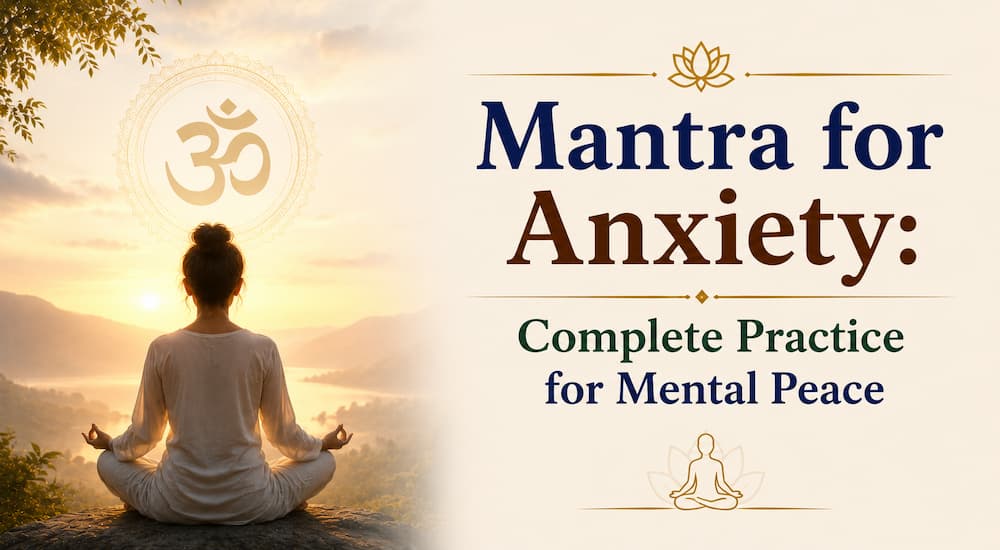
Time: Any quiet morning time before the day’s activities. Brahma Muhurta (before sunrise) for maximum effect.
Sequence:
1. Sit quietly for 2 minutes. Do not reach for your phone. Let the morning silence establish itself.
2. Three slow deep breaths. On each exhale, audibly say Om. This opens the practice.
3. Gayatri Mantra 108 times. Slow, clear pace. One breath per repetition.
4. Om Namah Shivaya 27 times. Let each repetition land in silence.
5. Sit in silence for 3 minutes after completing. This is the most important moment of the practice.
Total time: 25 to 30 minutes.
What this practice builds: Over 21 days, the sattvic quality of the morning practice begins to extend into the rest of the day. Most practitioners report that by Day 21, the quality of their baseline mental state has shifted : not dramatically, but measurably. The morning anxiety that many people experience on waking (the immediate rush of worry) typically reduces first. The broader anxiety levels reduce over 40 to 60 days of consistent practice.
From Our Practice
From Our Practice
I am a Jyotisha practitioner, not a psychologist. When clients come to me describing what we would recognise clinically as anxiety, I always say the same thing first: are you working with a doctor or therapist? If they are not and the anxiety is significantly affecting their daily functioning, I recommend they begin there. The mantra practice is an addition to appropriate care, not a substitute for it.
That said, I have seen the Gayatri Mantra practice produce a consistent and documented shift in the quality of mind in anxious clients over a 21 to 40 day period. The shift is not the absence of anxiety : it is a change in the relationship to anxious thoughts. Where before, anxious thoughts produced immediate bodily distress (tightness in the chest, rapid breathing, racing heart), after sustained Gayatri practice many clients report experiencing the same thoughts but with significantly less physical response. The thought arises, they notice it, and it passes without the full autonomic cascade that previously accompanied it.
This is precisely what the tradition describes as the Gayatri’s purification of the mind : not the elimination of difficult thoughts but the reduction of their power to disturb the underlying clarity of awareness.
Frequently Asked Questions
❓ I have severe anxiety and am seeing a therapist. Can I also chant mantras?
Yes, absolutely. Mantra practice and psychological therapy address different dimensions of anxiety and complement each other. The therapy addresses the psychological patterns, experiences and beliefs that generate anxiety. The mantra practice addresses the physiological quality of the nervous system’s baseline state. There is no conflict between them. Tell your therapist you are adding a morning meditation practice that involves rhythmic chanting : most therapists will be supportive. Do not substitute the mantra practice for therapy.
❓ I cannot sit still for 20 minutes to chant. My anxiety makes sitting still very difficult. What do I do?
Begin with 5 minutes, not 20. Chant Om Namah Shivaya 21 times : that takes less than 3 minutes. Then sit quietly for 2 minutes. Total: 5 minutes. Do this every morning for 7 days. At Day 8, add 7 more minutes. The tradition does not require you to sit for 20 minutes immediately. The consistent daily commitment matters far more than the duration of any single session. 5 sincere minutes every day for 40 days produces far more than 20 anxious minutes once a week.
❓ I get very anxious before sleep. Which mantra should I chant in bed?
Om Namah Shivaya 108 times, chanted quietly or silently in bed. The pace should be slow : slower than you think is necessary. Let the space between each repetition be at least one full breath. The Panchakshara (five syllables Na Ma Shi Va Ya) slows the breath rhythm naturally and shifts the nervous system toward the parasympathetic state needed for sleep. If you fall asleep before reaching 108, that is the practice working correctly.
❓ Can children chant mantras for anxiety?
Yes. Om Shanti is the safest and most accessible mantra for children experiencing anxiety : it requires no Sanskrit knowledge, no specific posture and no count. Teach a child to say Om Shanti three times slowly when they feel frightened or overwhelmed. This gives them a tool they can use independently in any situation. For older children (10+), the Saraswati Vandana before school and the Gayatri Mantra 21 times in the morning are appropriate additions.
❓ Which Ayurvedic approach complements mantra practice for anxiety?
Vata dosha imbalance is the Ayurvedic understanding of most anxiety conditions : Vata governs movement, air and the nervous system, and its excess produces the restlessness, agitation and fear that characterise anxiety. The Ayurvedic complement to mantra practice for Vata imbalance is: warm oil self-massage (Abhyanga) before bathing, warm and grounding foods (ghee, root vegetables, warm milk), regular sleep and wake times, and reduced exposure to screens and stimulation in the hours before sleep. Combined with the Gayatri and Om Namah Shivaya practice, this Ayurvedic lifestyle protocol addresses anxiety at multiple levels simultaneously.
❓ How quickly will I feel better?
The Om Shanti emergency mantra produces a measurable physiological shift within 2 to 5 minutes of beginning : this is the breath-regulation mechanism and it is immediate. The daily Gayatri practice typically produces noticeable effect on baseline anxiety between Day 14 and Day 21. Full stabilisation of the practice’s effect on the underlying anxious pattern typically occurs at 40 to 60 days. These timelines assume consistent daily practice without gaps. A gap of more than 3 days resets the cumulative effect to a degree : consistency is the single most important variable.
Begin Tonight
Before sleep: chant Om Namah Shivaya 27 times. Slowly. One full breath between each repetition. Notice what changes in your body as you chant.
Tomorrow morning: set an alarm 5 minutes earlier. Sit up when it sounds. Do not reach for your phone. Chant Om Namah Shivaya 21 times. Then sit quietly for 2 minutes. Then begin your day.
Do this every day for 21 days. At Day 21, add the Gayatri Mantra if the 5-minute practice feels established. The tradition asks for consistency, not perfection. Begin where you are.
Sources
- Wikipedia : Om Namah Shivaya: Panchakshara mantra significance and the five-syllable structure
- Wikipedia : Mantra: physiological effects of rhythmic chanting; parasympathetic activation through rhythmic sound
- Chandogya Upanishad 7.26 : on the purification of mental tendencies (chitta shuddhi) through sustained mantra practice
- Ayurvedic texts on Vata dosha and anxiety: Charaka Samhita, Sutra Sthana, on Vata as the governing force of the nervous system
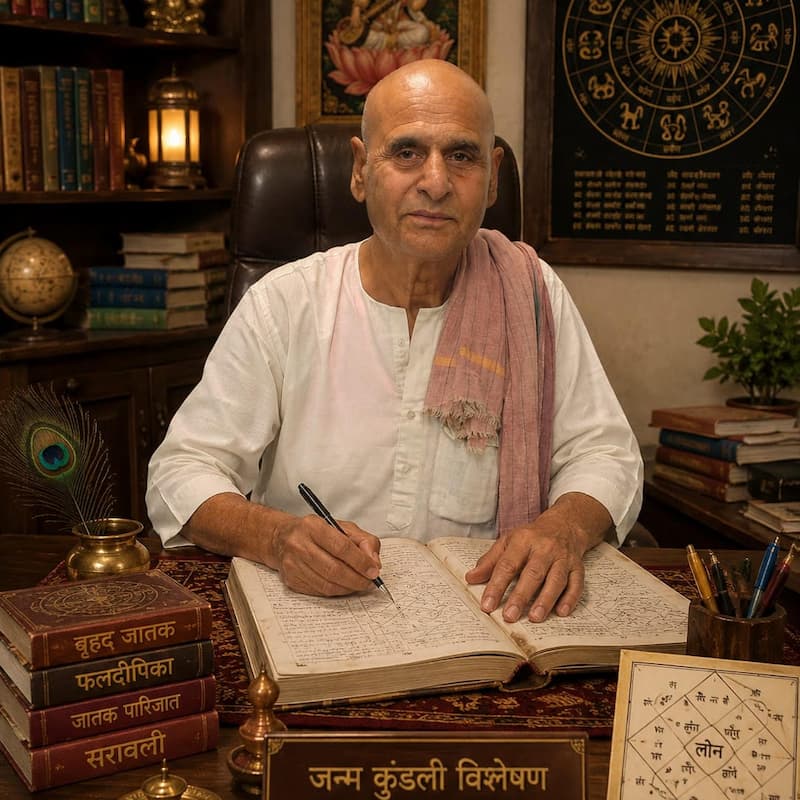
Narendra Kumar Chaubey is a Jyotisha Acharya with over 30 years of experience, based in Bihar and serving clients across India in Vedic astrology, mantra shastra, Vastu and ritual practice.
He completed his formal training at Kameshwar Singh Darbhanga Sanskrit University (KSDSU), one of India’s oldest and most respected institutions for Vedic and Sanskrit scholarship, where he studied Jyotisha shastra, mantra vidya and related classical sciences. KSDSU’s tradition of rigorous Sanskrit education tracing directly to the Mithila region’s centuries-old pandit lineage forms the foundation of his practice.
Over three decades, Narendra Kumar Chaubey has worked with thousands of individuals and families across Bihar and across India, offering guidance in:
- Kundli (birth chart) analysis: Identifying karmic patterns, planetary periods and life path guidance through classical Jyotisha
- Palmistry (Hasta Samudrika): Reading the hand according to the classical Samudrika Shastra tradition
- Vastu Shastra: Assessment and correction of living and working spaces according to directional and elemental principles
- Mantra and Pooja vidhi: Performing and guiding all categories of puja, havan, and mantra sadhana for personal, family and business situations
- Predictive Jyotisha: Transit analysis, muhurta (auspicious timing) selection and remedial guidance
He works across four languages Sanskrit, Hindi, English and Bhojpuri making classical knowledge accessible to practitioners across educational backgrounds and regions.
His writing for ABMantra brings the precision of classical Vedic training to practical mantra guidance: not general advice but specific prescriptions grounded in shastra, lineage and 30 years of direct practice with real situations.
For more info follow on: