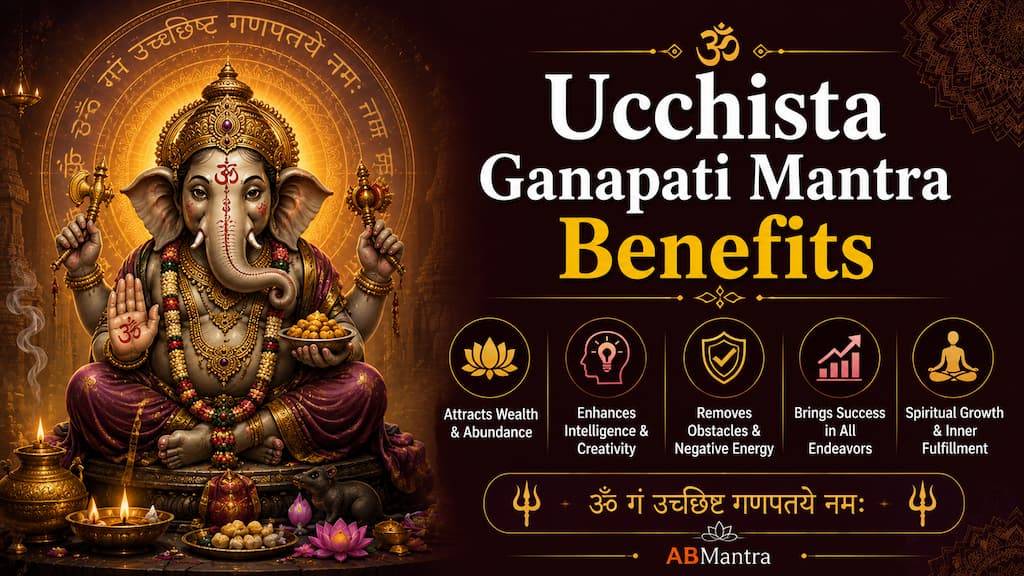

The Ucchista Ganapati Mantra benefits are accessed through one of the most unusual and least understood forms of Lord Ganesha in the entire Hindu tradition. Ucchista Ganapati is not the gentle, approachable Ganesha of everyday worship. He is the eighth of the 32 classical forms of Ganesha – a Tantric form from the Vamachara tradition who specifically accepts what every other deity and ritual rejects: that which is impure, contaminated, transgressive, and left over. Understanding why that quality is the source of his power – not a limitation – is the key to understanding what the Ucchista Ganapati Mantra actually does.
Who Is Ucchista Ganapati
Ucchista (also written Uchchishta or Uchishta) comes from the Sanskrit root Uch + Shishta – meaning “the leftover,” “the remnant,” “that which remains after eating.” Specifically, in the ritual context, it means food that has been touched by the mouth and mixed with saliva – which in the Vedic and Brahmanical tradition is considered ritually impure (ashudha). Such food cannot be offered to deities, touched during puja, or brought into sacred spaces.
Ucchista Ganapati’s name means, in effect: the Ganesha who accepts this. He is the deity who specifically receives the contaminated, the leftover, the ritually impure – and transforms it. In the Tantric philosophical understanding, his name points to a deeper truth: the divine is not absent from what convention labels as impure. He is present precisely there.
He is the eighth of the 32 forms of Ganesha described in the classical texts. Where the standard Ganapati is invoked for auspicious beginnings in a state of full ritual purity, Ucchista Ganapati specifically governs the spaces that standard purity rules exclude. This is not a lower or degraded form – it is a specific and distinct form that addresses what the standard forms cannot reach.
Classical Iconography: What the Form Tells You
The iconography of Ucchista Ganapati is described consistently across classical texts. He is:
- Six-armed (Shadabhuja): His six hands hold – a rosary (Japa mala), a pomegranate (representing abundance and fertility), an ear of paddy or grain (representing nourishment and prosperity), a blue lotus (Nilotpala), a veena (the musical instrument of his consort), and his sixth hand embraces Neela Saraswati
- Blue in colour: Blue (Neela) connects him to the Tantric tradition of Neela-associated deities – specifically Neela Saraswati, his consort, and Kali, who also appears in deep blue-black forms
- Seated with his consort Neela Saraswati: Neela Saraswati sits on Ucchista Ganapati’s left lap. Both are described as being in a state of intimate union (Suratapravrtta – engaged in amorous activity). His trunk rests on her thigh in the classical description.
- On a red lotus (Arakta Saroruha): The red lotus is the seat of Shakti energy – specifically Kameshwari, the energy of desire
Neela Saraswati: The Consort Who Matters
Most articles describe Ucchista Ganapati’s consort simply as “Goddess Shakti.” This is incomplete and misses an important dimension of the mantra’s benefits. His specific consort is Neela Saraswati – the blue form of Saraswati, goddess of all knowledge, learning, arts and creative expression.
Neela Saraswati is specifically associated with:
- Complete knowledge of all Vidya (branches of knowledge and spiritual practice)
- Kamakhya – her yoni is specifically identified with the Kamakhya Shakti Peeth in Assam in the Tantric tradition
- The unrestricted flow of creative and intellectual power – what flows when the ego’s restriction on intelligence is removed
This is why Ucchista Ganapati is specifically associated with knowledge, speech, creative power, and the acquisition of Vidya – not as secondary benefits but as primary ones. When you invoke him, you are not only invoking Ganesha’s obstacle-removing power. You are also invoking Neela Saraswati’s complete knowledge. The two are inseparable in this form.
Ucchista Ganapati Mantra: The Navarna Mantra
The primary accessible mantra for Ucchista Ganapati is the Navarna (nine-syllable) Mantra, which is documented in classical Tantra texts and is the mantra around which the foundational Sadhana is structured:
Word by word meaning:
Om (ॐ): The primordial cosmic sound – the ground from which all mantras emerge.
Hasti (हस्ति): The elephant – this is the name of Ganesha specifically in his Tantric form. Hasta means hand in Sanskrit, and Hasti refers to the one who has a trunk (Hastin – the elephant). The 655th name of Ganesha in the Ganesha Sahasranamavali is: Om Hastipishachishaya Namah (Salutations to the lord of the Pishachis). Hasti here is not a casual reference – it is the specific Tantric name that connects Ganesha to his role as lord of the Pishachi energy.
Pishachi (पिशाचि): The feminine form of Pishaca – a class of powerful being associated with the cremation ground, the liminal spaces between the living and the dead, and with hidden knowledge of realms unknown to ordinary consciousness. Pishachis are manifestations of Shakti that operate at the lower or liminal strata of consciousness. In this mantra, the Pishachi is specifically the Shakti that accompanies Ganesha – the power that knows the hidden dimensions. The inclusion of खे (Khe – void, emptiness, specifically associated with the cremation ground) in some versions of the mantra connects this energy to the Tantric space of Shunyata (emptiness) where transformation happens.
Likhe (लिखे): From the root Likh – to write, to inscribe, to draw, to trace. This word is crucial to the mantra’s specific powers: Likhita Japa (written mantra practice), writing, creative expression, inscribing knowledge, and the power of the written word all fall within Likhe’s domain. It is also associated with Lekhana – written communication, documents, contracts.
Svaha (स्वाहा): The Vedic completion syllable for fire offerings – I offer this to the divine fire. Svaha is the name of Agni’s wife in the tradition and specifically the syllable that confirms and releases the intention of the mantra into the cosmic fire. It is more intense than Namah (I bow) – it is the offering of the entire mantra’s energy into the divine.
Complete meaning: I invoke the elephant (Ganesha in his Tantric form) and the Pishachi (the liminal Shakti of hidden knowledge), the power of writing and inscription – and I offer this invocation completely to the sacred fire.
Ucchista Ganapati Mantra Benefits: Each One Explained
The benefits of Ucchista Ganapati worship arise directly from his nature – the deity who accepts what all others reject. Each benefit is not arbitrary but follows from what he specifically governs.
| Benefit | Why this deity specifically | Who it is most relevant for |
|---|---|---|
| Removal of obstacles in situations where standard puja has not worked | Because Ucchista Ganapati accepts what standard ritual purity excludes, he can reach and address situations that standard Ganesha worship cannot access – specifically those involving ritual impurity, taboo circumstances, or conditions that a conventionally devout person would consider beyond the reach of normal prayer. | Those in situations of deep difficulty where conventional religious practice has not produced results; those whose circumstances involve shame or social stigma |
| Knowledge and mastery of all Vidya | Neela Saraswati – his consort – is Vidyarajni (the queen of all knowledge). Invoking Ucchista Ganapati simultaneously invokes Neela Saraswati’s power of complete knowledge. The Likhe element in the mantra specifically governs the power of the written word and creative expression. | Writers, artists, scholars, those pursuing advanced studies, creative professionals |
| Speech, communication and persuasion | Ganesha governs Vak (speech) in all his forms. In the Ucchista form, where he is paired with the Saraswati energy of speech and knowledge, this dimension is intensified. The tradition specifically prescribes Ucchista Ganapati for success in debates, oratory and competitive speech. | Lawyers, speakers, teachers, politicians, those in competitive examinations |
| Wealth, abundance and prosperity | The pomegranate held in one hand (symbol of abundant seeds – multiple sources of prosperity), the paddy ear (abundance of grain – material sustenance) and the general quality of UG accepting what others reject (creating abundance from apparent scarcity) all point to his prosperity-granting quality. | Those in financial difficulty, business owners, those in trades and commerce |
| Relationship and intimacy | His form specifically and uniquely governs the domain of intimate connection – the divine union of Ganesha and Neela Saraswati is a direct statement of his authority over this domain. He specifically accepts sexuality as a sacred offering – not a transgression but a legitimate form of devotion. | Couples seeking deeper connection, those with relationship obstacles, those facing intimacy-related difficulties |
| Fertility and children | The combination of his intimate iconography, the pomegranate (classical symbol of fertility), and Neela Saraswati’s creative power makes Ucchista Ganapati one of the most specifically prescribed deities for fertility in the Tantric tradition. | Couples facing fertility challenges |
| Protection from negative forces and black magic | The Pishachi element in the mantra – which invokes the power that operates in the liminal spaces where negative forces originate – can specifically address negative energies at their source. When Ganesha controls the Pishachi, her power is converted from potentially destructive to protective. | Those experiencing unexplained negative events, those under the influence of hostile occult actions |
| Success in competition and victory over enemies | The Pishachi’s hidden knowledge, combined with Ganesha’s obstacle-removing power, gives the practitioner insight into hidden dimensions of competitive situations. The tradition specifically prescribes this form for Jaya (victory) in all competitions. | Those in competitive fields, legal disputes, political situations |
Why “Ucchista” Is Power, Not Impurity
The most important philosophical point – and the one that explains the mantra’s unique access to certain domains – is this: Ucchista Ganapati’s willingness to receive what is considered impure is not a lowering of his standard. It is a specific statement about the nature of the divine.
In the standard Brahmanical view, ritual purity (Shuddha) is required to approach the divine. Contaminated food, certain bodily states, contact with the dead, sexual activity – all make a person temporarily unfit for ritual. This view is practically useful for maintaining ritual boundaries. But it implies, if taken to its conclusion, that the divine is absent from the spaces it excludes.
Ucchista Ganapati’s philosophical position is the opposite: the divine is present everywhere – including in what conventional purity labels as impure. His acceptance of Ucchista (the leftover, the contaminated) is not permission for carelessness. It is a statement that the divine’s reach is unlimited. Nothing is beyond his grace. This is why the tradition calls him “Mahesa” – the great lord – in this form. His greatness is precisely in his non-rejection.
The Dashakshari Mantra is described in the Brihat Tantra Sara as the essence of all mantras – not because it is more powerful than other mantras through force, but because it reaches dimensions that other mantras cannot access, because it operates without the exclusions that standard mantric practice imposes.
Accessible Practice vs Formal Initiation: What You Can Do
This is the distinction that none of the competing articles makes clearly, leaving readers either over-cautioned (YantraChants: “don’t do this”) or without actionable guidance. The tradition has a clear structure:
| Level | Practice | Requires initiation? | For whom |
|---|---|---|---|
| 1 – Accessible | Devotional worship of Ucchista Ganapati’s image or yantra with sincere intention, basic offerings (modak, red flowers, red sandalwood), chanting Om Gam Ganapataye Namah 108 times with the specific intention of invoking Ucchista Ganapati’s accepting grace | No – open to all sincere devotees | Anyone drawn to this form with genuine sincerity |
| 2 – Navarna Mantra | Om Hasti Pishachi Likhe Svaha – chanted with understanding of its meaning, in a clean space, preferably after dusk (UG is specifically a Sandhya and post-dusk deity). 108 times daily or on Sankashti Chaturthi. | Ideally from a qualified practitioner who has received it correctly, but the mantra is documented in classical texts that are publicly available. The tradition does not require formal Deeksha for this specific mantra as it does for the Dashakshari. | Those with genuine devotion and clarity about their purpose |
| 3 – Full Tantric Sadhana | The complete Ucchista Ganapati Sadhana including the Dashakshari Mantra, specific Tithi observations, Panchamakara or Panchakalsha offerings, formal Nyasa and Dhyana | Yes – Guru Deeksha is mandatory. Without initiation this level of practice carries genuine risk as YantraChants correctly notes. The Kularnava Tantra is explicit about this. | Those who have found a qualified Guru in this specific lineage |
The Purashcharan Count
For the Navarna Mantra (Om Hasti Pishachi Likhe Svaha):
- Daily practice: 108 times, ideally after dusk on Sankashti Chaturthi (the monthly lunar day sacred to Ganesha)
- Complete Purashcharan: The Dashakshari Mantra has a Purashcharan of 16,000 repetitions as described in classical sources. For the Navarna, the traditional count varies by lineage.
- Most auspicious day: Sankashti Chaturthi – the 4th day of the Krishna Paksha (waning moon) each month. Wednesday (Mercury’s day – Ganesha governs Mercury/Budha) is also specifically auspicious for Ucchista Ganapati practice.
What Ucchista Ganapati Accepts as Offering
The tradition is specific about his offerings – and the specificity reflects his philosophical nature:
- Modak (sweet dumpling): Ganesha’s universal favourite offering
- Pomegranate: Held in one of his hands – the most appropriate fruit offering
- Red flowers: Red hibiscus specifically – associated with Shakti and the Tantric tradition
- Blue lotus (Nilotpala): The flower that is specifically Neela Saraswati’s and appears in his iconography
- Red sandalwood (Rakta Chandan): For anointing his image
- Wine (Madya) or coconut water as its substitute: In the formal Tantric puja, Madya is one of the traditional Panchamakara offerings. For home practice without initiation, coconut water is a legitimate and widely accepted substitute.
- Paddy (rice stalks with grain): Appearing in his iconography – offered as a symbol of nourishment and abundance
From Our Practice
Ucchista Ganapati is one of the forms I approach with the most care in consultations. When a client comes with situations that fall outside the reach of standard remedies – persistent difficulties despite consistent proper practice, circumstances involving social stigma or shame, creative blocks that no standard Mercury or Saraswati remedy has addressed, or situations where the person genuinely feels that their condition is somehow beyond the reach of normal prayer – this is where Ucchista Ganapati becomes relevant.
The philosophical teaching that his form embodies is, in my experience, often what is needed before the mantra itself: the understanding that nothing in your situation is so contaminated, so shameful, or so outside the divine’s reach that grace cannot enter it. The acceptance that Ucchista Ganapati represents is not moral relativism – it is a specific statement about the nature of the divine’s presence. It reaches where standard purity-based approaches cannot.
I am careful to always direct people toward the accessible level of practice – the Navarna Mantra with clear intention – before discussing the formal Sadhana. The formal Sadhana’s requirement for Guru initiation is not a bureaucratic obstacle. It exists because the Pishachi energy in the mantra, when not properly guided, can produce results in directions the practitioner did not intend. A qualified Guru who holds this lineage can assess the practitioner’s readiness and provide the specific guidance that prevents this. Do not bypass this.
Frequently Asked Questions
- Wikipedia – Ucchishta Ganapati: the eighth of 32 Ganesha forms, iconography (six hands, blue colour, pomegranate, paddy, lotus, veena, Neela Saraswati consort), Tantric Vamachara association
- Ganesha Sahasranamavali – the 655th name: Om Hastipishachishaya Namah (Lord of the Pishachis) – the classical source connecting Hasti (Ganesha) to the Pishachi energy in the Navarna Mantra
- Brihat Tantra Sara – the Dashakshari Mantra of Ucchista Ganapati described as the essence of all mantras; 16,000 repetitions Purashcharan; conditions for formal Sadhana
- Kularnava Tantra – the requirement for Guru initiation in Tantric practice; the specific warning against independent Tantrik practice without proper guidance: “You may walk on the sharp edge of a sword… but to follow rightly the way of the Kula is much more difficult”
- Wikipedia – Nila Saraswati: the blue Saraswati as Vidyarajni (queen of all knowledge), her identification with Kamakhya in the Tantric tradition, her role as Ucchista Ganapati’s specific consort
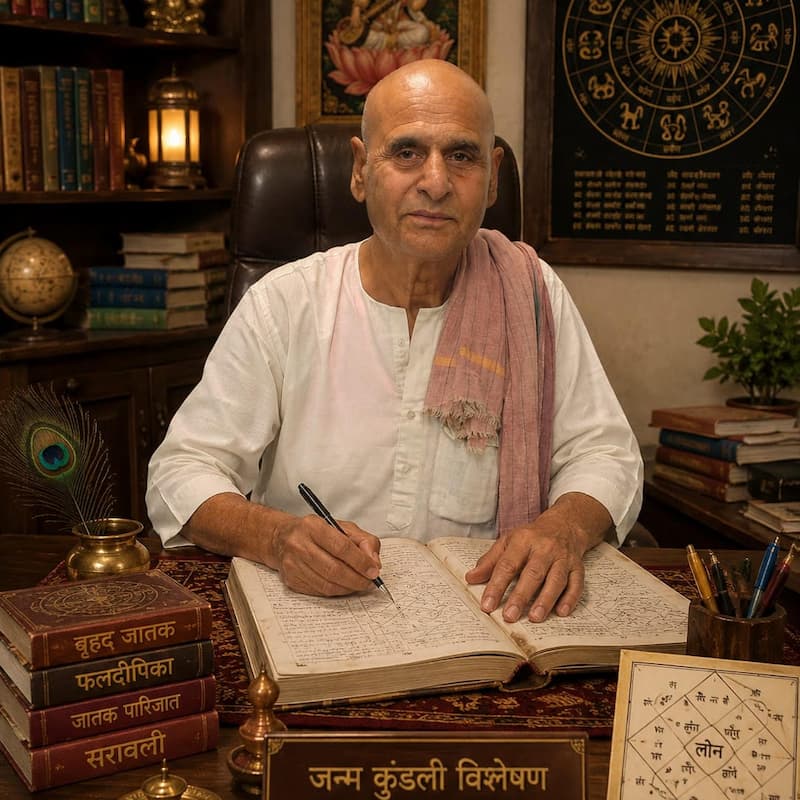
Narendra Kumar Chaubey is a Jyotisha Acharya with over 30 years of experience, based in Bihar and serving clients across India in Vedic astrology, mantra shastra, Vastu and ritual practice.
He completed his formal training at Kameshwar Singh Darbhanga Sanskrit University (KSDSU), one of India’s oldest and most respected institutions for Vedic and Sanskrit scholarship, where he studied Jyotisha shastra, mantra vidya and related classical sciences. KSDSU’s tradition of rigorous Sanskrit education tracing directly to the Mithila region’s centuries-old pandit lineage forms the foundation of his practice.
Over three decades, Narendra Kumar Chaubey has worked with thousands of individuals and families across Bihar and across India, offering guidance in:
- Kundli (birth chart) analysis: Identifying karmic patterns, planetary periods and life path guidance through classical Jyotisha
- Palmistry (Hasta Samudrika): Reading the hand according to the classical Samudrika Shastra tradition
- Vastu Shastra: Assessment and correction of living and working spaces according to directional and elemental principles
- Mantra and Pooja vidhi: Performing and guiding all categories of puja, havan, and mantra sadhana for personal, family and business situations
- Predictive Jyotisha: Transit analysis, muhurta (auspicious timing) selection and remedial guidance
He works across four languages Sanskrit, Hindi, English and Bhojpuri making classical knowledge accessible to practitioners across educational backgrounds and regions.
His writing for ABMantra brings the precision of classical Vedic training to practical mantra guidance: not general advice but specific prescriptions grounded in shastra, lineage and 30 years of direct practice with real situations.
For more info follow on: