
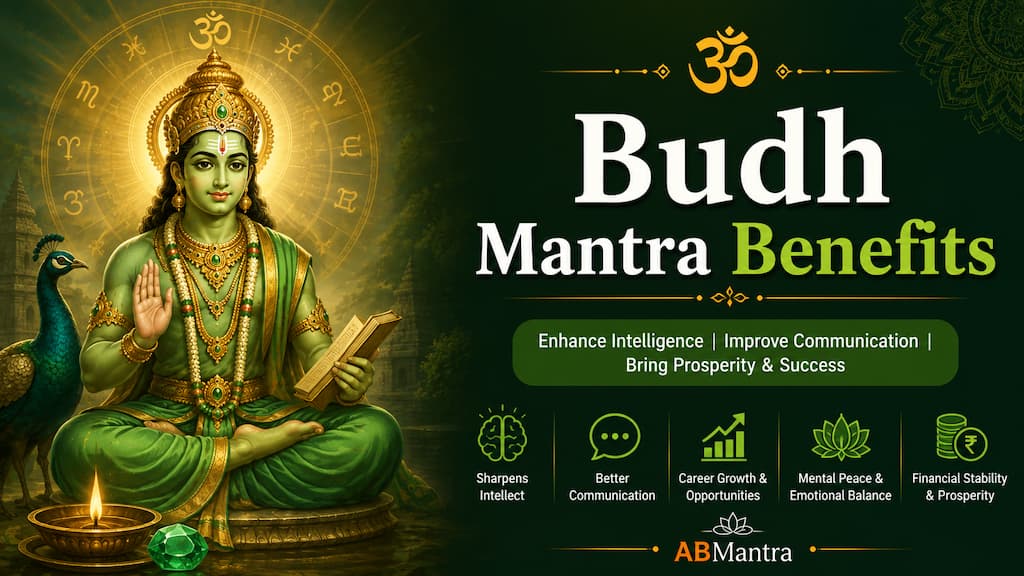

Quick Answer
The primary Budh Beej Mantra (Mercury Beej Mantra):
ॐ ब्रां ब्रीं ब्रौं सः बुधाय नमः॥
Om Braam Breem Braum Sah Budhaya Namah
Simple daily mantra: ॐ बुधाय नमः (Om Budhaya Namah) : 108 times daily
Benefits of Budh Mantra: Sharpens intelligence and communication, removes obstacles in education and business, strengthens Mercury in the birth chart, improves negotiation and speech, brings success in trade and creative fields, and removes the negative effects of weak or afflicted Mercury.
Best time: Wednesday mornings (Brahma Muhurta). Also effective at sunrise on Wednesdays. Chant 108 times facing northeast. Wear green clothing.
Who This Article Is For
This article is for you if: you have been told you have weak or afflicted Mercury (Budh) in your birth chart | you work in communication, writing, education, business or law and want to strengthen Mercury’s influence | you want to understand the difference between the Budh Beej Mantra and Om Budhaya Namah : and when each is appropriate | you want specific guidance on Budh mantra for success and good luck.
Also see: Navagraha Mantra: all 9 planet mantras with complete guide and Adityaya Somaya Mangalaya: the collective Navagraha mantra
Mercury : called Budh in Sanskrit : is the planet of the mind. Where the Moon (Chandra) governs the emotional, intuitive, feeling mind, Mercury governs the rational, communicating, calculating, expressing mind. Your ability to speak clearly, write persuasively, negotiate effectively, learn quickly, process information accurately and translate thought into speech : all of this falls under Mercury’s domain. The Budh Mantra benefits the practitioner by strengthening exactly these capacities.
Here is what most Budh Mantra articles miss: they present the benefits as a list without explaining that the Budh Mantra serves a fundamentally different purpose depending on whether your Mercury is weak, strong or afflicted in the birth chart. The mantra does not do the same thing in each case. Understanding which condition applies to you determines which mantra, which count and which additional practices are needed. This article covers all three scenarios.
Who Is Budh Dev: The Mythology Behind the Mantra
Budh (Mercury) has one of the most unusual origin stories in the Navagraha tradition. He is the son of Soma (the Moon) and Tara : but Tara was the wife of Brihaspati (Jupiter), not of the Moon. The Moon, captivated by Tara’s beauty, abducted her. This caused a great conflict among the gods : some supporting the Moon’s claim, others supporting Brihaspati’s. After a long celestial war, Brahma intervened and ordered Tara’s return. When Tara returned, she was pregnant. The child born from this union was Budh : extraordinarily beautiful and exceptionally intelligent, surpassing all the gods in quickness of mind and elegance of expression.
This origin story is encoded in Budh’s nature: he inherits the Moon’s emotional responsiveness (Soma) and embodies a kind of brilliance that exists slightly outside conventional boundaries : the intelligence that thinks laterally, communicates unusually well, and processes information faster than expected. The Budh Dhyana Shloka describes him as dark-complexioned like a black tulip, seated on a lion, four-armed, holding a sword and shield.
Classical names of Budh:
- Soumya : son of Soma (the Moon); also meaning gentle, auspicious, pleasing
- Rauhineya : son of Rohini (in one tradition, his mother is Rohini, daughter of Daksha)
- Tunga : the exalted one
- Vishnurupi : resembling Vishnu in beauty
- Budha : the intelligent, wise, awakened one (same root as Buddha)
Budh Mantra at a Glance
| Detail | Information |
|---|---|
| Budh Beej Mantra | Om Braam Breem Braum Sah Budhaya Namah |
| Sanskrit | ॐ ब्रां ब्रीं ब्रौं सः बुधाय नमः |
| Simple name mantra | Om Budhaya Namah (ॐ बुधाय नमः) |
| Gayatri Mantra | Om Saumyarupaya Vidmahe Vaneshaya Dhimahi Tanno Saumyah Prachodayat |
| Dhyana Shloka | Priyangukalikaashyamam Rupenam Pratimam Budham, Saumyam Saumyagunopetham Tam Budham Pranamamyaham |
| Planet governed | Mercury (Budh) : intelligence, communication, trade, education, writing |
| Best day | Wednesday (Budhavar) |
| Best time | Brahma Muhurta (before sunrise) or sunrise on Wednesdays |
| Direction | Northeast (Budh’s direction) |
| Colour | Green (Budh’s colour) : wear green clothing during practice |
| Mala | Emerald mala (Budh’s gemstone) or green glass bead mala or white crystal mala |
| Daily count | 108 times (one mala round) |
| Mahadasha count | 17,000 repetitions for Mercury Mahadasha (at 108 daily: approximately 157 days) |
| Zodiac signs | Gemini and Virgo (Budh’s own signs). Exalted in Virgo. Debilitated in Pisces. |
| Gemstone | Panna (Emerald) : worn on little finger of right hand on Wednesday morning |
| Nakshatras | Ashlesha, Jyeshtha, Revati |
All Four Budh Mantras: Text, Meaning and When to Use Each
Mantra 1: Budh Beej Mantra (Primary)
ॐ ब्रां ब्रीं ब्रौं सः बुधाय नमः
Transliteration: Om Braam Breem Braum Sah Budhaya Namah
Word by word meaning:
Om: The primordial cosmic sound : the ground of all mantras.
Braam (ब्रां): The first beej syllable of Mercury. Bra = Mercury’s sonic seed, Aa = the long open vowel of manifestation and beginning. This syllable corresponds to Mercury’s initiating quality : the first flash of intelligence, the beginning of understanding.
Breem (ब्रीं): The second beej syllable. The ee-sound of sustained intelligence : the quality of holding a thought, developing it, seeing its implications. Mercury’s sustained analytical capacity.
Braum (ब्रौं): The third beej syllable. The au-diphthong of completion and expression : the moment understanding translates into communication. The beej of Mercury’s culminating quality: the articulation of what was perceived and developed in the first two syllables.
Sah (सः): The identifying seal : the affirmative pranava that connects the three beej syllables to Mercury specifically.
Budhaya (बुधाय): To Budh (dative case). Budh = the intelligent one, the awakened one. Same Sanskrit root as Buddha : the one who has woken up, who is fully alert and awake to reality.
Namah (नमः): I bow. I surrender. I acknowledge Mercury’s authority over intelligence, communication and the rational mind.
Complete meaning: Through the three seed sounds of Mercury’s intelligence (Braam : perceiving, Breem : developing, Braum : expressing), I bow to Budh, the awakened and intelligent one.
Best for: Serious Mercury sadhana, weak or afflicted Mercury in the chart, Mercury Mahadasha, major communication or business challenges
Count: 108 times daily on Wednesdays. Daily during Mercury Mahadasha.
Mantra 2: Om Budhaya Namah : The Simple Name Mantra
ॐ बुधाय नमः | Om Budhaya Namah
Meaning: I bow to Budh, the awakened and intelligent one.
Why this form matters: Om Budhaya Namah is the simplest and most accessible form of Mercury invocation. It contains Budh’s name in the dative case (Budhaya = to Budh) and the universal salutation (Namah = I bow). While less concentrated than the Beej Mantra, it is ideal for:
– Daily informal chanting throughout the day
– Before studies, meetings, presentations or negotiations
– As a Japa practice for those new to mantra
– Wednesday morning practice alongside the Beej Mantra
Count: 108 times daily, or informally as many times as possible throughout Wednesday
The Om Budhaya Namah mantra benefits: Mental clarity before important communications, reduction of nervousness before public speaking, improvement in writing quality and persuasiveness, and the general strengthening of Mercury’s positive qualities in daily life regardless of chart placement.
Mantra 3: Budh Gayatri Mantra
ॐ सौम्यरूपाय विद्महे वाणेशाय धीमहि। तन्नो सौम्यः प्रचोदयात्॥
Transliteration: Om Saumyarupaya Vidmahe Vaneshaya Dhimahi Tanno Saumyah Prachodayat
Meaning: We know Saumyarupa (Mercury, the gentle/beautiful-formed one). We meditate on Vaneshaya (the lord of speech and expression). May that Saumya (Mercury, the gentle one) illuminate and guide our intellect.
Key words: Saumyarupa = beautiful form, also son of Soma (Moon); Vaneshaya = lord of Vak (speech, expression, communication) : directly invoking Mercury’s role as the master of language and communication; Prachodayat = may he illuminate, inspire, impel forward.
Best for: Wednesday morning practice specifically, improving speech and communication, students and writers, invoking Mercury’s blessing for academic and creative work
Count: 11 or 108 times on Wednesday mornings
Mantra 4: Budh Dhyana Shloka (Vedic Mantra)
प्रियंगुकालिकाश्यामं रूपेणाप्रतिमं बुधम्। सौम्यं सौम्यगुणोपेतं तं बुधं प्रणमाम्यहम्।।
Transliteration: Priyangukalikaashyamam Rupenam Pratimam Budham
Saumyam Saumyagunopetham Tam Budham Pranamam Yaham
Meaning: I bow to Budh who is dark like the Priyangu flower (a dark-coloured flowering tree), whose beauty is without equal (Apratinam = unmatched), who is gentle (Saumya) and endowed with gentle and auspicious qualities (Saumyagunopetham) : to that Budh I bow.
When to use: Chanted once at the beginning of the Wednesday puja as the meditation shloka. This Dhyana shloka establishes the mental image of Budh Dev before the main mantra Japa begins. It is the opening contemplation, not the main count mantra.
Budh Mantra Benefits: With Mechanism
Most Budh Mantra articles give bullet point lists without explaining why each benefit occurs. Here is the mechanism behind the primary benefits.
1. Sharpening of Intelligence and Memory
Mercury governs Buddhi : the discriminating, rational intelligence : and Smriti, the faculty of memory. The Budh Mantra, through the Braam-Breem-Braum beej sequence, works on this specific faculty by creating the sonic pattern of Mercury’s energy in the practitioner’s nervous system. Consistent practice strengthens the neurological pathways associated with precise thinking, quick information retrieval and accurate analysis. Practitioners consistently report that within 21 to 40 days of consistent Wednesday practice, their capacity to recall information quickly and to organize complex thoughts clearly shows measurable improvement.
2. Improvement in Communication and Speech
Mercury is Vak : the principle of speech. He is the lord of Vaneshaya (the lord of speech) as the Gayatri Mantra names him. Weak or afflicted Mercury specifically manifests as difficulty in expression: stammering, hesitation, difficulty finding the right words, misunderstandings in communication, and the frustration of having thoughts that cannot be translated into clear speech. The Om Budhaya Namah chanted before important communications specifically addresses this : it primes the speech faculty before it is needed.
3. Success in Business, Trade and Negotiations
Mercury governs commerce, trade, negotiation and contracts in Vedic astrology. He is the fastest moving planet : his speed represents the rapid exchange of goods, information and value that characterises commerce. The Budh Mantra for success in business works by strengthening the practitioner’s capacity for the specific Mercury qualities that business success requires: quick accurate assessment of situations, persuasive communication, skilled negotiation and the ability to find solutions to problems quickly. Wednesday Budh Vrat combined with daily Beej Mantra practice specifically amplifies these qualities.
4. Academic and Educational Success
Mercury governs learning, education, books, scholarship and the acquisition of knowledge. Students who chant the Budh Mantra before study sessions consistently report improved absorption of material, better performance in examinations that require logical and analytical thinking, and reduced anxiety about academic performance. The Om Budhaya Namah before each study session is the single most effective and accessible Mercury remedy for students.
5. Budh Mantra for Good Luck in Mercury-Governed Areas
Mercury governs the areas of life where “good luck” often appears as the right word said at the right moment, the right connection made at the right event, the business opportunity recognised before others see it. This is Mercurial luck : the fortune that arrives through intelligence, communication and being in the right mental state to recognise and seize opportunities. The Budh Mantra for good luck works by heightening this mental alertness and communicative readiness. Wednesday Budh Vrat, combined with green-coloured clothing and the Beej Mantra, is the tradition’s prescription for activating this Mercurial fortune.
6. Removal of Speech-Related Ailments
The Budh Dhyana Mantra specifically mentions health benefits related to Mercury’s physical domain: the nervous system, speech organs, lungs, skin and the hands. Stammering, speech difficulty, nervous disorders and respiratory issues are all associated with afflicted Mercury in the Vedic tradition. The mantra practice specifically addresses these by strengthening the Mercury energy that governs these physiological systems.
Weak Mercury vs Afflicted Mercury: Different Conditions, Different Practice
This distinction is missing from every competitor article and is critical for understanding what the Budh Mantra does in your specific situation.
| Mercury condition | Signs in life | What the Budh Mantra does | Primary prescription |
|---|---|---|---|
| Strong Mercury (Gemini, Virgo : own signs; Virgo : exalted) |
Natural eloquence, quick intelligence, mathematical aptitude, good business sense, versatility and adaptability | Deepens these positive qualities. Increases the consistency and reliability of Mercury’s already strong expression. | Wednesday Om Budhaya Namah 108 times as maintenance practice |
| Weak Mercury (Low Shadbala, combust, in Pisces : debilitation) |
Difficulty expressing thoughts clearly, poor memory for details, hesitation in communication, indecisiveness, difficulty in calculations and paperwork | Strengthens Mercury’s positive qualities so they become accessible. The Beej Mantra builds Mercury’s strength from the foundation. | Budh Beej Mantra 108 times daily. Wednesday 1,008 times. Green Emerald/Panna after chart assessment. |
| Afflicted Mercury (Conjunct or aspected by malefics : Saturn, Mars, Rahu) |
Communication that causes misunderstandings even when not intended, deception-related problems, document and contractual issues, nervous system disorders, anxiety about communication | Pacifies and realigns Mercury’s energy. Does not remove the conjunction but changes how it expresses : from negative to more constructive manifestation. | Beej Mantra 108 times daily. Wednesday fast. Combined with the mantra of the afflicting planet where appropriate. |
| Mercury Mahadasha (17-year Vimshottari period) |
Increased focus on Mercury’s domains: communication, business, education. If Mercury is well-placed: 17 years of career growth in Mercury fields. If poorly placed: 17 years of communication-related difficulties. | The Beej Mantra during Mercury Mahadasha : maintained consistently : is the primary remedy for amplifying the positive and reducing the negative of this extended period. | Budh Beej Mantra daily 108 times. 17,000 repetitions as the Mahadasha Purashcharan (at 108 daily: approximately 157 days minimum sadhana) |
Complete Wednesday Budh Vrat Practice
Wednesday Budh Vrat: Complete Step-by-Step Method
The Budh Vrat (Wednesday fast): Fasting on Wednesdays : partial or full : is the companion practice to the Budh Mantra. Mercury responds specifically to voluntary restraint of speech on his day: try to speak thoughtfully and avoid unnecessary words on Wednesdays. This is Mercury’s specific vrat practice : not just fasting from food but fasting from careless speech.
Best time: Brahma Muhurta (before sunrise) or at sunrise on Wednesday
Preparation: Bathe. Wear green clothing : Mercury’s colour. Face northeast.
Step 1 : Opening:
Chant the Budh Dhyana Shloka once while visualising Budh Dev:
Priyangukalikaashyamam Rupenam Pratimam Budham : dark-complexioned, four-armed, seated on a lion, holding a sword and shield.
Step 2 : Sankalpa:
State your intention clearly: “I, [name], perform this Budh Mantra practice for the strengthening of Mercury’s positive qualities in my life : specifically [name your need: communication, success in business, academic excellence, or the particular Mercury quality you are developing].”
Step 3 : Om Budhaya Namah (11 times):
The simple name mantra as the opening invocation before the Beej Mantra begins.
Step 4 : Main Beej Mantra (108 times):
Om Braam Breem Braum Sah Budhaya Namah : 108 times on the mala.
Move one bead per complete mantra. Do not cross the Meru bead.
Step 5 : Budh Gayatri (11 or 21 times):
Om Saumyarupaya Vidmahe Vaneshaya Dhimahi Tanno Saumyah Prachodayat
Step 6 : Closing silence (3 minutes):
Sit without speaking or thinking intentionally. Let the mantra’s energy settle.
Step 7 : Wednesday donation:
Donate green items : green moong dal (green lentils), green cloth, green vegetables : to those in need. Or feed cows and birds (Mercury is associated with birds, particularly parrots). This charitable act is Mercury’s specific karmic discharge on his day.
Budh Mantra for Success and Good Luck: Situation-Specific Protocols
| Situation | Protocol | Duration |
|---|---|---|
| Students : exams and academic performance | Om Budhaya Namah 108 times every morning before study. On the morning of each exam: 21 times before leaving home. Wednesday Beej Mantra 108 times throughout the year. | Ongoing through the academic year |
| Business owners : success and negotiations | Budh Beej Mantra 108 times every Wednesday morning. Before any important meeting or contract signing: Om Budhaya Namah 11 times silently. Wednesday green moong donation. | Ongoing Wednesday practice |
| Writers, speakers, lawyers, teachers | Budh Gayatri Mantra 108 times on Wednesday mornings. Om Budhaya Namah informally throughout Wednesday. Begin any important work (writing, speech preparation, case preparation) with 11 repetitions of Om Budhaya Namah. | Ongoing practice |
| Weak Mercury in birth chart | Budh Beej Mantra 108 times daily (not only Wednesday). Wednesday 1,008 times. Wednesday fast (partial). Emerald gemstone after chart assessment by a qualified Jyotisha. | 40 consecutive Wednesdays minimum. Reassess. |
| Mercury Mahadasha (17-year period) | Budh Beej Mantra 108 times daily. Wednesday 1,008 times. 17,000 minimum repetitions within the Mahadasha period as the formal Purashcharan (at 108 daily: approximately 157 days). | 17,000 repetitions minimum, then maintain Wednesday practice throughout the Mahadasha |
| Budh mantra for good luck (general Mercury fortune) | Om Budhaya Namah 108 times every Wednesday. Wear green on Wednesdays. Wednesday green food (moong, green vegetables). 40 consecutive Wednesdays of Beej Mantra to establish Mercury’s consistent positive influence. | 40 Wednesdays minimum, then ongoing weekly practice |
Professions That Benefit Most from Budh Mantra
Mercury governs specific domains of life. People in these professions benefit most from regular Budh Mantra practice because they are working in Mercury’s territory daily:
- Writers and journalists : Mercury governs all written expression. The Budh Gayatri specifically invokes Vaneshaya (lord of speech and writing).
- Lawyers and advocates : Mercury’s domain of precise language, logical argument and the ability to present a case persuasively is the core of legal practice.
- Teachers and lecturers : Mercury governs teaching, knowledge transmission and the ability to make complex ideas accessible through clear explanation.
- Business people and traders : Mercury is specifically the planet of commerce, trade, negotiation and contracts.
- Accountants and mathematicians : Mercury governs calculation, precision, mathematical aptitude and the ability to work accurately with numbers.
- Actors, comedians and public speakers : Mercury’s quickness of wit, improvisational intelligence and performance communication are the foundation of these arts.
- Students at all levels : Mercury governs learning, memory and examination performance.
- IT professionals and programmers : logical, structured thinking and the ability to translate complex problems into structured language are Mercury capacities.
From Our Practice
From Our Practice
Mercury is the most frequently underestimated of the Navagrahas in my Jyotisha experience. Clients who come with Saturn Mahadasha anxieties, Rahu-Ketu fears and Mangal Dosha concerns rarely present with “I think my Mercury is weak” as their chief concern. Yet when I look at charts where communication difficulties, business misunderstandings, contractual problems, or persistent educational struggles are the primary presenting issues, weak or afflicted Mercury is the most common finding.
The most consistent result I have observed from the Budh Mantra practice : specifically Om Budhaya Namah chanted daily alongside the Beej Mantra on Wednesdays : is a progressive improvement in the quality of the practitioner’s written communication. Not dramatic overnight transformation, but a gradual shift over 40 to 60 days where emails become clearer, documents become more organised, and the frustration of “I know what I mean but I can’t say it” begins to dissolve.
The secondary finding, which practitioners consistently mention, is improved outcomes in negotiations and meetings. One client who worked in corporate sales : whose Mercury was debilitated in Pisces in his natal chart : began the Wednesday Budh Beej Mantra practice during Mercury Mahadasha. Within three months, he reported his conversion rate in sales calls had improved noticeably, and his manager had commented on how much clearer and more persuasive his presentations had become. He had not changed his approach intentionally : the mantra practice had gradually shifted the quality of his Mercury expression from its debilitated manifestation toward something closer to Mercury’s genuine potential.
Frequently Asked Questions
❓ What is the difference between Om Budhaya Namah and the Budh Beej Mantra?
Om Budhaya Namah is the simple name mantra : Mercury’s name in the dative case with a bow (Namah). It is accessible, suitable for informal daily chanting, and appropriate for anyone wanting to establish a basic relationship with Mercury’s energy. The Budh Beej Mantra (Om Braam Breem Braum Sah Budhaya Namah) contains Mercury’s three beej syllables and is more concentrated, more specifically targeted to strengthening Mercury in the chart, and more appropriate for serious sadhana during Mercury Mahadasha or for significant Mercury afflictions. For daily practice without a specific Mercury problem: Om Budhaya Namah. For serious Mercury remedy: the Beej Mantra. For best results: both : Om Budhaya Namah throughout the day and the Beej Mantra in the formal Wednesday sitting.
❓ I am a student preparing for competitive exams. Which Budh Mantra should I chant?
For students: three practices in combination. First, Om Budhaya Namah 108 times every morning before the study session begins. Second, the Budh Gayatri Mantra (Om Saumyarupaya Vidmahe Vaneshaya Dhimahi Tanno Saumyah Prachodayat) 11 times on Wednesday mornings. Third, the Budh Beej Mantra 108 times on Wednesdays for the formal weekly sadhana. The Om Budhaya Namah before each study session is the most immediately practical : chanted at the desk before opening books, it primes the Mercury faculty for absorption and retention of what follows.
❓ Can chanting Budh Mantra help with public speaking anxiety?
Yes, specifically. Public speaking anxiety is often a Mercury problem: the disconnect between what you know and what you can express under pressure. Mercury governs the speech faculty and its relationship with the rational mind. Om Budhaya Namah chanted 21 times before any public speaking engagement creates a specific priming effect on the speech faculty. For deeper, long-term improvement in public speaking confidence: the Budh Beej Mantra 108 times every Wednesday for 40 consecutive Wednesdays produces a cumulative strengthening of Mercury’s expressive qualities that noticeably reduces the anxiety-driven gap between thought and speech.
❓ What is the significance of green colour in Budh Mantra practice?
Green is Mercury’s colour in the Vedic colour correspondence system. Wearing green on Wednesdays and using green offerings (green moong dal, green vegetables, green flowers) during the Budh Mantra practice creates a sensory alignment with Mercury’s energy field. The Vedic tradition holds that colour carries the specific vibration of its corresponding planet. Just as blue is Saturn’s colour and red is Mars’s, green is Mercury’s : it corresponds to Mercury’s qualities of growth, communication and the freshness of intelligent perception. This is not mere symbolism: the tradition holds that the body’s energy field responds to colour as a genuine vibrational input, making the green of the environment during Budh practice a legitimate component of the remedy.
❓ How do I know if my Mercury is weak or afflicted in my birth chart?
The two primary indicators: Mercury’s sign placement and aspects. Mercury is weakest when placed in Pisces (its sign of debilitation). It is afflicted when conjunct or aspected by malefic planets : particularly Mars (creates harsh, impulsive communication), Saturn (creates slow, fearful communication) or Rahu (creates deceptive or obsessive communication patterns). The experiential signs of weak or afflicted Mercury are: chronic difficulty finding the right words even when you know what you want to say; persistent misunderstandings in communication despite good intentions; difficulty with paperwork, contracts and administrative tasks; poor memory for names and details; and nervous anxiety specifically around speaking or writing. A birth chart assessment by a qualified Jyotisha confirms which condition applies.
❓ Does the Budh Mantra work only on Wednesdays or should I chant it every day?
For the best results: both. Wednesday is Mercury’s day and the most powerful day for Budh Mantra practice : the 1,008-count on Wednesdays is the traditional intensive prescription. Daily practice of Om Budhaya Namah or the Beej Mantra (108 times any morning) produces a cumulative strengthening that the once-weekly practice alone cannot match. Think of Wednesday practice as the intensive weekly session and daily practice as the sustained maintenance. If you can only choose one: consistent daily practice of 108 repetitions produces more transformation than an intensive Wednesday-only practice. If you have Mercury Mahadasha or significant Mercury affliction: daily practice is non-negotiable.
Begin This Wednesday
Tomorrow morning : or this coming Wednesday : take your mala, wear green if possible, face northeast, and chant Om Braam Breem Braum Sah Budhaya Namah 108 times. 10 to 12 minutes. Then Om Saumyarupaya Vidmahe Vaneshaya Dhimahi Tanno Saumyah Prachodayat 11 times. Then three minutes of silence.
Between now and the next Wednesday: Om Budhaya Namah : before each important email, each important conversation, each study session. Not 108 times each occasion. Just 11 times. Just enough to prime the Mercury faculty before it is needed.
Mercury is the planet of intelligence : and intelligence, in the Vedic understanding, is not a fixed quantity you either have or do not have. It is a faculty that can be cultivated, strengthened and refined. The Budh Mantra is the tradition’s primary tool for that cultivation. Begin this Wednesday. Continue every Wednesday. The intelligence that was always yours becomes increasingly available.
Sources
- Wikipedia : Budha: Mercury in Hindu astrology, mythology (son of Soma and Tara), classical names (Soumya, Rauhineya), Nakshatras governed (Ashlesha, Jyeshtha, Revati)
- Wikipedia : Navagraha: Mercury’s role in the nine-planet system, its zodiac signs (Gemini, Virgo) and the classical astrological significations
- Brihat Parashara Hora Shastra : Mercury as karaka of intelligence (Buddhi), speech (Vak), education, trade and writing; Mercury’s exaltation in Virgo and debilitation in Pisces; Budh Mahadasha duration of 17 years in Vimshottari system
- Navagraha Stotra tradition : Budh Dhyana Shloka (Priyangukalikaashyamam) and Budh Gayatri Mantra classical sources; Budh Beej Mantra Braam-Breem-Braum syllable sequence from the Navagraha mantra tradition
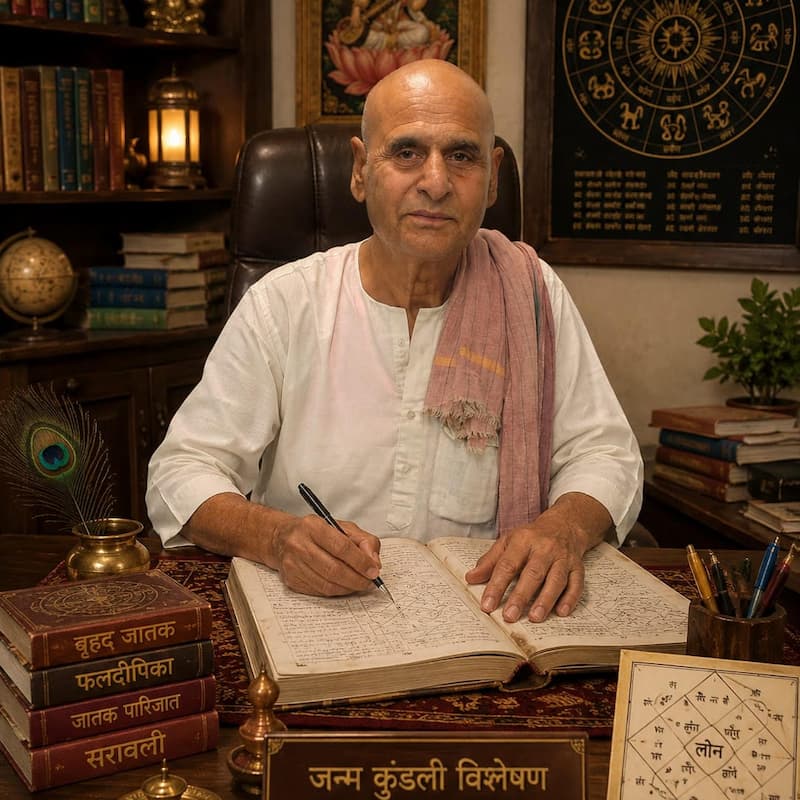
Narendra Kumar Chaubey is a Jyotisha Acharya with over 30 years of experience, based in Bihar and serving clients across India in Vedic astrology, mantra shastra, Vastu and ritual practice.
He completed his formal training at Kameshwar Singh Darbhanga Sanskrit University (KSDSU), one of India’s oldest and most respected institutions for Vedic and Sanskrit scholarship, where he studied Jyotisha shastra, mantra vidya and related classical sciences. KSDSU’s tradition of rigorous Sanskrit education tracing directly to the Mithila region’s centuries-old pandit lineage forms the foundation of his practice.
Over three decades, Narendra Kumar Chaubey has worked with thousands of individuals and families across Bihar and across India, offering guidance in:
- Kundli (birth chart) analysis: Identifying karmic patterns, planetary periods and life path guidance through classical Jyotisha
- Palmistry (Hasta Samudrika): Reading the hand according to the classical Samudrika Shastra tradition
- Vastu Shastra: Assessment and correction of living and working spaces according to directional and elemental principles
- Mantra and Pooja vidhi: Performing and guiding all categories of puja, havan, and mantra sadhana for personal, family and business situations
- Predictive Jyotisha: Transit analysis, muhurta (auspicious timing) selection and remedial guidance
He works across four languages Sanskrit, Hindi, English and Bhojpuri making classical knowledge accessible to practitioners across educational backgrounds and regions.
His writing for ABMantra brings the precision of classical Vedic training to practical mantra guidance: not general advice but specific prescriptions grounded in shastra, lineage and 30 years of direct practice with real situations.
For more info follow on: